How Many Miles Is 15 Minutes on an Elliptical
Senior Fitness & Outdoor Gear Writer at Gym Hike · NASM Certified Personal Trainer (CPT), Wilderness First Responder · 10+ years testing home gym equipment, strength training, and outdoor trail hiking
There is no single, universal answer to how many miles you cover in 15 minutes on an elliptical. The distance you travel is primarily determined by your machine’s specific stride length and your personal pace, not just time. A 15-minute session could equate to anywhere from 0.5 to over 2.0 “miles” depending on these factors. Instead of fixating on distance, focus on consistent effort, time, and perceived exertion for the best cardiovascular workout.
How Many Miles Is 15 Minutes on an Elliptical?
You hop on the elliptical at the gym or at home, set your timer for 15 minutes, and start moving. You glance up at the console after a few minutes and see a number ticking up: 0.3… 0.4… 0.5. It’s counting miles. But what does that number really mean? Is 0.8 miles in 15 minutes good? How does it compare to a 15-minute run? The frustrating, and surprisingly simple, answer is: it depends entirely on the specific elliptical machine you’re using.
This isn’t a cop-out. It’s the fundamental truth of elliptical trainers. Unlike a treadmill, where a mile is always 5,280 feet, or a bike, where distance is calculated from wheel revolutions, an elliptical’s “mile” is a software-generated estimate. It’s a useful metric for tracking your personal effort on one machine, but it’s not a universal standard. This article will demystify the elliptical mile, break down exactly what factors control that number, and give you the practical knowledge to make your 15-minute sessions as effective as possible, regardless of what the display says.
Key Takeaways
- Elliptical “miles” are not standardized: Unlike a treadmill, where a mile is a fixed distance, elliptical miles are a calculated estimate based on your machine’s unique stride length and your revolutions per minute (RPM).
- Stride length is the #1 factor: A machine with a 20-inch stride will generate a much higher “mile” count in 15 minutes than one with a 14-inch stride, even at the same effort level.
- Your pace (RPM) directly controls distance: The faster you pedal (higher RPM), the more “miles” you’ll accumulate in your fixed 15-minute window, regardless of the machine.
- Intensity affects pace, not the conversion: While higher intensity leads to a higher RPM and thus more miles, the core formula (Stride Length x RPM) remains the same. The effort feels harder, but the math is linear.
- Focus on time and effort, not distance: For health benefits like calorie burn and cardio improvement, maintaining a target heart rate or Rate of Perceived Exertion (RPE) for 15-30 minutes is far more important than the displayed mileage.
- Machine displays can be misleading: Some ellipticals use generic formulas that may not accurately reflect your true biomechanical stride. Take the distance reading with a grain of salt.
- Use distance for personal tracking only: The “miles” metric is best used to track your own progress on the same machine over time (e.g., “I went 1.2 miles last week, 1.4 this week”), not to compare across different ellipticals.
📑 Table of Contents
- The Elliptical Paradox: Why There’s No Single Answer
- Stride Length Deep Dive: The Engine of Your Elliptical Mile
- Intensity Matters: How Your Effort Changes the Equation
- Machine Variations: Why Your Gym’s Elliptical Differs from Your Home One
- Practical Tracking: What Should You Actually Focus On?
- Putting It All Together: Sample 15-Minute Workout Plans
- Conclusion: Your 15 Minutes, Your Rules
The Elliptical Paradox: Why There’s No Single Answer
Let’s start with the core reason for the confusion. A treadmill belt moves at a set speed. If you run at 6.0 mph, you are covering 1 mile every 10 minutes, period. The distance is a direct function of speed and time. An elliptical, however, has no belt. Your feet move in a fixed, oval path—a stride. The machine has no idea how long your actual, natural walking or running stride is. Instead, it uses a pre-programmed assumed stride length to convert your pedal revolutions into a distance.
The Formula: It’s All About Stride Length and RPM
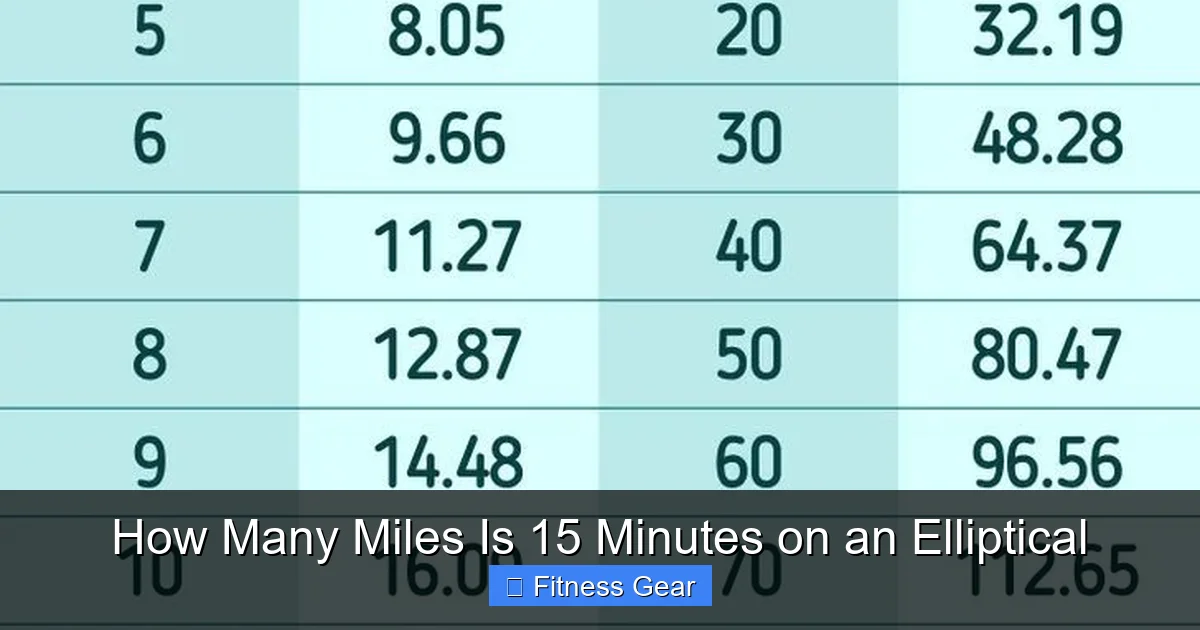
The calculation is surprisingly basic: Distance = Stride Length (in inches) x Number of Revolutions / 63,360 (inches in a mile). The machine’s computer counts how many times you complete a full pedal cycle (a revolution), multiplies that by its factory-set stride length, and converts it to miles. Your job is to pedal. The machine’s job is to guess how far you would have gone if you were actually striding on solid ground.
This means two people on two different ellipticals, pedaling at the exact same perceived effort and speed (RPM), could see vastly different “mile” readings. The person on the machine with a longer stride length will accumulate miles faster. It’s a mathematical illusion, but it’s consistent for that specific machine.
Stride Length Deep Dive: The Engine of Your Elliptical Mile
Stride length is the single most important variable. It’s the distance from the front-most point of your pedal’s travel to the back-most point. Think of it as the simulated length of your step.
Visual guide about How Many Miles Is 15 Minutes on an Elliptical
Image source: i.pinimg.com
Common Stride Lengths and Their Impact
You’ll find ellipticals in three general stride length categories:
- Compact/Home Models (14-16 inches): These are common in small apartments or budget home gyms. A 15-minute session at a moderate pace (say, 60 RPM) on a 14-inch stride yields roughly: (14 inches/rev x 60 RPM x 15 minutes) / 63,360 = ~0.20 miles. Even at a vigorous 80 RPM, you’d only reach about 0.27 miles. The distance will feel painfully slow.
- Standard/Commercial-Grade (18-20 inches): This is the gold standard for a natural, full-range motion. A 20-inch stride is very common in gyms. At 60 RPM for 15 minutes: (20 x 60 x 15) / 63,360 = ~0.28 miles. At a challenging 85 RPM: (20 x 85 x 15) / 63,360 = ~0.40 miles. This is the range most people will experience.
- Long-Stride/Performance Models (21+ inches): High-end home and commercial machines sometimes offer longer strides for taller users or a more aggressive motion. A 22-inch stride at 70 RPM for 15 minutes: (22 x 70 x 15) / 63,360 = ~0.36 miles. At 90 RPM: (22 x 90 x 15) / 63,360 = ~0.47 miles.
Practical Example: User A on a 16-inch stride elliptical pedals at 65 RPM for 15 minutes. User B on a 20-inch stride machine pedals at the same 65 RPM for 15 minutes. User B’s console will show about 25% more distance than User A’s, even though both exerted identical effort and leg speed. User B’s workout isn’t “better” because of the higher number; it’s just a function of the machine’s design.
Intensity Matters: How Your Effort Changes the Equation
Your stride length sets the potential, but your revolutions per minute (RPM) is the throttle. This is where your personal effort comes in.
Visual guide about How Many Miles Is 15 Minutes on an Elliptical
Image source: calculator.academy
Finding Your RPM Range
Most ellipticals display your current RPM. A leisurely warm-up might be 40-50 RPM. A moderate, sustainable cardio pace is typically 60-70 RPM. A high-intensity interval or vigorous effort can push 80-100+ RPM. Your 15-minute total distance is a direct product of your average RPM over that time.
- Low-Intensity (50 RPM avg): On a 20″ stride: ~0.24 miles in 15 min.
- Moderate (65 RPM avg): On a 20″ stride: ~0.31 miles in 15 min.
- High-Intensity (85 RPM avg): On a 20″ stride: ~0.40 miles in 15 min.
The takeaway? If you want to increase your “miles” on the same machine, you must increase your average RPM. This means pushing yourself to move your legs faster. However, be cautious: very high RPMs with low resistance can become a choppy, inefficient motion. True intensity on an elliptical is best achieved by combining a solid RPM (60-80) with increasing resistance levels, which builds muscle and burns more calories without sacrificing form.
Machine Variations: Why Your Gym’s Elliptical Differs from Your Home One
Beyond stride length, other design elements can subtly influence the distance calculation and the overall experience.
Visual guide about How Many Miles Is 15 Minutes on an Elliptical
Image source: p16-ehi-va.gauthmath.com
Front-Drive vs. Rear-Drive vs. Center-Drive
This refers to the location of the machine’s flywheel and mechanism. While it doesn’t change the fundamental stride-length formula, it affects the motion’s feel and can sometimes influence your natural RPM.
- Front-Drive: The flywheel is at the front. The pedal path often feels like you’re climbing a hill. It can encourage a slightly longer, more glute-focused stride. Common in older or budget models.
- Rear-Drive: The flywheel is at the back. This is the most common design in commercial gyms. It provides a smooth, flat, walking-like motion and is generally considered the most natural and comfortable for a wide range of users.
- Center-Drive: The mechanism is under the pedals. This design minimizes the overall footprint and creates a very upright, almost stair-climber-like motion with a very short, quick stride. These machines often have shorter effective stride lengths (even if advertised longer) and will show lower mileage for the same RPM.
The “Generic Formula” Problem
Many manufacturers, especially for affordable home models, use a one-size-fits-all formula. They might program all their machines to assume a 20-inch stride, even if the physical stride is only 16 inches. This inflates the distance reading. Conversely, a high-end machine with a precise, long stride might be calibrated perfectly. You cannot trust that the “mile” on one machine equals the “mile” on another. The only consistent use is comparing your performance on the same exact machine over time.
Practical Tracking: What Should You Actually Focus On?
If the distance is a flawed and variable metric, what should you use to measure the effectiveness of your 15-minute elliptical workout?
1. Time is King (For General Health)
The American Heart Association recommends at least 150 minutes of moderate-intensity aerobic activity per week. A 15-minute session is a fantastic, manageable block. Your primary goal can simply be to complete your allocated time consistently. Three 15-minute sessions a week = 45 minutes of movement. That’s a win.
2. Heart Rate: The Objective Intensity Gauge
This is the gold standard. Use a chest strap or optical monitor. Aim for 50-70% of your max heart rate for general cardio (moderate intensity) or 70-85% for more vigorous training. A 15-minute session where you spend 12 minutes in your target zone is excellent, regardless of the “miles” shown.
3. Rate of Perceived Exertion (RPE)
The simple 1-10 scale. A moderate 15-minute session should feel like a 5 or 6 (“I can talk, but not sing”). A vigorous interval session might hit an 8 (“I can only say a few words”). If your RPE matches your goal for the session, you’ve succeeded.
4. Calories Burned (With Skepticism)
Elliptical calorie counters are notoriously generous, often overestimating by 20-30%. They are, however, consistent on the same machine. If you normally burn 150 calories in 15 minutes and today you burn 180 at the same perceived effort, you likely worked harder (higher RPM/resistance). Use it as a relative, not absolute, measure.
5. The “Personal Best” Mileage on Your Machine
Here’s where the distance metric has value. Note: “Today I covered 0.85 miles in 15 minutes on my home elliptical.” Next week, aim for 0.87 miles. This is a valid performance goal because it accounts for your specific machine’s stride length and your improving fitness (higher sustainable RPM). Just never compare that 0.85 to a friend’s 1.2 miles on a different machine.
Putting It All Together: Sample 15-Minute Workout Plans
Let’s design three effective 15-minute sessions, ignoring the mile counter and focusing on the right metrics.
Plan 1: The Steady-State Cardio Burn
Goal: Build aerobic endurance, burn fat.
- Minutes 0-3: Warm-up. Low resistance (level 2-3), comfortable RPM (50-55). Focus on full, smooth strides.
- Minutes 3-12: Main set. Increase resistance to a level where your RPE is a steady 6/10. Aim to maintain a consistent RPM of 60-65. Check your heart rate—it should be in your moderate zone (e.g., 120-140 bpm for many).
- Minutes 12-15: Cool-down. Drop resistance back to 2, let RPM slow gradually to 40. Deep breathing.
What you’ll see on the console: A steadily increasing distance number, but you’re not focused on it. Your focus is on maintaining that challenging but sustainable effort.
Plan 2: High-Intensity Interval Torcher
Goal: Maximize calorie burn, improve anaerobic fitness.
- Minutes 0-2: Warm-up as above.
- Minutes 2-4: Interval 1. Resistance up 2-3 levels from your steady state. RPM as high as you can control (75-85). RPE 8/10.
- Minutes 4-5: Active recovery. Resistance back to moderate, RPM 50-55. RPE 4/10.
- Minutes 5-7: Interval 2. Repeat the high-intensity push.
- Minutes 7-8: Active recovery.
- Minutes 8-10: Interval 3.
- Minutes 10-15: Cool-down as above.
What you’ll see on the console: The distance will jump significantly during the 2-minute high-intensity bursts. You might cover more “miles” in this 15 minutes than in the steady-state plan, but the real benefit comes from the metabolic stress of the intervals.
Plan 3: The “No-Excuses” Maintenance Day
Goal: Just move. Beat sedentary behavior.
- Put the elliptical in a low resistance (level 1).
- Set your timer for 15 minutes.
- Move at a pace that feels easy and sustainable. Read a book, watch a show, listen to a podcast.
- Your RPM might be 40-50. Your heart rate barely elevates.
- This is still a huge win. You’ve broken up sitting time, increased blood flow, and burned more calories than sitting. The distance will be very low, and that’s perfectly okay.
Conclusion: Your 15 Minutes, Your Rules
So, how many miles is 15 minutes on an elliptical? The truthful, unhelpful answer is: it depends on the machine. The practical, empowering answer is: it doesn’t really matter. Chasing a specific mileage is a fool’s errand because the number is not portable. It’s a personal statistic tied to one specific piece of equipment.
The real power of your 15-minute session lies in what you control: your effort, your consistency, and your focus on meaningful metrics. Can you maintain a heart rate in your target zone for the full 15 minutes? Can you complete three sets of intervals with proper form? Can you just show up and move when you don’t feel like it? These are the victories.
Use the “miles” readout as a fun, personal benchmark on your own machine—a way to see if you’re pedaling faster this month than last. But release yourself from the pressure of comparing it to anyone else’s workout or to a distance on a different cardio machine. Your 15 minutes on the elliptical are a gift to your heart, your lungs, and your muscles. How you spend those minutes—with intention, with intensity, or with simple, steady movement—is what truly counts. Now go make those 15 minutes matter.
Frequently Asked Questions
Is the “miles” reading on an elliptical accurate?
No, not in an absolute, universal sense. It’s a calculated estimate based on the machine’s programmed stride length and your pedal revolutions (RPM). It’s accurate for tracking your own progress on that specific machine over time, but it cannot be compared to miles on a treadmill, bike, or another elliptical with a different stride length.
Can I use an elliptical to train for a running race?
Yes, but with a caveat. The elliptical is excellent for building cardiovascular fitness, leg strength, and endurance with low impact. However, because the motion is non-weight-bearing and has a fixed stride, it doesn’t perfectly replicate running biomechanics. It’s best used as a cross-training tool to supplement your running, not replace all your road or trail workouts.
What RPM should I aim for during a 15-minute workout?
It depends on your goal. For general cardio and fat burning, aim for a sustainable 60-70 RPM with moderate resistance. For high-intensity intervals, you can spike to 80-100+ RPM for short bursts. The key is maintaining good form—no bouncing or “sloppy” pedaling—at whatever RPM you choose.
Why do I feel like I worked harder on the elliptical but my “miles” are low?
This is common! You were likely using high resistance, which builds muscle and spikes your heart rate, but at a lower RPM. The distance formula favors speed (RPM) over resistance. A slow, heavy grind (high resistance, low RPM) is incredibly effective but yields a lower mileage count than a fast, light spin (low resistance, high RPM). Trust how you feel and your heart rate over the distance number.
How can I burn the most calories in 15 minutes on an elliptical?
Combine moderate-to-high resistance with a solid RPM (70-85). The resistance builds muscle, which boosts metabolism, and the RPM keeps your heart rate elevated. Incorporate short, 30-60 second bursts where you push both resistance and RPM (High-Intensity Interval Training or HIIT) for maximum calorie burn in a short time.
Should I buy an elliptical based on its advertised stride length?
Yes, stride length is a critical spec to consider. If you are taller (over 5’10”), look for a stride length of 20 inches or more for a comfortable, full range of motion that doesn’t feel cramped. Shorter users can be fine with 18-20 inches. Always test the machine if possible to see if the motion feels natural to your body.

Similar Posts