Can You Do Calf Raises with a Barbell
Yes, you can absolutely do calf raises with a barbell, and it is one of the best ways to build strong, defined calf muscles. This guide covers proper form, common mistakes, and expert tips to help you get the most out of your barbell calf workouts. Whether you are a beginner or a seasoned lifter, you will find practical advice to level up your calf training today.
Barbell calf raises are a staple exercise for anyone looking to build bigger, stronger calves. You have probably seen people in the gym doing them with a loaded barbell across their shoulders. But the real question is, are you doing them right? And more importantly, can you really get great results from this movement?
The short answer is yes. Barbell calf raises are one of the most effective exercises for targeting your lower legs. They work the two main muscles in your calf — the gastrocnemius and the soleus. Whether you want bigger calves, better ankle stability, or improved athletic performance, this exercise delivers.
In this guide, we will walk you through everything you need to know. From proper form to common mistakes, we have got you covered. You will learn how to set up the exercise correctly, choose the right weight, and avoid the errors that hold most people back. Let us dive in.
Key Takeaways
- Barbell calf raises are highly effective: They target the gastrocnemius and soleus muscles for balanced lower leg development.
- Proper form is essential: Correct foot positioning, range of motion, and posture prevent injury and maximize results.
- You can do them standing or seated: Both variations offer unique benefits for different parts of the calf.
- Progressive overload drives growth: Gradually increasing weight and volume leads to stronger, more defined calves over time.
- Common mistakes are easy to avoid: Rushing reps, bouncing at the bottom, and skipping warm-ups are top errors to fix.
- Barbell calf raises complement other exercises: They pair well with dumbbell and kettlebell variations for a complete lower body routine.
📑 Table of Contents
- What Are Barbell Calf Raises and Why Do They Matter?
- How to Perform Barbell Calf Raises With Perfect Form
- Barbell Calf Raise Variations You Should Try
- Common Mistakes to Avoid During Barbell Calf Raises
- Barbell Calf Raise Workout Plans for Every Level
- How Barbell Calf Raises Compare to Other Calf Exercises
- Quick Tips to Maximize Your Calf Growth
- Expert Insight: Why Calves Are Hard to Grow
- Final Thoughts on Barbell Calf Raises
What Are Barbell Calf Raises and Why Do They Matter?
A barbell calf raise is a weight training exercise where you stand with a barbell on your upper back and raise your heels off the ground. This movement targets the muscles in your lower leg, specifically the calf complex. It is a simple exercise, but the results can be impressive when done correctly.
Your calves play a big role in everyday movements like walking, running, and jumping. Strong calves also help with sports performance and injury prevention. Many people neglect their calves, which leads to an imbalance in lower body development. Adding barbell calf raises to your routine fixes that problem.
The Two Main Calf Muscles
Understanding the anatomy helps you train smarter. Here are the two primary muscles worked during barbell calf raises:
- Gastrocnemius: This is the larger, outer muscle of the calf. It is most active when your knee is straight. Standing calf raises target this muscle heavily.
- Soleus: This muscle sits deeper and closer to the shin. It is most active when your knee is slightly bent. It plays a key role in endurance and stability.
By adjusting your foot positioning and knee angle, you can shift the focus between these two muscles. That is one reason why barbell calf raises are so versatile.
How to Perform Barbell Calf Raises With Perfect Form
Proper form is the foundation of any effective exercise. Getting it right ensures you hit the right muscles and stay safe. Here is a step-by-step breakdown of how to do barbell calf raises correctly.
Step-by-Step Setup
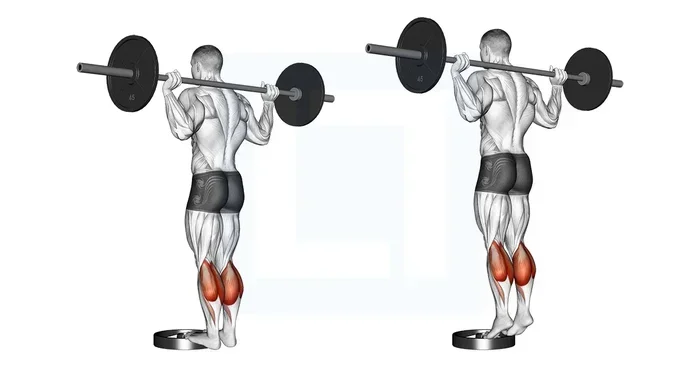
- Position the barbell: Place the barbell on a squat rack at shoulder height. Step under it and rest the bar across your upper traps, not your neck.
- Grip the bar: Grab the bar with an overhand grip, hands slightly wider than shoulder width. Squeeze your shoulder blades together to create a stable shelf.
- Unrack the bar: Lift the bar off the supports and take a step back. Plant your feet shoulder width apart, with the balls of your feet on the edge of a raised surface like a plate or block.
- Start position: Let your heels drop below the level of your toes. This gives you a full stretch in the calf. Keep your knees straight but not locked.
- Raise your heels: Push through the balls of your feet and lift your heels as high as possible. Squeeze your calf at the top for one to two seconds.
- Lower slowly: Control the descent back to the stretched position. Do not let gravity pull you down too fast.
Key Form Cues to Remember
- Keep your core tight throughout the movement.
- Do not lean forward or backward excessively.
- Maintain a slight bend in the knee if you want to emphasize the soleus.
- Breathe out as you raise your heels and breathe in as you lower them.
- Use a full range of motion — stretch at the bottom, squeeze at the top.
Barbell Calf Raise Variations You Should Try
Doing the same version of an exercise over and over can lead to plateaus. Mixing in variations keeps your muscles challenged and your workouts interesting. Here are some great barbell calf raise variations to add to your routine.
Standing Single-Leg Barbell Calf Raise
This variation shifts all the weight to one leg at a time. It helps fix strength imbalances and improves balance. You can hold onto a wall or rack for support. This version also puts more emphasis on the gastrocnemius due to the single-leg demand.
Seated Barbell Calf Raise
For the seated version, you sit on a bench and place a barbell across your thighs. This positions the knee in a bent angle, which shifts the focus to the soleus muscle. It is a great complement to standing calf raises for complete calf development.
Donkey Barbell Calf Raise
This is a more advanced variation where you bend forward at the waist while a partner or machine provides resistance. It gives an intense stretch and contraction in the calf. It is a favorite among advanced lifters looking to push their calf growth to the next level.
Common Mistakes to Avoid During Barbell Calf Raises
Even simple exercises can go wrong when you develop bad habits. Here are the most common mistakes people make with barbell calf raises and how to fix them.
Using Too Much Weight Too Soon
This is the number one mistake. Many lifters load the barbell heavy and sacrifice form for ego. When the weight is too much, you start rocking your body to complete reps. This takes the work away from your calves and increases the risk of injury. Start with a manageable weight and focus on controlled reps first.
Skipping the Full Range of Motion
A partial rep is a wasted rep. Many people only go halfway up or fail to drop their heels all the way down. The calf muscle needs to go through its full stretch and contraction to grow properly. Lower your heels completely and rise all the way up on every single rep.
Bouncing at the Bottom
Using momentum to bounce out of the stretched position is a bad habit. It reduces time under tension and increases the risk of Achilles tendon strain. Control the negative portion of the lift. A slow, deliberate descent is far more effective than a fast bounce.
Neglecting the Warm-Up
Calf muscles can be stubborn and tight. Jumping straight into heavy barbell calf raises without warming up is a recipe for tightness or strain. Spend five to ten minutes doing light cardio and dynamic stretches before your working sets.
Rushing Through Reps
Speed is not your friend here. Calf raises work best with a slow and controlled tempo. A good rule of thumb is two seconds up, one second squeeze, and three seconds down. This tempo maximizes muscle fiber recruitment and promotes growth.
Barbell Calf Raise Workout Plans for Every Level
Now that you know the form and variations, let us talk about how to program barbell calf raises into your routine. The right workout plan depends on your experience level and goals.
Beginner Plan
- Frequency: 2 times per week
- Sets and Reps: 3 sets of 12 to 15 reps
- Rest: 60 to 90 seconds between sets
- Focus: Learn the movement pattern and build a mind-muscle connection
Intermediate Plan
- Frequency: 3 times per week
- Sets and Reps: 4 sets of 10 to 12 reps
- Rest: 90 seconds between sets
- Focus: Increase weight gradually and add single-leg variations
Advanced Plan
- Frequency: 4 times per week
- Sets and Reps: 4 to 5 sets of 8 to 12 reps
- Rest: 2 minutes between heavy sets
- Focus: Incorporate all variations and apply progressive overload consistently
Progressive overload is the key to long-term growth. This means gradually increasing the weight, reps, or sets over time. Your calves respond well to both heavy, low-rep work and lighter, high-rep work. Mixing both approaches in your strength training routine yields the best results.
How Barbell Calf Raises Compare to Other Calf Exercises
Barbell calf raises are excellent, but they are not the only option. Here is how they stack up against some popular alternatives.
| Exercise | Equipment Needed | Primary Muscle | Difficulty |
|---|---|---|---|
| Barbell Calf Raise | Barbell and rack | Gastrocnemius and soleus | Intermediate |
| Dumbbell Calf Raise | Dumbbells | Gastrocnemius | Beginner |
| Kettlebell Calf Raise | Kettlebell | Gastrocnemius | Beginner |
| Machine Calf Raise | Leg press or calf raise machine | Gastrocnemius and soleus | Beginner |
| Jump Rope | Jump rope | Gastrocnemius and soleus | Intermediate |
Barbell calf raises offer a significant advantage in terms of load potential. A barbell allows you to use heavier weights than dumbbells or kettlebells, which can accelerate muscle growth. However, if you are new to training, starting with dumbbells or kettlebells can help you master the movement before adding heavy barbell work.
Many lifters also pair barbell calf raises with other lower body exercises for a complete leg workout. For example, you might follow up your calf work with a barbell hip thrust to target your glutes and hamstrings. This combination creates a well-rounded lower body session that builds strength and muscle evenly.
Quick Tips to Maximize Your Calf Growth
- Train calves at the start of your workout when you are fresh and can focus on quality reps.
- Use a slow tempo — control every rep instead of rushing through them.
- Stretch your calves between sets by keeping your heels dropped for 10 to 15 seconds.
- Wear lifting shoes with a raised heel if you struggle with ankle mobility.
- Train through the full range of motion on every single rep.
- Be patient — calves are stubborn muscles that may take longer to respond to training than other body parts.
Expert Insight: Why Calves Are Hard to Grow
Calves are notoriously difficult to build. Many lifters train them inconsistently or give up too soon. The truth is, your calves are designed to work all day long just from walking. They already have a high endurance base, which means they need targeted, intense stimulus to grow.
Experts recommend training calves with both heavy weight for strength and moderate weight for volume. Mixing standing and seated variations ensures you hit both the gastrocnemius and soleus. Consistency is the real game changer. Train your calves regularly, eat enough protein, and give them time to recover between sessions.
If you are looking to build a well-rounded lower body routine, consider pairing barbell calf raises with other compound movements like barbell rows or hip thrusts. These exercises complement each other and create a balanced gym workout that targets multiple muscle groups effectively.
Final Thoughts on Barbell Calf Raises
Barbell calf raises are a simple yet powerful exercise for building stronger, more defined calves. They target both the gastrocnemius and soleus muscles, improve ankle stability, and enhance athletic performance. With proper form, consistent training, and progressive overload, you can achieve noticeable calf growth over time.
Remember to avoid the common mistakes we covered. Focus on full range of motion, controlled tempo, and adequate warm-ups. Mix in variations to keep your muscles challenged and your workouts engaging. And be patient — calf development takes time and dedication.
Whether you are a beginner just starting out or an experienced lifter looking to refine your technique, barbell calf raises have a place in your routine. Start with the beginner plan, master the form, and gradually increase the challenge. Your calves will thank you.
If you enjoy barbell work, you might also want to explore other barbell exercises like barbell hip thrusts or barbell bent-over rows to round out your strength training program. These movements pair well with calf raises for a complete full-body routine. Keep pushing, stay consistent, and enjoy the process of building a stronger body.
Frequently Asked Questions
Can beginners do barbell calf raises?
Absolutely. Beginners can start with a light barbell or even just the bar without plates to learn the movement. Focus on form first, then gradually add weight as your strength and confidence grow. It is one of the most accessible calf exercises for all levels.
How often should I train calves with a barbell?
Training calves 2 to 4 times per week is ideal for most people. Your calves recover relatively quickly compared to larger muscle groups, so they can handle more frequent training. Start with 2 to 3 sessions per week and adjust based on your recovery and results.
What is the best weight to start with for barbell calf raises?
Beginners should start with just the barbell or a very light load. Focus on mastering the technique before adding significant weight. A good starting point is around 40 to 60 percent of your squat max, and you can increase from there as your form improves.
Do barbell calf raises help with running and sports?
Yes, they do. Strong calves improve your ability to push off the ground, which enhances running speed, jumping power, and overall athletic performance. They also help prevent injuries by strengthening the muscles and tendons around the ankle.
Can I do barbell calf raises every day?
While calves can handle frequent training, training them every day with heavy weight is not recommended. Allow at least 48 hours of rest between intense sessions. Light, high-rep calf work can be done more frequently, but heavy barbell work needs recovery time.
What is the difference between standing and seated barbell calf raises?
Standing calf raises primarily target the gastrocnemius, the larger outer calf muscle. Seated calf raises shift the focus to the soleus, a deeper muscle that contributes to calf thickness and endurance. Using both variations in your routine gives you complete calf development.