What Is a Good Weight for Barbell Row
Choosing the right weight for barbell rows depends on your fitness level, goals, and form. Beginners should start light and focus on technique, while advanced lifters can push heavier loads. This guide breaks down ideal weights, common mistakes, and expert tips for every fitness level.
The barbell row is one of the best exercises you can do for building a strong, muscular back. But here is the big question: what is a good weight for barbell row? The answer is not as simple as picking up the heaviest plate you see. Your ideal weight depends on your experience level, your goals, and how well you move.
Many people grab too much weight too fast. This leads to poor form, sore backs, and slow progress. Others stay too light for too long and never challenge their muscles enough. Finding the sweet spot is key. And that is exactly what this guide will help you do.
Whether you are just starting out or you have been lifting for years, you will find clear, practical advice here. We will walk through everything from beginner weights to advanced techniques. By the end, you will know exactly what weight to use and why.
Key Takeaways
- Start Light: Beginners should begin with 40-60% of their bodyweight to master form.
- Focus on Form First: Proper technique prevents injury and maximizes muscle engagement.
- Progressive Overload Works: Gradually increase weight as your strength improves over time.
- Rep Ranges Matter: Different rep ranges target different fitness goals like strength or endurance.
- Common Mistakes Hurt Progress: Rounding your back or using too much weight slows results.
- Barbell Row Variations Exist: Different grips and angles target different back muscles.
- Rest and Recovery Count: Your muscles grow during rest, not just during the workout.
📑 Table of Contents
- Why Barbell Row Weight Matters
- What Is a Good Weight for Barbell Row by Experience Level
- How to Pick the Right Weight for You
- Common Mistakes That Ruin Your Barbell Row
- Barbell Row Tips for Better Results
- How to Progress Safely Over Time
- How Barbell Row Weight Compares to Other Exercises
- Final Thoughts on Finding Your Ideal Barbell Row Weight
Why Barbell Row Weight Matters
The barbell row works several major muscle groups at once. It targets your lats, rhomboids, traps, and rear delts. It also engages your biceps, core, and even your legs to some degree. Because so many muscles are involved, choosing the right weight is extra important.
Too heavy, and your form breaks down fast. You start swinging the bar, using momentum, and putting your spine at risk. Too light, and you are not giving your muscles enough of a challenge to grow. The goal is to find a weight that lets you move with control and purpose.
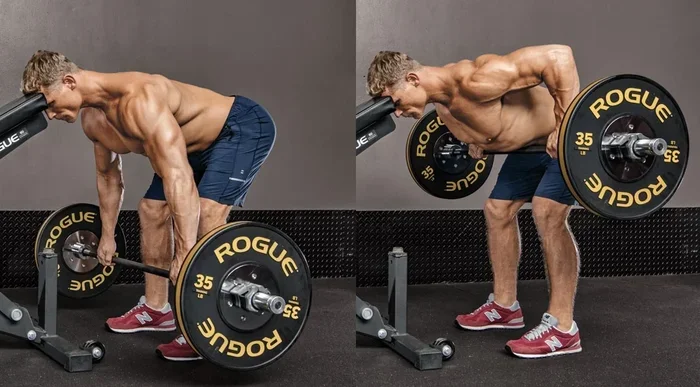
Proper barbell row technique keeps your back straight, your core tight, and your shoulders pulled back. When you nail this, every rep counts more. A moderate weight with perfect form will always beat a heavy weight with sloppy form.
What Is a Good Weight for Barbell Row by Experience Level
Beginner Weight Guidelines
If you are new to barbell rows, start conservative. A good starting point is about 40 to 60 percent of your bodyweight. For example, if you weigh 180 pounds, begin with a barbell loaded to roughly 70 to 110 pounds total. This includes the bar itself, which weighs 45 pounds.
Your first few sessions should focus entirely on learning the movement. Use a weight that feels easy to control. You should be able to complete 3 sets of 8 to 12 reps without your form falling apart. If you find yourself jerking or rounding your back, the weight is too heavy.
It is tempting to jump to heavier loads right away. Resist that urge. Building a strong mind-muscle connection at lighter weights pays off big time later. You will also build the grip strength and joint stability needed for heavier work down the road.
Intermediate Weight Guidelines
Once you have been training consistently for 6 to 12 months, you can increase your weight. Intermediate lifters typically use 60 to 80 percent of their bodyweight. This range allows you to challenge your muscles while still maintaining good control.
At this stage, you should be comfortable with the movement pattern. You know how to keep your back flat, your core braced, and your elbows pulling close to your body. The focus shifts from learning the movement to building strength and muscle.
Consider experimenting with barbell row variations at this level. Try an overhand grip, an underhand grip, or a chest-supported row. Each variation shifts the emphasis slightly and can help you break through plateaus.
Advanced Weight Guidelines
Experienced lifters can handle heavier loads, often 80 to 100 percent or more of their bodyweight. Advanced trainees have the joint strength, core stability, and technique to handle serious weight safely.
At this level, you might also incorporate barbell complexes for a more challenging full-body workout. If you want to learn more about rep ranges for these types of exercises, check out what is a good rep range for barbell complexes to fine-tune your programming.
Even with heavy weights, never sacrifice form. The moment your back rounds or your hips sag, reduce the load. Advanced does not mean reckless.
How to Pick the Right Weight for You
Consider Your Fitness Goals
Your goal plays a big role in choosing the right weight. Different goals require different approaches:
- Strength Building: Use heavier weights in the 4 to 6 rep range. Rest longer between sets.
- Muscle Growth (Hypertrophy): Use moderate weights for 8 to 12 reps. Keep rest periods shorter.
- Muscle Endurance: Use lighter weights for 15 to 20 reps. Focus on controlled movement.
No single rep range is best. They all have a place in a well-rounded program. Rotate through them based on your current training cycle.
Test Your One-Rep Max Safely
If you want to know your true max, test it carefully. Always warm up thoroughly first. Start with a light set, then gradually increase the weight in small jumps.
Never test your one-rep max without a spotter. A Smith machine barbell can be a safer alternative for max testing if you are training alone. You can learn more about barbell weights on different equipment in our guide on what is the weight of a Smith machine barbell.
Remember, your one-rep max is just a number. It does not define your progress. Use it as a tool to set training weights, not as a measure of your worth.
Common Mistakes That Ruin Your Barbell Row
Using Too Much Weight
This is the number one mistake lifters make. When the weight is too heavy, your body compensates in bad ways. Your back rounds, your hips sag, and you start yanking the bar with momentum. All of this reduces the work your back muscles actually do.
It also increases your risk of injury significantly. A rounded spine under heavy load is a recipe for disc problems. Keep the weight at a level where you can move smoothly and with full control.
Rounding Your Upper Back
Your upper back should stay flat and proud throughout the entire movement. Rounding it puts enormous stress on your spine and takes the work away from your target muscles.
Before each rep, set your shoulders back and down. Think about pinching a pencil between your shoulder blades. This mental cue helps keep your back in the right position.
Swinging the Bar
Some lifters use a bouncing motion to get the bar moving. This turns the exercise into a momentum-based movement rather than a true strength exercise. Your back muscles stop doing the work, and your lower back takes on unnecessary stress.
Slow down. Pause briefly at the top of each rep. Lower the bar with control. If you cannot do this, the weight is too heavy.
Barbell Row Tips for Better Results
Engage Your Core Throughout
Your core is your stabilizer during barbell rows. Brace your abs as if someone is about to punch you in the stomach. This keeps your spine protected and transfers more power from your legs and hips into the pull.
A strong core also helps you handle heavier weights over time. If your core is weak, it becomes the weak link that limits your progress. Work on your core strength alongside your rowing practice.
Control the Eccentric Phase
The lowering phase of the row matters just as much as the pulling phase. Take 2 to 3 seconds to lower the bar back to the starting position. This time under tension builds more muscle and improves your control.
Many people drop the bar quickly after pulling. Slow down. Every second of controlled movement counts toward your results.
Pair Barbell Rows with Complementary Exercises
Barbell rows work great alongside other back exercises. Pair them with pull-ups, lat pulldowns, or dumbbell rows for a well-rounded back workout. You can also compare compound movements like kettlebell swings, which are excellent for posterior chain development. To find a suitable weight for kettlebell swings, check out what is a good weight for kettlebell swings.
Variety prevents plateaus and keeps your workouts interesting. It also ensures no muscle group gets neglected.
How to Progress Safely Over Time
The best approach to getting stronger is progressive overload. This means gradually increasing the demands on your muscles over time. You can do this in several ways:
- Add weight: Increase the load by 5 to 10 pounds per week.
- Add reps: Do one or two more reps each session with the same weight.
- Add sets: Add an extra set to your workout every couple of weeks.
- Improve form: Focus on tighter control and better muscle engagement.
You do not need to use all of these at once. Pick one or two and apply them consistently. Small, steady increases lead to big results over months and years.
Track your workouts in a notebook or app. Write down the weight, reps, and sets each time. This gives you clear proof of progress and helps you plan your next session.
How Barbell Row Weight Compares to Other Exercises
It helps to see how barbell row weight compares to similar exercises. Here is a quick comparison of common back and compound movements:
| Exercise | Typical Beginner Weight | Typical Intermediate Weight | Primary Muscles |
|---|---|---|---|
| Barbell Row | 40-60% bodyweight | 60-80% bodyweight | Lats, rhomboids, traps |
| Barbell Deadlift | 50-70% bodyweight | 70-100% bodyweight | Hamstrings, glutes, back |
| Dumbbell Row | One arm: 30-50% bodyweight | One arm: 50-70% bodyweight | Lats, rhomboids, biceps |
| Kettlebell Swing | 15-25 lbs | 35-53 lbs | Glutes, hamstrings, core |
Notice that barbell row weights tend to be lower than deadlift weights. This makes sense because the row is more isolated to the upper and mid-back. It is not a full-body pull the way a deadlift is.
Do not compare your row weight to someone else’s. Everyone has different strengths, body weights, and training histories. Focus on your own progress and let your numbers improve naturally over time.
Final Thoughts on Finding Your Ideal Barbell Row Weight
Finding the right weight for barbell row is a personal journey. There is no single magic number that works for everyone. Your ideal weight depends on your experience, your goals, and how well you move.
Start with a manageable weight, focus on perfect form, and progress gradually. The barbell row is a powerful exercise that can transform your back, your posture, and your overall strength. But only if you do it right.
Listen to your body. If something feels off, reduce the weight and check your form. If a weight feels too easy, add a little more next session. The key is consistency and patience. Strength takes time, but it always rewards those who put in the work.
Now you have everything you need to pick the right weight and get the most out of every rep. Get to the gym, grab that barbell, and start building the back you have always wanted.
Frequently Asked Questions
What weight should I start with for barbell rows?
Beginners should start with 40 to 60 percent of their bodyweight. Focus on learning proper form before increasing the load. A weight that lets you complete 3 sets of 8 to 12 reps with clean technique is a great starting point.
Can I do barbell rows every day?
It is best to allow 48 hours of rest between barbell row sessions. Your back muscles need time to recover and grow. Training them too often can lead to overuse injuries and stalled progress.
How do I know if the weight is too heavy?
If your back rounds, your hips sag, or you start swinging the bar, the weight is too heavy. You should be able to complete each rep with full control and proper barbell row technique. When in doubt, go lighter.
What is the difference between barbell rows and dumbbell rows?
Barbell rows use both arms simultaneously and allow heavier loading. Dumbbell rows work one arm at a time and help fix strength imbalances. Both are excellent for building a strong back, and they pair well together in a training program.
Should I use an overhand or underhand grip for barbell rows?
An overhand grip targets your upper back and rear delts more. An underhand grip puts more emphasis on your lats and biceps. Try both grips to see which feels better and hits the muscles you want to develop most.
How often should I increase my barbell row weight?
Increase the weight by 5 to 10 pounds every one to two weeks, as long as your form stays solid. Do not rush the process. Small, consistent increases lead to lasting strength gains and reduce your risk of injury.