What Is Better an Elliptical or a Exercise Bike

Choosing between an elliptical and an exercise bike depends entirely on your fitness goals, physical condition, and personal preference. Ellipticals offer a full-body, low-impact workout engaging both upper and lower body, while exercise bikes provide a highly effective, focused lower-body workout that is exceptionally gentle on joints. The “better” machine is the one you will use consistently and that aligns with your specific needs for weight loss, rehabilitation, or endurance training.
Key Takeaways
- Full-Body vs. Lower-Body Focus: Ellipticals provide a true full-body workout using arms and legs; exercise bikes isolate the lower body (quads, hamstrings, glutes, calves).
- Joint Impact & Safety: Both are low-impact, but exercise bikes are generally the safest option for those with severe knee, hip, or back issues due to the seated, fixed-path motion.
- Calorie Burn & Intensity: Ellipticals often burn more calories *per minute* due to engaging more muscle mass, but high-intensity interval training (HIIT) on a bike can be equally or more effective for fat loss.
- Space & Cost Considerations: Exercise bikes, especially upright models, typically have a smaller footprint and a wider range of prices, from budget-friendly to luxury. Ellipticals require more floor space and are often more expensive.
- User Experience & Adherence: The “boring factor” is real. Test both! Some find the rhythmic, seated motion of a bike meditative, while others prefer the dynamic, standing motion of an elliptical to stay engaged.
- Muscle Engagement & Toning: For comprehensive muscular endurance and toning of arms, chest, and back alongside legs, the elliptical wins. For pure leg strength and hypertrophy, a bike (especially with high resistance) is excellent.
- Rehabilitation & Accessibility: Exercise bikes are the gold standard in physical therapy for lower-body rehab. Ellipticals are great for general low-impact cardio but may not suit all post-injury protocols.
📑 Table of Contents
Introduction: The Great Cardio Machine Debate
Stepping into the gym or scrolling through home fitness equipment catalogs, two machines consistently dominate the cardio floor: the elliptical cross-trainer and the stationary exercise bike. Both promise heart-pumping, calorie-torching, low-impact workouts, but they are fundamentally different tools. The question “What is better, an elliptical or an exercise bike?” doesn’t have a one-size-fits-all answer. It’s a question of match-up. It’s about aligning the machine’s unique movement pattern, muscle engagement, and physical demands with your body, your goals, and your lifestyle.
Think of it this way: choosing between these two is like choosing between a Swiss Army knife and a specialist’s tool. The elliptical is the versatile all-rounder, designed to work your entire body in a single, fluid motion. The exercise bike is the precision instrument, honed to perfect the act of pedaling, building incredible lower-body endurance and power while being supremely gentle on your joints. In this comprehensive, head-to-head comparison, we’ll dissect every angle—from biomechanics and calorie burn to space requirements and mental engagement—to give you the clarity you need to make the perfect choice for your fitness journey.
The Core Movement: Full-Body Glide vs. Seated Pedal
How an Elliptical Works: The Floating Stride
The elliptical’s defining characteristic is its elliptical pathway. Your feet move in a smooth, oval-shaped path on pedals that float freely. This motion is a hybrid, borrowing elements from running (the stride), stair-climbing (the lift), and cycling (the circular path), but without the jarring impact of any of them. The key is that your feet never leave the pedals. This “weight-bearing” but “non-impact” nature means you’re standing, engaging your core for stability, and—if the machine has moving handlebars—actively pushing and pulling with your arms. It’s a coordinated, full-body dance.
Visual guide about What Is Better an Elliptical or a Exercise Bike
Image source: i5.walmartimages.com
Practical Example: Imagine simulating a powerful walking stride while simultaneously doing a standing chest press. That’s the essence of an elliptical with moving arms. You’re driving through your heels, engaging your glutes and hamstrings on the “push” back, and pulling with your back and biceps on the “return” forward. It’s a single, integrated movement.
How an Exercise Bike Works: The Classic Pedal
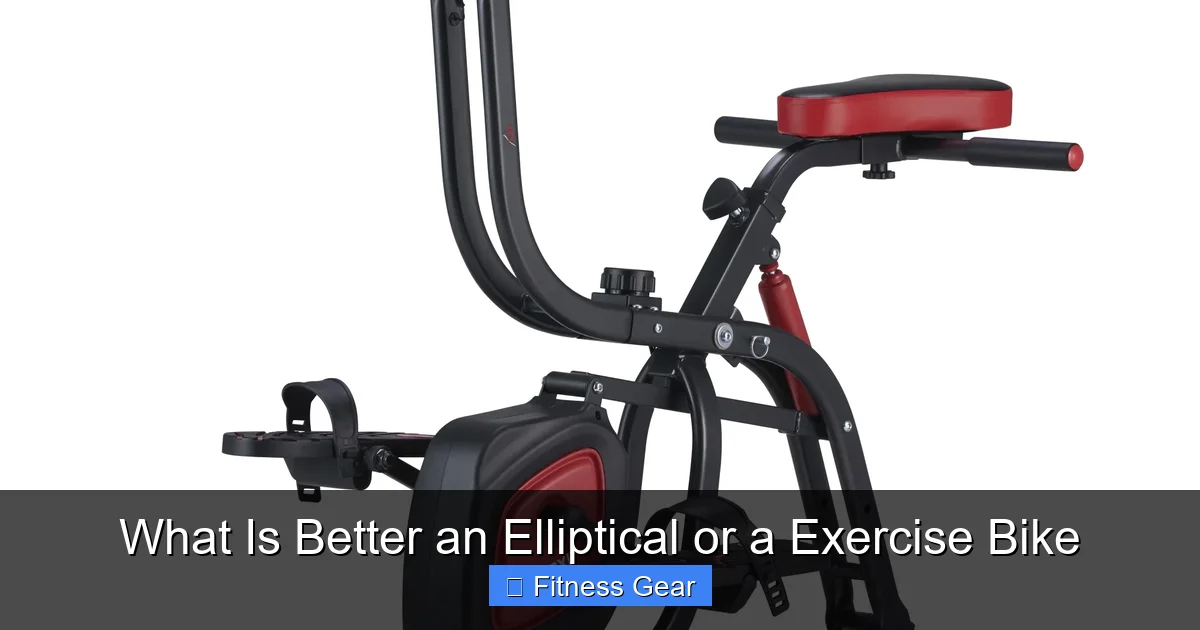
The exercise bike replicates the motion of a bicycle, but you stay in one place. You sit on a saddle and rotate pedals in a fixed, circular path. The resistance comes from a flywheel (magnetic, friction, or fan-based). This is a pure “non-weight-bearing” exercise for the lower body; your spine is supported by the seat, and all the work is done through your legs. Modern bikes come in two primary styles: upright (resembles a standard bicycle posture) and recumbent (features a chair-like seat with back support and pedals out in front).
Practical Example: Think of climbing a long, steady hill on a road bike. You’re seated, pushing down on the pedals to engage your quads, pulling up to engage your hamstrings, all while your core stabilizes your torso. On a recumbent bike, the motion is the same, but the reclined position shifts more emphasis to the glutes and reduces strain on the lower back.
Head-to-Head: Comparing the Key Factors
Joint Impact and Safety: Which is Gentler?
Both machines are celebrated for being “low-impact,” a critical feature for protecting ankles, knees, and hips. However, the degree and nature of that impact differ.

Visual guide about What Is Better an Elliptical or a Exercise Bike
Image source: fitnessvolt.com
- Elliptical: It is weight-bearing (you’re standing), which is good for bone density, but the floating motion eliminates the heel-strike shock of running. The stress on joints is minimal and distributed. However, the standing position can be problematic for those with severe balance issues, acute lower-body injuries, or chronic lower back pain, as it requires core stabilization.
- Exercise Bike: It is non-weight-bearing and seated. This is the lowest possible impact option for the lower body. The joints move through a fixed, controlled range of motion with no axial loading (weight pressing down the spine). For individuals recovering from knee surgery, dealing with arthritis, or managing significant back pain, a recumbent bike is often the only cardiomachine recommended by physical therapists initially.
Verdict: For absolute minimal joint stress, the exercise bike (especially recumbent) is the winner. The elliptical is a very close second and is excellent for most, but the seated, supported nature of the bike is the ultimate safe choice.
Calorie Burn and Weight Loss Potential
The equation for weight loss is simple: calories out > calories in. Both machines can be potent calorie-burners, but they achieve it differently.
- Elliptical: Because it engages large muscle groups in the arms, chest, back, and legs simultaneously, it has a higher theoretical calorie burn per minute at moderate to high intensities. A 185-pound person can burn approximately 300-400 calories in 30 minutes at a vigorous pace. The total-body effort raises the heart rate efficiently.
- Exercise Bike: Burns fewer calories per minute at a steady, moderate pace because it uses fewer muscle groups. However, it excels at high-intensity interval training (HIIT). You can rapidly spike and recover your heart rate by cranking the resistance and pedaling as fast as possible for short bursts (e.g., 30 seconds all-out, 60 seconds easy). HIIT on a bike is brutally effective for fat loss and boosting metabolic rate post-workout (the “afterburn effect” or EPOC).
Practical Tip: Don’t just compare “calories burned” on the machine’s console—they are notoriously inaccurate. Instead, focus on perceived exertion and heart rate. A sweaty, breathless 30-minute HIIT session on a bike can absolutely match or surpass a steady-state elliptical workout for fat loss.
Muscle Toning and Strength Building
This is where the philosophies diverge sharply.
- Elliptical: It’s an endurance and toning machine. The resistance is generally light to moderate, and the motion is designed for long-duration, aerobic activity. You’ll feel a burn in your legs, but also a significant engagement in your shoulders, chest, and back if you’re actively using the handles. It will not build significant muscle size (hypertrophy) but will improve muscular endurance and definition across the upper and lower body.
- Exercise Bike: It’s a leg-specialization tool. By cranking the resistance to a very high level, you can turn your bike session into a serious strength workout for your quadriceps, hamstrings, and glutes. You can achieve a “muscle burn” similar to leg presses or lunges. Spin classes are built on this principle—high resistance, high cadence for strength and power. It does nothing for the upper body unless you’re in a class adding light weights.
Verdict: Want full-body toning? Choose the elliptical. Want powerful, sculpted legs and glutes? Choose the bike and embrace high resistance.
Space, Cost, and Practicality for Home Gyms
For the home fitness enthusiast, real estate and budget are paramount.
- Elliptical: Cons: Requires a significant, dedicated footprint (often 6-8 feet long). They are heavy and can be difficult to move. Pros: They are a single, all-in-one cardio unit. Prices start around $600 for basic models and can exceed $3,000 for commercial-grade, feature-packed machines with adjustable stride lengths.
- Exercise Bike: Pros: The space-saving champion. Upright bikes can have a footprint as small as 2×3 feet. Recumbent bikes are larger but still typically smaller than an elliptical. They are often easier to assemble and move. Prices range dramatically: solid upright bikes start under $300, while high-end smart bikes with immersive screens (like Peloton, NordicTrack) can cost over $2,000 plus a monthly subscription.
Verdict: For apartments, small rooms, or tight budgets, the exercise bike is almost always the more practical choice.
Who is Each Machine Best For? Matching Machine to Person
The Ideal Elliptical User
The elliptical is your best bet if you:

Visual guide about What Is Better an Elliptical or a Exercise Bike
Image source: fitnessgearscan.com
- Want a true full-body workout in the shortest time.
- Enjoy a dynamic, standing motion and dislike sitting for long periods.
- Have mild to moderate joint sensitivities but no major stability issues.
- Are looking to improve overall muscular endurance and cardiovascular health simultaneously.
- Prefer a machine that allows you to go hands-free (for reading, watching TV) if you have a model with fixed handlebars.
Caution: If you have severe osteoporosis (needs weight-bearing), significant balance disorders, or acute lower-body injuries, consult a doctor first.
The Ideal Exercise Bike User
The exercise bike is your perfect match if you:
- Have knee, hip, or back issues and need the most joint-friendly option.
- Are in rehabilitation or recovery mode from surgery or injury.
- Love (or want to try) high-intensity interval training (HIIT) and spin-style classes.
- Have extremely limited space.
- Want to specifically target leg strength and glute development with high resistance.
- Enjoy the meditative, rhythmic nature of a seated pedal workout.
Caution: If you have saddle soreness or numbness issues, a proper bike fit and a padded shorts or gel seat cover are essential investments.
Beyond the Basics: Advanced Considerations
The “Boring Factor” and Long-Term Adherence
This is the most overlooked yet critical factor. The best machine is the one you will actually use month after month. The elliptical’s motion can feel more varied and engaging for some, as you can shift your weight, pedal backward, or use the arms in different ways. The bike’s motion is inherently more repetitive. However, this repetition can be its strength for others, allowing for a meditative state or intense focus on power output. The solution for both is technology and environment. A good tablet mount, a compelling TV show, a fitness app subscription (like iFit, Zwift, or Apple Fitness+), or a live/on-demand class can transform a monotonous pedal or stride into an immersive experience. Test both in a gym with your own entertainment setup to see which holds your attention.
Workout Variety and Programmability
Modern machines are smart. Both ellipticals and bikes now come with touchscreens, Bluetooth connectivity, and thousands of guided workouts. A hill climb program on a bike simulates a real mountain, while an elliptical might have a “glute blaster” program that increases incline and resistance. The potential for variety is high on both if you choose a model with a robust ecosystem. However, the type of variety differs: bike workouts often focus on terrain (hills, intervals, endurance rides), while elliptical workouts might focus on total-body circuits or stride-specific drills. Consider which type of programming motivates you more.
Conclusion: There is No Universal “Better”
So, what is better, an elliptical or an exercise bike? The answer is written in your own fitness story. If your primary goals are total-body conditioning, calorie burn through muscle engagement, and you have the space and no major joint contraindications, the elliptical cross-trainer is a phenomenal, versatile choice. It’s the Swiss Army knife of cardio.
If your priorities are minimizing joint stress, maximizing leg strength and HIIT potential, saving space, or you are in a rehabilitation phase, the exercise bike—particularly a recumbent model for ultimate support—is the specialist tool that will serve you flawlessly. It is the undisputed champion of accessible, joint-friendly, high-intensity leg work.
Our strongest advice is this: try both, extensively. Spend 20 minutes on each at a gym or a friend’s house. Notice which one feels more natural, which muscle groups fire, and—most importantly—which one doesn’t feel like a chore. The machine that feels like a natural extension of your movement, that you can see yourself using consistently for years, is the better machine for you. Your fitness journey is personal; your equipment should be too.
Frequently Asked Questions
Which machine burns belly fat faster, an elliptical or a bike?
Neither targets belly fat specifically (spot reduction is a myth), but both can be highly effective for overall fat loss. The elliptical may have a slight edge in total calories burned per minute due to full-body engagement, but a high-intensity interval training (HIIT) session on a bike can be equally, if not more, effective for boosting metabolism and burning fat. Consistency and intensity matter more than the machine itself.
Is an elliptical or exercise bike better for bad knees?
For severe knee issues, arthritis, or post-surgery rehab, an exercise bike (especially recumbent) is generally the safer, recommended choice. Its seated, non-weight-bearing motion provides the absolute minimum impact on the knee joint. The elliptical is low-impact but is weight-bearing and may not be suitable for all knee conditions; always consult your doctor or physical therapist.
Can you build muscle on an elliptical or exercise bike?
You can build muscular endurance and definition on both, but not significant size (hypertrophy). The elliptical provides light resistance for the entire body, promoting lean muscle tone. An exercise bike, when used with very high resistance (like in a strength-focused spin class), can build noticeable strength and size in the quadriceps, hamstrings, and glutes. For major muscle building, you’d need dedicated weight training.
Does an elliptical or bike take up more space?
An elliptical always takes up significantly more floor space. They are long machines requiring a clear area for the full range of the pedal stride. Exercise bikes, especially upright models, have a much smaller footprint, often comparable to a office chair, making them far better for small apartments or dedicated corners.
Which is better for a complete beginner?
Both are excellent for beginners. The recumbent exercise bike is often the gentlest starting point due to its supportive seat, simple motion, and ultra-low impact. An upright bike is also great. An elliptical is beginner-friendly but can be slightly more complex to coordinate at first. The best choice is whichever feels most comfortable and unintimidating on your first try.
Do I need a fancy screen and subscription for a good workout?
No. A basic model with manual resistance and incline adjustments is perfectly sufficient for a fantastic, effective workout. However, interactive screens and subscription classes (like Peloton, iFit) are powerful tools for motivation, variety, and coaching, which can dramatically improve long-term adherence for many people. It’s an added cost for an added experience, not a necessity for results.