How to Do a Barbell Incline Bench Press
The barbell incline bench press is one of the best exercises for building a well-rounded upper chest and stronger shoulders. This guide walks you through every step, from setting the bench angle to locking out the bar with perfect form. You will learn the correct setup, common mistakes to avoid, and how to progress safely over time.
The barbell incline bench press is a staple movement in any serious upper body workout. If you want to build a full, rounded chest and add serious strength to your pressing game, this exercise should be at the top of your list. Unlike the flat bench press, the incline version shifts the focus toward your upper chest and front shoulders. That makes it a powerful tool for building a balanced, athletic physique.
Many lifters skip the incline press because it feels harder or because they are not sure how to do it correctly. The truth is, once you nail the form and setup, the barbell incline bench press becomes one of the most rewarding lifts in the gym. Whether you are a beginner or an experienced lifter, this guide will give you everything you need to press with confidence and build real results.
Key Takeaways
- Proper Setup Matters: Setting the bench at the right angle and positioning your body correctly is the foundation of a safe and effective incline press.
- Grip and Form Are Key: A shoulder-width grip with controlled movement protects your joints and maximizes muscle engagement.
- Avoid Common Mistakes: Flaring your elbows too wide or bouncing the bar off your chest can lead to injury and wasted effort.
- Progressive Overload Works: Gradually increasing weight or reps over time is the most reliable way to build strength and muscle.
- Variations Keep Workouts Fresh: Switching up your incline angle or grip targets different muscle fibers and prevents plateaus.
- Warm Up Before Pressing: A proper warm-up prepares your shoulders and chest, reducing the risk of strain or injury.
📑 Table of Contents
- What Is the Barbell Incline Bench Press?
- Why the Incline Bench Press Is Important for Your Upper Chest
- How to Set Up for the Barbell Incline Bench Press
- Common Mistakes to Avoid
- Progressive Overload and Programming Tips
- Barbell Incline Bench Press Variations
- How the Barbell Incline Bench Press Compares to Other Exercises
- Final Thoughts on the Barbell Incline Bench Press
What Is the Barbell Incline Bench Press?
The barbell incline bench press is a compound pressing movement performed on an adjustable bench set at an angle. You lie back on the incline, grip the barbell, and press it upward until your arms are fully extended. The angle of the bench changes which muscles do the most work. A steeper angle shifts more load to the shoulders, while a shallower angle keeps the focus on the upper chest.
This exercise belongs to a family of compound pressing movements that include the flat bench press and the overhead press. What makes the incline version special is its ability to target the upper portion of the pectoral muscles. Most people have underdeveloped upper chests, and the incline press is one of the best ways to fix that. It also builds strong, stable shoulders, which helps with other lifts like the overhead press and dumbbell vs barbell bench press variations.
The barbell incline bench press also builds functional upper body strength. Think about pushing movements in sports or daily life. The incline angle mimics natural pressing patterns in a way that flat benching does not. This makes it a valuable exercise for both athletes and everyday fitness enthusiasts.
Why the Incline Bench Press Is Important for Your Upper Chest
Your chest is made up of two main parts: the upper chest and the lower chest. The upper chest starts at the collarbone and runs down to the middle of the sternum. When you only train with flat movements, the lower chest gets most of the work. Over time, this creates an imbalance that can affect both your appearance and your pressing strength.
The incline bench press fixes this imbalance by targeting the upper fibers of the pectoralis major. Studies and real-world experience both show that training at an angle between 15 and 45 degrees effectively activates the upper chest. Going too steep can turn the movement into more of a shoulder press, which defeats the purpose. Finding the sweet spot is key.
Muscles Worked During the Incline Press
Here are the main muscles that fire during the barbell incline bench press:
- Upper Pectorals: The primary target. These fibers do the most work at moderate incline angles.
- Front Deltoids: The front shoulders assist heavily, especially as the bench angle increases.
- Triceps: The back of your arms extend the elbow during every rep.
- Serratus Anterior: These muscles stabilize your shoulder blades against the bench.
- Core and Upper Back: These muscles keep your body tight and stable throughout the movement.
Training all of these muscles together makes the incline press a time-efficient exercise. You get more bang for your buck compared to isolation movements. This is why many strength coaches include the barbell incline bench press in their upper body workout routines.
How to Set Up for the Barbell Incline Bench Press
The setup is everything when it comes to the incline press. A poor setup leads to poor reps, and poor reps lead to stalled progress or injury. Take your time with each step, and the movement will feel much more natural over time.
Step 1: Adjust the Bench Angle
Set your adjustable bench to an angle between 30 and 45 degrees. This range hits the upper chest effectively without turning the exercise into a shoulder press. If you go above 60 degrees, your front deltoids will take over too much of the work. A simple way to check is to look at where the bar path meets your chest. It should land on the upper chest, just below the collarbone.
If your gym has limited bench options, even a 30-degree angle works well. Do not overthink the number. What matters most is that you feel the upper chest working during each rep.
Step 2: Position Your Body on the Bench
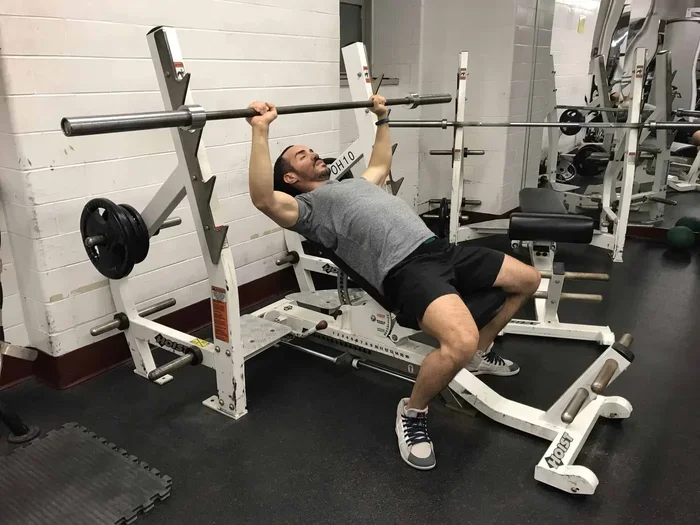
Sit on the bench with your eyes directly under the barbell. Your feet should be flat on the floor, shoulder-width apart. Drive your heels into the ground and squeeze your glutes to create a stable base. Your upper back should be pressed firmly against the bench, with a natural arch in your lower back.
Your shoulder blades should be pulled back and down, like you are trying to hold a pencil between them. This position creates a solid shelf for the bar to press from. It also protects your shoulders by keeping the joint in a safe, stable position. Think of your body as a solid platform that does not move during the entire set.
Step 3: Grip the Barbell Correctly
Your grip width plays a big role in how the exercise feels and which muscles it targets. A good starting point is to grip the bar just outside shoulder width. This places the elbows at roughly a 45 to 75-degree angle from your body at the bottom of the lift.
Wrap your thumbs around the bar and squeeze tight. A death grip is not necessary, but your hands should not be sliding around. When you grip the bar correctly, your wrists stay straight, and your forearms stay vertical at the bottom of the movement. If you are unsure about your exact hand placement, check out this guide on where to place hands on the barbell for bench press for more detailed instructions.
Step 4: Unrack the Bar and Set Your Position
Unrack the bar by straightening your arms and lifting it off the hooks. Hold it directly over your shoulders with your elbows locked. Take a deep breath and brace your core. This is your starting position. The bar should be directly over the middle of your foot, with your shoulder blades pulled back and down.
Do not rush this step. Many lifters bounce the bar off their chest because they did not set up properly. A controlled setup leads to a controlled rep. Lower the bar slowly until it touches the upper chest, just above the nipple line. Pause for a brief moment, then press the bar back up to the starting position.
Common Mistakes to Avoid
Even experienced lifters make mistakes on the incline bench press. Knowing what to avoid will save you from injury and help you get more out of every set.
Mistake 1: Setting the Bench Too Steep
An angle above 60 degrees turns the incline press into a shoulder press. Your front deltoids will do most of the work, and your upper chest gets shortchanged. Stick to the 30 to 45 degree range for optimal chest activation. If you feel your shoulders burning more than your chest, the angle is too steep.
Mistake 2: Flaring Your Elbows Too Wide
Flaring your elbows out at 90 degrees puts unnecessary stress on your shoulder joints. It also reduces the amount of weight you can press. Keep your elbows at a 45 to 75-degree angle from your torso. This position is more shoulder-friendly and allows you to press more weight safely.
Mistake 3: Bouncing the Bar Off Your Chest
Using momentum to bounce the bar off your chest is dangerous and ineffective. It reduces the time your muscles spend under tension and increases the risk of rib or sternum injuries. Lower the bar with control, pause briefly, and then press it back up. The brief pause also helps you reset your form before each rep.
Mistake 4: Lifting Your Feet Off the Floor
Some lifters lift their feet or tuck their legs under the bench to feel more stable. This actually reduces your ability to generate force. Your legs should stay flat on the floor, and you should drive through your heels. If your feet keep coming off the ground, the bench angle may be too steep or the weight may be too heavy.
Mistake 5: Neglecting the Lowering Phase
The eccentric, or lowering, phase of the press is just as important as the concentric, or pressing, phase. Lowering the bar slowly increases muscle time under tension, which drives growth and strength gains. Aim for a 2 to 3 second descent on every rep. Do not just drop the bar down and push it back up.
Progressive Overload and Programming Tips
To get stronger on the barbell incline bench press, you need to follow the principle of progressive overload. This means gradually increasing the stress on your muscles over time. There are several ways to do this, and you do not need to add weight every single session.
Increase Weight Gradually
The most common approach is to add small amounts of weight to the bar each week. Adding 2.5 to 5 pounds per session is a sustainable pace for most lifters. The key is consistency. Small, steady increases add up to big gains over months and years.
Adjust Rep Ranges for Different Goals
Your rep range should match your goal. Here is a quick breakdown:
- Strength: 3 to 5 reps with heavier weight and longer rest periods (2 to 3 minutes).
- Hypertrophy: 6 to 12 reps with moderate weight and rest periods of 60 to 90 seconds.
- Endurance: 12 to 20 reps with lighter weight and shorter rest periods (30 to 60 seconds).
Switching between these rep ranges every few weeks keeps your training varied and prevents plateaus. Most lifters benefit from spending the majority of their time in the hypertrophy range, as this builds both muscle and strength.
Frequency and Volume
Training the incline press 1 to 2 times per week is enough for most people. Your total weekly volume for chest and shoulders should be balanced with other exercises. If you are also doing flat bench presses, dips, and dumbbell and barbell bench press variations, make sure you are not overtraining your pressing muscles. Recovery is when your muscles actually grow, so give them the rest they need.
Barbell Incline Bench Press Variations
Adding variations to your incline press routine keeps your workouts interesting and challenges your muscles in new ways. Here are a few effective options to try.
Close Grip Incline Bench Press
A closer grip places more emphasis on your triceps and the inner portion of your chest. Keep your hands about shoulder-width apart or slightly narrower. This variation is great for lifters who want to build pressing strength and add size to their arms. It also helps correct imbalances between your left and right sides.
Floor Press on an Incline
Lying on the floor instead of a bench limits your range of motion but increases time under tension at the hardest part of the lift. This is a great option if you have shoulder pain or want to overload the lockout portion of the press. It is also an excellent travel or home gym exercise.
Pause Reps
Pausing the bar at the bottom of each rep for 2 to 3 seconds eliminates the stretch reflex and forces your muscles to do all the work. This is one of the best ways to break through plateaus and build raw strength. Start with lighter weight than you normally use, and focus on maintaining perfect form throughout each pause.
How the Barbell Incline Bench Press Compares to Other Exercises
The incline bench press is not the only way to train your upper chest. Other exercises like dumbbell incline presses, cable flyes, and machine presses all target the same area. Each has its own benefits and drawbacks.
The barbell version allows you to lift heavier weight, which is great for building raw strength. Dumbbells offer a greater range of motion and can help correct muscle imbalances. Cable flyes provide constant tension throughout the movement, which is excellent for muscle building. The best approach is to use a combination of these exercises in your routine.
If you are deciding between barbell and dumbbell options, consider your goals and any limitations you may have. For pure strength, the barbell incline bench press is hard to beat. For muscle isolation and a full range of motion, dumbbells have the edge. Many lifters benefit from doing both, which brings us to the question of whether you should combine them in your routine.
Final Thoughts on the Barbell Incline Bench Press
The barbell incline bench press is one of the most effective exercises you can do for building a strong, well-developed upper body. It targets the upper chest, shoulders, and triceps in a single movement, making it incredibly efficient. When performed with proper form and a smart training program, it delivers real results that you can see and feel.
Start with a weight you can control, focus on your setup, and progress gradually over time. Do not let common mistakes like flaring your elbows or bouncing the bar hold you back. With consistency and patience, the incline press will become one of your favorite and most rewarding lifts. Keep pressing, stay patient, and trust the process.
Frequently Asked Questions
What angle should I set my bench for the barbell incline bench press?
Set your bench between 30 and 45 degrees for the best upper chest activation. Angles steeper than 60 degrees shift too much work to your shoulders. Start at 30 degrees and adjust based on how the exercise feels.
How often should I train the barbell incline bench press?
Training the incline press 1 to 2 times per week is sufficient for most lifters. Make sure you allow at least 48 hours of rest between sessions targeting the same muscles. This gives your body time to recover and grow stronger.
Can beginners do the barbell incline bench press safely?
Yes, beginners can perform the incline bench press safely by starting with lighter weights and focusing on proper form. Have a spotter present, especially when trying new weights. Master the movement pattern before adding significant load.
What is the difference between the incline bench press and the flat bench press?
The main difference is the bench angle. The flat press targets the middle and lower chest, while the incline press shifts the focus to the upper chest and front shoulders. Both are valuable, and most lifters benefit from including both in their routine.
Should I use a thumbless grip on the barbell incline bench press?
No. Always wrap your thumbs around the barbell for safety. A thumbless grip, also known as a false grip, increases the risk of the bar rolling off your hands. A full grip keeps the bar secure and allows you to press with confidence.
How do I know if the barbell incline bench press is working my upper chest?
You should feel a strong contraction in the upper chest and front shoulders during each rep. If you feel the exercise mostly in your shoulders or triceps, check your bench angle and elbow position. Adjusting these factors will shift the focus back to your upper chest.