How Many Calories Should I Burn on the Treadmill
The number of calories you should burn on the treadmill isn’t a one-size-fits-all figure—it depends entirely on your unique goals, body, and lifestyle. Whether you’re aiming for weight loss, endurance, or general health, understanding the factors that influence calorie expenditure is key. Focus on sustainable habits, combine your treadmill work with strength training and proper nutrition, and remember that the number on the screen is just one part of a much bigger fitness picture.
Key Takeaways
- There is no universal “magic number” for treadmill calorie burn. Your target is highly individual, based on your specific goals (weight loss, maintenance, performance), current weight, age, gender, and activity level.
- Several key factors directly impact how many calories you burn. These include your body weight, the speed and incline of your walk/run, your fitness level, and even your age and muscle mass.
- Effective calorie management combines diet and exercise. You cannot out-run a poor diet. Sustainable results come from creating a moderate calorie deficit through a combination of mindful eating and consistent exercise, including treadmill workouts.
- Consistency and progressive overload are more important than daily extremes. Regular, moderate-intensity sessions are far more beneficial and sustainable than occasional, punishing workouts that lead to burnout or injury.
- Non-scale victories are crucial measures of success. Improved stamina, better sleep, reduced stress, clothes fitting better, and increased strength are all valid and important outcomes of your treadmill routine, often outweighing the calorie count.
- The treadmill is a tool, not the ultimate goal. Use it to support a well-rounded fitness regimen that includes strength training, flexibility work, and proper recovery for long-term health and metabolic function.
- Treadmill calorie counters are estimates, not precise measurements. They can be useful for tracking relative effort and progress over time, but don’t treat them as absolute gospel. Your actual burn may vary.
📑 Table of Contents
- Understanding Calorie Burn: It’s Not Just a Number on a Screen
- The Core Factors That Dictate Your Treadmill Calorie Burn
- How to Calculate a Personalized Target: From BMR to TDEE
- Sample Treadmill Workouts Aligned to Different Goals
- Common Mistakes That Make Your Treadmill Time Less Effective
- Beyond the Treadmill: A Holistic View of Fitness and Health
- The Final Word: Your Personalized Path Forward
Understanding Calorie Burn: It’s Not Just a Number on a Screen
So, you’ve stepped onto the treadmill, started your walk or run, and that little digital display is ticking up the calories. It’s satisfying, right? But then the question creeps in: “How many calories should I burn on the treadmill?” Is 300 enough? Should I be pushing for 500? What does that number even mean for my body and my goals? The truth is, the hunt for a single, perfect calorie-burn target is one of the most common—and frustrating—misconceptions in fitness. That number is a moving target, influenced by a constellation of personal factors. This guide will move you past the generic advice and help you understand what a meaningful calorie burn looks like for you, turning your treadmill time into a truly effective and intelligent part of your health journey.
Let’s be clear: the treadmill is a fantastic tool. It’s accessible, controlled, and provides a fantastic cardiovascular workout. But its primary value isn’t in hitting an arbitrary calorie count. Its value is in the physiological work it makes your body do—strengthening your heart, improving lung capacity, building leg endurance, and, yes, burning energy. To harness that value, we need to shift our mindset from “How many?” to “What for?” and “How?”
The Core Factors That Dictate Your Treadmill Calorie Burn
Before we talk targets, we must understand the variables. Your calorie burn is a personal equation. Here are the primary factors that change the output of that treadmill display.

Visual guide about How Many Calories Should I Burn on the Treadmill
Image source: gymkituk.com
1. Your Body Weight and Composition
This is the single biggest factor. It takes more energy (calories) to move a heavier body. A person weighing 250 pounds will burn significantly more calories walking at 3.5 mph for 30 minutes than a person weighing 150 pounds doing the exact same thing. Muscle tissue is also more metabolically active than fat tissue, so two people of the same weight but different body compositions (one more muscular) will see different burns, with the muscular individual typically burning slightly more.
2. Speed and Incline: The Intensity Duo
This is the lever you control most directly on the treadmill. Speed (mph or km/h) increases the work rate. Incline (the hill setting) is a game-changer. Walking or running uphill dramatically increases the demand on your glutes, hamstrings, and calves, forcing your heart to work harder and skyrocketing calorie expenditure. Even a 1-2% incline can boost your burn by 10-15% with minimal extra perceived effort compared to increasing speed. A 5% incline? That’s a whole new level of caloric demand.
3. Your Age and Gender
Metabolism naturally slows with age, largely due to the loss of muscle mass (sarcopenia). This means a 60-year-old will generally burn fewer calories performing the same activity as a 30-year-old of the same weight. Gender also plays a role due to differences in average muscle mass, body fat percentage, and hormonal profiles. Men typically have a higher basal metabolic rate (BMR) and may burn more calories during the same workout.
4. Your Current Fitness Level
Your body is an efficiency machine. A beginner’s body is inefficient at a new activity. Their heart rate spikes quickly, their movements are less economical, and they burn more calories for the same output. As you become fitter, your body adapts. Your heart becomes stronger, your muscles more efficient, and the same 30-minute run at 6 mph will burn fewer calories than it did six months ago. This is a sign of progress, not failure!
How to Calculate a Personalized Target: From BMR to TDEE
Okay, so we know the factors. But how do we translate that into a target? We start with some basic metabolic math. Don’t worry, we’ll keep it simple.

Visual guide about How Many Calories Should I Burn on the Treadmill
Image source: treadmill.run
Step 1: Know Your Baseline (BMR & TDEE)
Your Basal Metabolic Rate (BMR) is the number of calories your body burns at complete rest just to function (breathing, circulation, cell production). Your Total Daily Energy Expenditure (TDEE) is your BMR plus all the calories you burn through daily activity (including exercise). To find your approximate TDEE, you can use an online calculator that factors in your age, gender, weight, height, and activity level. This is your maintenance number—the calories needed to stay at your current weight.
Step 2: Define Your Goal
For Weight Loss: You need to create a calorie deficit. A safe, sustainable deficit is generally 300-500 calories per day. This can come from diet, exercise, or (best) a combination of both. So, if your TDEE is 2,200 calories, aiming for a net intake of 1,700-1,900 calories would create that deficit. The calories you burn on the treadmill contribute directly to this deficit. A goal might be: “I want to burn 300-400 calories on the treadmill, 4-5 times a week, to support my 400-calorie daily deficit.”
For General Health/Maintenance: Your goal is to balance intake with your TDEE. The treadmill’s role is to improve cardiovascular health, mood, and strength. Here, the calorie burn is a beneficial side effect. The CDC recommends at least 150 minutes of moderate-intensity aerobic activity (like brisk walking) or 75 minutes of vigorous activity (like running) per week for adults. Your weekly treadmill sessions should aim to hit that mark. Focus on time and intensity (can you talk? can you sing?) over the calorie count.
For Endurance/Performance: The goal shifts to improving aerobic capacity and stamina. Calorie burn becomes a secondary metric. You’ll focus on longer durations at a steady pace (for endurance) or high-intensity intervals (for VO2 max). Your fueling (eating) strategy becomes more important to support the work.
Step 3: Get a Realistic Estimate
Use the treadmill’s built-in calculator, but take it with a grain of salt. For a rough personal estimate: Calories Burned per minute ≈ (0.035 x body weight in kg) + ((speed in m/min)^2 / height in m) x 0.029 x body weight in kg. That’s complex! A simpler rule of thumb: Walking burns roughly 3.5-5 cal/min for an average adult; running burns 8-12 cal/min. So, a 30-minute walk might burn 120-150 calories for a 180lb person, while a 30-minute run could burn 240-360. Use these as starting ranges, not absolutes.
Sample Treadmill Workouts Aligned to Different Goals
Let’s make this practical. Here are sample workouts designed for different primary objectives, with estimated calorie burns for a 180-pound person. Adjust speed/incline based on your own weight and fitness.

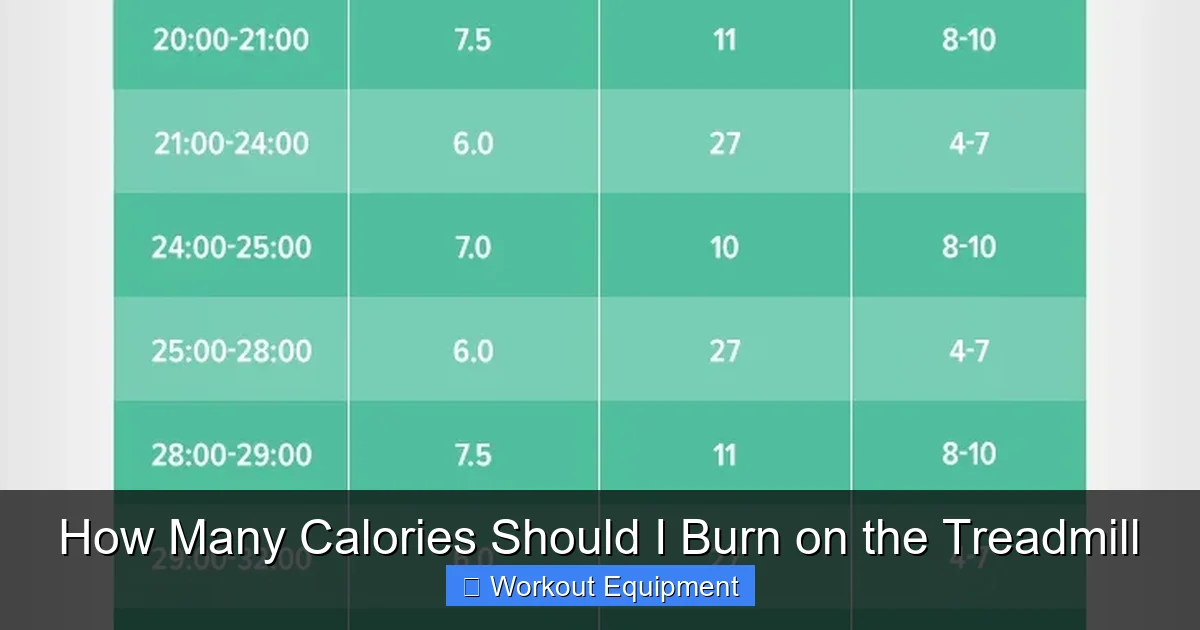
Visual guide about How Many Calories Should I Burn on the Treadmill
Image source: i.pinimg.com
Workout A: The Weight Loss Walker (Beginner-Friendly)
Goal: Build consistency, create a daily deficit, burn 250-350 calories per session.
Session: 45 minutes
Structure:
- 5 min warm-up: Walk at 2.5 mph, 0% incline.
- 30 min main set: Walk at 3.5-4.0 mph on a 1-3% incline. The incline is your friend here—it boosts burn without the joint stress of running. Aim for a “somewhat hard” effort where talking is possible but sentences take a breath.
- 5 min cool-down: Walk at 2.5 mph, 0% incline.
Estimated Burn: 280-350 calories. This is a sustainable, joint-friendly way to contribute significantly to your weekly deficit.
Workout B: The Time-Crunched HIIT Runner
Goal: Maximize calorie burn in minimal time, boost afterburn effect (EPOC).
Session: 25 minutes
Structure:
- 5 min warm-up: Jog at 5 mph.
- 15 min intervals: (1 min sprint at 8-9 mph, 1.5 min recovery jog/walk at 4 mph). Repeat 6 times.
- 5 min cool-down: Walk at 3 mph.
Estimated Burn: 300-400 calories during the session, plus additional calories burned in the hours afterward as your body recovers. This is intense; do not start here if you’re new.
Workout C: The Endurance Builder
Goal: Improve aerobic capacity, burn fat as fuel, build mental toughness.
Session: 60 minutes
Structure:
- 10 min warm-up: Easy jog.
- 40 min steady state: Run at a “comfortably hard” pace (you could speak in short phrases). Maintain a consistent speed. Add a 1% incline for the last 10 minutes to simulate a gentle hill.
- 10 min cool-down: Easy jog/walk.
Estimated Burn: 500-700 calories. The focus here is on time and steady effort, not peak intensity. Fuel properly before and after.
Common Mistakes That Make Your Treadmill Time Less Effective
You can have the perfect plan, but small errors can undermine your efforts. Avoid these pitfalls:
Relying Solely on the Machine’s Calorie Counter
Treadmill algorithms are generalized guesses. They don’t account for your individual muscle mass, exact running economy, or even if you’re lightly holding the handrails (which reduces work and lowers your true burn). Use the number as a relative measure—is it higher or lower than last week for the same workout? That trend is more valuable than the absolute figure.
Neglecting the Warm-Up and Cool-Down
Skipping these to “save calories” is counterproductive. A proper warm-up (5-10 min of easy movement) prepares your cardiovascular system, reduces injury risk, and can actually allow you to perform your main set more effectively. A cool-down aids recovery and prevents blood pooling. Both are essential for long-term consistency.
Doing the Exact Same Workout Every Time
Your body adapts. That 30-minute walk that burned 300 calories last month might now burn 250. To keep challenging your system (and burning more calories), you must progressively overload. Increase speed, increase incline, increase duration, or increase frequency. Change one variable every 2-3 weeks.
Poor Form and Handrail Dependency
Leaning heavily on the handrails shifts weight off your legs and reduces the work your body does, artificially lowering your calorie burn and heart rate. Maintain an upright, engaged posture. Use handrails only briefly for balance if needed. Imagine a string pulling your head toward the ceiling.
Ignoring the Other 23 Hours of the Day
This is the biggest mistake. You can burn 500 calories on the treadmill, but if you then consume an extra 600 calories with a “reward” smoothie and snack, you’ve created a surplus. Nutrition is 70-80% of the weight management equation. Your treadmill work creates the opportunity for a deficit; your food choices determine if that opportunity is realized.
Beyond the Treadmill: A Holistic View of Fitness and Health
Let’s zoom out. obsessing over treadmill calories can make fitness feel like a punishing math problem. It’s time to reframe.
The Power of Strength Training
Cardio is great for the heart, but muscle is metabolically active tissue. More muscle means a higher resting metabolic rate—you burn more calories 24/7, even while sleeping. Incorporating 2-3 strength training sessions per week (using weights, resistance bands, or bodyweight exercises) builds this calorie-burning engine. It also strengthens bones, improves posture, and creates a more toned physique.
Nutrition as Fuel, Not Punishment
View food as the fuel that powers your treadmill sessions and your life. Prioritize protein to support muscle repair, complex carbs for sustained energy, and healthy fats for hormone function. Hydration is non-negotiable; even mild dehydration can impair performance and make exercise feel harder. Instead of “I burned 400 calories, so I can eat 400,” think “I fueled my body well to support my 400-calorie workout and my recovery.”
Recovery is Part of the Process
Your body burns calories and gets stronger during recovery, not during the workout itself. Skimping on sleep (7-9 hours for adults) elevates stress hormones like cortisol, which can promote fat storage and increase appetite. Active recovery (light walking, stretching) and full rest days are when the magic of adaptation happens. Overtraining leads to burnout, injury, and a stalled metabolism.
Listen to Your Body, Not Just the Display
Some days you’ll feel strong and fast; the calorie count will be high. Some days you’re tired, stressed, or sore; the count will be lower. That’s okay. A “low-calorie” day of gentle walking is still valuable for movement, circulation, and mental health. Consistency over months and years trumps extreme daily efforts. Your well-being is the ultimate metric.
The Final Word: Your Personalized Path Forward
So, how many calories should you burn on the treadmill? The answer is: Enough to support your defined goal, in a way that you can sustain consistently, without sacrificing your overall health. For the person seeking weight loss, that might mean aiming for a 300-400 calorie burn, 4-5 times a week, paired with a modest dietary deficit. For the person training for a 5K, it might mean focusing on specific pace intervals, with calorie burn as a happy byproduct. For the person just wanting to feel better, it might mean 30 minutes of pleasant walking most days, with the calorie number being completely irrelevant.
Start by calculating your rough TDEE and defining your primary goal. Then, use the sample workouts as templates, adjusting speed and incline until you find a challenging but doable effort. Use the treadmill’s readout to track relative progress—can you run the same pace at a higher incline? Can you maintain a pace for longer? These are the true markers of improvement. And above all, integrate your treadmill time into a broader lifestyle that values strength, nutrition, sleep, and stress management. The treadmill is a powerful tool in your kit, but it’s the entire toolbox—and how you use it—that builds the healthy, resilient body you’re after.
Frequently Asked Questions
How accurate are treadmill calorie counters?
Treadmill calorie counters provide a rough estimate based on your weight, speed, and incline, but they are not highly accurate. They use generalized formulas that don’t account for individual factors like muscle mass, running efficiency, or genetics. Use them to compare your effort over time (e.g., “I burned more today than last week for the same workout”) rather than as an exact measurement of energy expended.
Is it better to walk on an incline or run to burn more calories?
For most people, especially those with joint concerns, walking on a significant incline (e.g., 4-6%) can burn calories at a rate comparable to or even exceeding a slower jog on a flat surface, with less impact stress. Running inherently burns more calories per minute at moderate speeds, but incline walking is a highly effective, lower-impact alternative for boosting calorie expenditure and building leg strength.
What is the best time of day to use the treadmill for calorie burn?
The best time is the time you can consistently do it. Your metabolism doesn’t drastically change based on the clock. Some research suggests morning cardio in a fasted state may burn a slightly higher percentage of fat, but the total daily calorie balance is what matters most for weight management. Choose a time that fits your schedule and energy levels to ensure you actually complete your workouts.
Should I eat before or after a treadmill workout to maximize fat burn?
For general health and performance, it’s best to eat a small, easily digestible snack (like a banana or toast) 30-60 minutes before a moderate-to-vigorous workout to fuel you properly. For very short, low-intensity sessions (under 30 minutes), fasted exercise is fine for many. Post-workout nutrition (a mix of protein and carbs) is crucial for muscle repair and recovery, which supports your long-term metabolic health and calorie-burning potential.
Can I lose weight by only using the treadmill?
You can create a calorie deficit with treadmill exercise alone, but it’s not the most efficient or healthy long-term strategy. Relying solely on cardio can lead to muscle loss, plateaus as your body adapts, and potential overuse injuries. For sustainable weight loss and body composition changes, combine treadmill workouts with strength training (to preserve/build muscle) and a balanced, calorie-conscious diet.
Is it safe to do high-intensity treadmill workouts (like daily HIIT) to burn the most calories?
High-intensity interval training (HIIT) is extremely effective for calorie burn and fitness, but it is also very demanding on the nervous system and muscles. Performing HIIT on the treadmill daily is not recommended for most people and can lead to overtraining, injury, and burnout. Limit HIIT sessions to 2-3 times per week, with at least one full rest day and other days dedicated to lower-intensity steady-state cardio, strength training, or active recovery.