Can I Plug My Treadmill into a Surge Protector
Yes, you can often plug a treadmill into a surge protector, but with critical caveats. The surge protector must be rated for the treadmill’s high amperage and voltage, and it must be a true “surge protective device” (SPD), not just a basic power strip. Ignoring these specifications risks damaging your treadmill’s electronics, creating a fire hazard, and voiding your manufacturer’s warranty. Always consult your treadmill’s manual first, as many brands explicitly prohibit the use of any power conditioning device.
You’ve finally set up your dream home gym. The shiny new treadmill is assembled, the space is cleared, and you’re ready to log your first mile. But then, a simple question stops you in your tracks: Can I plug my treadmill into a surge protector? It seems like a no-brainer. You protect your computer and TV with one, so why not your expensive fitness equipment? The answer, like most things involving electricity and high-value machinery, is nuanced and critically important. Using the wrong power protection can do anything from voiding your warranty to causing a house fire. Let’s break down everything you need to know, from the science of surges to the exact specs to look for (or avoid).
Key Takeaways
- Not All Power Strips Are Surge Protectors: A cheap, multi-outlet power strip offers zero protection. You need a UL-listed Surge Protective Device (SPD) with a sufficient joule rating and clamping voltage for heavy-duty appliances.
- Amperage (Amps) is the Critical Factor: Treadmills typically draw 15-20 amps. The surge protector must be rated for at least 15 amps (and ideally 20A) at 120V to handle the treadmill’s startup surge without overheating.
- Your Warranty is Likely at Stake: Most treadmill manufacturers (like NordicTrack, Peloton, Sole) state in their warranty that using any surge protector, power conditioner, or extension cord voids the warranty. Check your manual first.
- Direct Wall Outlet is the Gold Standard: For maximum safety and warranty compliance, plugging your treadmill directly into a dedicated, properly grounded wall outlet on a dedicated circuit is always the best and safest recommendation.
- Look for “Heavy-Duty” or “Appliance” SPDs: If you must use a protector, seek models specifically designed for home theater systems, appliances, or workshop tools, not for computers or home offices.
- Surge Protectors Wear Out: A surge protector’s components degrade after absorbing a surge. Once its protection is depleted (often indicated by a light), it becomes a simple, unsafe power strip and must be replaced.
- Consider a UPS for True Power Conditioning: For areas with frequent brownouts/blackouts, an Uninterruptible Power Supply (UPS) with battery backup is a safer, more robust solution than a basic surge protector, though it is more expensive.
📑 Table of Contents
- Understanding the Beast: What’s Actually Inside Your Treadmill?
- Surge Protector vs. Power Strip: There’s a World of Difference
- The Elephant in the Room: Your Treadmill’s Warranty
- Best Practices: How to Power Your Treadmill Safely (If You Must)
- Real-World Scenarios and Practical Tips
- The Bottom Line: A Clear, Actionable Verdict
Understanding the Beast: What’s Actually Inside Your Treadmill?
Before we talk about protection, we need to understand what we’re protecting. A modern treadmill isn’t just a motor and a belt. It’s a sophisticated electro-mechanical system with several sensitive components that all draw significant power.
The Power-Hungry Motor
The heart of your treadmill is its drive motor. This isn’t a little fan motor; it’s a robust, continuous-duty motor designed to spin a heavy belt and support your weight. Starting this motor from a dead stop requires a massive burst of current, called “inrush current” or “starting surge,” which can be 2-3 times the motor’s running amperage. This happens every time you press “Start.” A standard 3.0 CHP (Continuous Horsepower) motor might draw 15-18 amps while running but could spike to 40+ amps for a split second at startup.
The Delicate Brain: Electronics and Display
Parallel to the motor is the treadmill’s electronic control board, the LED/LCD display, and any connected smart features (Wi-Fi, Bluetooth, app integration). These components run on lower-voltage DC power but are fed by the main AC input. They are highly sensitive to voltage fluctuations. A minor surge or spike can fry microprocessors, corrupt settings, or cause display malfunctions.
The Incline/Decline Mechanism
Most treadmills have a motorized incline system. This is another motor (often smaller) that lifts and lowers the deck. It adds to the overall power draw, especially when adjusting incline while you’re running.
Takeaway: Your treadmill is a hybrid: a power-hungry brute (the main motor) and a delicate digital brain (the electronics), both sharing the same power source. Any protection must accommodate the brute’s needs without compromising the brain’s safety.
Surge Protector vs. Power Strip: There’s a World of Difference
This is the most common point of confusion. The long, cheap power strip with half a dozen outlets you got for $10 at the big-box store? That is not a surge protector. It’s simply an extension cord with a switch and a circuit breaker (maybe). It offers zero protection against voltage spikes.
What a Real Surge Protective Device (SPD) Does
A true SPD is an electrical device designed to limit transient voltage surges. It contains components like Metal Oxide Varistors (MOVs) that act as a pressure relief valve for electricity. When a surge (from a lightning strike, grid switching, or large appliance cycling on/off) travels down your wire, the MOVs divert the excess voltage to the ground wire, clamping the voltage to a safe level (e.g., from 200V down to 130V) for a fraction of a second.
Key Specs for a Treadmill-Grade SPD
- Joule Rating: This is the surge absorption capacity. Higher joules mean more protection and longer life. For a treadmill, look for at least 1,000 joules, with 2,000+ being ideal for heavy-duty use.
- Clamping Voltage: The voltage at which the SPD kicks in. Lower is better (e.g., 330V is common for home office gear; 400V or less is good for appliances).
- Amperage Rating: This is non-negotiable. The SPD must be rated for 15 amps minimum, 20 amps preferred, at 120V. This is often printed on the unit itself or in fine print. Anything less (like a 13A or 10A computer strip) will overheat and fail under the treadmill’s load.
- UL Certification: Look for the UL 1449 certification mark. This means it’s been tested for safety and performance. Avoid unknown brands or “certified” by obscure agencies.
- Outlet Configuration: Treadmills often have a large, bulky plug (sometimes a “twist-lock” or “hospital grade” plug). Ensure the SPD’s outlets are spaced widely enough to accommodate it without forcing.
The Elephant in the Room: Your Treadmill’s Warranty
Here’s where things get serious. You must find your treadmill’s owner’s manual. In the “Installation” or “Electrical Requirements” section, you will almost certainly find language similar to:

Visual guide about Can I Plug My Treadmill into a Surge Protector
Image source: galvinpower.org
“Plug the power cord directly into a properly grounded wall outlet on a dedicated circuit. Do not use an extension cord, power strip, or surge protector. Use of such devices may damage the treadmill and will void the warranty.”
Why Manufacturers Say This
It’s not just a corporate power play. They have legitimate technical reasons:
- Inrush Current Overload: A cheap or undersized SPD may not handle the treadmill’s massive startup surge. Its internal breaker could trip, or worse, the SPD itself could overheat, melt, or catch fire because it’s not rated for that instantaneous load.
- Grounding Integrity: SPDs rely on a perfect ground connection to shunt surges away. A faulty or high-resistance ground in a cheap SPD is worse than no protection at all, as it can create a floating neutral or ground, damaging sensitive electronics.
- Voltage Drop: Long cords or poor-quality SPDs can cause a slight voltage drop under heavy load. This can make your treadmill motor run hotter, strain components, and shorten its lifespan.
- Liability: If a treadmill plugged into a third-party SPD causes a fire, the manufacturer doesn’t want to be held liable. The warranty disclaimer shifts responsibility to the user for not following installation instructions.
Practical Example: A user plugs a NordicTrack Commercial 1750 into a $15 “6-Outlet Surge Protector.” After six months, the display flickers and dies. Upon inspection, the control board is fried. NordicTrack’s warranty service denies the claim, citing the use of an unauthorized power conditioning device. The repair costs more than the treadmill’s current value.
Best Practices: How to Power Your Treadmill Safely (If You Must)
Okay, so the ideal is a direct wall outlet. But what if your gym layout requires the treadmill 15 feet from the outlet? Or you live in Florida with brutal lightning storms? Here is the hierarchy of safe power solutions, from best to acceptable (with caveats).
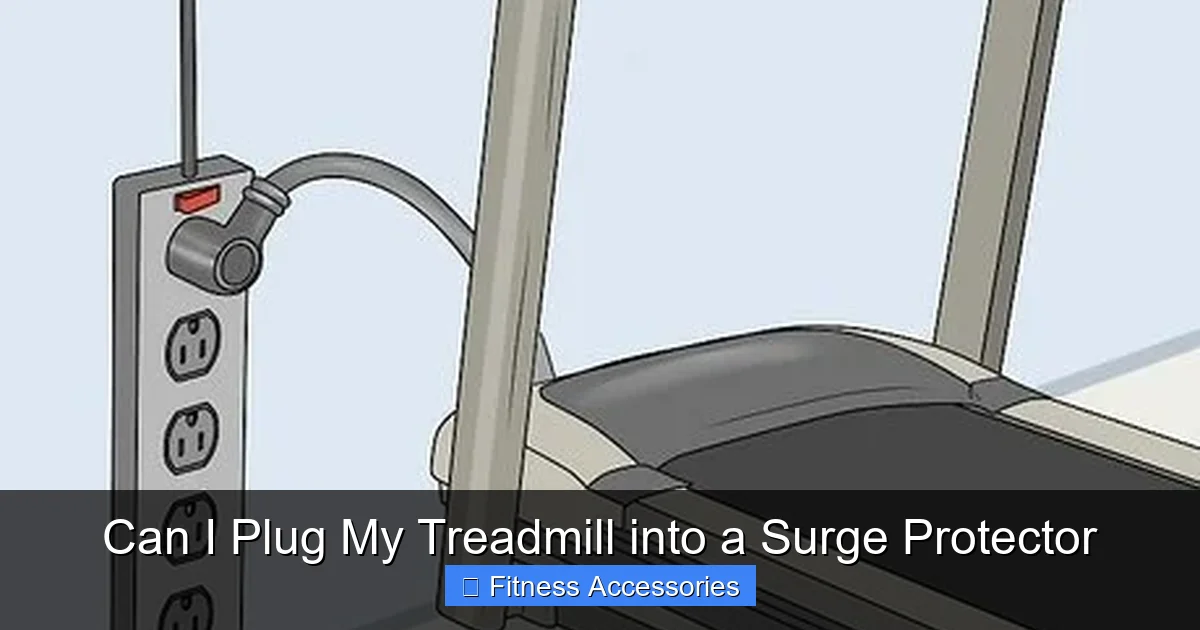
Visual guide about Can I Plug My Treadmill into a Surge Protector
Image source: wikihow.com
Tier 1: The Dedicated Direct Connection
This is the manufacturer’s dream and your safest bet. A “dedicated circuit” means a single breaker in your electrical panel feeds only that outlet, with no other lights, appliances, or outlets on it. This prevents voltage drop and ensures full, stable power. The outlet should be a standard 120V, 20-amp receptacle (the one with the T-shaped neutral slot). Have an electrician verify this if you’re unsure.
Tier 2: Heavy-Duty, Appliance-Grade SPD
If you are in an area with frequent surges and accept the warranty risk, you must buy the right tool. Search for “heavy-duty surge protector for appliances” or “home theater surge protector.” Brands like Tripp Lite, APC, and Eaton make models rated for 15-20A. Look at the specs: Input: 120V / 15A or 20A. These are bulky, expensive ($50-$150), and look more like a small brick than a power strip. They are built to handle the load.
Tier 3: The Uninterruptible Power Supply (UPS)
A UPS is the ultimate solution. It contains a battery and a pure sine wave inverter. It does three things: 1) Provides flawless, clean power to your treadmill (conditioning), 2) Gives you 10-30 seconds of battery backup to safely stop and save your workout during a blackout, and 3) Offers robust surge protection. The catch? You need a “line-interactive” or “double-conversion” UPS rated for at least 1,500 VA / 1,000 watts. This is a significant investment ($200-$600+) but is the only way to truly protect against brownouts and provide battery backup. Warning: Not all UPSes are created equal. Some cheaper “standby” UPSes output a “simulated” or “stepped” sine wave that can confuse or damage treadmill motors over time. You must get one with a pure sine wave output.
Real-World Scenarios and Practical Tips
Let’s translate this theory into your garage or basement gym.
Visual guide about Can I Plug My Treadmill into a Surge Protector
Image source: galvinpower.org
Scenario A: The Treadmill is 5 Feet from a Wall Outlet
Action: Use the shortest, heaviest-gauge extension cord only if absolutely necessary, and plug that directly into the wall. The extension cord must be 14-gauge or 12-gauge (thick), no longer than 10 feet. This is still not ideal and can void warranty, but it’s less risky than daisy-chaining a cheap power strip. Better: move the treadmill or have an electrician install a new outlet.
Scenario B: You Have Multiple Gym Devices (Fan, TV, Sound System)
Action: Do NOT plug them all into one SPD that also feeds the treadmill. The treadmill should be on its own dedicated outlet/SPD. Plug your low-power accessories (fan, phone charger) into a separate, standard (non-surge) power strip on a different circuit if possible.
Scenario C: You Live in an Apartment with Old Wiring
Action: Get a plug-in circuit analyzer (cheap online) to check your outlet for proper grounding and voltage. If the outlet is not grounded, no SPD in the world will work correctly. You must report this to management—it’s a safety issue for all your appliances.
Scenario D: After a Major Power Surge (Lightning)
Action: Even if your treadmill seems fine, have an electrician check it. A surge can weaken components internally. If you were using an SPD, check its “protection present” indicator light. If it’s off, the SPD is dead and must be replaced. It is now just a power strip.
The Bottom Line: A Clear, Actionable Verdict
So, can you plug your treadmill into a surge protector? The technically correct but frustrating answer is: It depends entirely on your treadmill’s manual and the specific protector’s specs.
- If your manual explicitly forbids it: Do not use a surge protector. Use a dedicated, grounded wall outlet. Invest in a whole-house surge suppressor at your electrical panel for broader protection. This is the only way to keep your warranty intact.
- If your manual is silent or allows it: You must use a heavy-duty, 15A/20A-rated, UL 1449 certified SPD with a high joule rating. Treat it as a critical safety component, not an accessory. Budget at least $75 for a proper unit.
- For ultimate peace of mind (and battery backup): Invest in a pure sine wave UPS sized appropriately for your treadmill’s wattage. This is the professional solution.
Your treadmill is a major investment in your health. Protecting it with improper power accessories is a false economy. The $20 you save on a cheap power strip could cost you a $1,500 repair bill or worse. When in doubt, default to the manufacturer’s instructions, consult a qualified electrician, and choose quality over convenience. Your heart rate—and your home’s electrical system—will thank you.
Frequently Asked Questions
Will using a surge protector definitely void my treadmill warranty?
Almost certainly, yes. The vast majority of treadmill manufacturers include a specific clause in their warranty stating that using any surge protector, power conditioner, or extension cord will void the warranty. This is because they cannot control the quality or specifications of third-party power devices. Always check your specific warranty terms first.
Can I use a standard computer surge protector for my treadmill?
Absolutely not. Computer surge protectors are designed for low-amperage devices (under 10-13 amps). They are typically rated for 125V/10A or 125V/13A. A treadmill’s startup surge will instantly trip their internal breaker or cause them to overheat and fail, creating a fire risk. They lack the joule capacity and amperage rating required.
What’s the difference between a whole-house surge protector and one I plug in?
A whole-house surge protector is installed at your main electrical panel by an electrician. It protects all circuits and devices in your home from large surges (like lightning or utility grid spikes). A plug-in SPD only protects the device it’s directly connected to from smaller, downstream surges that make it past the main panel. They work together for layered protection, but the plug-in unit must still be correctly sized for the treadmill’s amperage.
Is a UPS safer than a surge protector for a treadmill?
Yes, a high-quality, pure sine wave UPS is generally safer and more robust. It provides superior power conditioning (cleaning up brownouts and sags), battery backup for safe shutdowns, and heavy-duty surge protection. However, it is significantly more expensive. A properly sized, heavy-duty SPD is the minimum acceptable solution if a UPS is not feasible, provided you accept the warranty implications.
My outlet is far from the treadmill. Can I use a heavy-duty extension cord?
You can, but it’s a last resort. If you must, use the shortest possible cord (under 10 feet) with the thickest gauge available (12-gauge is best, 14-gauge minimum). Ensure it’s a single, solid cord, not a light-duty indoor/outdoor multi-outlet strip. Remember, this still likely violates your warranty and can cause voltage drop, making your motor work harder.
How do I know if my surge protector is actually still working?
Most quality SPDs have a diagnostic LED light labeled “Protected,” “OK,” or similar. If this light goes out, it means the internal components have been depleted by a surge and the device no longer offers protection. It now functions as a simple, unsafe power strip and must be replaced immediately. Some higher-end units also have a built-in audible alarm.