Are the Calories Burned Shown on a Treadmill Accurate

The calorie burn numbers on a treadmill are a rough estimate, not a precise measurement. They rely on generic formulas that often overestimate calories burned, especially for lighter individuals or slower walkers. Accuracy depends heavily on correctly inputting your weight and using heart rate data. For a more reliable picture, consider a heart rate monitor or fitness tracker and focus on consistent effort over a single machine’s readout.
Key Takeaways
- Treadmill estimates are generic: They use standardized formulas (like ACSM) that don’t account for individual fitness level, body composition, or metabolism.
- Your weight is the #1 factor: Entering an incorrect weight is the single biggest source of error. The machine’s calculation is only as good as the data you provide.
- Heart rate dramatically improves accuracy: Treadmills with chest strap or handlebar sensors that incorporate heart rate provide a significantly more personalized estimate.
- They consistently overestimate for lighter people: A 120 lb person will see a much larger percentage overestimate than a 200 lb person doing the same workout.
- Speed and incline matter, but not as much as you think: While included in the formula, the relationship between speed/grade and calorie burn is not perfectly linear for everyone.
- Use them for trends, not absolutes: The value is in comparing your performance *on the same machine over time* with consistent inputs, not for a precise daily calorie count.
- Better tools exist: Wearable heart rate monitors and fitness trackers with personal data profiles generally provide more accurate, individualized calorie expenditure data.
📑 Table of Contents
- The Promise and the Problem: What That Treadmill Readout Really Means
- How Treadmills Actually Calculate “Calories Burned”
- The Biggest Factors That Throw Off the Numbers
- Treadmill vs. Other Calorie Trackers: How Does It Stack Up?
- How to Get a Better Estimate From Your Treadmill
- The Bigger Picture: Why Obsessing Over the Treadmill Number is Counterproductive
- Conclusion: Knowledge is Power (and Better Workouts)
The Promise and the Problem: What That Treadmill Readout Really Means
You finish your run, sweat-drenched and accomplished. Your eyes dart to the console. “Calories Burned: 450.” A surge of satisfaction. But should you trust it? That number, glowing proudly on the treadmill’s digital display, is one of the most sought-after metrics in fitness. It quantifies effort, justifies the workout, and fits neatly into diet and weight-loss calculations. Yet, it’s also one of the most misleading.
The truth is, the calories burned shown on a treadmill are an estimate, not a measurement. They are the output of a mathematical formula, not a direct physiological reading like a thermometer measures temperature. This distinction is crucial. Understanding why these numbers are often inaccurate—and by how much—empowers you to use the treadmill as a tool for progress, not a gospel of truth. Let’s break down the science, the variables, and how to get the most useful information from your cardio sessions.
How Treadmills Actually Calculate “Calories Burned”
To understand the inaccuracy, you first need to know what’s happening under the hood. Treadmills don’t have a little calorie counter inside the belt. They use an algorithm. The most common formula is based on guidelines from the American College of Sports Medicine (ACSM). This formula estimates your gross calories burned (total energy expended during the exercise) and then typically subtracts your resting metabolic rate (RMR) for that time period to give a net calorie burn figure (the energy used purely for the activity).
Visual guide about Are the Calories Burned Shown on a Treadmill Accurate
Image source: sport-calculator.com
The Core ACSM Treadmill Formula
The basic equation considers several inputs:
- Speed (mph or m/min): How fast you’re moving.
- Grade (%): The incline or hill simulation.
- Body Weight (kg or lbs): The most critical user-input variable.
The formula calculates something called “oxygen consumption” (VO2) in ml/kg/min, which is then converted into an estimated calorie expenditure (1 liter of oxygen consumed ≈ 5 kcal). It’s a one-size-fits-most model derived from metabolic studies on a limited population sample. It assumes an “average” efficiency of movement and an “average” metabolic response. It does not factor in your age, sex (beyond weight), fitness level, muscle mass, or individual metabolism.
The Biggest Factors That Throw Off the Numbers
Now we get to the heart of the matter. Why is the treadmill’s guess often a poor one? Several key factors create a gap between the displayed number and your actual energy expenditure.
Visual guide about Are the Calories Burned Shown on a Treadmill Accurate
Image source: fitliferegime.com
1. The Weight Input: Your Biggest Responsibility
This is the low-hanging fruit of inaccuracy. If you enter 150 lbs but actually weigh 180 lbs, the calculation will be off by a significant margin. Calorie burn scales linearly with weight in these formulas—heavier bodies require more energy to move. Always be honest and accurate when entering your weight. It’s the single most important piece of data you give the machine. Update it monthly if your weight is changing.
2. The “Average” Person Fallacy
The ACSM formulas were developed from studies on a specific demographic, often young, healthy, and moderately fit. They do not account for:
- Body Composition: A 150 lb person with 25% body fat vs. a 150 lb person with 10% body fat (more muscle) will burn different calories. Muscle is metabolically active and requires more energy to move than fat. The treadmill sees “150 lbs” for both.
- Fitness Level/Efficiency: A seasoned runner moves with far greater economy (less energy wasted) than a beginner. For the same speed and grade, the beginner burns more calories. The treadmill formula cannot detect your efficiency.
- Age and Sex: While some advanced machines ask for age and sex, many basic models do not. Basal metabolic rate and exercise efficiency change with age. Biological sex influences muscle mass distribution and hormone profiles, affecting energy use. Generic formulas ignore this nuance.
3. The Handrail Dilemma: Leaning Throws Everything Off
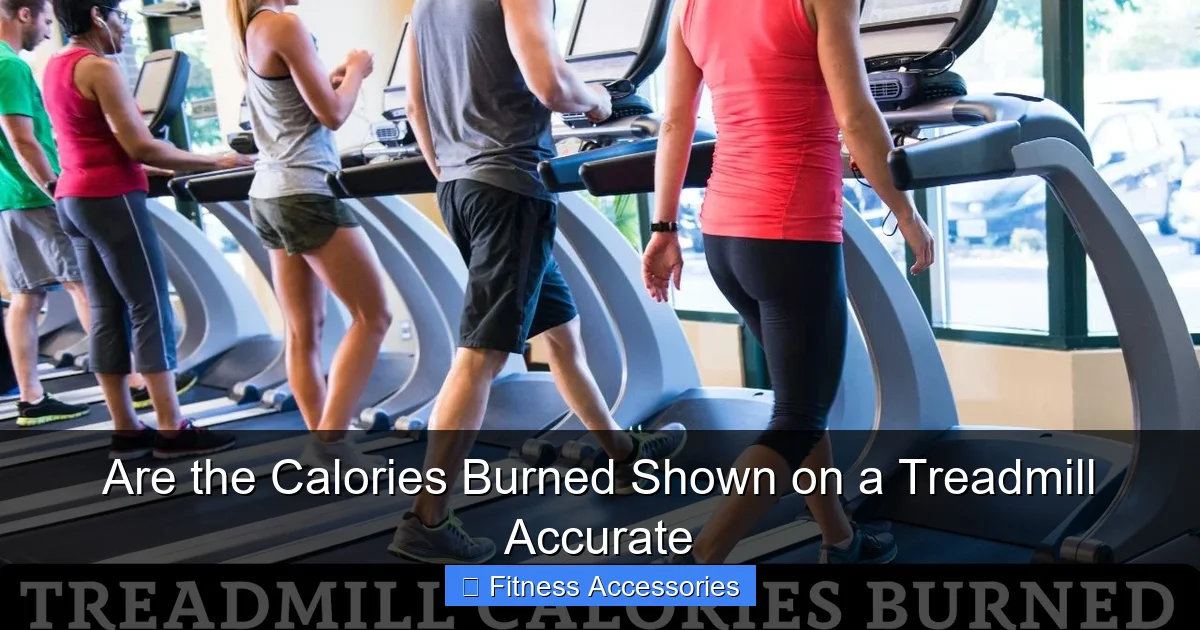
This is a massive, often overlooked source of error. Many people, especially on an incline, lean heavily on the handrails for support. When you do this, you are offloading a percentage of your body weight onto the rails. The treadmill, however, still thinks 100% of your entered weight is being propelled by your legs. It calculates calorie burn based on moving your full body weight against gravity and friction. In reality, your legs are doing less work. Your actual calorie burn can be 20-30% lower than the readout if you’re a “handrail huncher.” The rule of thumb: use handrails for balance and safety only, not for support during the majority of your walk or run.
Treadmill vs. Other Calorie Trackers: How Does It Stack Up?
So, the treadmill is flawed. How does it compare to other common methods? The hierarchy of accuracy generally looks like this:
Visual guide about Are the Calories Burned Shown on a Treadmill Accurate
Image source: treadmillreviewguru.com
- Most Accurate (Lab Setting): Indirect Calorimetry (a mask that measures your exact oxygen consumption and CO2 production). This is the gold standard but unavailable outside research.
- Very Good (Real-World): Chest Strap Heart Rate Monitors paired with a device that uses validated algorithms (like those from Polar or Garmin). Heart rate is a direct, real-time physiological signal of effort. When combined with your personal data (age, weight, sex, max HR), these provide a highly individualized estimate. They account for fitness level—your heart rate will be lower for the same pace as you get fitter, and the tracker will adjust the calorie estimate downward accordingly.
- Moderate/Good: Wrist-Based Fitness Trackers (Fitbit, Apple Watch, etc.). These use heart rate (optical sensor) plus motion sensors and personal data. They are generally more accurate than treadmill defaults because they personalize the algorithm. However, wrist-based HR can be less accurate during high-intensity, wrist-flexing activities like running.
- Least Accurate: Treadmill Console (without HR) and Cardio Machine Consoles (elliptical, stair climber). These rely purely on weight, speed, and incline. They are the “baseline” estimate and suffer from all the flaws listed above.
- Worst: Online calculators and generic “calories burned” charts. These are even more generalized than treadmill formulas.
Practical Example: A 35-year-old woman, 160 lbs, runs 3 miles at a 6 mph pace (10 min/mile) with 1% incline. A treadmill without HR might show ~350 calories. A chest strap monitor with her true max HR data might show ~290 calories. The difference? The treadmill assumes “average” efficiency; the HR monitor knows her actual cardiovascular response.
How to Get a Better Estimate From Your Treadmill
Don’t throw the treadmill’s readout out the window. You can significantly improve its usefulness with a few simple steps.
Step 1: Input EXACT, Current Data
Weigh yourself accurately (morning, nude, after bathroom) and enter that weight. If the machine asks for age and sex, fill it in honestly. Don’t guess or round up for “motivation.” Inaccurate inputs yield inaccurate outputs.
Step 2: Use the Heart Rate Feature If Available
This is the golden rule. If your treadmill has a chest strap transmitter or even reliable handlebar sensors, use them. The algorithm will switch to a heart rate-based calculation (often using the same ACSM principles but with HR as a key variable). This personalizes the estimate immensely. Ensure the sensor is moistened and makes good contact.
Step 3: Avoid Leaning on the Rails
Consciously keep your hands off the rails unless stopping. If you need them for balance, use the lightest touch possible. Your legs should support your full body weight. This aligns your actual effort with the machine’s assumption.
Step 4: Understand It’s a “Gross” Estimate
Most treadmill displays show “Calories Burned,” which typically means gross calories. This includes the calories you would have burned just sitting there for that time (your RMR). If you want the net calories (the true “extra” burn from exercise), you’d need to subtract your RMR for that duration (e.g., ~1.2 kcal/min for a 160 lb person at rest). For most practical purposes, the gross number is fine for comparison, but don’t add it all to your “net calorie deficit” for dieting without this adjustment.
The Bigger Picture: Why Obsessing Over the Treadmill Number is Counterproductive
Here is the most important philosophical shift: the treadmill calorie count should be a secondary metric, not the primary goal of your workout.
When you make the number on the screen your master, you start to game the system. You hold the rails. You slow your pace to “stay in the fat-burning zone” (a myth itself). You choose the treadmill over a more effective, but less numerically rewarding, workout like HIIT or strength training.
Instead, focus on these primary, controllable metrics:
- Time/Duration: “I ran for 30 minutes.”
- Distance: “I covered 3 miles.”
- Pace/Speed: “I maintained a 9:30 min/mile pace.”
- Heart Rate: “I spent 20 minutes in Zone 3.”
- Perceived Exertion (RPE): “That last five minutes felt like an 8/10.”
- Incline: “I increased the grade to 4%.”
These are tangible measures of effort and progress. You can reliably improve them week to week. The calorie number is a derivative of these factors plus a flawed formula. Track your time, distance, and heart rate consistently. If those improve, your fitness is improving, and your *actual* calorie burn is going up, regardless of what the old treadmill model says.
Conclusion: Knowledge is Power (and Better Workouts)
So, are the calories burned shown on a treadmill accurate? The definitive answer is no, they are not precise measurements. They are generalized estimates that frequently overestimate calorie expenditure, particularly for lighter individuals, slower walkers, and anyone who uses the handrails for support. Their accuracy is entirely dependent on correct weight input and is vastly improved by incorporating heart rate data.
The takeaway isn’t to despair over the number, but to demystify it. See it as a rough guideline, a relative indicator of effort *on that specific machine* when you use consistent form and data. For serious tracking, invest in a reliable chest strap heart rate monitor. And most importantly, liberate yourself from being a slave to that flashing number. Measure your workouts by what you can control: your time, your distance, your pace, your heart rate zones, and how you feel. Those are the true markers of fitness progress. The treadmill’s calorie counter is just a noisy passenger on your journey—useful for a vague sense of direction, but never trust it to navigate for you.
Frequently Asked Questions
Can I make the treadmill calorie count more accurate?
Yes. Always enter your correct, current weight. Use the heart rate sensors if available (a chest strap is best). Avoid leaning on the handrails. For the most consistent data, use the same treadmill with the same settings every time to track trends.
Why do I burn fewer calories than the treadmill says?
>This is very common. The most likely reasons are: you entered a weight higher than your actual weight, you are lighter than the “average” person the formula assumes (it overestimates for lighter bodies), you are more fit/efficient than the average person, or you are supporting your weight on the handrails, especially on an incline.
Are treadmill calories more accurate than a Fitbit or Apple Watch?
>Generally, no. Wearable devices like Fitbit and Apple Watch use your personal data (age, weight, sex, heart rate) and more sophisticated, personalized algorithms. A treadmill without heart rate input uses a completely generic formula based only on weight, speed, and grade, making it less accurate for an individual.
Does the “fat-burning zone” on the treadmill matter for calories?
>Not really. The “fat-burning zone” (typically lower intensity, ~60-70% max HR) refers to the *percentage* of calories from fat during that specific activity. For total calorie burn and weight loss, higher-intensity exercise that burns more total calories (even if a lower percentage is from fat) is more effective. The treadmill’s zone guidance is based on generic heart rate zones, not personalized fat metabolism.
Should I use the treadmill’s calorie count for my diet planning?
>With extreme caution. Because treadmills often overestimate, using their numbers to justify eating more can sabotage weight loss. If you must use it, be conservative. Assume the number is 20-30% higher than reality, or better yet, use a heart rate monitor’s estimate and then subtract 10-15% for safety.
Do all treadmills use the same formula to calculate calories?
>No. While most use variations of the ACSM (American College of Sports Medicine) formula as a base, each manufacturer implements its own tweaks, proprietary algorithms, and rounding methods. This is why calorie counts can differ between two different treadmill brands for the exact same workout and person. There is no universal standard.