Can You Use Couch to 5k on a Treadmill
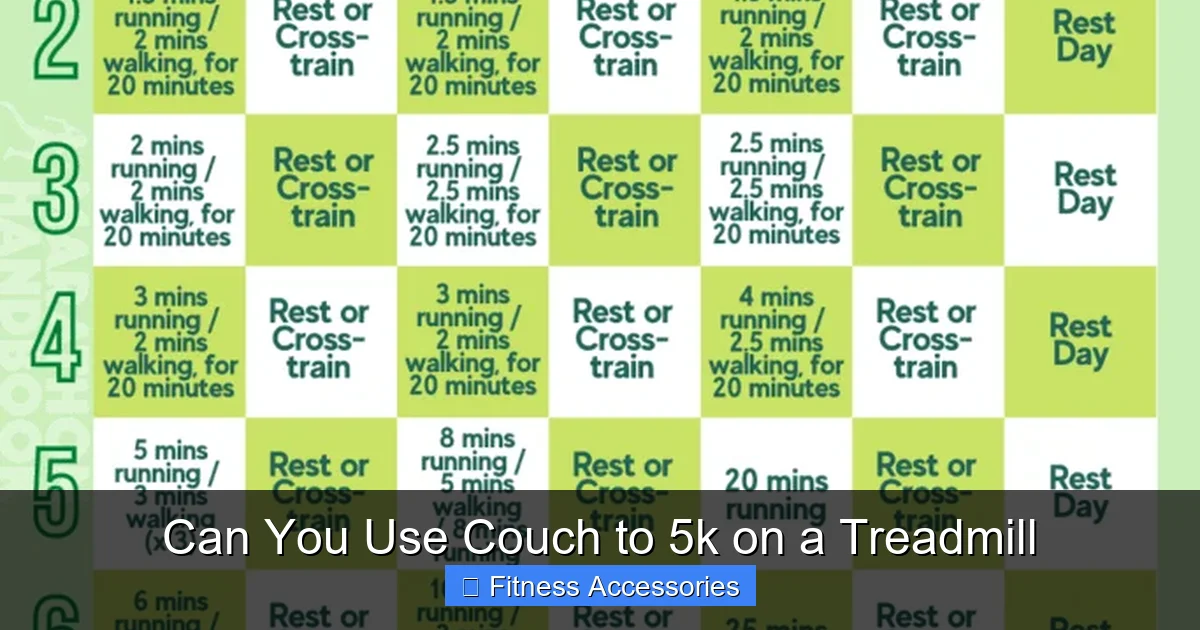
Yes, the Couch to 5k (C25K) program is not only possible but often ideal on a treadmill. It offers a controlled, weather-proof environment perfect for beginners to build consistency and focus on form without outdoor variables. You will need to make a few key adjustments, primarily to pace and incline, to simulate the outdoor experience and ensure you’re progressing appropriately. With the right setup and mindset, a treadmill can be your most reliable training partner to go from the couch to running a 5k.
Key Takeaways
- The C25K plan works perfectly on a treadmill: The structure of run/walk intervals translates directly to treadmill use, making it a fantastic tool for building endurance in a controlled setting.
- You must manually control pace and incline: Unlike a GPS watch, the treadmill won’t auto-adjust. You are responsible for setting and changing the speed during walk breaks and run intervals to follow the program’s effort levels.
- Safety and comfort are paramount: Use the safety clip, position the treadmill near a wall for support, and focus on a natural arm swing and upright posture to prevent strain.
- Boredom is the biggest mental challenge: Combat it with entertainment (podcasts, playlists, TV), virtual running apps, or simply changing your focus point to make the miles fly by.
- Incline is your secret weapon: Adding a 1-2% incline better simulates outdoor running’s energy cost and wind resistance, making your treadmill training more specific and effective.
- Transitioning outdoors requires preparation: Your treadmill pace will feel easier outside. Practice a few outdoor runs before your goal 5k to adapt to terrain, wind, and different surfaces.
- Listen to your body, not just the plan: The treadmill’s impact is different. If you feel unusual joint pain, reassess your form, footwear, or consider cross-training instead of pushing through.
📑 Table of Contents
- Can You Use Couch to 5k on a Treadmill? The Short Answer is a Resounding Yes!
- Why the Treadmill is a Perfect (and Often Superior) Training Tool for Beginners
- How to Adapt the Couch to 5k Plan for Treadmill Success
- The Honest Pros and Cons of Treadmill Couch to 5k
- Essential Tips for Treadmill C25K Success (Beyond the Basics)
- Frequently Asked Questions (FAQs)
Can You Use Couch to 5k on a Treadmill? The Short Answer is a Resounding Yes!
So, you’ve decided to take the plunge. You’ve downloaded a Couch to 5k (C25K) app or printed out a plan, and you’re mentally preparing to go from a sedentary lifestyle to crossing a 5k finish line. But then a thought creeps in: “Can I actually do this on a treadmill?” Maybe it’s the fear of judgment on the street, the unpredictable weather, or the convenience of your basement gym. The great news for aspiring runners everywhere is that the treadmill is not just a backup option for C25K—it is often the absolute best tool for the job.
The Couch to 5k program is beautifully simple in its premise: alternating short running intervals with walking recovery, gradually increasing the run time over 8-9 weeks. This structure is inherently compatible with the treadmill’s precise, controlled environment. You set the speed, you control the duration, and you eliminate the variables of traffic, hills, and getting lost. For a true beginner, this consistency is pure gold. It allows you to focus entirely on the sensation of your body moving, your breathing rhythm, and building that crucial mental confidence without the added stress of the great outdoors. Think of the treadmill not as a compromise, but as your personal, patient running coach that never closes, never rains, and never makes you feel self-conscious.
However, “can you” does not mean “should you just blindly copy the plan.” There are important nuances to using a treadmill for C25K that will make your training safer, more effective, and less mind-numbingly boring. This guide will walk you through everything you need to know, from the science of why it works to the practical tweaks you must make, the pros and cons to consider, and the essential tips to ensure your success. By the end, you’ll be fully equipped to start your journey from the couch to 5k, one controlled step at a time.
Why the Treadmill is a Perfect (and Often Superior) Training Tool for Beginners
Before we dive into the “how,” let’s establish the “why.” The skepticism around treadmill running often comes from seasoned outdoor runners who crave the “real” experience. But for someone taking their first wobbly steps into the running world, the treadmill offers unique advantages that can accelerate learning and build unshakeable habit strength.
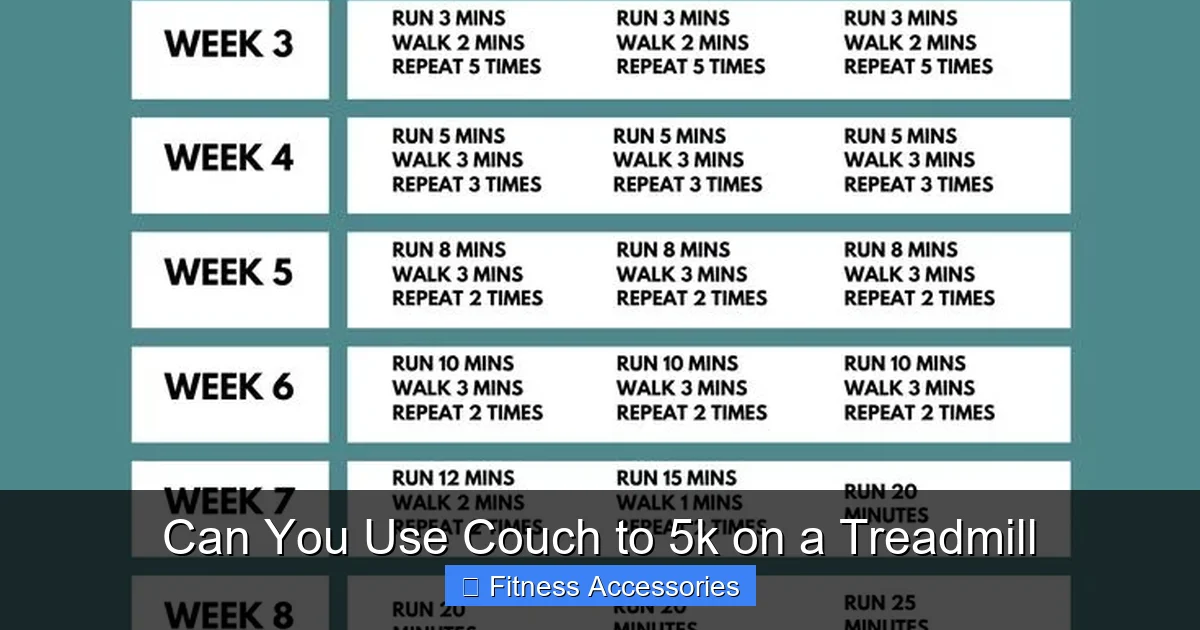
Visual guide about Can You Use Couch to 5k on a Treadmill
Image source: i.pinimg.com
The Science of Controlled Environment
The core principle of C25K is building time on your feet (or “time on your legs,” as runners say) at a low, manageable intensity. The treadmill provides a perfectly controlled environment for this. There is no stopping for traffic lights, no unexpected hills that spike your heart rate, and no slippery or uneven surfaces to navigate. This means the “run” portion of your run/walk interval is exactly what you program it to be. You can trust that if the app says “run for 60 seconds at a ‘conversational pace,'” you can set a speed that feels right and know it will be consistent for that entire minute. This consistency helps your body adapt predictably and builds a reliable sense of accomplishment week after week.
Eliminating External Barriers
How many times has a plan been derailed by “it’s too cold,” “it’s too dark,” “I don’t want to drive to the park,” or “I feel awkward running in my neighborhood”? The treadmill sits in your home or gym, a constant invitation. It removes every single external barrier to exercise. On days when motivation is low, the act of just putting on your shoes and stepping onto the belt is a victory in itself. This is critical for habit formation—the first few weeks of C25K are about showing up more than anything else. The treadmill makes showing up the path of least resistance.
Mastering Form and Pace Without Pressure
Beginners often struggle with pace. They start too fast, burn out, and feel like failures. On the treadmill, you have a tangible, numerical speed (mph or kph) to reference. You can experiment safely: “What does 3.0 mph feel like? What about 3.2?” You learn what a true “easy” or “conversational” pace is for your body without the peer pressure of other runners or the urge to keep up with a running partner. Furthermore, you can check your form in a mirror or window reflection. Are you hunching? Are your arms flailing? You can make micro-adjustments to your posture, stride, and arm swing in real-time, building good habits from day one that will prevent injury down the line.
How to Adapt the Couch to 5k Plan for Treadmill Success
Here is the crucial part. You cannot simply set the treadmill to the same speed you *think* you should be running and expect it to match the outdoor effort of the C25K plan. The treadmill belt moves under you, which changes the biomechanics slightly and often makes a given speed feel easier than running on solid ground. To get the intended training effect, you need to make two primary adjustments: pace calibration and strategic use of incline.
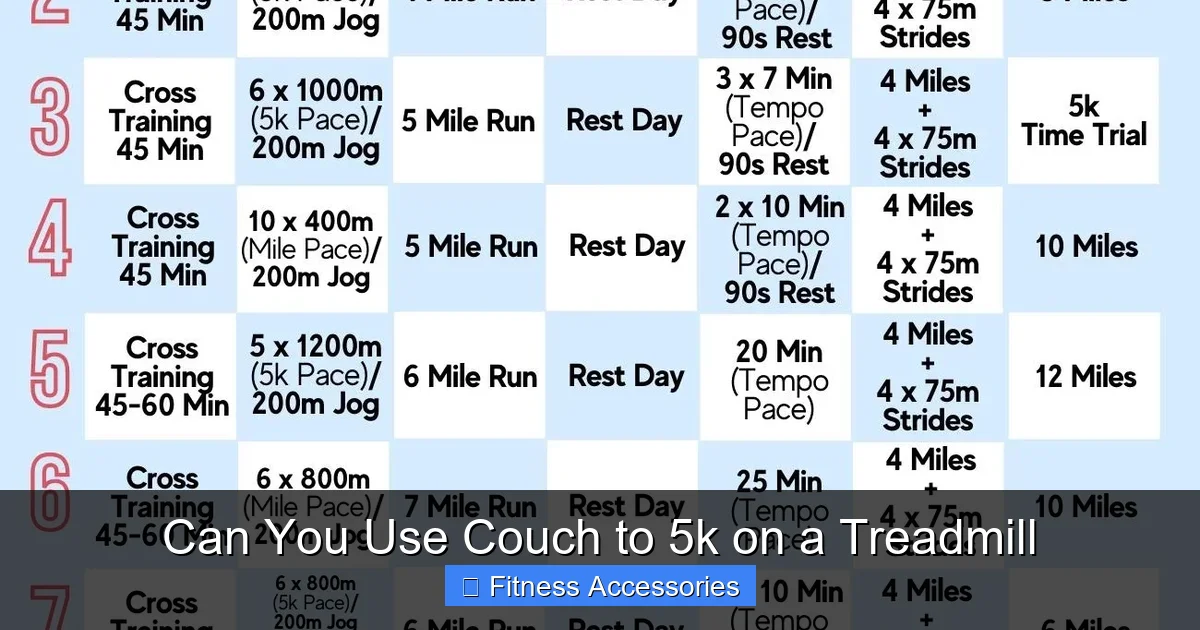
Visual guide about Can You Use Couch to 5k on a Treadmill
Image source: marathonhandbook.com
Step 1: Find Your True “Conversational Pace”
The entire C25K philosophy is built on the “talk test.” During your run intervals, you should be able to speak in full sentences with only a slight increase in breathing. This is your benchmark. Here’s how to find it on the treadmill:
- Week 1 Discovery: Start at a very slow walking speed (e.g., 2.5-3.0 mph). After your warm-up walk, increase to a running speed that feels like a *light jog*. For most complete beginners, this will be between 3.0 and 4.0 mph. Try 3.5 mph. Can you say a full sentence? “The sky is… blue.” If you can, that’s likely your starting run pace. If you’re gasping, drop it by 0.2-0.3 mph.
- The “Perceived Exertion” Check: Use the 1-10 Rate of Perceived Exertion (RPE) scale. Your C25K run intervals should feel like a 3-4 out of 10. It’s effortful, but not hard. If it feels like a 6 or 7, you’re going too fast. Slow down! The goal is duration, not speed.
- Record Your Pace: Once you find that magical pace where you can just about talk, write it down. This is your Week 1 run pace. You will likely only increase this pace by 0.1-0.2 mph every other week, if at all. The program is about increasing time, not speed.
Step 2: Use Incline to Simulate Reality and Build Strength
This is the most important adaptation for treadmill C25K. A flat treadmill is easier than outdoor running because there’s no wind resistance and you’re not propelling your body forward against gravity on uneven ground. To compensate and get a more specific workout:
- Add a 1-2% Incline for ALL Run Intervals: This small gradient mimics the energy cost of running outdoors on flat ground. It engages your glutes and hamstrings more, building strength that will serve you well on race day. Start with 1% and see how it feels. If it feels too hard at your current pace, keep the incline at 0% for the first 2-3 weeks and then gradually introduce it.
- Keep Incline at 0% for Walk Intervals: During your active recovery walks, drop the incline back to 0%. This allows your heart rate to come down and your legs to recover properly, which is the entire point of the walk break.
- Don’t Overdo It: A 5% or higher incline is for advanced hill repeats, not for a beginner building endurance. Stick to the 1-2% range for your run intervals throughout the entire C25K program.
Step 3: Manual Transition Between Speeds
Your C25K app will beep and say “Run” or “Walk.” On a treadmill, you must physically change the speed. Practice this! In the first few sessions, just focus on smoothly transitioning. As a “Walk” beep approaches, reduce your speed by 1.0-1.5 mph to your comfortable walking pace (usually 2.5-3.2 mph). When the “Run” beep sounds, increase the speed back to your run pace. Do this deliberately to avoid tripping. Many modern treadmills have quick-speed buttons you can program for your run and walk speeds—use them!
The Honest Pros and Cons of Treadmill Couch to 5k
Like any training method, using a treadmill for C25K comes with its own set of trade-offs. Understanding them helps you maximize the benefits and mitigate the drawbacks.
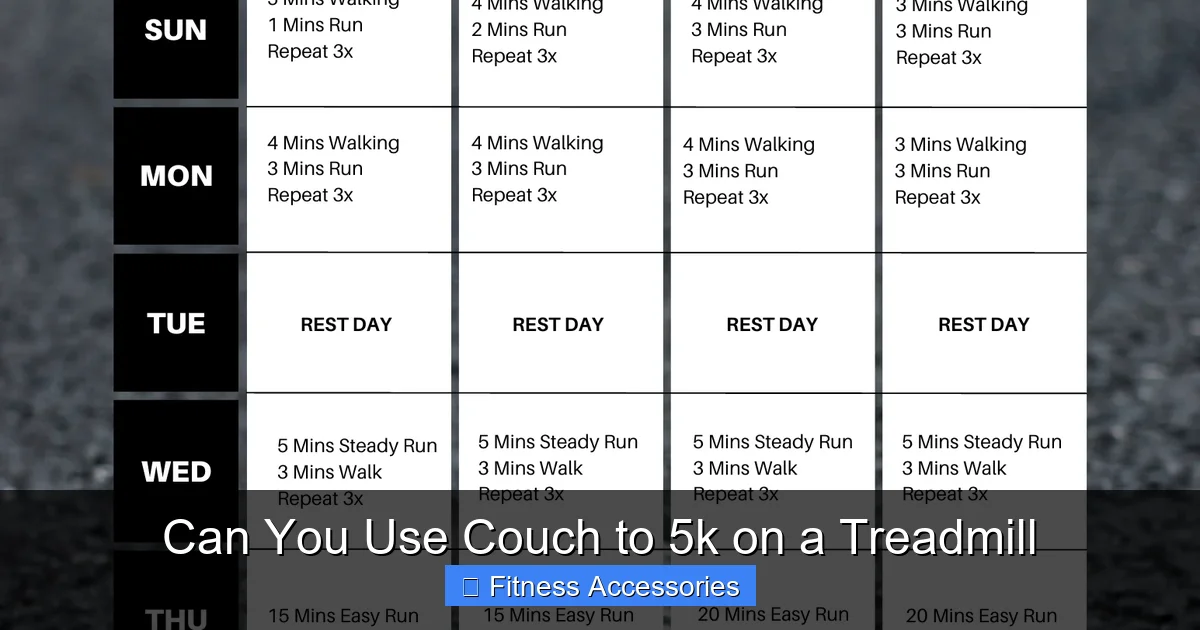
Visual guide about Can You Use Couch to 5k on a Treadmill
Image source: images.squarespace-cdn.com
Pros: Why the Treadmill Might Be Your Best Friend
- Unmatched Consistency & Control: You hit exactly the pace and time prescribed. No getting lost, no stopping for lights, no unexpected hills that ruin your interval. This is pure, predictable progressive overload.
- Safety & Security: Run at 5 AM in the dark? No problem. Run in a bad neighborhood? Not an issue. The treadmill is a safe, private space. You can also easily stop instantly if you feel dizzy or unwell, with the safety clip providing an extra layer of security.
- Climate-Proof Training: Rain, snow, heatwave, or extreme cold—your training schedule remains unaffected. This consistency is the single biggest factor in completing any program.
- Perfect for Form Focus: As mentioned, the ability to glance at your posture, check your foot strike, and adjust your arm swing is invaluable for a beginner learning efficient movement patterns.
- Immediate Feedback: You see your speed, distance, time, and calories burned in real-time. This data can be motivating and help you track your progress numerically.
Cons: The Challenges You’ll Need to Overcome
- Monotony and Mental Grind: This is the #1 drawback. Staring at a wall or a TV screen for 20-30 minutes can be mentally taxing. Boredom can sap your motivation faster than any physical challenge.
- Different Muscular Demand: The treadmill belt assists with leg turnover, which can lead to a slightly different (and sometimes weaker) recruitment of your posterior chain (glutes, hamstrings) compared to outdoor running. The strategic use of incline helps combat this.
- Lack of Terrain Variation: Real running has bumps, curves, and soft surfaces. The treadmill is a perfectly flat, hard plane. This can increase repetitive stress on joints if your form isn’t solid.
- False Sense of Pace: Because it’s easier, you might think you’re faster than you are. This can lead to disappointment or overexertion on your first outdoor run if you don’t adjust your expectations.
- Space and Cost: Not everyone has space or budget for a treadmill. Gym access solves this, but then you have to travel, which is another barrier.
Essential Tips for Treadmill C25K Success (Beyond the Basics)
Armed with the plan adjustments, here are the pro-tips that separate a successful treadmill C25K graduate from someone who quits after two weeks.
Entertainment is Not Optional—It’s Mandatory
Do not underestimate the mental battle. You must have a plan for the “wall-watching” time. This is non-negotiable.
- Podcasts & Audiobooks: The best option. A 30-minute episode is the perfect length for a C25K workout. Find a compelling story or an educational podcast to make the time fly.
- Curated Playlists: Create a “C25K” playlist with songs that match the energy of your intervals. Upbeat music for runs, calming tunes for walks. Structure it to last the entire session.
- TV Shows & Movies: Place the treadmill in front of a TV. Commit to only watching your favorite show while you run. It becomes a reward.
- Virtual Running Apps: Apps like Zwift Run, BitGym, or even the built-in iFit on some treadmills can transport you to scenic trails around the world, providing visual stimulation and a game-like experience.
Focus on Form, Even When You’re Tired
In the later weeks, when you’re running for 20+ minutes straight, fatigue will set in. This is when bad form creeps in: slouching, heel-striking heavily, swinging your arms across your body. Make a conscious effort, especially in Weeks 5-8, to check in with your body every 5 minutes.
- Posture: Imagine a string pulling your head up. Keep your shoulders relaxed and down. Look ahead, not at your feet.
- Arm Swing: Keep elbows bent at about 90 degrees. Swing front-to-back, not side-to-side. This helps maintain your rhythm and prevents wasted energy.
- Stride: Aim for a quick, light cadence. Your feet should land underneath your hips, not out in front. A slight forward lean from the ankles (not the waist) is ideal.
Hydration and Environment
Even though you’re indoors, you sweat. Keep a water bottle on the treadmill console or in a holder and take small sips during your walk breaks. Also, consider a small fan—the treadmill can get warm, and overheating will make your perceived effort skyrocket. A well-ventilated, cool room is ideal.
Footwear Matters More Than You Think
Do not run in old, broken-down walking shoes or random sneakers. Invest in a proper pair of running shoes fitted to your gait. This is the single most important piece of equipment you will buy. Go to a specialty running store if possible. Good shoes will absorb the repetitive impact and drastically reduce your risk of shin splints, knee pain, and plantar fasciitis. Replace them every 300-500 miles.
Frequently Asked Questions (FAQs)
Is running on a treadmill easier than running outside?
Yes, generally, running at the same speed on a treadmill requires less energy expenditure (about 5-10% less) due to the moving belt assisting leg turnover and the lack of wind resistance. This is why using a 1-2% incline is recommended to make your treadmill training more specific and prepare you for the effort of an outdoor 5k.
How do I stop getting so bored on the treadmill during Couch to 5k?
Boredom is the main mental hurdle. You must have an audio or visual distraction plan. Download a compelling podcast series, create an energetic playlist timed to your workout, place the treadmill in front of a TV for your favorite show, or use a virtual running app that displays scenic routes. Breaking the 30-minute session into two 15-minute “chunks” with different entertainment can also help mentally.
Should my treadmill pace be the same as my goal 5k race pace?
Absolutely not. Your C25K run pace is your *easy, conversational* pace—likely between 12:00 and 15:00 per mile (or 7.5-5.0 km/h) for most beginners. Your goal 5k race pace will be significantly faster (e.g., 10:00-12:00 min/mile). C25K is exclusively about building endurance at a low intensity. Speed work comes much later in your running journey.
Can I wear my regular running shoes on the treadmill?
Yes, but with a caveat. You should be wearing shoes designed for running, not general “athletic” or “walking” shoes. Running shoes have specific cushioning and flexibility for the heel-to-toe rolling motion. Ensure your shoes are in good condition (not worn out) and appropriate for your foot type (neutral, overpronator, supinator). This is crucial for joint health on the repetitive treadmill surface.
What incline should I use on the treadmill for Couch to 5k?
For your run intervals, set the incline to 1-2%. This small adjustment compensates for the treadmill’s easier nature and builds strength. Keep the incline at 0% for all your walk intervals to allow for proper recovery. Do not use high inclines (4%+) during C25K; that turns an endurance workout into a strength one, which is not the program’s goal.
How do I transition from treadmill C25K to running my first outdoor 5k?
In the 2-3 weeks leading up to your goal race, aim to do 1-2 of your weekly C25K sessions outdoors. Your treadmill pace will feel too fast at first; start 30-60 seconds per mile slower than your usual treadmill pace. Outdoor surfaces are uneven and there is no belt assistance, so your effort will feel higher. This transition period is vital to adapt your muscles and nervous system to the real-world demands of the race course.
Frequently Asked Questions
What is Can You Use Couch To 5k On A Treadmill?
Can You Use Couch To 5k On A Treadmill is an important topic with many practical applications.