What Muscles Are Used on an Elliptical Machine

The elliptical machine is a powerful full-body workout tool that engages dozens of muscles simultaneously. From your legs and glutes to your arms, core, and back, nearly every major muscle group gets activated during a session. Whether you are a beginner or experienced fitness enthusiast, understanding which muscles work hardest on an elliptical helps you maximize results and avoid injury.
Key Takeaways
- Full-Body Engagement: The elliptical activates both lower body and upper body muscles, making it one of the most complete cardio machines available.
- Lower Body Dominance: Your quadriceps, hamstrings, glutes, and calves do the heaviest lifting during every pedal stroke.
- Core Stability: Your abdominal and lower back muscles work constantly to keep you balanced and upright on the machine.
- Upper Body Activation: Pushing and pulling the handlebars recruits your biceps, triceps, shoulders, and upper back muscles.
- Low-Impact Advantage: Unlike running, the elliptical protects your joints while still delivering serious muscle engagement.
- Resistance Matters: Increasing the resistance level on your elliptical directly increases the intensity of muscle activation.
- Posterior Chain Focus: The elliptical is excellent for strengthening your hamstrings, glutes, and lower back collectively.
📑 Table of Contents
- Introduction
- What Muscles Are Used on an Elliptical Machine? A Complete Breakdown
- How the Elliptical Creates a Full-Body Workout
- Lower Body vs. Upper Body: Which Muscles Work Harder?
- How to Maximize Muscle Engagement on the Elliptical
- Benefits of Training Multiple Muscle Groups
- Common Mistakes That Reduce Muscle Activation
- Expert Insights on Elliptical Training
- How Long Should You Work Out on an Elliptical?
- Conclusion
Introduction
If you have ever stepped onto an elliptical machine, you probably noticed it feels like a full-body workout from the very first minute. That is not a coincidence. The elliptical is designed to move your legs, arms, and core all at the same time. But exactly what muscles are used on an elliptical machine? The answer might surprise you.
Understanding which muscles fire up during your session can completely change how you train. Instead of just pedaling mindlessly, you can focus on engaging the right groups for better results. Whether you want leaner legs, a stronger core, or toned arms, knowing how the elliptical works your body gives you a real edge. It also helps you prevent injuries by spotting muscle imbalances early. Let us break down every major muscle group that gets activated during your next session.
What Muscles Are Used on an Elliptical Machine? A Complete Breakdown
The beauty of the cardio machine is that it does not just work one area. It recruits muscles across your entire body. Let us look at each group in detail so you understand exactly what is happening under the skin during every stride.
Lower Body Muscles
Your legs carry the bulk of the work on an elliptical. Every time you push and pull through a stride, multiple lower body muscles jump into action. This is where the muscle engagement really heats up.
- Quadriceps: These four muscles on the front of your thigh are the primary drivers during the push phase. They extend your knee as you straighten your leg against the pedal.
- Hamstrings: Located on the back of your thigh, your hamstrings help flex the knee and assist with the pull-back motion. They are heavily engaged throughout each cycle.
- Glutes: Your glute muscles are the powerhouses behind every stride. They stabilize your hips and generate force during the push phase. Strong glute activation is one reason the elliptical is considered a posterior chain exercise.
- Calves: Your calf muscles contract with every push-off. They help you stabilize on the pedals and contribute to that propulsive feeling.
- Hip Flexors: These muscles lift your thigh forward during each stride. They stay active the entire time you are on the machine.
Together, these five muscle groups handle most of the physical demand. Increasing the resistance level on your elliptical directly increases the workload on all of them. For a deeper dive into how resistance affects your legs, check out our guide on stride length and how it impacts muscle targeting.
Upper Body Muscles
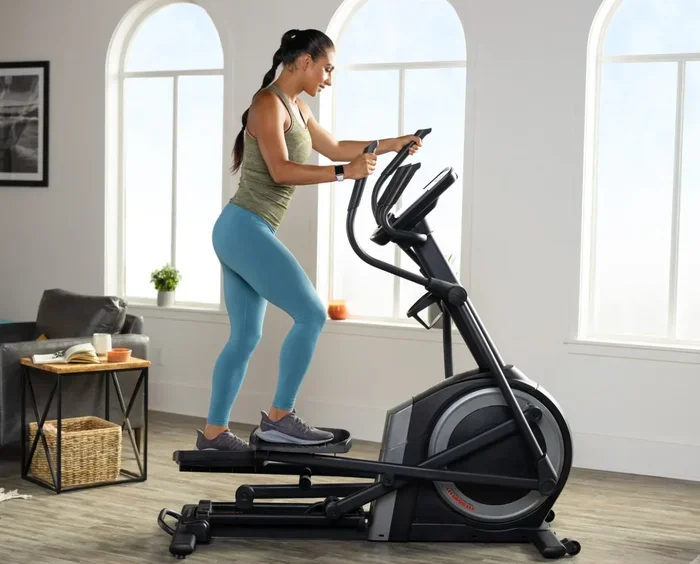
Many people underestimate how much the upper body works on an elliptical. The moving handlebars are not just for balance. They actively engage your arm and shoulder muscles. This is what sets the elliptical apart from machines like treadmills.
- Biceps: These muscles on the front of your upper arm contract every time you pull the handlebars toward you. The pulling motion keeps them engaged throughout the session.
- Triceps: Located on the back of your arm, your triceps push the handlebars forward. They work in opposition to the biceps, creating a balanced arm workout.
- Shoulder Muscles: Your deltoids stabilize and control the pushing and pulling motion. They keep your arms moving in a smooth, controlled path.
- Upper Back: Muscles like the rhomboids and trapezius retract your shoulder blades as you pull the handles. This helps improve posture over time.
- Chest Muscles: Your pectorals assist during the pushing phase. While not the primary movers, they still get meaningful activation.
The beauty of this upper body activation is that it happens without you having to do anything extra. Simply holding and pushing the handlebars recruits these muscles. If you want to increase the intensity, try pushing and pulling with more force. You can also learn more about maximizing your session in our article on what makes a good elliptical workout.
Core Muscles
Your core is the unsung hero of every elliptical session. It does not get the spotlight, but without it, you would not be able to stand upright. The core muscles work as stabilizers during the entire workout.
- Abdominals: Your rectus abdominis and obliques keep your torso stable as your legs and arms move independently. They prevent you from swaying or slouching.
- Lower Back: The erector spinae muscles support your spine and keep you from rounding forward. They work constantly to maintain proper posture.
- Deep Stabilizers: Muscles like the transverse abdominis act like a natural corset, holding everything together from the inside.
A strong core makes your elliptical sessions more efficient. It also reduces the risk of lower back pain. If you are curious about how the elliptical benefits your overall body composition, our piece on what the elliptical does for your body offers great insights.
How the Elliptical Creates a Full-Body Workout
What makes the elliptical so effective is that it combines aerobic exercise with resistance training elements. Your heart rate stays elevated for cardiovascular health, while the muscle engagement builds strength and endurance simultaneously. This is the definition of a full-body workout.
Unlike a stationary bike that mostly works your legs, the elliptical involves your arms, core, and back. The coordinated movement pattern means no muscle group sits idle. Here is a quick look at how muscle engagement compares across popular cardio machines:
- Treadmill: Primarily lower body. Upper body engagement is minimal unless you use the armrails lightly.
- Stationary Bike: Almost entirely lower body. Core and upper body involvement is very low.
- Rowing Machine: Full-body engagement similar to the elliptical, but with more emphasis on the back and arms.
- Elliptical: Balanced full-body activation across legs, arms, and core with a smooth, low-impact motion.
This balanced engagement is why so many people choose the elliptical as their go-to toning exercise machine. It simply does more in less time.
Lower Body vs. Upper Body: Which Muscles Work Harder?
In truth, your lower body muscles carry the heaviest load on an elliptical. The legs generate the majority of the force that moves the pedals. However, the upper body is far from passive. The handlebars add a meaningful training stimulus to your arms and shoulders.
Here is a closer look at the effort distribution:
- Lower Body: Approximately 60-70% of the total muscle activation comes from your legs, glutes, and calves. These muscles are responsible for the main pedaling motion.
- Upper Body: Roughly 20-30% of activation occurs in your arms, shoulders, and upper back. This increases when you actively push and pull the handlebars.
- Core: The remaining 10-15% is dedicated to core stabilization. It may seem small, but it is essential for safe and effective movement.
You can shift this balance by changing your technique. For example, standing up straight and leaning slightly forward engages your glutes and hamstrings more. Leaning back targets the quads. You can also try resistance training by increasing the machine’s resistance settings to make every muscle work harder.
How to Maximize Muscle Engagement on the Elliptical
Knowing which muscles are used is only half the battle. You also need to train them effectively. Here are some practical tips to get the most out of every session.
Adjust the Resistance Level
Low resistance means less muscle activation. Cranking up the resistance forces your legs and arms to work harder against the machine. It also boosts your heart rate for a better cardiovascular workout. Start at a moderate level and increase gradually over weeks.
Use the Handlebars Actively
Do not just rest your hands on the handles. Push and pull them with intention. This adds real muscle engagement to your upper body. Think of it as doing a pushing and pulling motion with every stride.
Focus on Posture
Stand tall with your shoulders back and your core tight. Avoid leaning heavily on the handles. Good posture ensures that your core muscles stay engaged and your lower body muscles do the work they are supposed to do.
Try Interval Training
Alternate between high resistance and low resistance periods. This style of aerobic exercise spikes your muscle activation and keeps your workout interesting. It also burns more calories in less time. For tips on calorie burn, see our article on calorie burn on the elliptical.
Vary Your Stride
Changing the length and speed of your stride targets different muscle groups. Shorter strides emphasize your calves and hip flexors. Longer strides engage your glutes and hamstrings more deeply.
Benefits of Training Multiple Muscle Groups
Training several muscle groups at once offers advantages that go beyond just getting stronger. Here is why the elliptical approach to muscle engagement is so effective.
- Higher Calorie Burn: More muscles working means more energy used. The elliptical is a fantastic tool for weight management.
- Better Coordination: Coordinating your arms and legs together improves your overall motor skills and balance.
- Time Efficiency: You get a cardiovascular and strength stimulus in one session. There is no need to split your workout into separate segments.
- Joint-Friendly Workout: The smooth, gliding motion protects your knees and ankles. Unlike running, the elliptical does not pound your joints. This makes it ideal for people who need a joint-friendly workout.
- Improved Posture: Engaging your upper back and core helps you stand taller and stronger over time.
These benefits explain why the elliptical is a favorite among beginners, older adults, and serious athletes alike. It delivers results without the wear and tear that high-impact activities can cause. The low-impact nature means you can train more frequently and recover faster.
Common Mistakes That Reduce Muscle Activation
Even the best machine will not work properly if your form is off. Here are mistakes that silently reduce the effectiveness of your workout.
- Leaning on the Handles: This takes the load off your legs and core. Light contact is fine for balance, but do not lean your full weight on the handles.
- Skipping the Warm-Up: Cold muscles are less responsive. Spend five minutes at a low resistance level to get your blood flowing before increasing intensity.
- Ignoring the Upper Body: If you only focus on your legs, you miss out on arm, shoulder, and back engagement. Push and pull the handles throughout.
- Staying at One Resistance Level: Your muscles adapt quickly. If you never change the resistance, your progress will plateau. Challenge yourself regularly.
- Rushing Through Strides: Fast pedaling with poor form leads to less muscle activation. Slow down and focus on controlled, deliberate movements.
Avoiding these mistakes will immediately improve the quality of your sessions. You will feel the difference in your muscles the very next day.
Expert Insights on Elliptical Training
Fitness professionals often recommend the elliptical for its unique combination of benefits. Dr. Sarah Lin, a sports medicine specialist, notes that “the elliptical provides a remarkably balanced workout because it naturally coordinates upper and lower body movement. Most people do not realize how much their core is working until they focus on it.”
Certified personal trainer Mark Rivera adds, “I always tell my clients to treat the handlebars as a tool, not a handrail. Active pushing and pulling doubles the upper body benefit. It also forces your core to stabilize, which is where a lot of the hidden strength gains come from.”
These expert opinions reinforce what the science shows. The elliptical is not just a cardio machine. It is a comprehensive tool for building functional strength across every major muscle group. Whether you are training for general fitness or preparing for a specific sport, the elliptical delivers a full-body workout that few other machines can match.
How Long Should You Work Out on an Elliptical?
The ideal session length depends on your goals. For general health, aim for at least 150 minutes of moderate-intensity aerobic exercise per week. That works out to about 30 minutes a day, five days a week. For weight loss or endurance building, you can extend your sessions to 45 or 60 minutes.
For more guidance on session length, check out our detailed breakdown on how long to workout on an elliptical. The key is consistency. A regular routine, even if moderate, produces better long-term results than occasional intense sessions.
Conclusion
So, what muscles are used on an elliptical machine? The answer is nearly all of them. Your quadriceps, hamstrings, glutes, and calves power every stride. Your biceps, triceps, shoulders, and upper back engage through the handlebars. Your core holds everything together. It is one of the most complete workout tools you can use.
The elliptical machine offers a joint-friendly workout that builds cardiovascular health, strengthens muscles, and burns calories. By adjusting resistance, using proper form, and actively engaging your upper body, you can turn every session into a powerful full-body workout. Now that you know which muscles are at work, you have the knowledge to train smarter, not harder.
Step onto that elliptical with purpose. Push those pedals. Pull those handles. And feel every muscle getting stronger with each stride.
Frequently Asked Questions
What are the main muscles used on an elliptical machine?
The primary muscles include your quadriceps, hamstrings, glutes, calves, hip flexors, biceps, triceps, shoulders, and core. The elliptical is a true full-body machine that activates both lower and upper body groups simultaneously.
Does the elliptical work your abs?
Yes, your abdominal muscles are actively engaged as stabilizers during every session. They keep your torso upright and prevent swaying. While they are not the primary movers, consistent core activation helps tone and strengthen your abs over time.
Is the elliptical better than running for muscle building?
The elliptical offers broader muscle engagement because it involves your arms and core alongside your legs. Running primarily targets lower body muscles and has less upper body involvement. However, running may build more raw leg strength. The elliptical is better for a balanced, low-impact full-body workout.
How can I increase muscle activation on the elliptical?
Increase the resistance level, actively push and pull the handlebars, maintain good posture, and try interval training. Standing tall and engaging your core forces more muscles to participate. Avoid leaning on the handles, as this reduces the workload on your legs and core.
Are the muscles used on an elliptical different from a rowing machine?
There is significant overlap, but the emphasis differs. The elliptical focuses more on the lower body with coordinated arm movement. A rowing machine places greater emphasis on the back, lats, and posterior chain. Both are excellent for full-body training, but the movement patterns and muscle recruitment ratios vary.
Can you build noticeable muscle tone from using an elliptical?
Yes, especially when combined with proper nutrition and consistent training. The elliptical promotes muscle endurance and toning across multiple groups. While it may not build bulk like heavy resistance training, it creates lean, defined muscle tone over time, particularly in your legs, arms, and core.