Barbell rows and T‑bar rows both build a strong back, but they aren’t the same exercise. While they share a pulling motion, the equipment, body position, and muscle emphasis differ enough to affect strength, size, and safety. Choose the right row for your program based on your goals, mobility, and gym setup.
Key Takeaways
- Equipment differs: Barbell rows use a straight barbell; T‑bar rows use a pivoting handle attached to a landmine or dedicated machine.
- Body angle matters: Barbell rows can be performed bent over or pendlay style, while T‑bar rows keep the torso more upright.
- Muscle focus varies: Barbell rows hit the lower lats and erector spinae harder; T‑bar rows emphasize the middle back and rear delts.
- Load capacity: Barbell rows typically allow heavier loads, but T‑bar rows provide a safer, more stable platform for beginners.
- Joint stress: T‑bar rows reduce lower‑back strain, making them joint‑friendlier for those with mobility limits.
- Training goals decide: Pick barbell rows for raw strength and power; pick T‑bar rows for hypertrophy and form control.
- Both can coexist: Alternating them in a program gives balanced back development and prevents plateaus.
📑 Table of Contents
- Introduction: Why the Row Debate Matters
- 1. The Basics: What Is a Barbell Row?
- 2. The Basics: What Is a T‑Bar Row?
- 3. Comparing the Mechanics
- 4. Which Exercise Is Best for Your Goals?
- 5. Programming Both Rows Effectively
- 6. Practical Tips for Perfect Form
- Conclusion: Both Rows Have a Place in a Balanced Back Routine
Introduction: Why the Row Debate Matters
When you walk into a gym and see two people pulling a bar toward their chest, you might think they’re doing the same thing. In reality, the barbell row and the T‑bar row are distinct moves with unique mechanics, benefits, and drawbacks. Understanding these nuances helps you build a stronger, healthier back and avoid unnecessary injury.
In this article we’ll break down each exercise, compare the muscles they hit, discuss who should use which, and give you practical tips to add both to your routine. By the end you’ll know exactly when to grab a straight bar and when to step up to the T‑bar station.
1. The Basics: What Is a Barbell Row?
Equipment and Setup
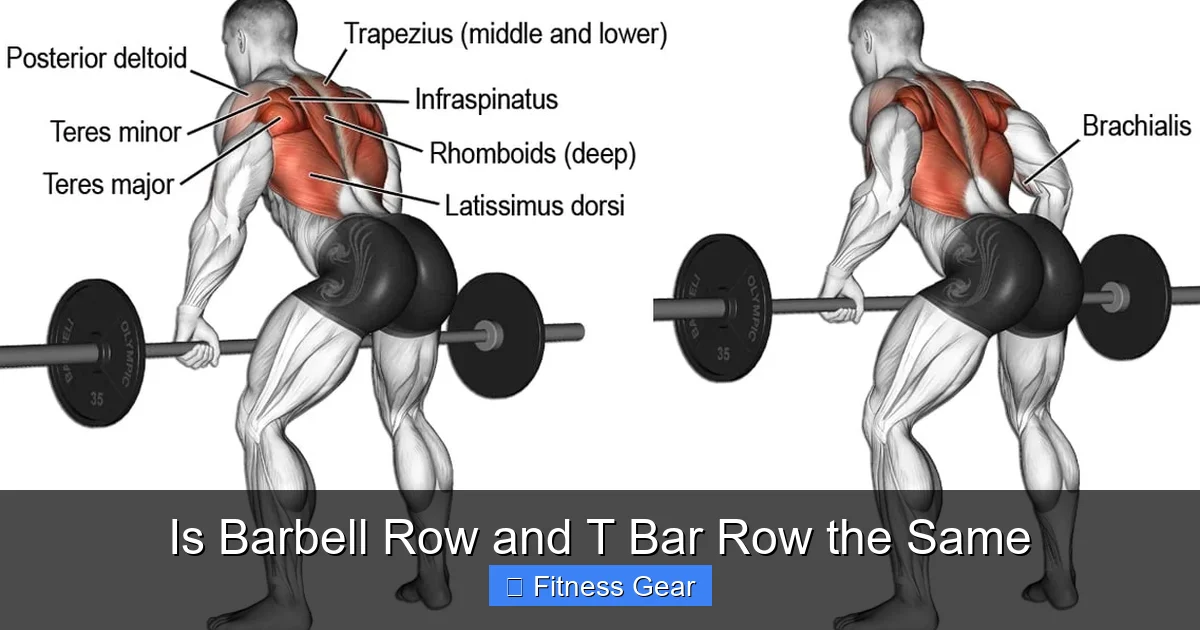
The classic barbell row requires a standard Olympic bar, weight plates, and a flat floor. You can perform it with a pronated (overhand) grip, a supinated (underhand) grip, or a mixed grip. The bar sits on the floor, and you pull it toward your lower ribcage while keeping your torso hinged.
Visual guide about Is Barbell Row and T Bar Row the Same
Image source: fitnessvolt.com
How It Works
Start with the bar on the ground. Bend at the hips until your torso is roughly 45‑60 degrees from vertical. Keep your back flat, shoulders retracted, and core braced. Pull the bar to your torso, pause, then lower it with control.
Primary Muscles Engaged
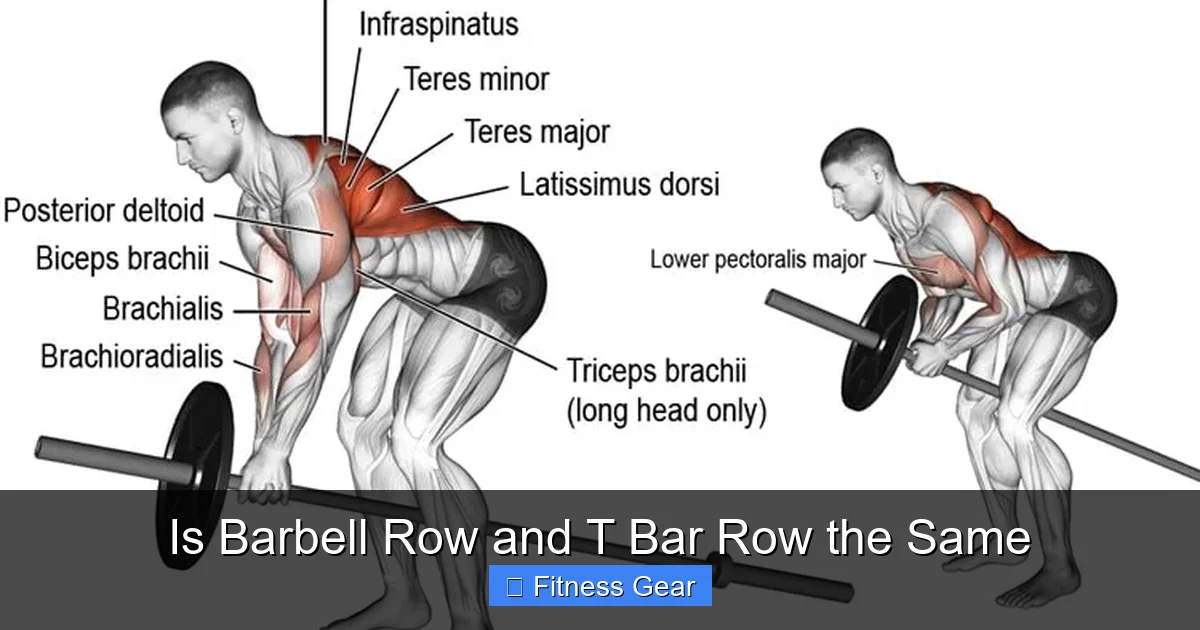
- Latissimus dorsi (lower lats): The main pulling muscle.
- Erector spinae: Works to stabilize the spine.
- Rhomboids and middle traps: Retract the scapulae.
- Biceps and forearms: Assist the pulling motion.
Variations
- Pendlay Row: Starts each rep from the floor, emphasizing explosiveness.
- Yates Row: Slightly more upright torso, underhand grip for biceps focus.
- Chest‑Supported Row: Uses an incline bench to reduce lower‑back stress.
2. The Basics: What Is a T‑Bar Row?
Equipment and Setup
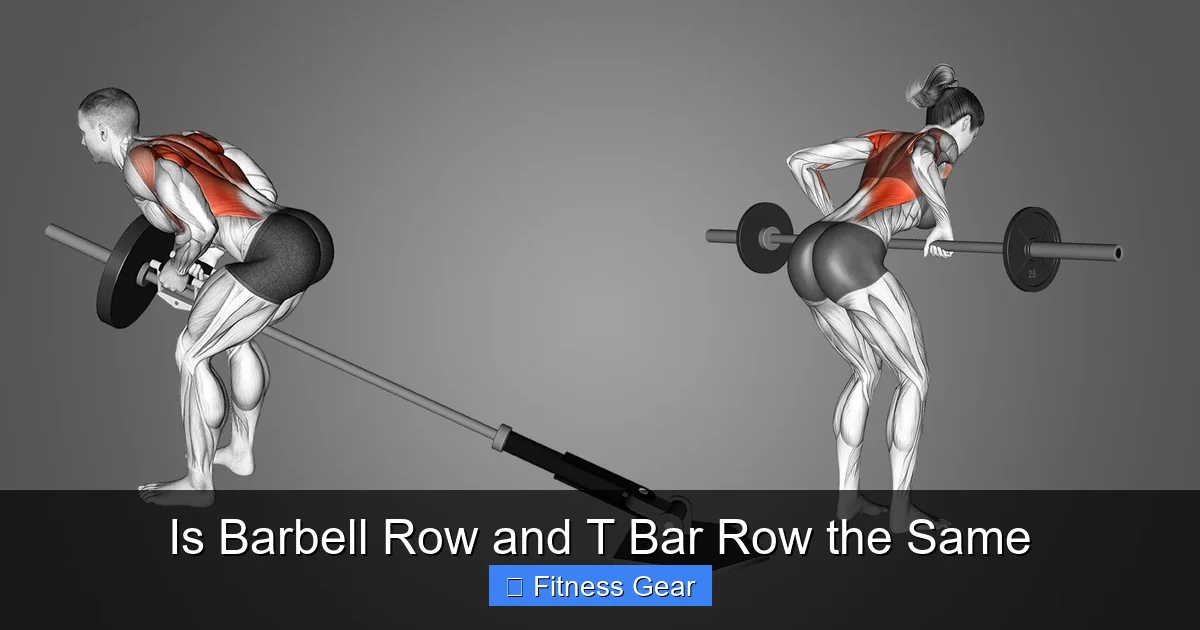
A T‑bar row uses a landmine attachment or a dedicated T‑bar machine. The bar is anchored at one end, creating a pivot point. You load plates onto the free end, grip the handle (or a V‑grip), and pull toward your chest.
Visual guide about Is Barbell Row and T Bar Row the Same
Image source: inspireusafoundation.org
How It Works
Stand over the bar, feet shoulder‑width apart. Hinge at the hips just enough to keep a neutral spine, then grasp the handle. Pull the weight toward your sternum, squeezing the shoulder blades together, then lower it slowly.
Primary Muscles Engaged
- Middle traps and rhomboids: Primary drivers of the movement.
- Latissimus dorsi (mid‑lats): Contribute heavily.
- Posterior deltoids: Assist in shoulder extension.
- Biceps: Secondary pulling aid.
Variations
- Neutral Grip T‑Bar: Uses a close‑grip handle for more biceps activation.
- Wide Grip T‑Bar: Emphasizes the upper back and rear delts.
- Single‑Arm T‑Bar: Allows unilateral work and addresses imbalances.
3. Comparing the Mechanics
Body Position and Range of Motion
Barbell rows typically involve a steeper torso angle, which places more demand on the lower back and allows a longer range of motion. T‑bar rows keep the torso more upright, shortening the pull and reducing spinal shear forces.
Visual guide about Is Barbell Row and T Bar Row the Same
Image source: fitnessvolt.com
Grip and Wrist Stress
Because the barbell is a straight bar, wrist strain can be an issue, especially with heavy loads. The T‑bar’s built‑in handles often provide a more natural wrist position, making it easier on the joints.
Load Capacity
Most lifters can load more weight on a barbell row due to the stability of a free‑standing bar and the ability to use both hands independently. The T‑bar’s pivot point limits the maximum safe load, but many gyms have heavy‑duty landmine setups that can still handle substantial weight.
4. Which Exercise Is Best for Your Goals?
Strength and Power Development
If your primary aim is to increase raw pulling strength, the barbell row is the go‑to. It recruits more stabilizer muscles and lets you handle heavier loads, translating well to deadlifts and other compound lifts.
Hypertrophy and Muscle Symmetry
For those chasing a fuller, more balanced back, the T‑bar row shines. Its upright position isolates the middle back, allowing you to focus on the rhomboids and traps without over‑taxing the lower back.
Injury Prevention and Mobility Limits
People with limited hip hinge mobility or lower‑back concerns often find the T‑bar row safer. The reduced forward lean and fixed pivot lower the risk of lumbar strain.
Beginner vs. Advanced Lifters
Beginners benefit from the T‑bar’s guided path, which teaches proper scapular retraction without the need for perfect hip hinge technique. Advanced lifters can use barbell rows to fine‑tune their pulling mechanics and overload the posterior chain.
5. Programming Both Rows Effectively
Weekly Split Example
Here’s a simple 4‑day split that incorporates both movements:
- Day 1 – Upper Body Pull: Barbell Row 4×6, Pull‑Ups 3×8, Face Pulls 3×12.
- Day 2 – Lower Body: Squat, Romanian Deadlift, Lunges.
- Day 3 – Upper Body Pull (Variation): T‑Bar Row 4×10, Seated Cable Row 3×12, Rear‑Deltoid Fly 3×15.
- Day 4 – Push Focus: Bench Press, Overhead Press, Triceps Extensions.
Progression Tips
- Increase weight by 2.5–5 lb each session while maintaining strict form.
- Swap grip styles every 4‑6 weeks to hit the lats from different angles.
- Use tempo training (e.g., 3‑second eccentric) on T‑bars for extra time‑under‑tension.
Common Mistakes to Avoid
- Barbell Row: Rounding the back, jerking the bar, using momentum.
- T‑Bar Row: Over‑leaning, letting the shoulders roll forward, using a too‑wide grip that reduces lat activation.
6. Practical Tips for Perfect Form
Barbell Row Form Checklist
- Feet shoulder‑width, knees slightly bent.
- Hinge at hips, keep spine neutral.
- Chest up, shoulder blades pulled together.
- Pull the bar to the lower ribcage, not the neck.
- Control the descent; avoid letting the bar drop.
T‑Bar Row Form Checklist
- Stand with the bar centered under your hips.
- Maintain a slight hip hinge, but keep torso upright.
- Grip the handle firmly, elbows close to the body.
- Drive elbows backward, squeezing shoulder blades.
- Pause briefly at the top, then lower with a smooth tempo.
Conclusion: Both Rows Have a Place in a Balanced Back Routine
Barbell rows and T‑bar rows are not the same, but they complement each other beautifully. The barbell row builds raw strength, stabilizer power, and lower‑back resilience, while the T‑bar row offers safer, more focused hypertrophy for the middle back. By understanding the differences and applying the tips above, you can choose the right row for your day, avoid common injuries, and keep your back growing stronger.
Remember, the best workout is the one you can perform consistently with good form. Mix, match, and listen to your body—your back will thank you.
Frequently Asked Questions
Are barbell rows better than T‑bar rows for building a thick back?
Barbell rows allow heavier loads and engage the lower back, making them great for overall thickness. T‑bars target the middle back more directly, which helps create width and definition. Using both gives the most balanced development.
Can I replace barbell rows with T‑bar rows if I have lower‑back pain?
Yes. The T‑bar’s more upright position reduces lumbar strain, making it a safer alternative for those with lower‑back discomfort.
Do I need a special grip for T‑bar rows?
Most T‑bar stations include a V‑grip handle that fits naturally in the hand. If you prefer a neutral grip, many rigs allow you to attach a close‑grip handle or a rope.
How many sets and reps should I do for each row?
For strength, aim for 4–5 sets of 4–6 reps on barbell rows. For hypertrophy, 3–4 sets of 8–12 reps on T‑bars work well. Adjust based on your training phase.
Is a pendlay row a type of barbell row?
Yes. The pendlay row is a strict variation of the barbell row where each rep starts from the floor, emphasizing explosiveness and reducing momentum.
Can I use the same weight for both exercises?
Usually not. Barbell rows typically allow you to lift heavier due to the free‑standing bar, while T‑bars often feel lighter because of the fixed pivot and shorter range of motion.