How Much Walking on a Treadmill to Lose Weight

Losing weight with a treadmill is about consistency and calorie deficit, not just time. Aim for 150-300 minutes of moderate-intensity walking weekly, combined with a healthy diet. Boost results with incline intervals and tracking your progress. It’s a sustainable, low-impact strategy for long-term success.
Key Takeaways
- Consistency Over Intensity: Regular, moderate walking (150-300 mins/week) creates a sustainable calorie deficit for fat loss.
- The Calorie Deficit is King: Weight loss requires burning more calories than you consume; treadmill walking is a tool to increase burn.
- Incline is Your Secret Weapon: Adding incline dramatically increases calorie burn and builds leg muscle, boosting metabolism.
- Progressive Overload Applies: Gradually increase duration, speed, or incline to keep challenging your body and avoid plateaus.
- Diet is Non-Negotiable: You cannot out-walk a poor diet; nutrition controls the majority of your calorie balance.
- Non-Scale Victories Matter: Focus on endurance, inches lost, energy levels, and sleep quality alongside the scale.
- Listen to Your Body: Balance walking with rest, strength training, and recovery to prevent injury and burnout.
📑 Table of Contents
- The Science of Walking and Weight Loss: It’s All About the Deficit
- Designing Your Treadmill Walking Routine for Maximum Fat Loss
- Maximizing Calorie Burn: Beyond Just Time and Speed
- Nutrition: The Other Half of the Weight Loss Equation
- Common Mistakes That Sabotage Treadmill Weight Loss
- Making It Sustainable: From Routine to Lifestyle
- Conclusion: Your Personalized Treadmill Walking prescription
The Science of Walking and Weight Loss: It’s All About the Deficit
Let’s cut through the noise right away. Losing weight on a treadmill—or through any exercise—is not a mysterious magic trick. It’s simple physics and biology: you must create a calorie deficit. This means you consume fewer calories through food and drink than your body burns through all its daily activities, including your treadmill walks. Walking is a fantastic, low-impact way to increase that “burn” side of the equation. But how much walking actually moves the needle?
The answer isn’t a single number. It depends on your starting weight, your walking pace, the incline, your diet, and your overall daily activity. A general, evidence-based guideline from health organizations like the CDC and American Heart Association recommends at least 150 minutes of moderate-intensity aerobic activity per week for general health. For significant weight loss, that number often doubles to 300 minutes or more per week. That breaks down to about 30-60 minutes a day, 5-7 days a week. But “moderate-intensity” is the key phrase here.
What Does “Moderate-Intensity” Actually Mean?
Moderate-intensity means your heart rate is elevated, you’re breathing harder but can still hold a conversation (the “talk test”), and you’re breaking a light sweat. On a treadmill, this typically correlates to a speed of 2.5 to 3.5 miles per hour (4.0 to 5.6 km/h) for many beginners, but this is highly individual. A more precise measure is your Metabolic Equivalent of Task (MET). Walking at 3.0 mph is about 3.3 METs. The higher the MET, the more calories you burn per minute.
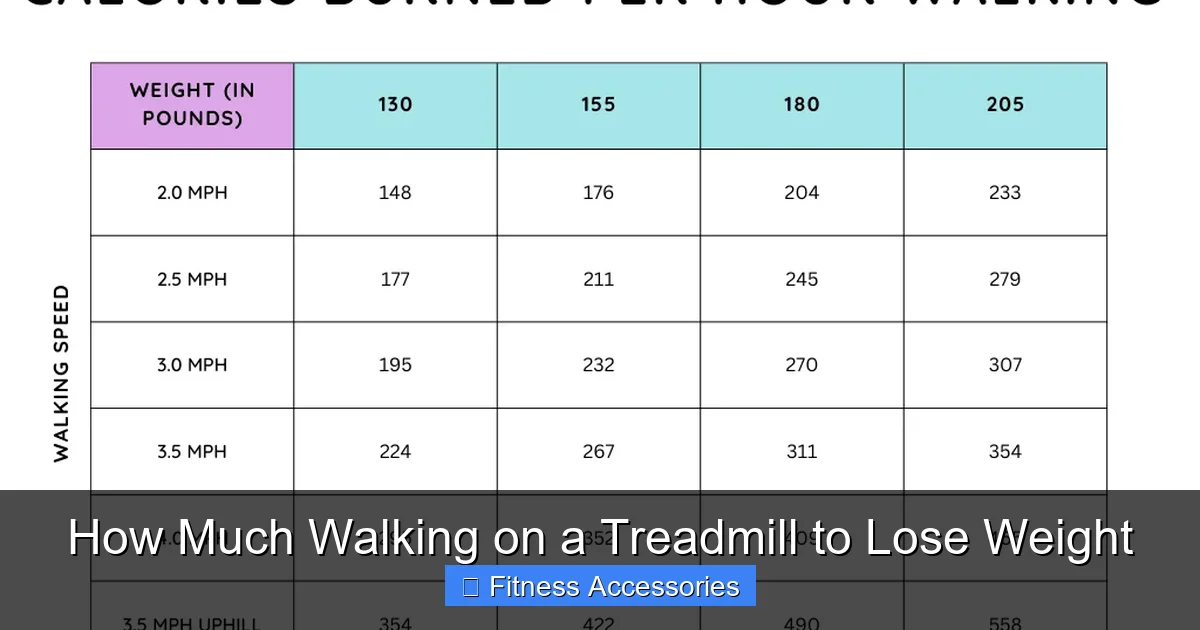
To lose one pound of fat, you need a total deficit of approximately 3,500 calories. You can create this deficit through diet, exercise, or a combination of both. Let’s use a practical example. A person weighing 155 pounds (70 kg) walking at a moderate 3.5 mph on a flat surface burns roughly 149 calories per 30 minutes. If they do this 5 times a week, that’s about 745 calories burned from walking alone. To lose one pound purely from this walking, they would need to maintain this for over 4.5 weeks without changing their diet. This illustrates why diet is the other critical half of the weight loss equation. The treadmill is your powerful ally, not your sole solution.
Designing Your Treadmill Walking Routine for Maximum Fat Loss
So you’ve committed to walking. Now, how do you structure it? A monotonous, slow stroll is better than nothing, but it won’t optimize your results. Think of your treadmill time as a workout with a purpose. The most effective routines mix different types of sessions to challenge your body, prevent boredom, and maximize calorie burn.

Visual guide about How Much Walking on a Treadmill to Lose Weight
Image source: gym-pact.com
The Foundation: Steady-State Endurance Walks
These are your bread and butter. Steady-state walks are performed at a consistent, moderate pace for a longer duration (30-60 minutes). Their primary benefit is building aerobic endurance, burning a good number of calories during the session, and being relatively easy to recover from. This is perfect for your longer, daily walks. Example: Start with a 5-minute warm-up walk at 2.5 mph. Increase to 3.2 mph and maintain that pace for 35 minutes. Finish with a 5-minute cool-down. Aim to have 2-3 of these sessions per week.
The Booster: High-Intensity Interval Training (HIIT) Walks
If you’re short on time or want to spike your metabolism, HIIT is your go-to. It involves short bursts of high-intensity effort (a brisk walk or light jog) followed by periods of active recovery (a slower walk). The magic of HIIT is the afterburn effect (Excess Post-exercise Oxygen Consumption or EPOC), where your body continues to burn extra calories for hours after the workout as it recovers. Example: 5-min warm-up. Then repeat 8 times: 1 minute at a very fast walk or slow jog (4.0-4.5 mph), followed by 2 minutes of recovery walking (2.8-3.0 mph). Finish with a 5-min cool-down. This entire session might only take 25-30 minutes but delivers a massive metabolic punch. Do 1-2 of these per week, not on consecutive days.
The Game-Changer: Incline Walking
This is the single biggest modification you can make to your treadmill walking to burn more calories and build muscle. Walking uphill engages your glutes, hamstrings, and calves far more than flat walking. It significantly increases the workout’s intensity without the joint impact of running. A 5% incline can increase your calorie burn by 30-50% compared to a 1% incline at the same speed. Example: For your steady-state day, set the incline to 2-3%. Maintain your pace. You’ll feel the difference immediately. For a dedicated incline session, try a “pyramid”: Start at 1% incline for 5 mins, then increase by 1% every 2 minutes until you reach 6-8%, then work your way back down.
Maximizing Calorie Burn: Beyond Just Time and Speed
You now have your workout framework. To truly maximize fat loss, you need to dial in the details. These are the lever switches you can pull on the treadmill console to make every minute more effective.
Visual guide about How Much Walking on a Treadmill to Lose Weight
Image source: images.squarespace-cdn.com
The Incline Imperative
We touched on it, but it bears repeating. Incline is your most powerful tool. A common myth is that treadmill incline is “harder” than real hill walking. In reality, it’s often more consistent and measurable. For every 1% increase in incline, you increase the work your legs do. Don’t be afraid of hills! Start with a modest 1.5-2% and get comfortable. As you get stronger, push it higher. A 30-minute walk at 3.0 mph with a 4% incline can burn as many calories as a 30-minute run at 5.0 mph on a flat surface, with far less impact on your knees and hips.
Mind Your Posture and Arm Drive
Slouching and holding the handrails is a calorie-burning sin. It reduces the work your core and legs have to do. Stand tall, engage your core, look forward (not down at your feet), and let your arms swing naturally at your sides. A strong arm drive helps propel you forward and increases your heart rate. If you need the handrails for balance, use them lightly with your fingertips, not a death grip. This small adjustment can increase your energy expenditure by 5-10%.
Track Everything: Data is Your Friend
Modern treadmills and fitness watches provide a wealth of data: distance, time, calories (estimated), heart rate, and pace. Use it. The most accurate metric for intensity is heart rate. Aim to spend most of your moderate workout in the 60-70% of your maximum heart rate zone (a rough estimate for max HR is 220 minus your age). This ensures you’re working hard enough. Tracking your weekly total time and distance also provides objective proof of your progress, which is incredibly motivating.
Nutrition: The Other Half of the Weight Loss Equation
Here is the brutal, beautiful truth: you can walk on a treadmill for an hour a day and still not lose weight if your diet is off. Exercise creates the opportunity for a deficit, but diet creates the deficit itself. You cannot out-exercise a diet high in processed foods, sugary drinks, and oversized portions. Walking will make you hungrier, which is a natural physiological response. If you reward that hunger with junk food, you’ll easily erase the 200-300 calories you just burned.
Prioritize Protein and Fiber
When you’re in a calorie deficit, preserving muscle is crucial. Muscle is metabolically active tissue that burns calories at rest. Ensure you’re eating enough lean protein (chicken, fish, tofu, legumes, Greek yogurt) to support muscle repair and satiety. Pair protein with high-fiber foods like vegetables, fruits, and whole grains. Fiber slows digestion, keeps you full longer, and stabilizes blood sugar, preventing energy crashes and cravings that derail your diet.
Hydration and Liquid Calories
Often, we mistake thirst for hunger. Drink plenty of water throughout the day, especially before and after your walk. More importantly, eliminate liquid calories. A single 16-oz sugary coffee or soda can contain 200+ calories. That’s the equivalent of a 30-minute walk burned in a sip. Switch to black coffee, tea, or infused water. This is one of the easiest and most impactful changes you can make.
Mindful Eating, Not Just Calorie Counting
While calorie awareness is important, don’t get obsessively caught up in numbers. Focus on food quality. Eat whole, single-ingredient foods 80% of the time. Cook at home more often. Eat slowly and without distraction. These habits naturally lead to better food choices and appropriate portion sizes, creating a sustainable calorie deficit without feeling deprived. Your treadmill walking gives you metabolic flexibility; good nutrition makes that flexibility work for fat loss.
Common Mistakes That Sabotage Treadmill Weight Loss
Even with the best intentions, people often sabotage their treadmill weight loss efforts. Recognizing these pitfalls is half the battle.
Relying Solely on the Treadmill’s Calorie Readout
Treadmill calorie counters are notoriously inaccurate. They are based on generic formulas and often overestimate burn, especially if you’re holding the rails. Use the number as a relative measure (e.g., “I burned more today than last week”), not an absolute truth. A heart rate monitor or fitness tracker will give a more personalized estimate. More importantly, don’t use that number as a license to eat more; it’s likely inflated.
Doing the Same Walk, Every Single Day
Your body is an adaptation machine. If you do the exact same 30-minute walk at 3.0 mph, flat, five days a week, your body will adapt. It will become more efficient, burning fewer calories for the same output over time. This leads to a plateau. Solution: Have a mix of steady-state, HIIT, and incline days. Each week, try to add a tiny bit more time, a slight bump in speed, or an extra 0.5% incline. This principle of progressive overload keeps your body challenged and burning.
Neglecting Strength Training and Recovery
Walking is cardio. Cardio burns calories during the activity. Strength training builds muscle, which burns calories 24/7. A body with more muscle has a higher resting metabolic rate. If you only walk, you risk losing muscle along with fat, which slows your metabolism over time. Incorporate 2 full-body strength sessions per week (bodyweight squats, lunges, push-ups, resistance bands). Also, don’t walk at a high intensity every day. Your body needs rest days to recover, repair, and come back stronger. Overtraining leads to fatigue, injury, and burnout.
Making It Sustainable: From Routine to Lifestyle
The goal isn’t just to lose weight; it’s to keep it off. The biggest predictor of long-term weight loss success is sustainability. A torturous routine you hate will be abandoned. The key is to build a walking habit you enjoy and can maintain for life.
Find Your “Why” and Make it Enjoyable
Connect your walking to something deeper than the scale. Is it for more energy to play with your kids? To feel strong and confident? To clear your mind after a stressful day? Hold onto that “why.” Then, make the experience pleasant. Create a killer playlist, podcast, or audiobook that you only listen to while walking. Invest in good walking shoes and comfortable clothes. If you have a home treadmill, set it up in front of a window with a view, or use a tablet to watch a show. Transform the treadmill from a punishment device into your private sanctuary for movement and mental reset.
Listen to Your Body and Be Flexible
Some days you’ll feel like a champion and crush your HIIT workout. Other days, you’ll feel drained, and a 20-minute slow walk with a high incline is all you can manage. That’s okay! The habit is showing up. A 20-minute walk is infinitely better than a zero-minute walk. If you’re sore, take an extra rest day or do a gentle walk. Flexibility prevents the “all-or-nothing” mindset that leads to quitting. Life happens. Your walking routine should serve your life, not stress it.
Celebrate Non-Scale Victories (NSVs)
The scale lies. It doesn’t account for muscle gain, water retention, or hormonal fluctuations. If you only focus on the number, you’ll miss the real signs of progress. Celebrate your Non-Scale Victories: walking further without stopping, climbing stairs without getting winded, your clothes fitting looser, better sleep, improved mood, and the pride of sticking to your routine for a month. These are the true markers of a healthier, more capable you. The weight loss will follow as a natural consequence of your new, active lifestyle.
Conclusion: Your Personalized Treadmill Walking prescription
So, how much walking on a treadmill to lose weight? Start with the public health goal of 150 minutes of moderate-intensity activity per week. Use that as your baseline. Then, listen to your body and progressively challenge yourself. Aim to build toward 300 minutes or more by combining different workout types: the steady endurance walks, the intense HIIT sessions, and the muscle-building incline climbs. But remember, this number is a moving target. A 200-pound person will burn more calories walking for 30 minutes than a 130-pound person doing the exact same walk. Your “enough” is unique to you.
The most successful approach is a triad of consistency, challenge, and nutrition. Be consistent by showing up most days. Challenge your body by changing up speed, incline, and intervals. And support it all with a diet focused on whole foods, protein, and hydration. Don’t get bogged down in the minutiae of daily calorie math. Focus on the habit. Put on your shoes, step on the belt, and walk. Do it again tomorrow. Over weeks and months, the cumulative effect of thousands of steps, thousands of extra calories burned, and thousands of better food choices will transform your body and your health. The treadmill isn’t a magic machine; it’s a simple, reliable tool. And you, with a plan and patience, are the one who makes it work.
Frequently Asked Questions
How long should I walk on a treadmill each day to see weight loss results?
For noticeable weight loss, aim for 30-60 minutes per day, most days of the week. Start with 20-30 minutes if you’re new and build up. Consistency with total weekly time (150-300+ minutes) is more important than one heroic daily session.
Is it better to walk faster or with more incline for weight loss?
Incline is generally more effective. Walking uphill burns significantly more calories per minute than walking faster on a flat surface, builds more muscle, and is lower impact. A combination is best: use incline for your main walks and speed for short HIIT intervals.
Can I lose weight by walking on a treadmill without changing my diet?
You may see very slow initial results, but significant weight loss is extremely difficult with exercise alone. Diet controls the calorie deficit. Creating a moderate calorie deficit through both improved nutrition and treadmill walking is the fastest, most sustainable approach.
How many days a week should I walk on the treadmill?
Aim for 4-6 days per week. This allows for 1-3 days of rest or active recovery (like gentle stretching). Mix in your workout types: 2-3 steady-state days, 1-2 HIIT/incline days, and ensure you have at least one full rest day.
Why am I not losing weight even though I walk on the treadmill every day?
>Common reasons include: 1) Overestimating burn / underestimating intake (the treadmill calorie counter is often high; diet may be the issue). 2) Doing the same routine (your body adapted). 3) Holding the handrails (reduces effort and burn). 4) Not getting enough sleep or high stress levels, which affect hormones and appetite.
Should I walk on an empty stomach in the morning for better fat loss?
This is debated. Some fasted cardio studies show a slight increase in fat *oxidation* during the session, but the total daily fat burn is likely equal. The most important factor is total daily calorie deficit. If fasted walking helps you stick to your routine and diet, do it. If it makes you ravenous and leads to overeating later, eat a small, protein-rich snack first.