
Can You Use an Hsa to Buy a Treadmill
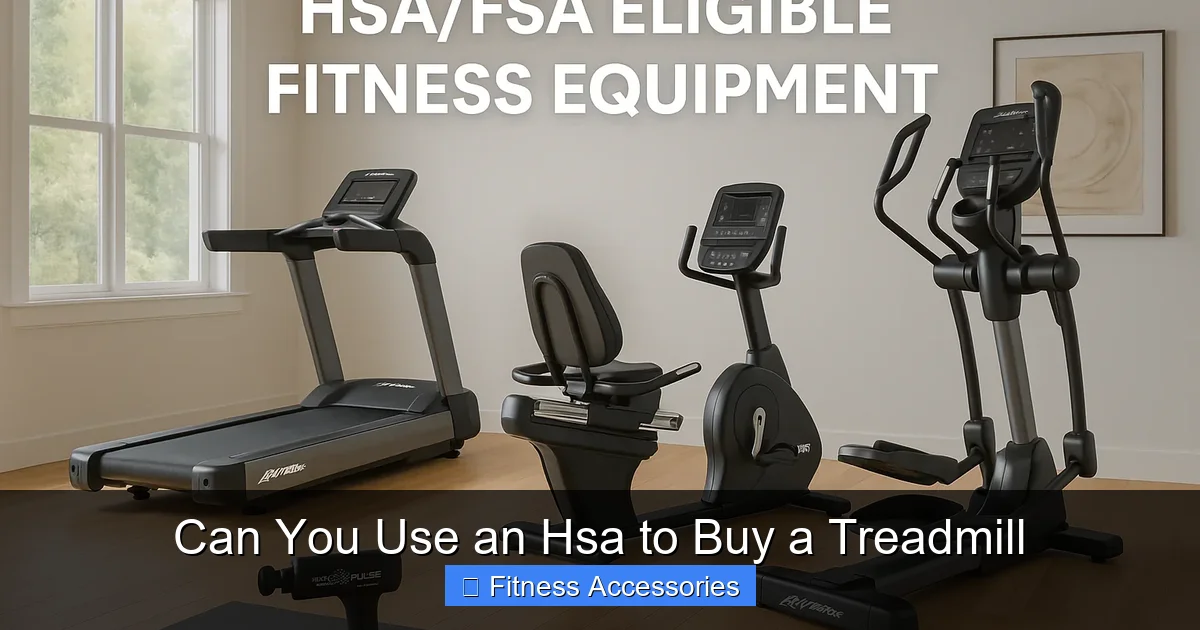
Yes, you can use your Health Savings Account (HSA) to buy a treadmill, but only if it is deemed a medical necessity by a licensed healthcare provider. You will need a formal “Letter of Medical Necessity” (LMN) from your doctor prescribing the treadmill for a specific medical condition. The purchase must be made exclusively for treating that condition, not general fitness. Using your HSA this way offers significant tax advantages, but failing to get proper documentation can lead to taxes and penalties. Always confirm eligibility with your HSA administrator before purchasing.
So, you’re looking at a shiny new treadmill, dreaming of home workouts and better health. Then you glance at your Health Savings Account (HSA) balance and think: Can I just use that pre-tax money? It’s a brilliant idea in theory—using your HSA for a major fitness purchase. But the rules around HSAs and what qualifies as a medical expense are famously strict. The short answer is: yes, you potentially can, but it’s not as simple as swiping your HSA card at the checkout. It hinges on one critical word: necessity. This guide will walk you through exactly what the IRS requires, the steps you must take, the potential pitfalls, and whether it’s truly the smart financial move for your situation.
Key Takeaways
- Medical Necessity is Mandatory: An HSA can only reimburse a treadmill if a doctor prescribes it for a specific diagnosed medical condition, not for general health or weight loss.
- Letter of Medical Necessity (LMN) is Required: You must obtain a written prescription or LMN from your healthcare provider that details your diagnosis, why a treadmill is the treatment, and the specific type/features needed.
- Significant Tax Savings Are Possible: If eligible, using HSA funds saves you money by avoiding federal income tax, state income tax (in most states), and FICA taxes on the amount used.
- The Treadmill Must Be Used Primarily for Treatment: The IRS requires the equipment be used primarily (more than 50%) for the medical purpose outlined by your doctor. Family use can complicate eligibility.
- Retailer Doesn’t Matter, Documentation Does: You can buy from any store (big-box, specialty, online), but your HSA administrator will require the LMN and receipt for reimbursement or direct payment.
- Audit Risk Exists: HSA expenses are subject to IRS audit. Without the LMN, the treadmill purchase will be considered a non-qualified expense, leading to taxes and a 20% penalty if you’re under 65.
- Alternative Funding May Be Better: For general fitness, using a regular savings account or a 0% APR credit card is simpler and avoids the administrative burden and audit risk of an HSA claim.
📑 Table of Contents
- Understanding Your HSA: It’s Not a General Fitness Fund
- The Crucial Role of the Letter of Medical Necessity (LMN)
- The Step-by-Step Process: From Doctor’s Office to Your Living Room
- Tax Implications and Audit Risks: The Fine Print
- Practical Examples: When It (Probably) Works vs. When It Doesn’t
- Alternatives and Smart Considerations
- Conclusion: Proceed with Caution and Documentation
Understanding Your HSA: It’s Not a General Fitness Fund
First, let’s clear up a common misconception. An HSA is not a flexible spending account (FSA) for wellness. It is a tax-advantaged savings account linked to a high-deductible health plan (HDHP) with one primary purpose: to pay for qualified medical expenses. The IRS defines these in Publication 502. The list includes obvious things like doctor visits, prescription drugs, and hospital stays. It also includes some less obvious items like certain dental treatments, vision care, and even some over-the-counter medicines (with a prescription).
The “Medical Necessity” Hurdle
The core of the issue is the concept of medical necessity. For an expense to be HSA-eligible, it must be primarily for the prevention or mitigation of a specific medical condition. General fitness, weight loss without a diagnosed condition, stress reduction, or “feeling better” do not qualify. The IRS is very clear on this. For example, a gym membership is almost always ineligible. However, if a doctor prescribes a gym membership as part of a cardiac rehabilitation program following a heart attack, that specific program could be eligible. The same logic applies to exercise equipment.
So, a treadmill isn’t automatically eligible. It becomes eligible only when it crosses the threshold from a general wellness item to a prescribed medical device. This is where the “Letter of Medical Necessity” becomes your golden ticket. Without it, your HSA purchase is a non-qualified expense, subject to full income tax plus a 20% penalty if you’re under age 65.
The Crucial Role of the Letter of Medical Necessity (LMN)
The LMN is not a casual note. It’s a formal, detailed document from your treating physician (MD or DO) that serves as your legal and financial safeguard. Your HSA administrator will almost certainly ask for it before reimbursing you for a treadmill, or they may require it for a direct debit card transaction at the point of sale. A weak or vague letter will get your claim denied.
Visual guide about Can You Use an Hsa to Buy a Treadmill
Image source: levermovement.com
What Exactly Must the LMN Say?
A valid LMN for a treadmill must include several specific elements to satisfy IRS guidelines and HSA administrators:
- Patient Information: Your full name and date of birth.
- Diagnosis: The specific medical condition being treated (e.g., chronic lower back pain, osteoarthritis of the knee, hypertension, obesity with a BMI over 30 linked to comorbidities, post-operative orthopedic rehabilitation, peripheral artery disease). A vague term like “being out of shape” is insufficient.
- Treatment Rationale: A clear explanation of why a treadmill is the prescribed treatment. For instance: “Walking on a flat, controlled surface with shock absorption is the safest, most effective low-impact aerobic exercise to improve cardiovascular health and strengthen quadriceps to mitigate knee pain associated with patient’s osteoarthritis.”
- Specificity: The letter should ideally specify the type of treadmill needed (e.g., “a treadmill with a belt length of at least 55 inches and a maximum incline of 10% to accommodate patient’s stride and prescribed walking program”). This proves it’s a medical device, not a luxury model.
- Duration: The prescribed duration of use (e.g., “for a period of 6 months to 1 year as part of a long-term management plan”).
- Physician Details: Doctor’s name, NPI number, practice address, phone number, signature, and date.
How to Obtain a Legitimate LMN
This is the most critical step. You cannot write this letter yourself. You must have a legitimate, ongoing doctor-patient relationship and a documented medical history supporting the need. Here’s how to approach the conversation:
1. Schedule a Dedicated Visit: Don’t spring it on your doctor during a quick sick visit. Book a consultation specifically to discuss managing your chronic condition with a home exercise program.
2. Frame it Around Your Condition: Say, “Doctor, my [diagnosed condition] is really impacting my daily life. I’ve read that low-impact walking is often recommended. Would a home treadmill be a medically appropriate part of my treatment plan? I’m hoping to get a prescription so I can use my HSA to afford one.”
3. Be Prepared to Discuss: Your doctor will want to know your current activity level, pain levels, and why a treadmill is superior to other options (like walking outside, which may be limited by weather, safety, or uneven terrain). Have your reasoning ready.
4. Understand They Can Say No: A ethical doctor will only write an LMN if they genuinely believe it’s medically necessary for your specific diagnosis. If your condition is well-managed or if other cheaper alternatives (like a community center membership) are viable, they may refuse. Do not seek a “note mill” or try to pressure a doctor. That is fraud.
The Step-by-Step Process: From Doctor’s Office to Your Living Room
Assuming you have a legitimate condition and a cooperative doctor, here is the practical pathway to using your HSA for a treadmill.

Visual guide about Can You Use an Hsa to Buy a Treadmill
Image source: injectco.com
Step 1: Get the Diagnosis and the LMN
As detailed above, this is the foundation. Ensure the letter is on the doctor’s official letterhead and contains all the required elements. Make a copy for your records.
Step 2: Research and Select Your Treadmill
Now you shop. But shop with your LMN in mind. While the letter should specify needs (e.g., “shock absorption,” “safety handrails”), you should still choose a reliable, durable model that meets those specs. You are buying a medical device for your treatment. Focus on:
- Stability and Weight Capacity: It must be robust enough for your regular use.
- Deck Cushioning: Critical for joint conditions.
- Safety Features: Emergency stop clip, sturdy handrails.
- Warranty: A good parts and labor warranty is a sign of quality.
Keep all receipts, invoices, and the product specification sheet. The receipt should clearly show the item purchased (“Treadmill, Model XYZ”), the date, the price, and the retailer’s information.
Step 3: Pay and Seek Reimbursement
You have two main options:
Option A: Pay Out-of-Pocket, Then Reimburse. This is the most common and often simplest method. You purchase the treadmill with your personal funds (checking, credit card). Then, you submit a claim to your HSA administrator. This claim package must include:
- The completed claim form (from your HSA provider).
- The original, itemized receipt.
- A copy of the Letter of Medical Necessity.
- Sometimes, a statement of how the expense is for the treatment of the diagnosed condition.
Once approved, the administrator will send a check or make a direct deposit to your bank account for the treadmill’s cost (up to your HSA balance).
Option B: Use an HSA-Linked Debit/Credit Card at Point of Sale. Some HSA providers offer a debit card. You could try to use it directly at the store. However, this is riskier. The transaction may be declined at the point of sale if the merchant code doesn’t flag as a medical supplier (which a sporting goods store won’t). Even if it goes through, you must retain the LMN and receipt, as you will still need to substantiate the expense during tax time or if your provider requests proof later. Many providers automatically request documentation for all card transactions above a certain amount.
Tax Implications and Audit Risks: The Fine Print
This is why the LMN is non-negotiable. The tax benefits are huge, but the penalties for misuse are severe.
Visual guide about Can You Use an Hsa to Buy a Treadmill
Image source: shunvogue.com
The Triple Tax Advantage (When Done Correctly)
If your treadmill purchase is a qualified HSA expense, you save on three levels of tax:
- Federal Income Tax: The money you contribute to your HSA is tax-deductible. The money you spend on qualified expenses comes out tax-free.
- State Income Tax: Most states follow the federal rules, but a few (like California and New Jersey) do not conform fully. Check your state’s regulations.
- FICA Taxes: HSA contributions are exempt from Social Security and Medicare taxes (7.65% total). This is the biggest immediate win.
For someone in the 24% federal tax bracket and paying 7.65% FICA, using $1,500 of HSA funds for a treadmill effectively saves them about $475 in taxes compared to spending after-tax income.
The Audit Consequences (If You’re Wrong)
If the IRS audits your HSA and finds a non-qualified expense like a treadmill without an LMN, the consequences are:
- The amount is added to your taxable income for the year you took the distribution.
- You must pay income tax on that amount.
- You incur a 20% additional penalty on the non-qualified amount.
- After age 65, the 20% penalty goes away, but you still pay income tax on the non-qualified withdrawal, effectively turning it into a regular (but less efficient) retirement account withdrawal.
So, a $1,500 treadmill could become a $1,800+ liability (original tax savings clawed back + 20% penalty + new tax bill). The risk is real, which is why meticulous documentation is paramount.
Practical Examples: When It (Probably) Works vs. When It Doesn’t
Theoretical rules are one thing. Let’s look at real-world scenarios.
Likely Eligible Scenarios
- Post-Knee Replacement Surgery: A patient is 3 months post-op, still in physical therapy. The doctor prescribes a home walking program on a treadmill with specific cushioning to rebuild strength and range of motion with minimal joint impact. The LMN cites the surgical diagnosis and rehab protocol. This is strong.
- Severe Chronic Back Pain: A patient has degenerative disc disease. Their doctor has tried multiple treatments and determines that daily, controlled walking on a padded treadmill is the best way to strengthen core muscles and improve circulation to alleviate pain, as outdoor walking on uneven surfaces aggravates symptoms. The LMN details the diagnosis and why a treadmill is the specific solution. This is plausible.
- Hypertension and Obesity (BMI 42) with Comorbidities: A patient has stage 1 hypertension and obesity-related sleep apnea. After diet and medication, the doctor prescribes a rigorous, daily aerobic exercise regimen. Given the patient’s joint pain and limited mobility, a low-impact treadmill is prescribed as the safest way to achieve the required 30 minutes of daily cardio. The LMN connects the treadmill directly to managing the diagnosed hypertension and obesity. This can work with strong documentation.
Unlikely or Ineligible Scenarios
- “I want to get in shape for my wedding.” No diagnosed medical condition. Ineligible.
- General weight loss without a documented obesity diagnosis or related comorbidities. The IRS explicitly states weight loss programs are ineligible unless prescribed for a specific disease (like obesity or hypertension). A simple desire to lose 10 pounds doesn’t count.
- Preventative use for a family history of heart disease. No current diagnosis. Ineligible.
- The doctor writes a note saying, “John should exercise more.” Too vague. It lacks a specific diagnosis and treatment rationale linking a treadmill as the necessary tool. Will be denied.
- Buying a treadmill for your child to burn energy. Unless the child has a specific, diagnosed medical condition (like a developmental coordination disorder) for which a physical therapist has prescribed a treadmill, it’s ineligible.
Alternatives and Smart Considerations
Even if you think you qualify, pause and consider if using your HSA is truly the best path.
Is This the Best Use of Your HSA Funds?
HSAs are incredibly powerful long-term wealth-building tools because of their triple tax advantage. Some financial advisors recommend saving HSA funds for major, unavoidable future healthcare costs in retirement (like long-term care premiums, Medicare premiums, or huge deductibles). Using a large chunk for a $1,500-$3,000 treadmill depletes that nest egg. Consider:
- Could this money grow tax-free for 20 years? If you’re young and healthy, putting that money into low-cost index funds within your HSA and letting it compound could yield a much larger sum for a future major health crisis.
- Do you have other high-interest debt? Paying off a 20% APR credit card is a guaranteed 20% return on your money. That’s better than any HSA tax break.
Other Ways to Finance a Treadmill
If your goal is general fitness, consider these alternatives that avoid audit risk:
- 0% APR Credit Card: If you can pay it off within the promotional period (usually 12-18 months), this is effectively an interest-free loan from the credit card company, not your future tax-advantaged self.
- Personal Savings: Simple, clean, no red tape.
- Store Financing: Many retailers offer 0% financing for 12-24 months on large appliances and fitness equipment. Read the fine print for deferred interest traps.
- FSA (if available):strong> A limited-purpose FSA (for dental/vision) won’t cover it, but a general-purpose FSA might if you have a valid LMN. FSA rules are similar to HSA rules for medical necessity. However, FSAs are “use-it-or-lose-it” annually, so timing is tricky.
Conclusion: Proceed with Caution and Documentation
The idea of using your HSA to buy a treadmill is appealing because it turns a major purchase into a tax-free transaction. But the IRS pathway to that benefit is narrow and well-defined. The rule is simple: no legitimate, documented medical necessity prescribed by your doctor = no HSA funds. The Letter of Medical Necessity is your shield against audit and your key to tax savings.
If you have a real, diagnosed condition that a doctor agrees can be treated with a prescribed walking program on a treadmill, then by all means, follow the steps in this guide. Get the detailed LMN, buy an appropriate machine, keep every piece of paper, and submit a clean claim. But if your motivation is primarily fitness, weight loss without a diagnosed disease, or convenience, it’s wise to leave your HSA untouched. Protect that account for the medical emergencies it was designed to cover. Your future self, facing a high deductible, will thank you for preserving that tax-advantaged safety net. When in doubt, call your HSA administrator and ask about their specific documentation requirements before you spend a dime.
Frequently Asked Questions
Can I use my HSA to buy a treadmill without a doctor’s note?
No. A treadmill is not an automatically eligible HSA expense. Without a Letter of Medical Necessity from a licensed physician prescribing it for a specific diagnosed medical condition, the purchase is considered non-qualified. Using HSA funds would trigger income tax and a 20% penalty if you’re under 65.
What if I only use the treadmill for my prescribed treatment and my family uses it occasionally?
This creates significant risk. The IRS requires the equipment be used “primarily” (more than 50%) for the treatment of the named condition. Regular family use for general fitness could be seen as violating this rule, potentially disqualifying the entire expense during an audit. It’s safest if the treadmill is dedicated to your medical use.
Can I buy a used treadmill with my HSA?
Yes, there is no rule against buying used. However, you must still have a valid LMN. The receipt must be detailed enough to show the item purchased (e.g., “Used Treadmill, Model ABC”). Ensure the used treadmill is safe, functional, and meets any specifications (like cushioning) mentioned in your doctor’s letter. A private party sale receipt may need to be more formal.
Can I buy a treadmill from any retailer, like Amazon or a big-box store?
Yes, the retailer does not affect eligibility. You can purchase from a sporting goods store, department store, specialty fitness retailer, or online marketplace like Amazon. What matters is the item itself (a treadmill) and your documentation (LMN and receipt). Ensure the receipt clearly itemizes the treadmill purchase.
My doctor says exercise is good for me but refuses to write a specific LMN for a treadmill. What should I do?
Respect their decision. A doctor has an ethical obligation to only prescribe what they deem medically necessary. If they won’t write a detailed LMN linking a treadmill to your specific diagnosis, it means they do not believe it qualifies as a medical necessity. Do not seek another doctor simply to get a note; this is considered abuse. Instead, fund the treadmill through other means.
How likely is an HSA audit for a treadmill purchase?
The IRS does not publish specific audit rates by expense type. However, large, unusual, or non-routine expenses like exercise equipment are more likely to be scrutinized if your HSA is audited. Since a treadmill is a clear red flag for general wellness, having the LMN is absolutely essential. Without it, the audit risk makes the purchase financially dangerous. Keep your LMN and receipt with your important tax documents for at least 7 years.