How to Get Bigger Arms Fast with Dumbbells
Want bigger arms fast? This guide covers the best dumbbell exercises, workout routines, and nutrition tips to help you build bigger arms quickly and safely at home. Whether you are a beginner or intermediate lifter, you will find practical steps to start seeing real results in weeks.
Building bigger arms fast is one of the most popular fitness goals out there. Whether you want to fill out your shirts, boost your confidence, or simply get stronger, dumbbells are all you need. You do not need a fancy gym or expensive equipment. A pair of dumbbells and a solid plan are enough to transform your arms.
In this guide, I will walk you through everything you need to know about getting bigger arms with dumbbells. We will cover the best exercises, how to structure your workouts, what to eat, and the mistakes most people make. By the end, you will have a clear roadmap to follow. Let us get started.
Key Takeaways
- Dumbbells are the most accessible tool for building bigger arms at home because they allow a full range of motion and target all arm muscles.
- Compound and isolation exercises together deliver the fastest results for arm growth.
- A structured workout routine with progressive overload is essential for continuous gains.
- Protein intake and recovery play a huge role in how fast your arms grow.
- Avoiding common mistakes like skipping warm-ups or using poor form can make or break your progress.
- Training arms 2-3 times per week strikes the right balance between stimulation and recovery.
📑 Table of Contents
Why Dumbbells Are Perfect for Building Bigger Arms
Dumbbells are the best tool for arm training at home. Unlike barbells or machines, they let each arm work independently. This means no muscle gets a free pass. Your weaker arm has to keep up with your stronger one, which fixes imbalances over time.
Here is why dumbbells work so well for arm growth:
- Full range of motion: Dumbbells allow your joints to move freely, which stretches and contracts your muscles more completely.
- Joint-friendly: They put less stress on your wrists and elbows compared to heavy barbells.
- Versatile: You can target every arm muscle from multiple angles with just one pair.
- Space-efficient: A set of dumbbells fits in a small room and costs far less than a gym membership.
- Scalable: You can go light for high-rep toning or heavy for raw strength gains.
Which Arm Muscles Should You Train?
Your arms are made up of several muscles that all need attention. The biceps sit at the front of your upper arm and are responsible for curling movements. The triceps make up about two-thirds of your arm mass and sit at the back. Your forearms control your grip and wrist movements.
To get bigger arms fast, you must train all three areas. Many people focus only on biceps and ignore triceps. That is a big mistake. Balanced development creates arms that look full and impressive from every angle.
Best Dumbbell Exercises for Bigger Arms
The right exercises make all the difference. Below are the most effective dumbbell arm exercises you can do at home. Each one targets a specific part of your arm for maximum growth.
Bicep Exercises
The biceps are the showpiece muscle of your arms. These exercises hit them from different angles:
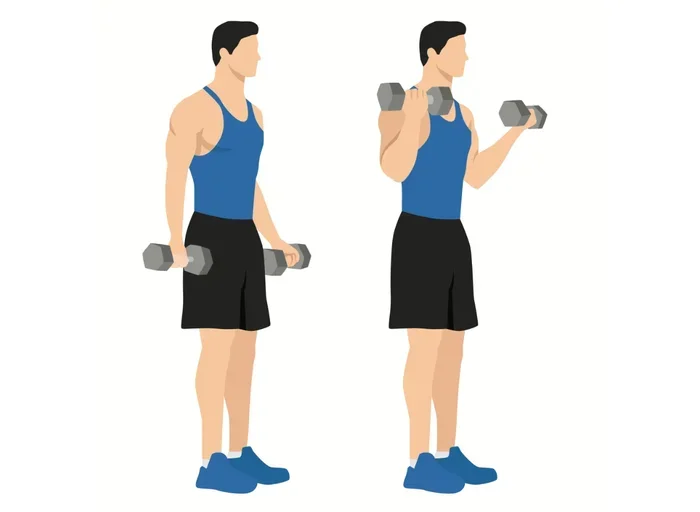
- Dumbbell Bicep Curls: Stand tall, hold a dumbbell in each hand, and curl them up slowly. Lower them with control. This is the king of bicep builders.
- Hammer Curls: Hold the dumbbells with a neutral grip (palms facing each other). This targets the brachialis, a muscle underneath the bicep that adds width.
- Concentration Curls: Sit on a bench, rest your elbow against your inner thigh, and curl one arm at a time. This removes momentum and isolates the bicep perfectly.
Tricep Exercises
Your triceps are the key to adding mass and size. These exercises build bigger triceps fast:
- Dumbbell Overhead Tricep Extension: Hold one dumbbell with both hands behind your head and extend your arms upward. This stretches the tricep fully at the bottom.
- Dumbbell Skull Crushers: Lie on the floor, hold dumbbells above your shoulders, and lower them toward your temples. Press back up to complete the rep.
- Close-Grip Dumbbell Floor Press: Hold dumbbells shoulder-width apart and press them up. This hits the long head of the tricep hard.
Forearm Exercises
Do not neglect your forearms. Thick forearms make your arms look complete and powerful:
- Dumbbell Wrist Curls: Rest your forearms on your knees, palms up, and curl the dumbbells up with your wrists. This builds the forearm flexors.
- Reverse Wrist Curls: Same position, but palms face down. This targets the forearm extensors for balanced development.
For a more complete routine that targets all these areas, check out how to build arm muscles at home with dumbbells for additional exercise variations and structure.
How to Structure Your Arm Workout Routine
A great routine is only as good as its structure. Randomly picking exercises will not get you bigger arms fast. You need a plan that balances volume, intensity, and recovery.
The 3-Day Arm Split
Training arms three times per week gives you enough stimulus without overtraining. Here is a simple split:
- Day 1: Focus on biceps and forearms (4 exercises, 3 sets each)
- Day 2: Focus on triceps and forearms (4 exercises, 3 sets each)
- Day 3: Full arm workout hitting all muscles (5 exercises, 3 sets each)
Rest 60 to 90 seconds between sets. Keep your rest days active with light walking or stretching.
Progressive Overload: The Secret to Fast Growth
Progressive overload means gradually increasing the weight, reps, or sets over time. Your muscles only grow when they face a challenge they are not used to. If you curl the same weight every week, your arms have no reason to grow.
Here is how to apply progressive overload:
- Week 1: Use a weight you can lift for 10 reps with good form.
- Week 2: Try to hit 12 reps with the same weight.
- Week 3: Increase the weight slightly and drop back to 10 reps.
- Week 4: Push for 12 reps again at the new weight.
This cycle keeps your muscles constantly adapting. It is the most proven method for building bigger arms with dumbbells over time.
Sample Weekly Arm Routine for Beginners
If you are just starting out, try this simple routine. It takes about 30 minutes and requires only dumbbells:
| Exercise | Muscle Target | Sets x Reps |
|---|---|---|
| Dumbbell Bicep Curl | Biceps | 3 x 10-12 |
| Hammer Curl | Brachialis, Forearms | 3 x 10-12 |
| Overhead Tricep Extension | Triceps | 3 x 10-12 |
| Close-Grip Floor Press | Triceps | 3 x 10-12 |
| Dumbbell Wrist Curl | Forearms | 2 x 15-20 |
For more detailed arm workout ideas and variations, you can also explore how to get bigger biceps and triceps with dumbbells for additional exercise combinations and progression strategies.
Nutrition Tips for Faster Arm Growth
You cannot build bigger arms without proper nutrition. Training breaks your muscles down, but food rebuilds them stronger. Think of nutrition as the foundation of your arm-building house.
Eat Enough Protein
Protein is the #1 nutrient for muscle growth. Aim for about 0.7 to 1 gram of protein per pound of body weight each day. Good sources include:
- Chicken breast and turkey
- Eggs and Greek yogurt
- Lean beef and fish
- Beans, lentils, and tofu for plant-based options
- Protein shakes for convenience
Do Not Fear Carbs and Fats
Carbs fuel your workouts. Without enough carbs, you will feel weak and your arm workouts will suffer. Healthy fats support hormone production, which is critical for muscle growth. Eat whole grains, fruits, vegetables, nuts, and olive oil daily.
Timing Matters
Try to eat a protein-rich meal or snack within 60 minutes after your arm workout. This is when your muscles are most receptive to nutrients. A simple post-workout shake with protein powder and a banana works great.
Common Mistakes That Slow Down Arm Growth
Even with a perfect routine, bad habits can hold you back. Here are the most common mistakes people make when trying to get bigger arms fast:
Using Too Much Momentum
Swinging the dumbbells and using your back or shoulders to cheat the movement is a huge mistake. It takes the tension off your arm muscles and reduces the stimulus for growth. Use a controlled tempo. Lift for 2 seconds, lower for 2-3 seconds. Feel the muscle working throughout every rep.
Skipping the Warm-Up
Jumping straight into heavy curls without warming up is a recipe for injury. Spend 5 minutes doing light arm circles, wrist rolls, and a few warm-up sets with lighter weights. Your joints and tendons will thank you.
Overtraining Without Recovery
Training arms every single day sounds productive, but it actually works against you. Muscles grow during rest, not during the workout. Give your arms at least 48 hours between sessions. Sleep 7 to 9 hours per night to optimize recovery and hormone levels.
Neglecting Triceps
As mentioned earlier, triceps make up the majority of your arm size. Many lifters spend all their time on biceps and wonder why their arms are not growing. Give triceps equal attention, and you will see faster results.
For targeted tricep guidance, visit how to get bigger triceps at home with dumbbells for a detailed breakdown of tricep-specific exercises and tips.
How Often Should You Train Arms for Maximum Growth?
The ideal frequency depends on your experience level and recovery capacity. Most people see great results training arms 2 to 3 times per week. This gives you enough volume to stimulate growth while allowing full recovery between sessions.
Beginners should start with 2 sessions per week. As your body adapts, you can increase to 3. Advanced lifters may benefit from 4 sessions, but they also need more careful programming to avoid burnout.
Listen to your body. If your arms feel sore and fatigued for days after a workout, you are training too often or with too much volume. Scale back and let recovery do its job. Consistent, moderate training beats intense, infrequent sessions every time.
For more guidance on building bigger biceps at home specifically, check out how to get bigger biceps at home with dumbbells for bicep-focused routines and tips.
Conclusion
Getting bigger arms fast with dumbbells is entirely achievable if you follow the right approach. Train all three arm muscles, use a structured routine with progressive overload, eat enough protein, and recover properly. Avoid the common mistakes that slow most people down, and stay consistent.
The beauty of dumbbell training is that you can do it anywhere, anytime. You do not need a gym membership or fancy equipment. Just a pair of dumbbells, a plan, and the discipline to follow through. Start with the exercises and routines in this guide, track your progress, and adjust as you go. Your bigger, stronger arms are closer than you think.
Frequently Asked Questions
How quickly can I see results in my arms with dumbbells?
Most people notice visible changes in arm size within 4 to 6 weeks of consistent training. Beginners tend to see faster initial gains due to neural adaptations. Staying consistent with your routine and nutrition is the key to faster results.
Can I get bigger arms with light dumbbells?
Yes, you can. Light dumbbells work well for high-rep sets that build muscle endurance and definition. However, you should also incorporate heavier weights for lower reps to stimulate muscle growth. A mix of both approaches yields the best results.
Do I need to train arms every day to get bigger?
No, training arms every day is counterproductive. Muscles need rest to repair and grow. Training arms 2 to 3 times per week is the sweet spot for most people. Overtraining leads to fatigue and injury, which slows your progress.
What is the best dumbbell exercise for overall arm size?
The dumbbell curl and overhead tricep extension are two of the most effective exercises for overall arm size. They target the two largest arm muscles and allow a full range of motion. Combining both in your routine gives you balanced arm development.
How important is diet for building bigger arms?
Diet is extremely important. Without enough protein and calories, your muscles simply cannot grow, no matter how hard you train. Aim for a slight caloric surplus and eat 0.7 to 1 gram of protein per pound of body weight daily for the best arm-building results.
Should I use dumbbells or barbells for arm training?
Dumbbells are better for most people, especially beginners. They fix muscle imbalances, allow a natural range of motion, and are safer for home workouts. Barbells have their place too, but dumbbells give you more control and versatility for arm training at home.