What Is the Best Elliptical Machine for the Money

Finding the best elliptical machine for the money isn’t about the cheapest price tag; it’s about matching durable construction, smooth performance, and useful features to your specific fitness goals and budget. This guide cuts through the marketing to highlight models that offer exceptional long-term value, whether you’re a beginner or a seasoned home athlete. We evaluate build quality, warranty, space needs, and tech to help you make a smart, lasting purchase.
So, you’ve decided to bring an elliptical into your home. Great choice! It’s a fantastic, low-impact way to burn calories, build endurance, and strengthen your legs and core without pounding your joints. But then you start shopping and… wow. The prices range from “impulse buy” to “small car down payment.” The ads all scream “BEST VALUE!” How do you cut through the noise and actually find the best elliptical machine for the money?
Let’s be clear: “best for the money” does not mean “the cheapest.” It means the machine that gives you the most reliable performance, the smoothest ride, and the features you’ll actually use for the longest possible time, all within your budget. It’s about long-term value, not short-term savings. A $300 elliptical that breaks or feels terrible after six months is a terrible investment. A $900 one that you use faithfully for five years is a bargain. This guide is your roadmap to finding that sweet spot. We’ll break down what truly matters, review top contenders in different price brackets, and give you the checklist to make a decision you won’t regret.
Key Takeaways
- Value is Personal: The “best for the money” is the machine that best fits your budget, space, and workout style, not just the cheapest or most feature-packed.
- Prioritize the Core: A sturdy frame, smooth elliptical motion, and a solid warranty are non-negotiable foundations of value. Fancy screens are secondary.
- Budget Realistically: True value starts around $500-$700 for reliable entry-level models. Under $400 often means significant compromises in durability and performance.
- Space is a Cost: A machine that doesn’t fit your room or is a nightmare to move is a poor investment, no matter the price. Factor in footprint and transport wheels.
- Features Have a Price: Decide which tech (Bluetooth, app subscriptions, large screens) you’ll actually use monthly. Paying for unused features wastes money.
- Know Your User: Consider weight capacity, stride length, and adjustability for all intended users in your household to avoid buying a second machine later.
- Try Before You Buy (If Possible): Visiting a store to test the motion, pedal spacing, and console usability is the single best way to assess if a machine feels like value to you.
[FEATURED_IMAGE_PLACEHOLDER]
📑 Table of Contents
Defining “Value” in an Elliptical: It’s More Than Price
Before we look at specific models, we need a common language. What makes one elliptical a better value than another? It comes down to a few critical pillars that determine whether you’ll love your machine or hate it in three months.
The Holy Trinity of Quality: Frame, Motion, and Resistance
These are the absolute fundamentals. If these aren’t good, everything else is irrelevant.
- Frame stability: A wobbly frame is unsafe and distracting. Look for a heavy-gauge steel construction. A machine that doesn’t rock when you step on it or change pace is essential. The weight of the machine itself is a clue—heavier is usually (but not always) more stable.
- The Elliptical Path: This is the magic. A true, smooth, oval path that mimics natural running/walking motion is key. Some cheap models have a “choppy” or rigid feel. Pay attention to the stride length. For most adults, a 15-18 inch stride is comfortable. If you’re taller (over 6’2″), look for 20 inches or more. A short stride will feel cramped and limit your range of motion.
- Resistance System: You want smooth, incremental changes in difficulty. Magnetic resistance is the gold standard for home machines—it’s silent, smooth, and requires no maintenance. Avoid older, friction-based systems that can be noisy and wear out. The number of resistance levels is less important than the quality of the transition between them.
The Warranty: Your Financial Safety Net
This is the manufacturer’s vote of confidence in their own product. A warranty that covers the frame for 10+ years, parts for 2-5 years, and labor for 1-2 years is what you should aim for. A 90-day or 1-year “everything” warranty on a $500 machine is a red flag—they don’t expect it to last long. The warranty is a direct predictor of durability and a core component of value.
Features You’ll Actually Use vs. Marketing Fluff
Here’s where budgets get blown. A huge, colorful touchscreen is cool. But do you need it? For many, a simple, backlit LCD display showing speed, time, distance, calories, and heart rate (via hand grips or a chest strap) is perfectly sufficient. Value comes from paying for features you’ll engage with weekly, like:
- Bluetooth connectivity to sync data to apps like Fitbit, Apple Health, or Zwift.
- Adjustable pedals or footplates for comfort.
- Transport wheels if you need to move it occasionally.
- Adjustable incline/ramp (not just resistance) to change muscle emphasis and intensity.
You often pay a $200-$500 premium for a large, app-driven screen with subscription-based content. If you love guided workouts and have the budget, great! But if not, that’s money that could be better spent on a sturdier frame or longer warranty.
Top Value Picks: Breakdown by Budget Tier
Now, let’s get to the machines. We’ve categorized them by realistic value tiers. Remember, “best” depends on your primary need: solid basics, smart tech, or commercial-grade durability.
Visual guide about What Is the Best Elliptical Machine for the Money
Image source: s3.money.com
The “Solid Starter” Tier ($500 – $900)
This is the sweet spot for most first-time home buyers. You get a reliable, durable machine with a good warranty and smooth magnetic resistance, without paying for luxury features you may not use.
- Bowflex Max Trainer Series (M3, M6): While technically a hybrid (elliptical/stair-stepper), its motion is incredibly smooth and low-impact. The M3 is a fantastic value at its frequent sale prices (~$700), offering a unique, powerful workout with a simple console. Build quality is excellent for the price.
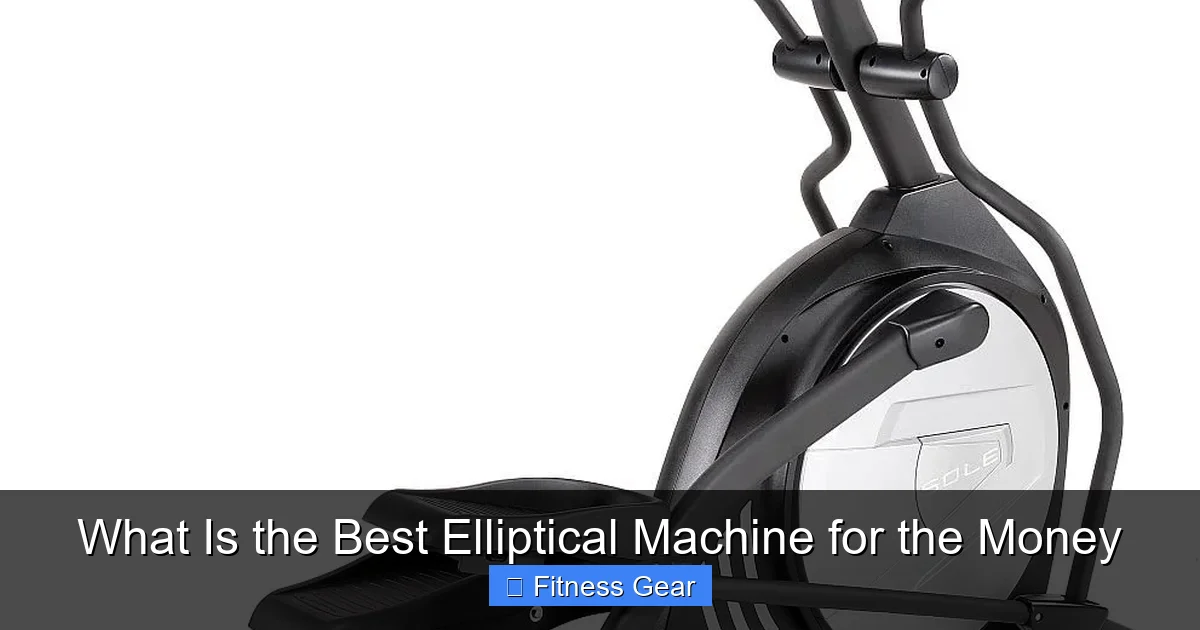
- Sole Fitness E25 & E35: These are perennial value champions. The E25 (often ~$700) is a no-frills workhorse with a heavy-duty frame, excellent 20″ stride, and a superb 10-year frame warranty. The E35 (~$1,000 on sale) adds power-adjustable incline and a better console. Sole’s customer service and part availability are top-notch, which is a huge long-term value.
- ProForm Carbon Series (CX 595, CX 795): If you want iFit integration and a big screen without the high-end price, ProForm delivers. The CX series has a solid magnetic resistance system and sturdy build. The value here is in the included iFit membership (often the first year free), providing endless guided workouts. Ensure you like the iFit ecosystem before buying.
The “Tech-Integrated” Tier ($900 – $1,800)
For the user who thrives on interactive content, leaderboards, and immersive training. The machine itself is good, but the major value (and cost) is in the connected ecosystem.
- NordicTrack Commercial Series (C 7.5, C 9.2, C 10.9): The kings of the connected home gym. They feature large, pivoting touchscreens and a 1-year iFit family membership. The C 7.5 is the entry point (~$1,200 on sale) with a 20″ stride and power ramp. Build quality is good, not commercial, but the motivating content is the star. Value is entirely dependent on your use of iFit.
- Schwinn 430i, 470i: Often overshadowed by the bigger brands, Schwinn offers exceptional value in this tier. The 430i (~$800) provides a very smooth ride, solid build, and Bluetooth connectivity to explore routes on your own tablet or phone. The 470i adds power incline. They are reliable, have good warranties, and let you choose your own entertainment (Netflix, YouTube, Spotify) on your personal device, avoiding locked-in subscriptions.
The “Commercial-Grade / Long-Term Investment” Tier ($1,800+)
This is for the serious athlete, the whole family, or anyone who plans to use their elliptical 5+ days a week for years. The value is in unparalleled durability, whisper-quiet operation, and warranties that mean “lifetime.”
- Life Fitness Club Series, Platinum Series: You see these in gyms for a reason. They are built like tanks. The motion is buttery smooth and biomechanically perfect. The warranties are legendary (often lifetime on frame). The price is high, but if you use it daily, the per-workout cost plummets. This is the ultimate definition of “for the money” if you have the budget and the discipline.
- Precor EFX Series (EFX 222, 423): Another gym staple. Precor’s “CrossRamp” technology is iconic, offering a natural, self-adjusting motion. The EFX 222 is their residential workhorse with a fantastic 10-year frame warranty. It’s not flashy, but it’s an indestructible tool that will outlast you.
- True Fitness TS Series: A favorite among home users who want gym quality without the full commercial price tag. Their magnetic resistance and solid construction are superb. Look for open-box or refurbished deals for incredible value.
The Critical Check: Durability, Build, and Your Space
You could buy the most feature-rich elliptical in the world, but if it’s a nightmare to assemble, shakes violently, or won’t fit through your door, it’s a failed purchase. This is the practical side of value.

Visual guide about What Is the Best Elliptical Machine for the Money
Image source: img.money.com
Materials and Weight: The Stability Equation
Don’t just look at the product weight; think about the user weight capacity. A higher capacity (300 lbs vs. 250 lbs) usually indicates a stronger frame and components. For a stable machine, you want a high “user weight capacity” relative to your own weight. A 250-lb capacity machine for a 180-lb person will feel much more solid than the same machine for a 240-lb person. Look for steel construction, not just tubular metal.
Footprint and Assembly: The Hidden Costs
Before you click “buy,” measure your space. Leave at least 2 feet of clearance behind and on the sides for ventilation and access. Check the machine’s assembled dimensions. Then, check the shipping weight. A 200-lb box arriving at your doorstep is a major project. Do you have help? Will you need to pay for white-glove delivery? The cost and effort of assembly are part of the total investment. Some brands (like NordicTrack) offer excellent assembly services for a fee—factor that into your “money” equation.
Noise Level: The Peaceful Workout
All ellipticals make some noise—the whir of the flywheel and the footfalls. But a poorly designed one can sound like a construction site. Magnetic resistance systems are inherently quieter. Read reviews specifically for noise complaints. A quiet machine you can use while others sleep or watch TV is infinitely more valuable than a cheap, loud one you avoid using.
Matching the Machine to the User: It’s Not One-Size-Fits-All
The best elliptical for a couple in their 60s is not the best for a solo 25-year-old athlete. Let’s match profiles.

Visual guide about What Is the Best Elliptical Machine for the Money
Image source: img.money.com
The Beginner / Casual User
Needs: Simplicity, ease of use, low impact, basic tracking, gentle learning curve. Value Play: A Sole E25 or a Bowflex Max M3. No confusing apps, just a solid machine that works. The focus is on building the habit without frustration.
The Tech-Savvy & Motivation-Seeker
Needs: Variety, guided coaching, competition, immersive entertainment to stay engaged. Value Play: A NordicTrack or ProForm with iFit. The subscription cost is part of the package. If the content keeps you consistent, it’s worth every penny. Consider a Schwinn with your own tablet for a more cost-effective connected experience.
The Whole Family / Heavy-Duty User
Needs: Maximum durability, wide weight capacity, adjustable stride for different heights, ultra-smooth motion. Value Play: A Life Fitness or Precor model, or a True TS series. The initial cost is high, but it’s a 10-20 year asset. It will handle daily use from multiple people without issue.
The Space-Constrained Urban Dweller
Needs: Small footprint, easy mobility (transport wheels), possibly foldable (though few quality ellipticals fold well). Value Play: Look at center-drive designs (like some newer Sole or Schwinn models) which often have a smaller footprint than rear-drive models. Prioritize models with a compact design listed clearly in the specs. A smaller, high-quality machine is better than a large, poorly made one you can’t fit.
Where to Buy & The Final Decision Checklist
Where you buy can affect your total value. Big box stores (Dick’s, Walmart) have easy returns but limited high-end stock. Specialty fitness retailers (both online and local) offer better expertise and often better warranties or service packages. Amazon has great prices and returns but can be a mix of brands and less personalized support. Direct from manufacturer (NordicTrack, Peloton, etc.) often includes delivery and assembly.
Your Pre-Purchase Value Checklist
Before you spend, run through this list. If a machine fails too many, keep looking.
- Frame & Warranty: Is the frame steel? What is the frame warranty? (Aim for 5+ years, 10+ is best).
- Motion: What is the stride length? Is the motion path smooth and natural? (Watch video reviews closely).
- Resistance: Is it magnetic? How many levels? Are the changes noticeable?
- Capacity: Does the user weight capacity meet or exceed the heaviest user by at least 50 lbs?
- Space: Does the assembled footprint fit in my room with clearance? Can it get there (doorways, stairs)?
- Noise: Do multiple reviews mention it being quiet?
- Console: Is the display readable? Are the buttons intuitive? Does it have the connectivity (Bluetooth, USB) I need?
- Extras: Do I want/need power incline, adjustable pedals, a large screen? Am I willing to pay for a subscription?
- Support: What is the company’s reputation for customer service and parts availability?
Conclusion: Your Best Value Awaits
The search for the best elliptical machine for the money ends not with a single model name, but with a clear set of priorities for you. It ends when you identify the non-negotiable pillars—a stable frame, a smooth magnetic resistance system, and a warranty that gives you peace of mind—and then find the most affordable machine that delivers on those pillars while also fitting your space and your motivational style.
For most people, that value lies in the $700-$1,200 range from brands like Sole, Schwinn, or a sale-priced Bowflex/NordicTrack. You get a durable, effective machine without paying for a locked-in content ecosystem you might abandon. If you are a daily athlete or have a multi-user household, investing $2,000+ in a Life Fitness or Precor is the ultimate long-term value. Avoid the ultra-budget tier; the compromises in feel and durability will cost you more in frustration and replacement parts down the line.
Finally, if you can, test the motion in a store. Your body will tell you if the stride feels right. Combine that gut feeling with the research on frame quality and warranty, and you will make a purchase that delivers health, happiness, and true value for years to come. You’re not buying a clothes rack; you’re investing in a tool for your health. Choose wisely.
Frequently Asked Questions
Is an elliptical a good investment for weight loss?
Yes. An elliptical provides an efficient, full-body cardio workout that burns significant calories, especially when using intervals or incline. Its low-impact nature allows for consistent, daily exercise without joint pain, which is key for sustainable weight loss and long-term adherence.
What’s the most important feature to look for in a value elliptical?
The quality of the flywheel and magnetic resistance system. This dictates the smoothness, quietness, and overall feel of the machine. A choppy or noisy motion is a deal-breaker for long-term use, regardless of other features. Pair this with a robust frame warranty for true value.
Can I use an elliptical if I have bad knees or back problems?
Generally, yes. The elliptical’s motion is low-impact and non-weight-bearing, which is often recommended for those with joint issues. However, you must maintain proper posture—upright, core engaged, no excessive leaning. Always consult with a doctor or physical therapist first, and start with very low resistance to ensure pain-free movement.
Do I need a big touchscreen and subscription service?
Not necessarily. The screen is a motivational tool. If you’ll use guided classes daily, it’s valuable. If you prefer listening to podcasts, music, or watching your own TV, a simple Bluetooth-enabled console that lets you use your own tablet is a smarter, more cost-effective value. Never buy features you won’t consistently use.
How much space do I really need for an elliptical?
Check the specific model’s assembled footprint and add at least 2 feet of clearance on all sides for safe mounting/dismounting and ventilation. Most quality home ellipticals require a 4′ x 6′ to 5′ x 7′ area. Also, measure your doorway and stairwell for delivery—a 200+ lb box is impossible to maneuver through a tight space.
Are front-drive or rear-drive ellipticals better for value?
It’s about preference, not inherent value. Rear-drive models often have a longer, more natural stride and a slightly smaller footprint. Front-drive models can feel more like a stair-stepper and sometimes have a larger console. The “best” is the one whose motion feels most comfortable and natural to you when you test it. Both can offer excellent value.