The time needed to burn calories on a stationary bike isn’t a fixed number—it depends on your weight, workout intensity, and metabolism. Generally, a 155-pound person burns about 260 calories in 30 minutes of moderate cycling. For significant weight loss, aim for 150-300 minutes per week, combining moderate and high-intensity sessions. Remember, consistency and pairing exercise with a balanced diet are key to creating a sustainable calorie deficit for fat loss.
Key Takeaways
- Calorie burn is highly individual: Your weight, age, gender, muscle mass, and metabolic rate dramatically influence how many calories you burn per minute on a stationary bike.
- Intensity trumps单纯时间: A shorter, high-intensity interval training (HIIT) session can burn more calories *during and after* the workout than a longer, steady-state ride at a leisurely pace.
- The “afterburn effect” (EPOC) is real: Intense workouts create an “oxygen debt,” causing your body to burn extra calories for hours after you’ve finished pedaling, boosting total expenditure.
- Duration guidelines are for *total* weekly time: Health organizations recommend 150-300 minutes of moderate aerobic activity weekly for health, but more may be needed for weight loss, often requiring 300+ minutes.
- Exercise is only one part of the equation: You cannot out-exercise a poor diet. Sustainable fat loss requires a consistent calorie deficit, best achieved by combining cycling with mindful nutrition.
- Consistency and progression are non-negotiable: The most effective plan is one you enjoy and can stick to. Gradually increase duration, intensity, or frequency to keep challenging your body and avoid plateaus.
- Use metrics beyond the scale: Focus on performance improvements (longer rides, higher resistance, faster RPMs) and body measurements, as muscle gain from cycling can mask fat loss on the scale.
📑 Table of Contents
- How Long Should You Ride a Stationary Bike to Burn Calories? It’s Not a Simple Answer.
- The Calorie Burn Equation: Why Your 30 Minutes Is Different From My 30 Minutes
- Practical Math: Calculating Your Personal Calorie Burn
- Crafting the Optimal Ride: Workout Structures for Maximum Calorie Torch
- Beyond the Bike: The Unseen Calorie Burn (EPOC) and Muscle Building
- The Calorie Burn Equation: Exercise Is Only Half the Story
- Tracking, Adjusting, and Staying Motivated: Making It a Habit
- The Final Pedal: Putting It All Together for Your Goals
How Long Should You Ride a Stationary Bike to Burn Calories? It’s Not a Simple Answer.
You hop on the stationary bike, set the timer for 30 minutes, and start pedaling. The question burning in your mind, almost as much as the calories in your muscles, is: “Is this enough? How long do I really need to ride to burn calories and see results?” If you’ve ever searched for a magic number—30 minutes? 45? 60?—you’re not alone. The allure of a simple, universal answer is strong. Unfortunately, the truth is more nuanced. The time it takes to burn calories on a stationary bike is a moving target, influenced by a constellation of personal factors and workout variables. This article will dismantle the one-size-fits-all myth and equip you with the knowledge to design the most effective, efficient cycling routine for your unique body and goals. We’ll dive into the science of calorie expenditure, compare workout styles, and provide practical frameworks so you can stop guessing and start strategically torching calories.
The Calorie Burn Equation: Why Your 30 Minutes Is Different From My 30 Minutes
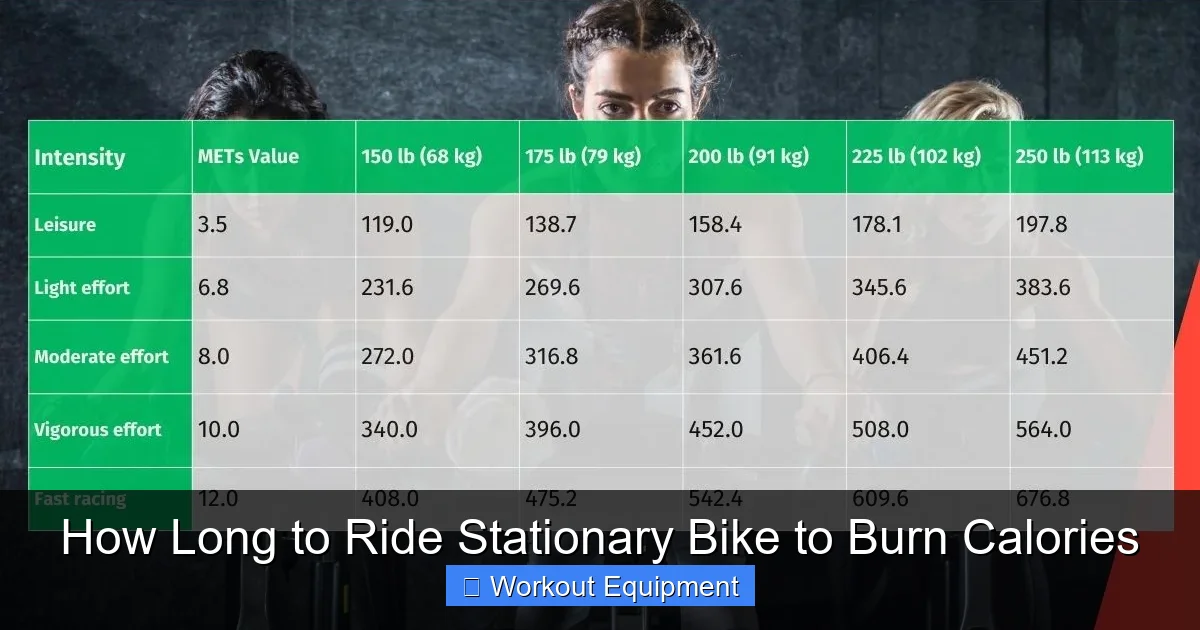
Before we talk time, we must understand what determines calorie burn. Your body burns calories (a unit of energy) to perform any function, from breathing to thinking to pedaling. Exercise increases this rate dramatically. The total calories burned during a stationary bike session are calculated using a formula: Calories Burned = MET value x Weight in kg x Time in hours. The Metabolic Equivalent of Task (MET) is the key variable here—it’s a number that represents the energy cost of an activity. Cycling at a leisurely pace (<10 mph) has a MET of about 4.0, while vigorous cycling (>14 mph) soars to 10.0+. This means intensity isn’t just a feeling; it’s a mathematical multiplier on your calorie burn.
Visual guide about How Long to Ride Stationary Bike to Burn Calories
Image source: rinascltabike.com
Your Weight: The Primary Multiplier
The most significant factor in the equation is your body mass. Simply put, it takes more energy (calories) to move a larger body. Consider this example from the Compendium of Physical Activities: A person weighing 125 pounds (56.7 kg) cycling at a moderate pace (12-13.9 mph) burns approximately 240 calories in 30 minutes. Now, a person weighing 185 pounds (83.9 kg) performing the exact same activity for the same duration burns about 355 calories. That’s a difference of 115 calories in the same 30-minute window, purely due to weight. This is why generic calorie counters on gym machines are often wildly inaccurate if they don’t ask for your weight.
Intensity and Speed: The Effort Lever
How hard you work is directly tied to your speed and resistance. On a stationary bike, this is controlled by your RPM (revolutions per minute) and the tension knob or digital resistance level. A slow, easy pedal with low resistance might have a MET of 3-4. Increase your pace to a vigorous, sweat-inducing clip with high resistance, and you’re in the 8-10+ MET range. The difference is monumental. For that 155-pound person, 30 minutes at a moderate pace (MET 6.8) burns ~260 calories. Push to a vigorous pace (MET 10.0) for the same time, and that jumps to ~390 calories. You can burn 50% more calories in the same 30 minutes by simply increasing your effort.
Age, Gender, and Muscle Mass: The Metabolic Baseline
Your basal metabolic rate (BMR)—the calories you burn at rest—is influenced by age, gender, and body composition. Generally, younger individuals and males have higher BMRs due to typically higher muscle mass and testosterone levels. Muscle tissue is metabolically active, burning more calories at rest than fat tissue. Therefore, two 40-year-old women, one with a higher muscle percentage from strength training, will have different calorie-burning potentials even at the same workout intensity and duration. While these factors are less adjustable during a single ride, they form the foundational metabolic “floor” from which your exercise calorie burn is added.
Practical Math: Calculating Your Personal Calorie Burn
Now that we know the formula, let’s make it practical. You don’t need to be a mathematician, but a rough estimate empowers you. Here’s a simplified method:

Visual guide about How Long to Ride Stationary Bike to Burn Calories
Image source: sparklingmoods.com
Step 1: Find your weight in kilograms (divide pounds by 2.2).
Step 2: Choose an appropriate MET value for your perceived effort:
- Light effort (casual, <50% max HR): MET 3.5-4.5
- Moderate effort (can talk, <70% max HR): MET 5.5-7.0
- Vigorous effort (difficult to talk, 70-85% max HR): MET 8.0-10.5
- Very vigorous/race pace (>85% max HR): MET 11.0+
Step 3: Plug into the formula or use this quick estimate: Calories per minute ≈ (MET x 3.5 x weight in kg) / 200.
Real-World Examples: Time to Burn 300 Calories
Let’s see how long it takes different people to burn a round 300 calories, a common benchmark for a solid workout.
- Example A (Light Effort): Sarah, 130 lbs (59 kg), pedals lightly (MET 4.0). Her burn rate is ~53 calories/hour/kg * 0.059 kg = ~83 calories per 30 minutes. Time to burn 300 calories: ~110 minutes (1 hour 50 min).
- Example B (Moderate Effort): Mike, 180 lbs (82 kg), does a moderate ride (MET 6.8). Burn rate: ~86 cal/min/kg * 0.082 kg = ~145 calories per 30 minutes. Time to burn 300 calories: ~62 minutes.
- Example C (Vigorous Effort): Alex, 150 lbs (68 kg), does a vigorous session (MET 9.0). Burn rate: ~108 cal/min/kg * 0.068 kg = ~190 calories per 30 minutes. Time to burn 300 calories: ~47 minutes.
Look at that range! From under an hour to nearly two hours. This clearly shows why fixating on a universal time limit is futile. Your personal “how long” is dictated by your weight and chosen intensity.
Crafting the Optimal Ride: Workout Structures for Maximum Calorie Torch
Knowing the math is one thing; applying it is another. The structure of your workout—its pattern of intensity and duration—is arguably more important than the total time. Here are the most effective formats for calorie burning, from foundational to advanced.

Visual guide about How Long to Ride Stationary Bike to Burn Calories
Image source: sparklingmoods.com
1. The Foundation: Steady-State Endurance Rides
This is the classic “get on and go for a set time at a consistent pace.” It’s excellent for building aerobic base, improving cardiovascular health, and burning a solid number of calories in a single session. It’s also sustainable for longer durations (45-90 minutes). For calorie burn, the key is to keep the effort truly “moderate.” Many people overestimate what feels moderate. Use the “talk test”—you should be able to speak in full sentences, but not sing. For a 155-pound person, a 60-minute moderate ride can burn 500-600 calories. Best for: Beginners, active recovery days, and building the stamina needed for more intense formats.
2. The Efficiency King: High-Intensity Interval Training (HIIT) on the Bike
HIIT alternates short bursts of maximum or near-maximum effort with brief recovery periods. A classic protocol is 30-60 seconds of all-out sprinting (very high resistance, high RPM) followed by 60-90 seconds of easy pedaling, repeated for 15-25 minutes. The magic of HIIT is two-fold: First, the calorie burn *per minute* during the session is extremely high. Second, and more importantly, it triggers a significant EPOC (Excess Post-exercise Oxygen Consumption), or “afterburn effect,” where your metabolism remains elevated for 24-48 hours afterward, burning extra calories as your body works to restore homeostasis (repair muscle, replenish oxygen stores, etc.). Studies show HIIT can increase post-workout calorie burn by 6-15% compared to steady-state exercise. Best for: People short on time (20-30 minutes is sufficient), those who have plateaued with steady-state, and anyone wanting to maximize metabolic impact.
3. The Hybrid Approach: Tempo and Fartlek Rides
These blend elements of steady-state and intervals for a potent calorie-burning cocktail.
- Tempo Ride: A sustained effort at a “comfortably hard” pace (just below your maximum sustainable speed) for a continuous block, say 20-40 minutes. It improves your lactate threshold, allowing you to work harder for longer in future rides.
- Fartlek (Speed Play): A less structured interval session where you spontaneously vary intensity based on landmarks (e.g., “sprint to the next virtual lamppost, recover for 30 seconds”). This keeps the mind engaged and taxes the body unpredictably, which can enhance calorie burn.
Best for: Breaking monotony, improving performance, and providing a middle ground between long slow rides and brutal HIIT.
Beyond the Bike: The Unseen Calorie Burn (EPOC) and Muscle Building
If you only count the calories displayed on the bike’s console at the end of your ride, you’re missing a significant part of the picture. The real metabolic story extends for hours after you unclip.
The Afterburn Effect Explained (EPOC)
When you engage in high-intensity exercise, you create an “oxygen debt.” Your body’s systems are disrupted: muscle glycogen stores are depleted, muscle fibers experience microscopic tears, and body temperature and hormone levels are elevated. The work of repairing all of this—rebuilding muscle, restoring hormone balance, cooling down, and refueling—requires additional energy (calories) in the post-exercise period. The more intense the workout, the greater the disturbance, and the larger and longer the EPOC. A 30-minute HIIT session might show 300 calories on the monitor, but its total 24-hour metabolic impact could be equivalent to burning 350-400+ calories. A 60-minute steady-state ride might burn 500 calories on the spot, but its afterburn might only add 50-100 calories over the next day. For pure calorie-burning efficiency, HIIT has a strong advantage.
Building Muscle to Burn More Calories 24/7
Stationary biking is primarily a cardiovascular exercise, but it’s not entirely devoid of muscle-building potential, especially when using high resistance at lower RPMs (like climbing a hill). This type of training can stimulate hypertrophy (growth) in the quadriceps, hamstrings, glutes, and calves. Why does this matter for calorie burn? Muscle tissue is metabolically active. Each pound of muscle on your body burns approximately 6-10 calories per day at rest, just to maintain itself, whereas a pound of fat burns about 2-3. By incorporating strength-focused cycling (high resistance, slower cadence) and complementing it with off-bike strength training, you can increase your resting metabolic rate. This means you’ll burn more calories all day long, even when you’re not exercising. The stationary bike, therefore, can be part of a dual strategy: burning calories directly during the ride and building muscle to boost your baseline burn.
The Calorie Burn Equation: Exercise Is Only Half the Story
Here is the most critical, non-negotiable truth about weight loss and calorie burn: You cannot out-exercise a diet that is in a calorie surplus. It is far easier to consume 500 calories (a fancy coffee and a pastry) than it is to burn 500 calories on a bike (which for many, takes 45-90 minutes of solid effort). For sustainable fat loss, you must create a consistent calorie deficit, where calories consumed are less than calories expended.
Understanding Your Total Daily Energy Expenditure (TDEE)
Your TDEE is the total number of calories you burn in a day. It’s comprised of:
- BMR (Basal Metabolic Rate): Calories for basic bodily functions at rest (~60-75% of TDEE).
- NEAT (Non-Exercise Activity Thermogenesis): Calories burned through daily movement (walking, fidgeting, chores). This is highly variable.
- Exercise Activity Thermogenesis (EAT): The calories from your planned workouts, like your stationary bike rides.
- TEF (Thermic Effect of Food): Calories burned digesting food (~10% of intake).
Your stationary bike ride contributes to the EAT portion. To lose weight, your intake must be less than your TDEE. A safe, sustainable deficit is 300-500 calories per day, leading to ~1 pound of fat loss per week (since 1 lb of fat ≈ 3,500 calories). This is where your bike time becomes a powerful tool: A 300-calorie bike ride can contribute one-third to half of your daily deficit, making the dietary changes required much more manageable and less restrictive.
Synergizing Cycling with Nutrition
The most effective strategy is to use your stationary bike to support a healthy, nutrient-dense diet, not to compensate for a poor one. Frame your thinking this way: “I’m riding for 45 minutes today to boost my mood, strengthen my heart, and create a calorie buffer so I can enjoy a wholesome dinner that fuels my body.” Prioritize protein to support muscle repair from your rides, and fiber from vegetables to promote satiety. Hydration is also paramount, as dehydration can impair performance and make you mistake thirst for hunger. The synergy of consistent cycling + mindful eating is the undisputed champion for long-term calorie management and health.
Tracking, Adjusting, and Staying Motivated: Making It a Habit
Knowledge is power, but application is everything. How do you translate this information into a sustainable routine that delivers results?
Monitor More Than Just Time and Calories
While the bike’s console gives you time, distance, and (often inaccurate) calories, go deeper. Use a heart rate monitor. It’s the best real-time gauge of intensity. Aim to spend time in different heart rate zones:
- Zone 1 (Recovery): 50-60% max HR. Very easy.
- Zone 2 (Endurance): 60-70% max HR. Moderate, fat-burning zone. Great for long rides.
- Zone 3 (Tempo): 70-80% max HR. Comfortably hard.
- Zone 4 (Threshold): 80-90% max HR. Hard, where lactate builds.
- Zone 5 (Peak): 90-100% max HR. All-out, short efforts.
For calorie burn and EPOC, you need time in Zones 3-5. A balanced week might include 2 days in Zone 2 (45-60 min), 1 day of Zone 4 intervals (20-30 min total work), and 1 day of Zone 5 sprints (10-15 min total work). Tracking your average heart rate and time in zone gives you a far more objective measure of effort than “I felt like I worked hard.”
Progressive Overload: The Rule of Continuous Improvement
Your body adapts. What was a challenging 30-minute ride in Month 1 will feel easy in Month 3. To keep burning calories effectively, you must progressively overload your system. This doesn’t always mean riding longer. It can mean:
- Increasing Intensity: Adding resistance, increasing RPM, or pushing into a higher heart rate zone.
- Increasing Duration: Adding 5-10 minutes to your steady-state rides.
- Increasing Frequency: Adding an extra ride day per week (with proper recovery).
- Improving Efficiency: Focusing on a smooth, powerful pedal stroke to generate more power with the same effort.
Plan to make one small change every 2-3 weeks. This ensures your metabolism stays challenged and your calorie burn remains elevated for the effort you put in.
Listen to Your Body and Prioritize Recovery
More is not always better. Overtraining—doing too much intensity or volume without adequate rest—leads to fatigue, injury, and hormonal imbalances (like elevated cortisol) that can actually *hinder* fat loss and burn you out. Schedule at least 1-2 full rest or active recovery (very light Zone 1) days per week. Sleep is a massive, often overlooked, factor in metabolic health and appetite regulation. Prioritize 7-9 hours of quality sleep. Your stationary bike is a tool for health, not punishment. The goal is to build a lifelong habit, not a short-term grind that ends in burnout.
The Final Pedal: Putting It All Together for Your Goals
So, how long should you ride? Let’s synthesize. If your primary goal is general health and maintenance, the standard guideline of 150 minutes of moderate-intensity aerobic activity per week (like 30 minutes, 5 days a week) is your foundation. That could be 5 steady-state rides.
If your goal is significant weight loss or fat loss, research consistently points toward the higher end of the spectrum: 200-300+ minutes of moderate activity, or a mix of moderate and vigorous activity (like 150 min moderate + 75 min vigorous) per week. A highly effective weekly structure for a busy person might look like this:
- Monday: 25-minute HIIT session (high calorie burn + afterburn).
- Wednesday: 45-minute steady-state endurance ride (Zone 2, builds aerobic engine).
- Friday: 30-minute tempo/intervals (Zone 3-4, improves performance).
- Saturday: 60-minute long, easy ride (Zone 2, builds endurance and burns a high absolute number of calories).
This totals 160 minutes but packs a metabolic punch with variety. Remember, the “how long” is flexible. A killer 20-minute HIIT session can be more metabolically valuable than a mindless 60-minute stroll on the bike. Focus on the quality of effort, the consistency of your weekly routine, and the synergy with your nutrition. Your stationary bike is one of the most accessible, joint-friendly, and effective tools for burning calories and transforming your health. Stop searching for a single magic number. Instead, use the principles in this guide to build a personalized, progressive, and enjoyable cycling practice that fits your life and delivers the results you deserve. The most important ride is the one you consistently take. Now, go pedal with purpose.
Frequently Asked Questions
Is 30 minutes on a stationary bike enough to burn calories and lose weight?
Yes, 30 minutes can be very effective, but its impact depends entirely on your intensity and weight. A vigorous 30-minute HIIT session can burn 300-400+ calories for many people and trigger a significant afterburn effect. A leisurely 30-minute ride may only burn 150-200 calories. For weight loss, 30 minutes daily is a great start, but you’ll likely need to increase duration, intensity, or pair it with dietary changes to create a substantial enough calorie deficit for fat loss.
What is the best intensity on a stationary bike for burning the most calories?
Vigorous intensity (where speaking in full sentences is very difficult, heart rate at 70-85% of max) burns the most calories per minute and maximizes the afterburn (EPOC) effect. However, you cannot sustain this for long periods. The most effective long-term strategy is a mix: use HIIT for efficiency and metabolic boost, and moderate-intensity steady-state for building endurance and burning a high total calorie count in a single session without excessive fatigue.
How often should I use a stationary bike to see calorie-burning results?
For noticeable health and fitness benefits, aim for at least 3-5 days per week. For significant weight loss, research suggests 5-7 days per week of some form of aerobic activity, combining different intensities. Consistency is more important than occasional heroic efforts. A daily 20-30 minute ride is far better than one 2-hour ride and six days of inactivity. Ensure you include at least one full rest or active recovery day to prevent overtraining.
Should I do long, slow rides or short, intense rides to burn more fat?
This is a common debate. Long, slow rides (steady-state) burn a higher percentage of calories from fat during the session because your body has enough oxygen to use fat as fuel. However, short, intense rides (HIIT) burn more total calories during the session and, crucially, cause a much larger afterburn effect (EPOC), leading to greater total calorie and fat burn over 24 hours. HIIT is also more time-efficient. For most people seeking fat loss, a combination—primarily HIIT with one longer steady-state ride—is optimal.
Can riding a stationary bike build muscle and boost metabolism?
Yes, but with limits. Riding with high resistance at a slower cadence (like simulating a hill climb) can strengthen and mildly hypertrophy the leg muscles (quads, hamstrings, glutes). This increases your resting metabolic rate because muscle burns more calories at rest than fat. However, the stationary bike is primarily a cardio tool. For significant muscle growth and a major metabolic boost, you should complement your cycling with dedicated full-body strength training 2-3 times per week.
Why does my stationary bike say I burned 400 calories, but online calculators say less?
Gym machine calorie counters are notoriously inaccurate and tend to overestimate. They often use generic formulas that don’t account for your personal weight, age, fitness level, or body composition. They also don’t measure your actual power output (watts). Online calculators that ask for your weight and selected intensity level are more reliable. For the best estimate, use a heart rate monitor paired with a reputable app or formula that incorporates your heart rate data, as it’s the most individualized metric available outside of lab testing. Always treat machine numbers as a rough estimate, not a medical fact.