The time it takes to cycle 5 miles on an exercise bike isn’t one-size-fits-all—it’s shaped by your current fitness level, the resistance you set, and your pedaling cadence. A beginner might finish in 25-35 minutes, while a seasoned rider could do it in 15-20. Instead of chasing a specific number, focus on consistent effort and gradual progress to build endurance and achieve your personal best.
So, you’ve set a goal: cycle 5 miles on your trusty exercise bike. It sounds simple, right? But then you wonder, “How long is this actually going to take?” Maybe you’re planning your morning workout, scheduling your day, or just curious about what a realistic target looks like. The honest truth? There’s no single answer. The time it takes to cover those 5 miles can feel like a sprint for one person and a steady, meditative journey for another. It’s not about a universal standard; it’s about your body, your bike, and your effort. This guide will walk you through everything that influences that number, from your fitness level to the knobs on your bike, and help you find your perfect pace. Whether you’re a total newbie or a seasoned indoor cyclist, understanding these variables is the first step to making every mile count.
Think of your exercise bike not just as a machine, but as a personal coach that meets you exactly where you are. The beauty of indoor cycling is its controllability—you dictate the terrain, the wind, and the incline. That means the 5-mile mark is a flexible benchmark, not a rigid test. We’ll break down the science, share realistic averages, and give you practical tools to calculate and improve your own time. By the end, you’ll not only know what to expect but also how to use that 5-mile ride as a powerful tool for your health and fitness goals. Let’s pedal into the details.
Key Takeaways
- Time varies significantly: Your 5-mile time depends on fitness, resistance settings, bike type, and cadence.
- Beginner average: Typically 25-35 minutes; intermediate: 20-25 minutes; advanced: 15-20 minutes.
- Resistance matters: Higher resistance increases time and calorie burn but builds more strength.
- Calorie burn: A 5-mile ride can burn approximately 200-400 calories, influenced by weight and intensity.
- Track your metrics: Use your bike’s console to monitor speed, distance, and time for accurate progress tracking.
- Consistency is key: Regular 5-mile rides improve cardiovascular health, leg strength, and mental well-being.
📑 Table of Contents
- What Factors Actually Determine Your 5-Mile Time?
- Average 5-Mile Times: What’s Realistic for Your Fitness Level?
- How to Calculate and Track Your Own 5-Mile Time
- Why 5 Miles? The Hidden Benefits of This Distance
- How to Make Every 5-Mile Ride Count: Tips for Speed and Enjoyment
- Common Mistakes That Slow Your 5-Mile Time (And How to Fix Them)
- Setting Realistic Goals and Celebrating Progress
- Conclusion
What Factors Actually Determine Your 5-Mile Time?
Before we throw numbers at you, let’s get clear on the moving parts. Your time for cycling 5 miles isn’t random; it’s a direct result of several key variables interacting. Understanding these is crucial because it helps you diagnose why your time might be faster or slower on different days and, more importantly, how to adjust it intentionally.
Your Fitness Level: The Biggest Factor
This is the heavyweight champion of all factors. Your cardiovascular endurance, leg strength, and muscular efficiency dictate how fast you can sustainably pedal. A person who has been consistently cycling or running for a year will have a much higher aerobic capacity than someone just starting out. Their heart pumps more blood per beat, their muscles use oxygen more efficiently, and their lungs work better. This means for the same resistance and cadence, the fitter rider will simply be able to maintain a higher speed with less perceived effort. It’s not magic—it’s adaptation. Your fitness level sets your baseline potential.
Resistance and Intensity Settings
This is the “terrain” knob on your stationary bike. Turning the resistance up simulates riding uphill. It makes each pedal stroke harder, which naturally slows your speed (cadence in RPM) if you’re exerting the same effort. However, a higher resistance also increases the work done per minute, boosting calorie burn and building more leg strength and power. A rider doing 5 miles at a light resistance (like a flat road) might spin fast at a high cadence but lower torque. Another rider tackling a heavy resistance (like a steep hill) will move slower but be generating vastly more power. The intensity you choose directly manipulates your time.
Bike Type and Setup
The bike itself matters more than you might think. A upright exercise bike, a recumbent bike, and a spin bike (with a heavy flywheel) offer different riding positions and resistance mechanisms. A spin bike, often used in studio classes, typically allows for a higher power output at the same perceived effort due to its design and weighted flywheel, potentially leading to faster times for the same rider. Your bike’s setup—seat height, handlebar position—also affects efficiency. A poor fit can waste energy, slow you down, and even cause discomfort that forces you to slow down. Ensure your bike is adjusted so your legs have a slight bend at the bottom of the pedal stroke and you’re not straining your back or wrists.
Your Cadence (Pedaling Speed)
Cadence, measured in Revolutions Per Minute (RPM), is how fast you’re turning the pedals. It’s separate from resistance. You can have a high cadence with low resistance (spinning fast but easy) or a low cadence with high resistance (pushing hard but slowly). Most efficient cyclists find a moderate cadence (70-90 RPM) that balances resistance and speed. Some riders naturally gravitate to a very high “spinning” cadence, while others prefer a slower, “mashing” style with more force per stroke. Your preferred cadence, combined with resistance, will determine your overall miles per hour (MPH) and thus your time for 5 miles.
Average 5-Mile Times: What’s Realistic for Your Fitness Level?
Now for the numbers you’ve been waiting for. Below are general averages for completing 5 miles on a standard exercise bike. These are estimates based on typical resistance settings (moderate, around 5-7 on a scale of 1-10) and assume a steady, sustainable pace—not an all-out sprint. Your personal time will fall somewhere in these ranges or beyond them based on the factors we just discussed.
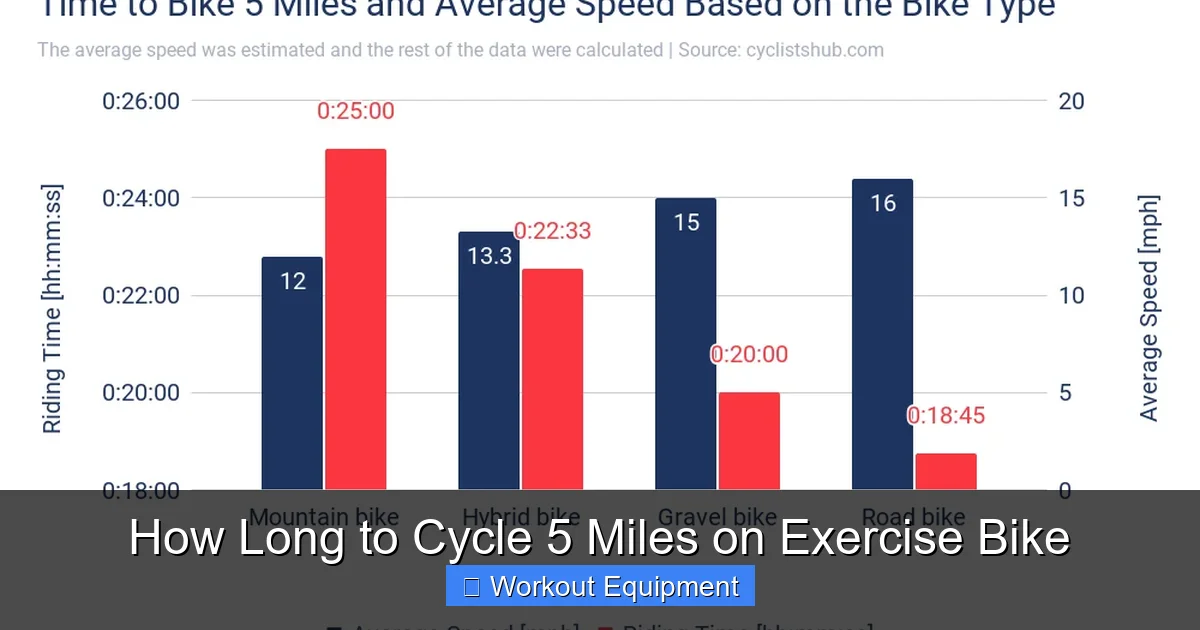
Visual guide about How Long to Cycle 5 Miles on Exercise Bike
Image source: cyclistshub.com
Beginner Rider (0-3 months consistent training)
If you’re new to structured exercise or returning after a long break, your body is still building its aerobic engine and muscular endurance. Expect a time in the 25 to 35-minute range. You might find yourself needing to adjust resistance down frequently, taking short breaks, or feeling your legs burn early on. That’s completely normal! The goal here is to complete the distance comfortably. A time at the higher end of this range (30+ minutes) is excellent for building a foundation. Focus on maintaining a cadence of 60-70 RPM at a resistance that feels “somewhat hard” but sustainable for the full duration.
Intermediate Rider (3-12 months of regular training)
You’ve moved past the initial hump. You can ride consistently for 30+ minutes, your recovery is better, and you understand how to push yourself. For you, 5 miles should take roughly 20 to 25 minutes. You’re likely comfortable at a cadence of 70-85 RPM and can handle moderate to moderately-high resistance without gasping for air. This is the sweet spot for many recreational fitness enthusiasts. You might even start incorporating short intervals (30 seconds faster, 90 seconds recovery) within your 5-mile ride to shave off a minute or two.
Advanced Rider (1+ year of dedicated training)
This is where efficiency and power meet. Advanced riders have trained their bodies to deliver and utilize oxygen at a high rate. They can sustain a challenging resistance while maintaining a strong, smooth cadence. For them, 5 miles is a solid warm-up or a short, sharp workout, often completed in 15 to 20 minutes. Elite indoor cyclists or those who supplement with other endurance sports might even dip below 15 minutes, maintaining speeds over 20 MPH. This requires not just fitness but also excellent technique and mental toughness to hold a high intensity without fading.
Important Note: These times assume a continuous, steady-state effort. If you’re doing high-intensity interval training (HIIT) on your bike—alternating all-out sprints with recovery—your average speed for the entire 5 miles might be different. A HIIT session could take longer due to recovery periods or be shorter if the sprints are extremely intense but brief. The averages above best describe a steady-pace endurance ride.
How to Calculate and Track Your Own 5-Mile Time
While averages are helpful, your personal benchmark is what truly matters. The beauty of modern exercise bikes is they do most of the math for you. Here’s how to find your number and use it effectively.

Visual guide about How Long to Cycle 5 Miles on Exercise Bike
Image source: cyclistshub.com
The Simple Math: Speed and Distance
The core formula is straightforward: Time = Distance / Speed. If your bike’s console shows your average speed in miles per hour (MPH), you can calculate your time. For example, if you average 12 MPH, your time for 5 miles is 5 / 12 = 0.416 hours, which is 0.416 * 60 = 25 minutes. Do this calculation after a few rides to see the relationship. If your average speed is 15 MPH, your time drops to 20 minutes. This formula is your best friend for setting targets. Want to ride 5 miles in 22 minutes? You need to average about 13.6 MPH.
Using Your Exercise Bike’s Metrics
Don’t overcomplicate it. Most bikes display:
- Distance: Usually in miles or kilometers. Ride until it hits 5.00.
- Time: The elapsed time. When you hit 5 miles, note this. This is your raw 5-mile time.
- Average Speed: The average MPH over your ride. Use this for the calculation above and to gauge effort.
- Calories: An estimate based on your weight (if entered) and effort.
Your simplest method: just ride 5 miles and record the time shown. Do this at the same resistance level and similar effort (e.g., “moderate”) a few times to establish a reliable baseline. Use a notebook or fitness app to log it.
Setting a Baseline and Monitoring Progress
Your first few timed 5-mile rides are about establishing a baseline, not breaking records. Go at a comfortable, sustainable pace. Note the time, the average resistance level, and your average RPM. This is your starting point. To improve, you can:
- Increase resistance slightly on future rides while trying to maintain or even improve your time (this builds power).
- Maintain resistance but work on cadence to pedal faster and reduce time (this improves cardiovascular efficiency).
- Combine both: Add a little resistance and push your cadence a bit.
Re-test your 5-mile time every 2-4 weeks under similar conditions. Seeing that number creep down is one of the most motivating things in fitness. It’s objective proof your engine is getting stronger.
Why 5 Miles? The Hidden Benefits of This Distance
You might be thinking, “Why focus on 5 miles? Why not 3 or 10?” Five miles is a fantastic, Goldilocks-zone distance for indoor cycling. It’s long enough to provide substantial cardiovascular and calorie-burning benefits, but short enough to fit into a busy schedule without causing dread. Let’s explore why this specific benchmark is so powerful.

Visual guide about How Long to Cycle 5 Miles on Exercise Bike
Image source: shape.com
Cardiovascular Health and Endurance
A sustained 20-30 minute effort, which is what a 5-mile ride typically is, hits the sweet spot for improving heart health. It’s long enough to elevate your heart rate into the aerobic zone (usually 60-80% of your max heart rate) and keep it there, strengthening your heart muscle and improving circulation. Regularly challenging your cardiovascular system in this way lowers resting heart rate, improves blood pressure, and increases overall stamina. You’ll notice it in daily life—climbing stairs, carrying groceries, or playing with kids feels easier.
Calorie Burn and Weight Management
The calorie burn from a 5-mile ride is significant and highly variable. A 150-pound person might burn 200-300 calories at a moderate pace, while a 200-pound person could burn 250-400. The exact number depends on the resistance and intensity we discussed. This makes 5-mile rides an excellent tool for creating a calorie deficit for weight management. It’s a manageable, repeatable session that, when combined with a balanced diet, contributes steadily to your goals. Plus, building muscle through higher resistance can boost your resting metabolic rate over time.
Low-Impact, Joint-Friendly Exercise
Unlike running or jumping, cycling is non-weight-bearing. Your joints—knees, hips, ankles—don’t absorb the impact of each stride. This makes a 5-mile ride on an exercise bike an ideal workout for people with arthritis, those recovering from injuries, or anyone who wants to protect their joints while still getting a fierce cardio workout. You can push your cardiovascular system hard without the pounding. This accessibility is a huge reason why indoor cycling is recommended by physical therapists and doctors for a wide population.
Mental Health and Stress Relief
Let’s not forget the mind. Twenty to thirty minutes of focused pedaling can be a form of moving meditation. The rhythmic motion, combined with the release of endorphins (those “feel-good” hormones), is a proven stress-buster. It clears mental fog, reduces anxiety, and boosts mood. Setting a tangible goal like “5 miles” gives your session purpose and a satisfying endpoint. The act of completing it, regardless of time, provides a sense of accomplishment. Pair it with your favorite podcast, music playlist, or even a guided meditation, and you’ve got a powerful daily mental health ritual.
How to Make Every 5-Mile Ride Count: Tips for Speed and Enjoyment
Want to improve your time? Or maybe you just want to make the ride more enjoyable so you stick with it. These strategies work for both.
Warm-Up and Cool-Down Routines
Never skip these. A 5-minute warm-up at very light resistance and a slow cadence (50-60 RPM) preps your muscles and heart, reducing injury risk and making the main effort feel smoother. Post-ride, a 5-minute cool-down gradually lowers your heart rate and prevents blood pooling. Include a few gentle stretches for quads, hamstrings, and calves. This routine makes the entire experience more comfortable and aids recovery, allowing you to ride more frequently.
Interval Training for Faster Times
To shave minutes off your steady-state time, incorporate intervals into some of your 5-mile rides. For example: ride the first mile at an easy warm-up pace. For miles 2-4, alternate: 1 minute at a resistance that feels “hard” (you can speak only in short phrases) with 1 minute at an easy recovery pace. Sprint the final mile (or last 0.5 miles) if you have it in you. This trains your body to handle higher intensities, improves your lactate threshold, and boosts your average speed over time. Start with just one or two intervals per ride and build up.
Music, Podcasts, and Entertainment
Distraction is a powerful tool. Create a high-energy playlist with songs that match your target cadence (e.g., 120-140 BPM for ~70-80 RPM). The rhythm can naturally pull your pedaling speed. Alternatively, listen to an engaging podcast or audiobook. If your bike has a screen or you use a tablet, watch a show. The key is to make the time fly by so you’re not staring at the distance ticker. Just be cautious with volume to stay aware of your body’s signals.
Proper Form and Ergonomics
Efficiency is speed. Check your form: keep your core engaged, back straight (not hunched), and elbows soft. Your knee should track over the ball of your foot as you pedal. A common mistake is “pumping” with the arms; keep upper body stable. A slight forward lean from the hips (on upright bikes) is more aerodynamic. If you’re on a recumbent, ensure your back is fully supported. Efficient form means less wasted energy, which translates directly to a faster 5-mile time with the same effort.
Common Mistakes That Slow Your 5-Mile Time (And How to Fix Them)
Even with the best intentions, some habits can sabotage your progress. Watch out for these.
Ignoring Resistance Settings
Many beginners (and even some intermediates) ride at too low a resistance because it’s “easier.” They spin their legs fast but with minimal force, generating little power and burning fewer calories. This can lead to a false sense of speed (high RPM, low MPH) and actually hinder fitness gains. Fix: Periodically increase resistance by 1-2 levels and work on maintaining your cadence. You should feel a significant push on the downstroke. Aim for a resistance where you’re working hard but can still pedal smoothly for the duration.
Poor Pedaling Technique
Are you only pushing down on the pedals? Efficient pedaling involves a full 360-degree stroke: push down, pull back, and sweep up. This engages more muscle groups (hamstrings, glutes) and creates a smoother, more powerful rotation. It also reduces knee strain. Fix: Practice with one-leg drills (if your bike allows) or just focus on “scrubbing” the pedal backwards on the upstroke. Imagine you’re trying to wipe mud off the bottom of your shoe.
Neglecting Consistency
One monumental effort followed by three days off won’t build lasting fitness. Fitness gains come from repeated, consistent stimulus. Sporadic riding means you’re always starting from scratch, so your 5-mile time never improves. Fix: Schedule your 5-mile rides like appointments. Even on tired days, do a shorter, easier ride. Consistency compounds. Over weeks, your baseline time will drop as your body adapts.
Setting Realistic Goals and Celebrating Progress
Your first goal shouldn’t be “cycle 5 miles in 18 minutes” unless you’re already advanced. Start with completion. Then, aim to finish within your category’s average range. Then, shave 1-2 minutes off your personal best. Use the progression: Finish → Time Goal → Pace Goal → Intensity Goal. And celebrate every milestone! That first time you break 25 minutes as a beginner? Huge. That moment you hold a higher resistance and still hit your target time? Celebrate that too. The 5-mile mark is a fantastic, repeatable measuring stick. It’s not about being the fastest; it’s about being better than you were last month. That’s a win every time.
Conclusion
So, how long does it take to cycle 5 miles on an exercise bike? As we’ve seen, the answer lives in a spectrum—from a steady 30+ minutes for those new to the saddle to a blistering sub-20-minute effort for the well-trained. Your time is a unique reflection of your current fitness, the resistance you choose, and your bike’s setup. The real power lies not in comparing yourself to others, but in using the 5-mile distance as a personal benchmark. It’s a practical, powerful tool for building a stronger heart, leaner muscles, and a more resilient mind. Start by finding your baseline time. Then, use the tips on resistance, cadence, and consistency to gradually bring that number down. Remember, every single mile you pedal is a victory for your health. Now, hop on that bike, set your course for 5 miles, and discover what your body can do. Your best time is waiting to be set.
Frequently Asked Questions
Is cycling 5 miles on an exercise bike a good workout?
Yes, absolutely. A 5-mile ride typically provides 20-30 minutes of moderate-to-vigorous cardiovascular exercise, which strengthens the heart, burns significant calories, and improves leg strength and endurance. It’s a highly efficient and time-effective workout suitable for most fitness levels.
How does resistance affect the time it takes to cycle 5 miles?
Higher resistance makes each pedal stroke harder, which usually slows your speed (cadence) if effort is constant. This increases your time for 5 miles but dramatically boosts calorie burn and muscular strength. Lower resistance allows for faster spinning and a shorter time but focuses more on pure cardio endurance.
Can I lose weight by cycling 5 miles a day?
You can, as part of a calorie-controlled diet. A 5-mile ride burns roughly 200-400 calories depending on your weight and intensity. Consistently creating a daily calorie deficit through diet and this exercise will lead to weight loss over time. Pair it with strength training for best results.
What is a good average speed for a 5-mile bike ride?
A good average speed varies by fitness. Beginners often average 10-12 MPH (25-30 min for 5 miles). Intermediates reach 12-15 MPH (20-25 min). Advanced riders sustain 15+ MPH (under 20 min). Focus on gradually increasing your own average speed rather than hitting a specific number.
Should I aim for a faster time or higher resistance?
Both have merit. For pure cardiovascular speed and endurance, work on maintaining a higher cadence at a moderate resistance to improve your time. For building leg strength, power, and maximizing calorie burn, prioritize increasing resistance, even if your time increases slightly. A balanced approach that cycles between these focuses is most effective.
How often should I do a 5-mile ride to see improvements?
For noticeable improvements in your time and fitness, aim for 3-5 sessions per week. Consistency is key. You can also vary the intensity—some days steady-state, some days with intervals. Allow at least one full rest day per week for recovery, especially when starting out.