Why Do My Feet Go Numb on an Elliptical
Feet going numb on an elliptical is a common but usually preventable issue. It’s primarily caused by nerve compression or restricted blood flow due to shoe tightness, improper foot positioning, or prolonged pressure. The fix often involves simple adjustments: wearing proper footwear, loosening straps, changing your stance, and taking short breaks. While rarely serious, persistent numbness warrants a doctor’s visit to rule out underlying conditions. Understanding the anatomy and your equipment is key to a comfortable, effective cardio session.
You’re in the zone, powering through a solid 20 minutes on the elliptical, heart rate up, feeling strong. Then, it happens. That familiar, tingling, “pins and needles” sensation creeps into your toes and spreads across the ball of your foot. Your foot has gone numb. You shift your weight, wiggle your toes inside your shoe, and maybe even hop off for a second. It’s frustrating, distracting, and honestly, a little worrying. Why do your feet go numb on an elliptical? You’re not alone—this is one of the most common complaints among elliptical users, from beginners to seasoned athletes. The good news? It’s almost always a mechanical or ergonomic issue you can fix yourself, not a sign of a major health crisis. Let’s break down exactly what’s happening to your feet, why this machine in particular is a culprit, and give you a clear, actionable plan to make your next workout numb-free.
Think of your foot as a complex network of bones, nerves, and blood vessels, all packed into a relatively small space. When you strap into an elliptical, you’re essentially creating a controlled environment where pressure and motion are constant. Numbness, clinically termed paresthesia, is your nervous system’s alarm bell saying, “Hey, a nerve is being compressed or a blood vessel is being pinched, and signals aren’t getting through properly!” It’s not that your foot is “asleep” in the literal sense; it’s that the communication highway between your foot and your brain has a temporary roadblock. On an elliptical, several factors combine to create that roadblock. We’ll explore the anatomy, the specific machine-related causes, and arm you with solutions so you can focus on your fitness, not your tingling toes.
Key Takeaways
- Primary Cause is Compression: Numbness is typically due to pressure on nerves (like the peroneal nerve) or blood vessels in your feet or ankles, not a problem with the elliptical itself.
- Shoes Are the #1 Culprit: Tight laces, rigid soles, or worn-out shoes are the most frequent reasons for “asleep” feet during elliptical workouts.
- Form & Position Matter: Placing too much weight on your toes, not using the heel, or an unnatural foot angle can pinch nerves and restrict circulation.
- It’s Usually Fixable: Simple changes like loosening straps, adjusting foot placement, wearing different socks, or taking micro-breaks often resolve the issue immediately.
- Know When to Worry: If numbness persists for hours after your workout, occurs without exercise, or is accompanied by pain/weakness, consult a doctor to rule out conditions like tarsal tunnel syndrome.
- Elliptical Design Plays a Role: The fixed, oscillating motion and pedal design can exacerbate poor form or fit issues that might not occur on other machines.
📑 Table of Contents
- The Anatomy of Numbness: What’s Actually Happening in Your Foot?
- The Usual Suspects: 6 Common Causes of Elliptical Foot Numbness
- Immediate Fixes: What to Do The Next Time Your Feet Go Numb
- Long-Term Solutions: Setting Yourself Up for Numb-Free Success
- When to See a Doctor: Red Flags to Heed
- Elliptical-Specific Tips: Maximizing Your Machine’s Design
- Conclusion: Comfort is a Component of Fitness
The Anatomy of Numbness: What’s Actually Happening in Your Foot?
To solve the problem, you need to understand the scene of the crime. Two main systems are involved when your foot goes numb: your nerves and your blood vessels.
Nerve Compression: The Pinched Wire
Your feet are innervated by several key nerves. The most common suspect in elliptical-induced numbness is the deep peroneal nerve, which runs along the top of the foot and between the metatarsal bones (the long bones in your mid-foot). It’s responsible for sensation between your first and second toes. If pressure is applied directly on top of the foot—from a tight shoe strap, a rigid tongue, or even an improperly positioned foot on the pedal—this nerve can get compressed. Another potential, though less common, site is the tarsal tunnel on the inside of your ankle, where the tibial nerve passes. Pressure here can cause numbness across the sole of the foot.
When a nerve is compressed, its protective myelin sheath is squeezed. This disrupts the electrochemical signals traveling to and from your brain. The “pins and needles” (the medical term is paresthesia) is actually the nerve firing erratically as the pressure is released and blood flow returns. It’s a warning signal that if the compression continues, it could lead to more prolonged issues like neuropathy.
Blood Flow Restriction: The Clogged Highway
Your circulatory system is just as important. Arteries deliver oxygenated blood to your foot, and veins return deoxygenated blood. Tight shoes—especially around the mid-foot or ankle—can act like a tourniquet, squeezing the dorsalis pedis artery on the top of the foot or veins that need to pump blood back against gravity. When venous return is restricted, blood pools, and oxygen delivery drops. Nerves are extremely sensitive to oxygen deprivation; they start malfunctioning quickly, leading to numbness. This is often why you might feel your foot is not only numb but also slightly cool or looks a bit pale when you take your shoe off.
The key takeaway from anatomy? Numbness is a symptom of pressure, not the cause itself. Our job is to find what’s applying that pressure on the elliptical.
The Usual Suspects: 6 Common Causes of Elliptical Foot Numbness
Now for the detective work. Based on thousands of user reports and biomechanical analysis, here are the top six reasons your feet protest on the elliptical, ranked from most to least likely.
Visual guide about Why Do My Feet Go Numb on an Elliptical
Image source: high-tech-fitness.com
1. Your Shoes Are the Problem (It’s Almost Always the Shoes)
This is the heavyweight champion of foot numbness causes. The elliptical is a low-impact machine, but it still forces your foot into a repetitive, constrained motion. If your footwear isn’t up to the task, it’s a recipe for disaster.
- Too Tight: Overzealous lacing, especially if you use the “lock lacing” technique across the top of the foot, can create a literal band of pressure right over the dorsal nerves. This is the #1 cause of “top of the foot” numbness.
- Wrong Sole: Shoes with an extremely stiff, inflexible sole (like some work boots or worn-out running shoes) don’t allow your foot to flex naturally with the elliptical’s rocker motion. This forces pressure points onto specific areas.
- Old & Worn Out: A shoe that has lost its cushioning and structural support allows your foot to slide and shift inside, creating friction and pressure points. The midsole foam compresses, offering no shock absorption.
- Wrong Type: Running shoes are designed for a heel-to-toe strike. Ellipticals have a flat, gliding motion. Cross-training shoes or dedicated “elliptical shoes” with a more flexible forefoot and a lower profile often work better. Bulky hiking boots or fashion sneakers are terrible choices.
2. Foot Position & Pedal Stance
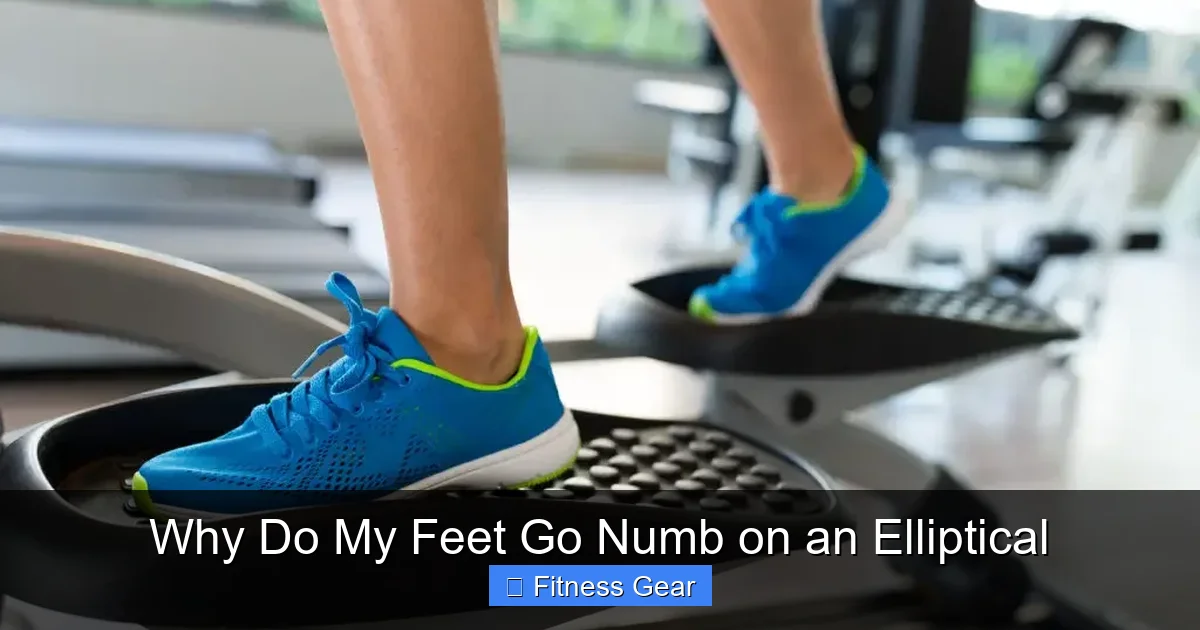
How you place your foot on the pedal is critical. The elliptical pedal is not a flat surface; it’s a rocker. A common mistake is standing with the ball of the foot too far forward on the pedal, near the front axle. This puts immense pressure on the metatarsal heads (the bony pads just below your toes) and the nerves between them. It also shifts your center of gravity forward, making you work harder and strain your knees.
The correct position is to place your heel slightly back, so the pedal axle is roughly in line with the arch of your foot or just behind it. Your entire foot should be in contact with the pedal. You should feel pressure distributed across your heel, mid-foot, and ball of the foot. If you’re “up on your toes” the whole time, numbness in the ball of the foot is inevitable.
3. Straps and Buckles (on Specific Elliptical Models)
Some ellipticals, particularly older models or certain commercial brands, have adjustable straps or buckles over the top of the foot to secure it. These are notorious for causing numbness if tightened too much or if the strap material is rigid. They create a direct, concentrated pressure line across the dorsum (top) of the foot. If your machine has these, loosen them significantly. Your foot should be stable but not constricted. You should be able to wiggle your toes freely.
4. Sock Choice & Foot Swelling
What’s between your foot and your shoe matters. Thick, bulky socks with heavy seams (especially across the toes or the top of the foot) can create pressure points. On the other hand, very thin socks offer no cushioning and can increase friction. During a workout, your feet naturally swell due to increased blood flow and gravity. If your shoes were already a bit snug, this slight swelling (even ½ shoe size) is enough to squeeze nerves and vessels. This is why a shoe that fits perfectly in the store might cause numbness after 10 minutes of cardio.
5. Underlying Medical Conditions (The Less Common, But Important, Cause)
For a small percentage of people, the elliptical simply unmasks a pre-existing, subclinical issue. Conditions like mild peripheral neuropathy (often from early diabetes), a tarsal tunnel syndrome, a Morton’s neuroma (a benign nerve thickening between the toes), or even a slight anatomical variation (like an extra bone) can make the foot more susceptible to compression. The repetitive motion and pressure of the elliptical aggravate the already-sensitive nerve. If numbness is your only symptom and it’s fixed by shoe/form changes, this is unlikely. But if numbness occurs with other activities or lingers for hours, it’s a red flag.
6. Duration & Lack of Movement
The elliptical’s motion is smooth and gliding, which is great for joints but can lull you into a static foot position. Unlike running, where your foot flexes and rolls dynamically, on an elliptical your foot is locked in a relatively fixed angle on the pedal for the entire stroke. If you’re not consciously flexing your ankle or shifting pressure from heel to toe, you’re creating a prolonged, static compression point. Simply not moving your foot enough is a cause in itself.
Immediate Fixes: What to Do The Next Time Your Feet Go Numb
Don’t just suffer through it. The moment you feel that telltale tingle, take action. These are on-the-fly adjustments you can make mid-workout.

Visual guide about Why Do My Feet Go Numb on an Elliptical
Image source: empoweryourwellness.online
Unlace and Re-lace Strategically
Stop the machine. Take your shoe off and re-lace it using a technique that relieves top-of-foot pressure. Skip the middle eyelets (the ones over the highest part of your instep). This creates a “pressure relief zone.” Or, use “heel lock” lacing only—criss-cross the laces up to the ankle, then use the lock technique. This secures the heel without tightening across the mid-foot.
Adjust Your Foot Placement on the Pedal
consciously shift your foot backward so your heel is closer to the back edge of the pedal. You should feel your weight settle more into your heel during the “push” phase. If your feet are small and the pedal is large, you might even benefit from placing them slightly inward (toes pointed slightly in) or outward to find a more natural, pressure-free angle. Experiment while moving slowly.
Wiggle, Point, and Flex
Don’t just wiggle your toes inside your shoe. Every few minutes, actively point your toes down (plantarflex) and then pull them up toward your shin (dorsiflex). This mobilizes the ankle joint, pumps blood, and shifts pressure around. Do 5-10 repetitions with each foot.
Take a Micro-Break
Stop for 30 seconds. Step off the machine, shake your legs out, and walk in place. This resets circulation and nerve pressure. It’s better to lose 30 seconds of workout time than to train with compromised form and sensation for 20 minutes.
Loosen or Remove Straps
If your elliptical has foot straps, unbuckle them completely. You likely don’t need them at all if your foot placement is correct and you’re not sprinting at high resistance. The elliptical motion naturally keeps your foot on the pedal.
Long-Term Solutions: Setting Yourself Up for Numb-Free Success
Prevention is always better than a mid-workout intervention. Invest a little time and thought into these areas for a permanent fix.
Footwear Overhaul: The Right Shoe for the Job
This is your most important purchase for elliptical comfort. Look for these features:
- Low or No Heel-to-Toe Drop: A “zero-drop” or very low-profile shoe (like many minimalist or cross-trainers) allows your foot to sit flat on the pedal without forcing your toes down.
- Flexible Forefoot: You should be able to bend the shoe easily at the ball of the foot. This accommodates the elliptical’s rocking motion.
- Secure Mid-Foot Fit: The shoe should hold your mid-foot snugly without pressure on the top. A padded tongue and a lacing system that allows you to avoid the instep are key.
- Adequate Toe Box: Your toes should have a little wiggle room. A cramped toe box increases pressure on the nerves between the toes.
- Consider Dedicated Shoes: If you use the elliptical frequently (3+ times a week), consider buying an inexpensive pair of cross-training or “gym” shoes specifically for it. Don’t use your worn-out running shoes.
Brands like New Balance, Reebok (Nano series), Nike (Metcon or some training models), and ASICS (GEL-Quantum series) often have models that fit these criteria. Try them on at the end of the day when your feet are slightly swollen, and wear the socks you plan to use for your workouts.
Sock Strategy: Thin, Seamless, and Moisture-Wicking
Ditch the thick cotton athletic socks. Opt for:
- Material: Synthetic blends (polyester, nylon, olefin) or merino wool. They wick moisture, reduce friction, and are thinner.
- Construction: “No-show” or “low-cut” socks with a seamless toe closure. The seam over the toes is a classic pressure point creator.
- Fit: They should be snug but not tight. No elastic bands that cut into your ankle or mid-foot.
Machine Setup & Form Drills
Your elliptical has settings for a reason. Use them!
- Stride Length: If adjustable, set it so your legs are comfortably extended but not locked at the furthest point. Over-extending can change foot angle and pressure.
- Resistance: Higher resistance isn’t always better. Sometimes, lower resistance with a faster stride allows for more natural foot movement and less static pressure.
- Console & Posture: Stand up straight! Don’t lean on the handles. Engage your core. Good posture aligns your entire kinetic chain, from hip to foot. Hunching forward shifts weight unnaturally onto the balls of your feet.
- Mindful Striding: Practice a “full-foot” press. Imagine scrubbing the floor with the sole of your foot. Push through your heel on the backward phase and roll through the entire foot on the forward phase. This distributes pressure.
Strengthen & Mobilize
Weak foot and ankle muscles can’t support the arch or control motion as well, leading to collapse and pressure points. Simple exercises help:
- Towel Scrunches: Place a towel on the floor. Use your toes to scrunch it toward you, then push it away. Do 2-3 sets of 15 reps per foot.
- Heel Raises (Calf Raises): Strengthens the calf muscles that support the ankle and foot’s rear.
- Ankle Alphabet: Sit with your leg elevated. Trace the letters of the alphabet in the air with your big toe. This mobilizes the entire ankle joint through all ranges of motion.
When to See a Doctor: Red Flags to Heed
While 95% of elliptical foot numbness is benign and fixable with the steps above, you must listen to your body if symptoms suggest something deeper. Consult a podiatrist or your primary doctor if:

Visual guide about Why Do My Feet Go Numb on an Elliptical
Image source: hurstpodiatry.com.au
- Numbness persists for more than 1-2 hours after you’ve stopped exercising and taken off your shoes. Normal nerve compression resolves quickly once pressure is removed.
- The numbness occurs with other activities like sitting with legs crossed, wearing different shoes, or even while sleeping.
- You experience pain, burning, or weakness in the foot or leg along with the numbness.
- You have symptoms in both feet symmetrically, which can point to a systemic issue like diabetes-related neuropathy.
- You’ve made all the footwear and form adjustments and the numbness returns within 5 minutes of starting your workout, every time.
A doctor can perform a physical exam, nerve conduction studies, or ultrasound to diagnose conditions like Morton’s neuroma, tarsal tunnel syndrome, or nerve entrapment. Treatment may range from custom orthotics and physical therapy to, in rare cases, minor procedures.
Elliptical-Specific Tips: Maximizing Your Machine’s Design
Finally, understand your tool. The elliptical’s design has inherent pros and cons for foot health.
The Fixed Motion: A Double-Edged Sword
The elliptical’s path is predetermined. This is great for joint safety but means your foot follows the same arc every single stride. If that arc is even slightly misaligned with your natural foot angle or your shoe’s flex point, it creates a repetitive stress. Solution: If your machine has adjustable Q-factor (the distance between the pedal axles), a wider setting can sometimes reduce inward foot rolling (pronation) that pinches nerves. Also, ensure the machine is level.
Pedal Size and Shape
Some pedals are very narrow, forcing your foot into a “ski boot” position. Others are oversized. If you have a narrow foot on a wide pedal, you might be straining to keep your foot stable, engaging muscles unnaturally. Find the center of the pedal and place your foot so it’s stable without your toes hanging off the edge or your heel riding up on the back.
Arm vs. Leg Emphasis
Are you pushing and pulling primarily with your arms? This often leads to a “hanging” leg position where you’re not actively engaging your lower body, causing your feet to slap down and shift on the pedals. Focus on driving through your heels and engaging your glutes and hamstrings. Your legs should do the majority of the work. This active engagement promotes better foot alignment and pressure distribution.
Conclusion: Comfort is a Component of Fitness
Feet going numb on an elliptical is your body’s feedback that something in your setup—your shoe, your sock, your form, or your machine settings—is creating a harmful pressure point. It’s a sign to pause and adjust, not to push through. By systematically addressing the causes—starting with your footwear and foot position—you can eliminate this nuisance for good. Remember, the goal of exercise is to build health and strength, not to cause temporary nerve damage or chronic discomfort. A numb foot means you’re not getting the full benefit of your workout because you’re distracted, and you might be developing bad movement habits. Take the time to implement the fixes in this guide. Your feet carry you through life; they deserve to be comfortable and healthy while you carry them through your fitness journey. So lace up correctly, mind your form, and get back to enjoying that smooth, gliding cardio—sensation intact.
Frequently Asked Questions
Is foot numbness on the elliptical dangerous?
In the vast majority of cases, it’s not dangerous and is simply caused by temporary nerve compression from tight shoes or poor form. However, if numbness persists long after your workout, occurs without exercise, or is accompanied by pain or weakness, you should see a doctor to rule out underlying conditions like neuropathy or nerve entrapment.
What is the best type of shoe to wear on an elliptical?
Look for a low-profile, flexible cross-training or gym shoe with a secure mid-foot fit, a wide toe box, and minimal heel-to-toe drop. Avoid rigid running shoes, boots, or shoes with thick, stiff soles. The shoe should allow your foot to bend naturally with the pedal’s rocking motion.
Can poor circulation really cause my feet to go numb?
Yes. Tight shoes or straps can act like a tourniquet, squeezing blood vessels and restricting both arterial flow and venous return. Nerves are highly sensitive to reduced oxygen from poor circulation, leading to numbness. Loosening footwear often improves circulation instantly.
Should I stop exercising if my feet go numb?
Yes, you should stop or at least pause and fix the issue immediately. Continuing to exercise while numb can prolong nerve compression and potentially worsen the problem. Step off, adjust your shoes and foot position, wiggle your toes, and only resume once sensation returns.
Could this be a sign of diabetes or neuropathy?
It’s possible, but unlikely if the numbness only occurs on the elliptical and is resolved by adjusting shoes or form. Diabetic neuropathy typically causes symmetrical numbness in both feet that is present during daily activities, not just during exercise. If you have other risk factors or symptoms, consult a doctor.
Are there specific elliptical settings that help prevent numbness?
Yes. Ensure your foot placement is correct (heel slightly back, not on the ball of the foot). If your machine has an adjustable Q-factor (pedal width), a slightly wider stance may help. Most importantly, focus on using your legs to drive the motion rather than leaning on your arms, which promotes better foot alignment and weight distribution.