Which Is Better to Burn Fat Treadmill or Elliptical

The treadmill typically burns more calories per hour, making it a potent tool for fat loss, but the elliptical offers a significantly lower-impact workout that’s gentler on joints while still providing a strong cardiovascular challenge. The “better” machine truly depends on your individual fitness level, any existing injuries, and your personal preference for movement, as consistency in your workouts is the ultimate key to burning fat.
So, you’ve decided it’s time to focus on fat loss. You’ve sorted your diet, you’re committed, and you’re standing in the gym or your home gym, staring at two of the most popular cardio machines: the treadmill and the elliptical. The question echoes in your mind: which is better to burn fat, treadmill or elliptical? It’s a fantastic question, and the answer isn’t as simple as “this one is best.” The truth is, both are powerful, effective tools for shedding body fat and improving your health. The “better” choice hinges on your unique body, your goals, your history with injuries, and—perhaps most importantly—which machine will make you actually want to work out day after day. Let’s dive deep into the science, the mechanics, and the practical realities to help you make an informed decision.
First, let’s establish a fundamental principle: fat loss occurs when you create a caloric deficit, meaning you burn more calories than you consume. Both the treadmill and elliptical are excellent vehicles for burning those calories and improving your cardiovascular fitness, which in turn boosts your metabolism. The debate centers on efficiency, sustainability, and safety. We’ll compare them head-to-head on key metrics like calorie expenditure, joint stress, muscle activation, and workout versatility. By the end, you’ll have a crystal-clear picture of which machine aligns best with your personal fat-loss journey.
Key Takeaways
- Calorie Burn: Treadmills generally have a slight edge in raw calorie expenditure per hour at comparable effort levels, primarily due to the weight-bearing nature of running.
- Joint Impact: Ellipticals are the clear winner for low-impact exercise, drastically reducing stress on knees, hips, and ankles compared to a treadmill.
- Muscle Engagement: Treadmills focus on lower body (quads, hamstrings, glutes, calves); ellipticals engage both upper and lower body (arms, chest, back, legs) for a more full-body workout.
- Perceived Exertion: You often feel like you’re working harder on an elliptical for the same physiological output, which can be a psychological advantage for longer sessions.
- Injury & Accessibility: The elliptical is often recommended for those with joint issues, arthritis, or during rehabilitation, while treadmills are better for weight-bearing bone density benefits.
- Consistency is King: The best machine for burning fat is the one you will use regularly and enjoy. Personal preference and long-term adherence trump minor statistical differences.
- Workout Variety: Both machines can be manipulated with incline, resistance, and speed to create highly effective, varied fat-burning routines (like HIIT).
📑 Table of Contents
- The Science of Fat Burning: It’s All About the Burn
- Impact on Your Joints: The Treadmill vs. Elliptical Showdown
- Muscle Activation: Full Body vs. Lower Body Focus
- Workout Versatility and Intensity: Creating the Fat-Burning Burn
- The Psychology of Movement: Which Will You Actually Use?
- Making Your Choice: A Personalized Decision Framework
- Pro-Tips to Maximize Fat Burn on ANY Machine
The Science of Fat Burning: It’s All About the Burn
Before we compare machines, we need to understand what “burning fat” means in an exercise context. During moderate-intensity exercise, your body uses a mix of stored carbohydrates (glycogen) and fat for fuel. As your workout duration increases, the percentage of energy derived from fat rises. High-intensity exercise burns more total calories and a higher rate of fat *per minute*, but also relies more on carbohydrates. The key takeaway? The machine that helps you sustain a higher total weekly calorie burn, in a way you can maintain consistently, is your winner.
Metabolic Efficiency: Which Machine Moves the Needle More?
Numerous studies and metabolic calculators suggest that, pound for pound, running on a treadmill will typically burn 5-15% more calories per hour than using an elliptical at a “perceived similar” effort. Why? Running is a weight-bearing activity. You’re propelling your entire body mass upward against gravity with each stride. This requires more total energy output. The elliptical’s moving platform absorbs much of that impact and momentum, making it easier to keep going at the same speed with less relative effort. However, this “easier” feeling can be deceptive. The elliptical’s upper-body involvement adds a significant calorie-burning component that many people underutilize. If you actively push and pull with your arms, you can close that calorie gap considerably.
Here’s a practical example: A 155-pound person might burn approximately 700 calories running at 6 mph on a treadmill for 30 minutes. The same person might burn around 500 calories on an elliptical at a moderate resistance in 30 minutes. But if that person increases the elliptical’s resistance to a very challenging level and uses the moving arms aggressively, they could easily hit 600+ calories. The treadmill’s advantage is in its raw, unassisted power. The elliptical’s advantage is in its ability to allow for a longer, more sustained effort with less fatigue from impact, potentially leading to a higher total weekly volume.
Impact on Your Joints: The Treadmill vs. Elliptical Showdown
This is arguably the most critical factor for long-term success and injury prevention. Joint health dictates whether you can work out consistently for years to come.

Visual guide about Which Is Better to Burn Fat Treadmill or Elliptical
Image source: healthncare.info
The Treadmill: High-Impact, High Reward (and Risk)
Running, even on a cushioned treadmill deck, is a high-impact activity. With each foot strike, your joints absorb a force equal to 1.5 to 3 times your body weight. Over time, this repetitive stress can contribute to issues like runner’s knee, shin splints, or exacerbate existing conditions like arthritis. However, this impact is a double-edged sword. Weight-bearing exercise is crucial for building and maintaining bone density (osteoporosis prevention) and strengthening the stabilizing muscles around your joints. If you have healthy joints and proper form, the treadmill’s impact is a beneficial stimulus. If you have a history of joint pain, are significantly overweight, or are returning from an injury, that constant pounding can quickly become a barrier to consistency.
The Elliptical: The Low-Impact Champion
The elliptical’s defining feature is its smooth, continuous, and circular motion. Your feet never leave the pedals, and the machine’s design guides the path of motion. This eliminates the jarring impact of foot strike. The stress on your ankles, knees, and hips is dramatically reduced—often by 50% or more compared to running. This makes the elliptical an exceptional choice for:
- Individuals with arthritis, chronic joint pain, or those recovering from lower-body injuries.
- People who are obese or significantly overweight, as it allows for calorie burning without excessive joint load.
- Older adults seeking cardiovascular benefits without wear-and-tear.
- Anyone needing a “recovery day” workout that still burns fat without hindering recovery from heavy weight training.
The trade-off is the lack of weight-bearing stimulus. You won’t get the same bone-strengthening benefits as you would from running. For pure fat loss with minimal injury risk, the elliptical is the safer, more sustainable option for a broader population.
Muscle Activation: Full Body vs. Lower Body Focus
Where and how your muscles work during the exercise influences your metabolism, physique, and workout fatigue.

Visual guide about Which Is Better to Burn Fat Treadmill or Elliptical
Image source: ellipticalking.com
Treadmill: The Lower Body Powerhouse
Walking or running on a treadmill primarily targets the major muscle groups of the lower body: quadriceps (front of thigh), hamstrings (back of thigh), glutes (buttocks), and calves. Adding incline dramatically increases glute and hamstring engagement, turning it into a serious leg and booty workout. Your core (abdominals and lower back) works isometrically to stabilize your torso. However, your upper body remains largely passive, aside from the arm swing. This focused lower-body work is excellent for building leg strength and endurance, but it limits the total muscle mass involved in the movement. More muscle mass engaged generally means a higher calorie burn.
Elliptical: The Total-Body Torch
A true elliptical (not an ” elliptical trainer” with fixed handles) has movable arms. This design engages the upper body in a pushing and pulling motion, activating the chest (pectorals), back (latissimus dorsi, rhomboids), shoulders (deltoids), and arms (biceps, triceps). When you use the handles with purpose, you transform the workout from primarily leg-driven to a coordinated full-body motion. This simultaneous upper and lower body engagement increases oxygen consumption and heart rate more than lower-body-only work at the same speed. It’s a more efficient full-body circuit in one machine. For overall metabolic conditioning and balanced muscle development, the elliptical has a clear advantage. The key is to *use the arms*. Many people set the resistance high but then lean on the machine and let the arms swing passively, negating this major benefit.
Workout Versatility and Intensity: Creating the Fat-Burning Burn
Both machines are incredibly versatile, but they offer different tools for manipulating intensity, which is crucial for maximizing fat burn through methods like High-Intensity Interval Training (HIIT).
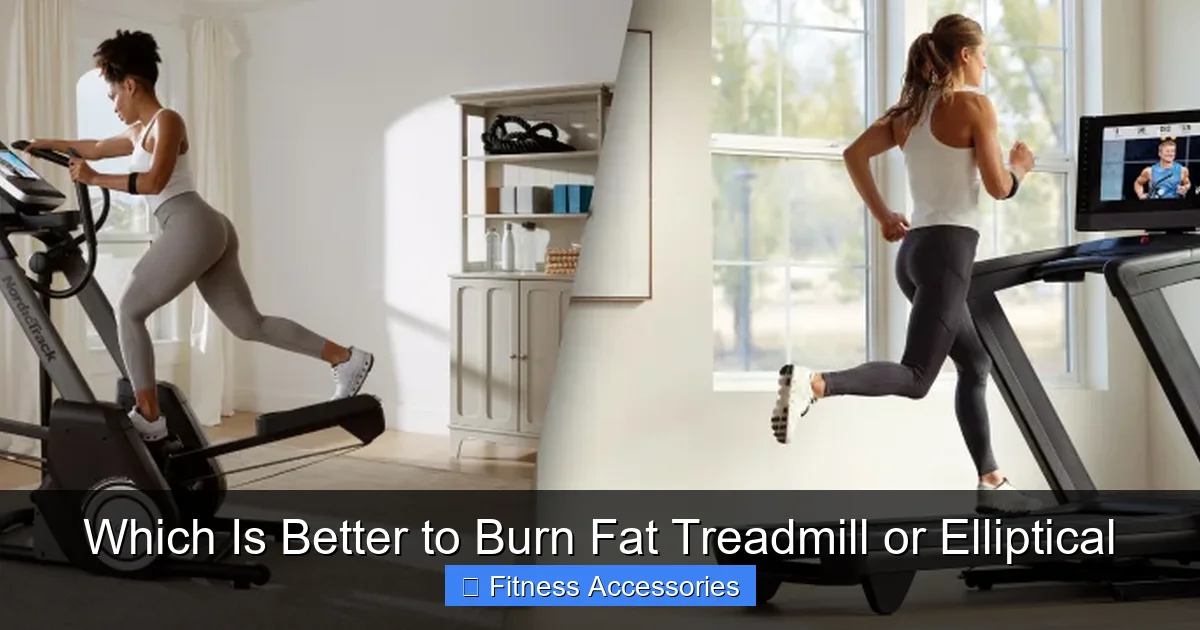
Visual guide about Which Is Better to Burn Fat Treadmill or Elliptical
Image source: blog.nordictrack.com
Treadmill Tools: Speed and Incline
The treadmill gives you two primary variables: speed and incline. This is a potent combination for interval training.
- Speed Intervals: Alternating between a fast run/jog and a slow walk or rest. Simple and brutally effective for spiking your heart rate.
- Incline Intervals: Walking or running at a steep incline (e.g., 8-12%) simulates hill climbing. This builds immense leg strength and burns a huge number of calories with less perceived joint stress than running fast on a flat surface.
- Combo Intervals: The classic “hill sprint” workout: high speed on a low incline followed by low speed on a high incline. This maximizes both cardiovascular and muscular endurance.
The treadmill’s limitation is that you can’t easily adjust resistance; you adjust the grade (incline) which changes the muscle emphasis.
Elliptical Tools: Resistance and Reverse Motion
The elliptical’s primary tool is resistance. You can dial up the tension on both the upper and lower body components independently on some models, creating a muscle-burning strength-cardio hybrid. Other key features:
- Reverse Stride: Most ellipticals allow you to pedal backward. This shifts the muscle emphasis to your glutes and hamstrings in a novel way, preventing adaptation and providing a different stimulus.
- Variable Resistance: You can create a “hill” simulation by gradually increasing resistance over a set time, mimicking a climb without the joint impact.
- Upper-Body Focus: You can set a high resistance and use only your arms for a pure upper-body cardio burst, or vice versa.
The elliptical’s interval potential is huge, but it requires more conscious effort to create the same dramatic heart rate spikes as a treadmill sprint. A 30-second all-out effort on an elliptical, even at max resistance, may not reach the same peak speed as a treadmill sprint, but it will deeply fatigue the muscles.
The Psychology of Movement: Which Will You Actually Use?
This is the non-negotiable section. The best fat-burning machine is a paperweight if it collects dust. The sensory and psychological experience of each machine is profoundly different.
The Treadmill Experience: Familiar, Forgiving, and Boring?
Walking or running is a natural, ingrained movement pattern for most people. The treadmill feels familiar. The console often provides entertainment (TV, internet, virtual trails). However, the monotony of staring at a wall or a screen while running in place is legendary. The impact, while beneficial, can also lead to mental fatigue and a sense of “punishment.” For some, the rhythmic pounding is meditative. For others, it’s a quick path to boredom. The key is distraction (podcasts, playlists) or using the time for mindful movement.
The Elliptical Experience: Smooth, Engaged, and Complex
The elliptical motion is less natural. It requires a bit of coordination to use properly, especially with the arms. This initial learning curve can be a barrier. However, once mastered, the motion is incredibly smooth and fluid. The lack of impact makes it feel “easier,” which can be a major plus for longer, steady-state sessions where you want to watch a show or read without the jarring distraction. The full-body engagement means your mind is also engaged in coordinating the arm-leg push-pull pattern. For many, this subtle mental engagement makes the time pass faster. The challenge is avoiding the “coasting” trap where you stop actively pushing with your arms and just let the machine move you.
Making Your Choice: A Personalized Decision Framework
Now, let’s translate all this into a simple decision-making process. Grab a notepad and answer these questions.
Ask Yourself: What’s My Current Joint Health?
- If you have knee, hip, or ankle pain, are overweight, or have been diagnosed with arthritis: Start with the elliptical. It is the safest, most sustainable path to begin burning fat without risking injury. You can always add treadmill work later as you lose weight and strengthen supporting muscles.
- If you are injury-free, have good joint mobility, and enjoy running: The treadmill is a fantastic, efficient tool. Just prioritize good form (short, quick strides, mid-foot strike) and listen to your body.
Ask Yourself: What Are My Primary Goals?
- Maximize calorie burn in minimal time, and you love running: Treadmill with incline intervals is hard to beat.
- Build full-body endurance and muscle tone while burning fat: Elliptical with purposeful arm engagement and varied resistance is your best bet.
- Improve bone density (e.g., post-menopausal women): Weight-bearing treadmill work is beneficial, but should be balanced with strength training.
- Need a “recovery” cardio day that still counts: Elliptical is perfect for active recovery.
Ask Yourself: What Will I Do Consistently?
This is the most important. Be brutally honest.
- Do you find running monotonous and dread it? The elliptical’s different motion might keep you engaged.
- Do you feel uncoordinated or silly on the elliptical? The natural gait of the treadmill might be more comfortable.
- Try both machines for 20 minutes each, with the honest intention of using them 3 times a week for a month. Which one did you look forward to more? Which one did you feel you could push harder on? Your emotional response is a powerful predictor of adherence.
Pro-Tips to Maximize Fat Burn on ANY Machine
Regardless of your choice, you must use it correctly to maximize fat loss. Here’s how:
Forget “Fat-Burning Zone” Nonsense
Old-school charts suggested working at 60-70% of your max heart rate to “burn fat.” This is misleading. Yes, at very low intensities, a higher *percentage* of calories comes from fat. But the *total* calories burned are so low that it’s inefficient. For fat loss, you want to maximize total caloric expenditure. Higher-intensity work (70-85%+ of max HR) burns way more total calories and creates an “afterburn effect” (Excess Post-Exercise Oxygen Consumption, or EPOC), where your metabolism stays elevated for hours afterward. Use interval training.
Sample Treadmill HIIT for Fat Loss
Warm-up: 5 min brisk walk/jog.
Workout: Repeat 8 rounds.
- 30 seconds: Run at a challenging pace (8-9/10 effort)
- 60 seconds: Walk or very slow jog for active recovery
Cool-down: 5 min walk.
Sample Elliptical HIIT for Fat Loss
Warm-up: 5 min easy pedaling, no arms.
Workout: Repeat 10 rounds.
- 45 seconds: Increase resistance to a very hard level (8-9/10 effort) and PUSH with arms and legs.
- 75 seconds: Lower resistance to easy, active recovery, focus on steady motion.
Cool-down: 5 min easy.
Resistance and Incline Are Your Friends
Never just go through the motions. To build muscle and burn more calories, you must create a challenge. On the treadmill, use incline. Even a 1-2% grade simulates outdoor wind resistance and engages your glutes more. On the elliptical, turn that resistance dial up until your legs are burning at the end of the interval. Muscle is metabolically active tissue. The more muscle you engage and fatigue, the more calories you burn during and after the workout.
Fuel Properly and Stay Hydrated
You cannot out-train a bad diet. Fat loss is 80% nutrition. Ensure you’re in a modest caloric deficit with adequate protein to preserve muscle. Dehydration drastically reduces performance and perceived energy. Drink water before, during (if long session), and after.
Frequently Asked Questions
Is the treadmill or elliptical better for belly fat specifically?
You cannot spot-reduce fat from your belly. Both machines are excellent for overall fat loss, which will eventually reduce belly fat. The treadmill may have a slight edge in total calorie burn, but the elliptical’s lower impact may allow for longer, more frequent sessions, leading to greater overall deficit. Consistency with either, combined with a healthy diet, is what matters.
Which is better for a complete beginner who is overweight?
The elliptical is almost always the better starting point for an overweight beginner. Its low-impact nature protects vulnerable joints from the constant stress of walking or running, allowing you to build cardiovascular fitness and lose initial weight without pain or injury. You can start at a very low resistance and gradually increase.
Can I get a good workout on an elliptical without using the moving arms?
Yes, but you’re missing the primary benefit. Using only your legs turns the elliptical into a lower-body-only machine, similar to a stationary bike but with different biomechanics. You’ll still burn calories and improve leg endurance, but the calorie burn and full-body engagement will be significantly lower. Always strive to incorporate the arm motion for maximum effectiveness.
Does running on a treadmill burn more calories than an elliptical at the same speed?
Yes, generally. If you set a treadmill to 6 mph and an elliptical to a speed equivalent to your leg turnover (often called “strokes per minute”), the treadmill will burn more calories because it’s weight-bearing. The elliptical’s speed number is not directly comparable to a treadmill’s mph due to its different mechanics and momentum.
I have bad knees. Is the elliptical completely safe?
The elliptical is considered a safe, low-impact option for most people with knee issues, but “safe” is individual. The motion is gentle, but if you have a specific injury (like a torn meniscus or severe osteoarthritis), you must consult a doctor or physical therapist. Start with no resistance, perfect your form (full stride, no rocking hips), and stop immediately if you feel pain. It’s often recommended, but professional guidance is key for specific diagnoses.
Should I use both machines in my weekly routine?
Absolutely! Using both is a fantastic strategy. You could do 2 days of treadmill (e.g., interval runs) and 1-2 days of elliptical (e.g., steady-state or resistance-focused). This variety prevents overuse injuries from repetitive motion, keeps your workouts mentally fresh, and challenges your body in slightly different ways, leading to better overall adaptation and fat loss. Consider adding strength training to the mix for the best results.