How to Use Dumbbells for Biceps and Triceps
Using dumbbells for biceps and triceps is one of the most effective ways to build bigger, stronger arms. This guide covers the best dumbbell exercises, proper form, and a ready-to-follow workout plan. You will learn how to target both heads of the biceps and all three heads of the triceps for balanced arm growth.
Want bigger, more defined arms? Using dumbbells for biceps and triceps is one of the smartest things you can do. Dumbbells give you a greater range of motion than barbells. They also let you fix strength imbalances between your left and right arms. In this guide, we will walk you through the best dumbbell exercises, proper form tips, and a sample workout plan you can start today.
Whether you are a beginner or have been lifting for a while, this article has something for you. We will cover bicep exercises, tricep exercises, how to structure your arm workout, and the mistakes you should avoid. By the end, you will know exactly how to build bigger, stronger arms with dumbbells.
Key Takeaways
- Dumbbells let you isolate the biceps and triceps more effectively than barbell exercises, helping you fix strength imbalances.
- The bicep has two heads (short and long), and you need different exercises to hit both fully.
- The tricep has three heads (long, lateral, and medial), and dumbbell exercises can target each one.
- Progressive overload is key to continuous arm growth and strength gains.
- Avoid common mistakes like swinging weights and using poor form to prevent injury and maximize results.
- A structured workout plan ensures you train arms the right amount without overtraining.
📑 Table of Contents
Why Dumbbells Are Great for Biceps and Triceps
Dumbbells are a staple in any arm workout routine. They offer benefits that other equipment simply cannot match. Here is why dumbbell exercises are so effective for arm training.
Greater Range of Motion
With dumbbells, your arms can move freely through a full range of motion. This means your muscles stretch more and contract more fully. A greater range of motion leads to better muscle activation. Over time, this translates to more muscle growth and improved arm definition.
Fixing Strength Imbalances
Most people have a stronger side. Barbell exercises can let your dominant arm take over. Dumbbells force each arm to work independently. This helps you build balanced arm strength and prevents injuries caused by overcompensation.
Joint-Friendly Training
Dumbbells are easier on your joints than heavy barbells. You can adjust the angle of your wrist and elbow to find a comfortable position. This makes dumbbell training a great option for people who want to build muscle hypertrophy without stressing their joints.
Versatility
You can use dumbbells for hundreds of exercises. They work great at home and in the gym. You do not need a spotter for most dumbbell movements. This makes them one of the most convenient tools for resistance training.
Best Dumbbell Exercises for Biceps
The bicep muscle has two heads: the short head and the long head. To build full, impressive arms, you need to train both heads. Here are the best dumbbell exercises for biceps.
Dumbbell Bicep Curl
The classic bicep curl is the foundation of any bicep workout. Stand with your feet shoulder-width apart. Hold a dumbbell in each hand with your palms facing forward. Keep your elbows close to your torso. Curl the weights up slowly while squeezing your biceps. Lower them back down with control. This exercise targets the short head of the bicep and builds overall arm size.
When you learn how to use dumbbells for biceps and triceps, mastering the curl is step one. Focus on a slow tempo. Do not rush the movement. The lowering phase is just as important as the lifting phase.
Hammer Curl
The hammer curl is a must-add to your arm workout routine. Hold the dumbbells with your palms facing your body. Curl them up while keeping your palms in the same position. This exercise targets the brachialis muscle, which sits underneath the bicep. It also builds thicker arms and improves bicep peak development.
Concentration Curl
The concentration curl isolates the bicep like nothing else. Sit on a bench and rest your elbow against your inner thigh. Curl the dumbbell up slowly and squeeze at the top. This exercise removes momentum from the movement. It forces your bicep to do all the work. This is one of the best exercises for building a bigger bicep peak.
Incline Dumbbell Curl
Set an incline bench to about 45 degrees. Sit back and let your arms hang straight down. Curl the dumbbells up with your palms facing forward. The incline position puts a deep stretch on the long head of the bicep. This helps you build a fuller, more rounded bicep.
Best Dumbbell Exercises for Triceps
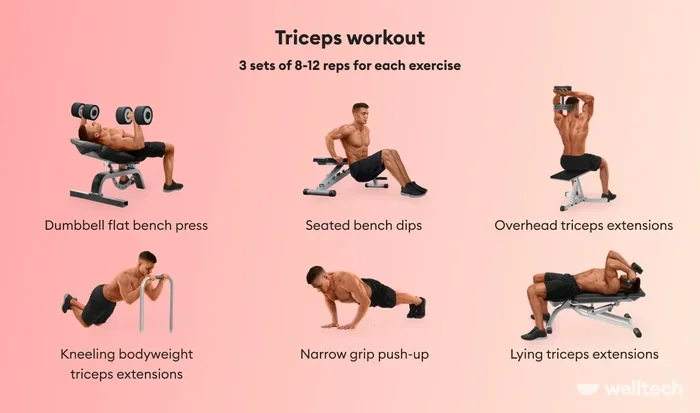
The tricep makes up about two-thirds of your upper arm. If you want bigger arms, you must train your triceps hard. The tricep has three heads: the long head, the lateral head, and the medial head. Here are the best dumbbell exercises for triceps.
Overhead Tricep Extension
This exercise targets the long head of the tricep, which is the largest portion. Hold one dumbbell with both hands behind your head. Extend your arms upward until they are fully straight. Lower the dumbbell back down slowly. Keep your elbows close to your head throughout the movement. This is one of the most effective exercises for building tricep mass.
Tricep Kickback
The tricep kickback isolates the lateral head of the tricep. Lean forward with a flat back. Hold a dumbbell in each hand with your elbows bent at 90 degrees. Extend your arms straight back. Squeeze your triceps at the top. This exercise is perfect for adding arm definition and shaping the back of your arms.
Skull Crusher
Lie on a flat bench and hold a dumbbell in each hand. Start with your arms straight up. Slowly bend your elbows to lower the dumbbells toward your temples. Extend your arms back up. This exercise hits all three heads of the tricep. It is a powerful movement for building overall tricep size.
Close-Grip Floor Press
Lie on the floor and hold dumbbells with a close grip. Your hands should be about shoulder-width apart. Press the dumbbells up and lower them slowly. This exercise works the triceps and chest together. It is a great compound movement that builds functional arm strength.
For more detailed guidance on tricep exercises, check out our guide on how to train the long head of triceps with dumbbells. Also, if you want to target the lateral head specifically, see our article on training the lateral head of triceps with dumbbells.
How to Build a Biceps and Triceps Workout Plan
A good workout plan is the key to consistent progress. You need the right exercises, sets, reps, and rest periods. Here is how to build an effective dumbbell arm workout.
Choosing the Right Exercises
Pick 2 to 3 exercises for biceps and 2 to 3 exercises for triceps. This gives you enough volume without overtraining. Mix compound and isolation movements. For example, pair curls with extensions for a balanced workout.
Sets and Reps for Arm Growth
For muscle hypertrophy, aim for 3 to 4 sets of 8 to 12 reps. Use a weight that challenges you in the last two reps. If you can easily do 15 reps, increase the weight. If you cannot complete 8 reps with good form, decrease the weight.
Rest Between Sets
Rest 60 to 90 seconds between sets. This keeps your heart rate elevated while allowing enough recovery for muscle growth. Do not rest too long, or you will lose the pump that drives arm hypertrophy.
Training Frequency
Train your biceps and triceps 2 to 3 times per week. Allow at least 48 hours of rest between sessions. This gives your muscles time to recover and grow. Overtraining your arms will slow your progress and increase your risk of injury.
If you are new to dumbbell training, you might want to check out our article on how to workout with dumbbells at home for beginners to get started safely.
Common Mistakes to Avoid
Even the best exercises will not work if you make these common mistakes. Here is what to watch out for.
- Swinging the weights. Using momentum takes the work away from your muscles. Control the weight on both the way up and the way down.
- Using too much weight. Heavy weights with poor form lead to injury. Choose a weight that allows you to complete each rep with full control.
- Partial reps. Only going halfway through the movement limits muscle growth. Always take the dumbbell through a full range of motion.
- Neglecting the triceps. Many people focus too much on biceps. Remember, your triceps make up most of your arm size. Train them equally.
- Skipping the warm-up. Cold muscles are more prone to injury. Do 5 to 10 minutes of light cardio and warm-up sets before your arm workout.
Tips for Maximum Arm Growth
Want to get the most out of your dumbbell biceps and triceps training? Follow these proven tips.
Focus on the Mind-Muscle Connection
Think about your biceps or triceps working during every rep. This simple trick increases muscle activation. You will feel the target muscle working much more. Over time, this leads to better results.
Practice Progressive Overload
Progressive overload means gradually increasing the weight, reps, or sets over time. This is the most important principle for muscle growth. Add a small amount of weight each week or try to do one more rep than last time.
Use a Full Range of Motion
Do not cheat your reps by cutting the movement short. A full stretch at the bottom and a full squeeze at the top maximize muscle activation. This is especially important for bicep curls and tricep extensions.
Control Your Tempo
Try a 3-1-2 tempo. That means 3 seconds to lower the weight, 1 second pause at the bottom, and 2 seconds to lift the weight. This increases time under tension and drives more hypertrophy.
Eat Enough Protein
Exercise alone is not enough. You need proper nutrition to build muscle. Aim for 0.7 to 1 gram of protein per pound of body weight each day. Protein provides the building blocks your muscles need to recover and grow after your dumbbell arm workout.
Sample Biceps and Triceps Workout
Here is a simple, effective workout you can try today. This dumbbell arm workout targets both the biceps and triceps.
Biceps:
- Dumbbell Bicep Curl — 3 sets of 10 to 12 reps
- Hammer Curl — 3 sets of 10 to 12 reps
- Concentration Curl — 3 sets of 12 reps per arm
Triceps:
- Overhead Tricep Extension — 3 sets of 10 to 12 reps
- Tricep Kickback — 3 sets of 12 reps per arm
- Skull Crusher — 3 sets of 10 reps
Rest 60 to 90 seconds between sets. Train this routine 2 to 3 times per week with at least one rest day in between. Track your weights and reps to ensure you are making progress each week.
For more information on how long it takes to see results from dumbbell training, read our article on how long does it take for dumbbells to work.
Final Thoughts
Using dumbbells for biceps and triceps is one of the most effective ways to build bigger, stronger arms. You have a wide variety of exercises to choose from. You can train at home or in the gym. The key is to use proper form, train consistently, and apply progressive overload over time.
Do not skip your triceps. Do not swing your weights. Focus on the mind-muscle connection and always use a full range of motion. Follow the workout plan in this guide, eat enough protein, and give your muscles time to recover. Within a few weeks, you will notice your arms getting bigger and more defined.
Start today. Grab your dumbbells, follow the exercises in this guide, and commit to your arm workout routine. Your future self will thank you for it.
Frequently Asked Questions
How often should I train my biceps and triceps with dumbbells?
Train your arms 2 to 3 times per week with at least 48 hours of rest between sessions. This frequency gives your muscles enough time to recover and grow. Overtraining can lead to injury and slow your progress.
What weight dumbbells should I use for biceps and triceps exercises?
Choose a weight that allows you to complete 8 to 12 reps with good form. If you can do more than 12 reps easily, increase the weight. If you cannot complete 8 reps, decrease the weight. Progressive overload is the key to building bigger arms.
Can I build big arms using only dumbbells?
Yes, you can build impressive arms with dumbbells alone. Dumbbells offer a wide range of exercises that target both the biceps and triceps effectively. Focus on progressive overload and proper form to maximize your results.
How long does it take to see results from dumbbell arm exercises?
Most people start to notice changes in arm size and strength within 4 to 6 weeks of consistent training. Results vary based on your diet, genetics, and training intensity. Stay consistent and patient with your arm workout routine.
Should I train biceps before triceps or vice versa?
It is generally better to train your larger muscle group first. Since the triceps are larger than the biceps, many people prefer to train triceps first. However, you can also train whichever muscle you want to prioritize first. The most important thing is to train both muscles regularly.
Are dumbbell exercises better than barbell exercises for arm growth?
Dumbbells offer several advantages over barbells. They allow a greater range of motion, help fix strength imbalances, and are easier on your joints. Both dumbbells and barbells are effective for arm growth. Using both in your resistance training routine can give you the best results.
=== CONCLUSION ===
Using dumbbells for biceps and triceps gives you everything you need to build bigger, stronger arms. From curls to extensions, the exercises in this guide cover all the key movements for complete arm development. Focus on proper form, progressive overload, and consistency. Avoid the common mistakes that hold most people back. Follow the sample workout plan, eat enough protein, and give your muscles time to recover. With dedication and the right approach, you will see real results. Start your dumbbell arm workout today and take the first step toward the arms you have always wanted.