How to Get Big Biceps Fast with Dumbbells
Want bigger biceps fast? This guide shows you exactly how to get big biceps fast with dumbbells through targeted exercises, proper form, and a smart workout plan. You will learn the best curl variations, how to structure your routine, what to eat for muscle growth, and the mistakes that hold most people back. Whether you are a beginner or intermediate lifter, these tips will help you build noticeable arm size quickly and safely.
Building bigger arms is one of the most popular fitness goals out there. And let us be honest — when you think about looking strong, the first thing people notice is your biceps. Whether you want to fill out your shirts or impress at the beach, how to get big biceps fast with dumbbells is a question almost every gym-goer asks.
The good news? You do not need a fancy gym membership or expensive machines. A simple pair of dumbbells is all you need to build serious bicep mass. In this guide, we will walk you through everything you need to know — from the best exercises to nutrition tips and common mistakes that slow you down.
We kept this guide practical and straightforward. No fluff. No confusing jargon. Just real, actionable advice that works. By the end, you will have a clear roadmap to build bigger arms right from your home or gym.
Key Takeaways
- Dumbbells are the best tool for bicep growth: They allow a full range of motion and target both heads of the bicep effectively.
- Progressive overload is essential: Gradually increasing weight or reps forces your muscles to grow bigger over time.
- Variety in curl exercises prevents plateaus: Mixing hammer curls, incline curls, and concentration curls hits the biceps from different angles.
- Proper nutrition fuels muscle growth: Eating enough protein and calories supports faster bicep development.
- Avoiding common mistakes saves time: Swinging weights, skipping warmups, and overtraining can stall your progress.
- Rest and recovery matter as much as training: Muscles grow during rest, not during the workout itself.
- Consistency beats intensity: Training your biceps 2-3 times per week with good form delivers better results than sporadic heavy sessions.
📑 Table of Contents
Why Dumbbells Are Perfect for Building Big Biceps
You might wonder why dumbbells beat other tools for bicep exercises. The answer is simple — they give you freedom of movement. Barbells lock your arms into a fixed path. Machines guide your motion. But dumbbells let each arm work independently, which fixes strength imbalances and activates more muscle fibers.
Here is why dumbbell training is so effective for arm growth:
- Full range of motion: Dumbbells let you stretch and squeeze your biceps completely at the top and bottom of every rep.
- Independent arm work: Your weaker arm cannot hide behind your stronger one. Both sides have to pull their weight — literally.
- Joint-friendly: Dumbbells put less stress on your elbows and wrists compared to heavy barbells.
- Versatility: You can do dozens of different curl variations with just one pair of dumbbells.
- Space-efficient: A set of dumbbells fits in any room, making home workouts incredibly effective for building arm muscles.
If you are serious about how to get big biceps fast with dumbbells, understanding this advantage is the first step. Every other tip in this guide builds on this foundation.
The Best Bicep Exercises With Dumbbells
Not all curls are created equal. Some hit the long head of the bicep, while others target the short head. To build full bicep size, you need to train both heads. Here are the most effective dumbbell bicep exercises you should be doing.
Standing Dumbbell Curls
This is the bread and butter of any bicep workout. Stand tall, hold a dumbbell in each hand, and curl both arms up slowly. Keep your elbows pinned to your sides. The key is to control the weight on the way down — do not let gravity do the work.
Pro tip: Squeeze your biceps hard at the top for one second. This time under tension triggers more muscle growth.
Hammer Curls
Hammer curls target the brachialis, a muscle underneath your bicep that pushes your arms wider and thicker. Hold the dumbbells with a neutral grip (palms facing each other) and curl up. These also strengthen your forearms, which gives your arms a more complete look.
Incline Dumbbell Curls
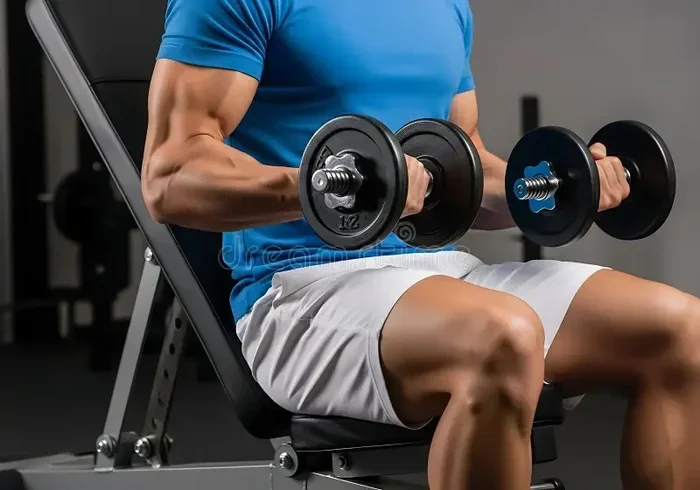
Set an adjustable bench to about 45-60 degrees. Lean back and let your arms hang straight down. This position places a deep stretch on the bicep, which is where hypertrophy really kicks in. These are brutal but incredibly effective for building bigger biceps.
Concentration Curls
Sit on a bench and rest your elbow against your inner thigh. Curl one dumbbell at a time with full focus. This exercise removes momentum and isolates the bicep completely. It is perfect for finishing off your workout with a strong bicep pump.
Zottman Curls
Start with palms up like a regular curl. At the top, rotate your wrists so palms face down, then lower the weight slowly. This hits both the bicep and the brachioradialis. It is a two-for-one exercise that saves time and boosts arm strength.
How to Structure Your Bicep Workout Routine
Doing random curls will not get you the results you want. You need a structured bicep routine that balances volume, intensity, and recovery. Here is how to build one that actually works.
Training Frequency
Train your biceps 2 to 3 times per week. This gives your muscles enough stimulus to grow while allowing proper recovery between sessions. Training them every single day will actually hurt your progress, not help it.
Sets and Reps for Growth
For bicep hypertrophy, aim for these rep ranges:
- Heavy compound work: 4-6 reps with heavier dumbbells
- Mid-range hypertrophy work: 8-12 reps — this is the sweet spot for most bicep exercises
- High-rep pump work: 15-20 reps with lighter weight to flush the muscles with blood
Perform 3-4 sets per exercise. A typical bicep workout should last 20-30 minutes. Short, focused, and intense.
Progressive Overload
This is the single most important principle in strength training. You must gradually increase the challenge over time. Add a little more weight, do one extra rep, or add one extra set each week. Your muscles grow because you constantly push them beyond what they are used to.
If you want deeper guidance on building overall arm size, check out how to build arm muscles at home with dumbbells for more detailed programming.
Sample Weekly Routine
Here is a simple bicep-focused routine you can follow:
- Standing Dumbbell Curls — 4 sets of 8-12 reps
- Incline Dumbbell Curls — 3 sets of 10-12 reps
- Hammer Curls — 3 sets of 10-12 reps
- Concentration Curls — 2 sets of 12-15 reps
Do this routine twice a week with at least 48 hours of rest between sessions. Within 4-6 weeks, you will notice visible changes in your bicep size and definition.
Nutrition Tips for Faster Bicep Growth
You cannot build muscle in a vacuum. What you eat matters just as much as what you lift. Proper nutrition is the fuel that powers muscle recovery and growth.
Eat Enough Protein
Protein provides the building blocks your muscles need to repair and grow after a tough bicep workout. Aim for at least 0.7-1 gram of protein per pound of body weight daily. Good sources include chicken, fish, eggs, Greek yogurt, beans, and protein powder.
Do Not Fear Carbs
Carbohydrates give you the energy to lift heavier and train harder. Without enough carbs, your performance drops and your recovery slows. Eat rice, oats, sweet potatoes, fruits, and whole grains to fuel your arm training sessions.
Stay in a Slight Calorie Surplus
To build muscle, you need to eat slightly more calories than you burn. A surplus of 200-300 calories per day is enough to support muscle growth without adding excess fat. This is the sweet spot for lean arm gains.
Hydration Matters
Muscles are about 75% water. Dehydration reduces strength, slows recovery, and makes your biceps look flat. Drink at least 8-10 glasses of water per day, and more on training days.
Common Mistakes That Slow Down Your Progress
Even with the best routine, bad habits can stall your gains. Here are the most common mistakes people make when trying to get big biceps fast — and how to avoid them.
Swinging and Using Momentum
One of the biggest errors is using your back and shoulders to swing the dumbbells up. This takes the work away from your biceps and increases injury risk. Slow down. Control every rep. If you need to cheat a little on the last rep of a set, that is fine — but do not make it a habit.
Skipping the Warm-Up
Cold muscles are injury-prone muscles. Spend 5-10 minutes doing light cardio and a few warm-up sets with lighter dumbbells before jumping into heavy curls. Your bicep tendons will thank you.
Overtraining Your Biceps
More is not always better. Training your biceps every day with high volume actually breaks down muscle tissue faster than it can rebuild. Stick to 2-3 sessions per week and let your body do the growing during rest.
Ignoring Triceps and Other Arm Muscles
Your arm is made up of more than just the bicep. The triceps make up about two-thirds of your upper arm mass. If you only train curls, you are leaving gains on the table. For a balanced approach, also work on your triceps. You can learn more about complete arm development in this guide on how to get bigger arms at home with dumbbells.
Not Tracking Your Progress
If you do not measure, you cannot improve. Keep a workout log. Write down the weights, sets, and reps for every session. When you see your numbers go up week after week, that is proof your biceps are growing.
How To Get Big Biceps Fast With Dumbbells — Final Tips
You now have the exercises, the routine structure, the nutrition advice, and the mistakes to avoid. Here are a few final tips to accelerate your results.
First, focus on the mind-muscle connection. When you curl, really think about your biceps doing the work. Visualize the muscle contracting and shortening. This simple mental trick has been shown to increase muscle activation significantly.
Second, prioritize sleep. Your body releases growth hormone during deep sleep, which is when muscle repair and growth happen most actively. Aim for 7-9 hours of quality sleep every night.
Third, be patient but consistent. Real bicep growth takes time. You will not see massive changes in a week, but if you stick to your plan, the results will come. Most people notice visible differences within 4-8 weeks of consistent training.
Fourth, mix up your grip and angles. Changing your hand position or the angle of your curl hits the bicep fibers differently. This prevents plateaus and keeps your muscles guessing, which drives continued growth.
If you want to take your bicep and tricep training to the next level, explore how to get bigger biceps and triceps with dumbbells for more advanced techniques and exercise combinations.
Conclusion
How to get big biceps fast with dumbbells comes down to three things: smart training, proper nutrition, and consistent effort. You now have the exercises, the routine, and the knowledge to make real progress. Pick up your dumbbells, follow the plan, and trust the process. Your dream arms are closer than you think — you just need to start.
Stay consistent, avoid the mistakes, and keep pushing your limits. The bicep growth you want is waiting for you on the other side of hard work and dedication.
Frequently Asked Questions
How quickly can I see results from dumbbell bicep exercises?
Most people notice visible changes in bicep size within 4-8 weeks of consistent training. Your results depend on your genetics, nutrition, and how hard you train. Stick with the program, track your progress, and trust the process.
How heavy should my dumbbells be for bicep growth?
Choose a weight that challenges you in the 8-12 rep range. You should feel a strong burn by the last 2-3 reps of each set. If you can easily do 15+ reps, increase the weight. Progressive overload is the key to building bigger biceps.
Can I get big biceps with just dumbbells at home?
Absolutely. Dumbbells are one of the most effective tools for bicep hypertrophy. You do not need a gym or machines. With the right exercises, a structured routine, and proper nutrition, you can build impressive arm size entirely at home.
Should I train biceps every day for faster growth?
No. Training biceps every day actually slows your progress. Muscles grow during rest, not during the workout. Train your biceps 2-3 times per week, allow 48 hours of recovery between sessions, and let your body do the growing.
What is the best time of day to train biceps?
The best time is whenever you can train consistently and with full energy. Some people prefer mornings when their muscles are fresh, while others train better in the evening. Pick a time you can stick with long-term.
Do I need supplements to build big biceps with dumbbells?
Supplements are not required, but they can help. Whey protein makes it easier to hit your daily protein goals. Creatine monohydrate has strong evidence for supporting muscle growth and strength. However, whole foods should always come first.