How to Do High Intensity Interval Training on Elliptical

High Intensity Interval Training (HIIT) on an elliptical is a powerful, low-impact workout that torches calories, boosts cardiovascular health, and builds endurance efficiently. By alternating short bursts of maximum effort with active recovery periods, you can achieve significant fitness gains in less time than steady-state cardio. This guide provides everything you need to safely and effectively design your own elliptical HIIT routines, from machine setup to advanced programming.
Key Takeaways
- Elliptical HIIT is highly effective and joint-friendly: It delivers a powerful cardio and full-body muscular workout with minimal impact on knees, hips, and ankles.
- Proper form and machine setup are non-negotiable: Correct posture, resistance, and stride settings prevent injury and ensure the intensity targets the right muscles.
- Work-to-rest ratios define the workout: Beginners should start with longer rests (e.g., 1:2 ratio), while advanced athletes use shorter rests (e.g., 1:1 or 2:1) to increase demand.
- Warm-ups and cool-downs are essential: Never skip them. A 5-10 minute warm-up prepares your body, and a cool-down aids recovery and prevents dizziness.
- Listen to your body and progress gradually: Start with 2-3 sessions per week, focus on mastering intervals before increasing duration or frequency.
- Use perceived exertion and heart rate for intensity: Aim for an 8-9/10 RPE during sprints and a 3-4/10 during recovery. Heart rate zones provide objective feedback.
- Variety prevents plateaus: Change your interval structures, resistance levels, and incline to continually challenge your body and avoid boredom.
📑 Table of Contents
- Why Choose the Elliptical for High Intensity Interval Training?
- Getting Started: Your Elliptical HIIT Foundation
- Designing Your Elliptical HIIT Workout: The Art of the Interval
- Advanced Techniques to Maximize Your Elliptical HIIT
- Common Mistakes That Derail Your Elliptical HIIT Progress
- Sample 4-Week Progressive Elliptical HIIT Plan
- The Essential Cool-Down and Beyond
- Conclusion: Your Journey to a Fitter, Stronger You Starts Here
Why Choose the Elliptical for High Intensity Interval Training?
Let’s be honest. The elliptical sometimes gets a bad rap. People see it as the “easy” machine, the one for casual conversation while scrolling through your phone. But what if we told you that this misunderstood piece of equipment is actually one of the most powerful tools for a transformative, high-intensity workout? When you harness its potential for High Intensity Interval Training (HIIT), the elliptical becomes a full-body furnace that blasts calories, builds a resilient heart, and sculpts muscle—all while being incredibly gentle on your joints.
The magic of elliptical HIIT lies in its unique combination of benefits. Unlike the repetitive impact of running or the limited range of motion on a stationary bike, the elliptical provides a smooth, gliding motion that engages both your upper and lower body simultaneously. This means you’re working your quads, hamstrings, glutes, chest, back, and shoulders in one fluid motion. For anyone with knee issues, recovering from injury, or simply wanting to reduce wear and tear on their body, this is a game-changer. You can push your cardiovascular system to its absolute limit without the punishing jarring forces. In short, you get the brutal efficiency of a sprint session with the safety of a low-impact movement pattern. It’s the best of both worlds, making it a sustainable choice for long-term fitness.
The Full-Body Engagement Advantage
Most cardio machines are lower-body dominant. The elliptical’s moving handles are your secret weapon. During the high-intensity “on” intervals, actively pushing and pulling with your arms creates a significant upper body workout. This dramatically increases your oxygen consumption and calorie burn per minute. Think of it as combining a leg press and a rowing motion in one continuous, low-impact cycle. This total-body recruitment means your heart has to work much harder to supply blood to all those working muscles, skyrocketing your heart rate and metabolic demand very quickly. That’s the core of HIIT: creating a massive metabolic disturbance in a short amount of time.
Low Impact, High Reward
The elliptical’s path of motion keeps your feet in constant contact with the pedals. There is no “flight phase” where you land and absorb shock, as there is with running. This eliminates the high-impact forces that can stress ankles, knees, and the lower back. For individuals with arthritis, past joint injuries, or those who are significantly overweight, this allows you to safely perform intervals at a truly high intensity without fear of aggravating a sensitive area. You can sprint on the elliptical with 90% effort, but your knees will feel like they just went for a gentle walk. This accessibility is why it’s a cornerstone for sustainable, lifelong fitness.
Getting Started: Your Elliptical HIIT Foundation
Before you even touch the interval timer, you must build a rock-solid foundation. Jumping into high-intensity work with poor setup is a direct ticket to injury, frustration, and an ineffective workout. This section is your non-negotiable pre-flight checklist. Taking 5 minutes to dial in your machine and your body will make the next 20 minutes exponentially more productive and safe.

Visual guide about How to Do High Intensity Interval Training on Elliptical
Image source: heandsheeatclean.com
Machine Setup: The Critical First Step
Stand on the pedals and adjust the stride length first. Your knees should have a slight bend at the most extended point of the pedal stroke—never lock out. A good rule of thumb: if you feel like you’re doing exaggerated step-ups, the stride is too long. If you feel cramped, it’s too short. Most modern ellipticals have a good default range for average heights. Next, set the resistance. For HIIT, you will be dramatically increasing resistance during your work intervals. Start with a moderate resistance (level 4-6 on a 1-10 scale) that feels challenging but allows you to maintain a fast, controlled pace for your work interval duration (e.g., 30 seconds). You will increase this later.
Now, the upper body. Adjust the handlebars so your elbows are at a comfortable, slightly bent angle (about 15-30 degrees). You should not have to hunch your shoulders or reach far forward. Your grip should be firm but not white-knuckled. Finally, ensure the machine is on a stable, level surface. A wobbly machine is dangerous at any speed.
Perfecting Your Form: The Power Position
Once moving, your posture is everything. Stand tall through your spine. Imagine a string pulling the crown of your head toward the ceiling. Your core should be gently braced—think about preparing for a light punch to the stomach. This stabilizes your entire torso and protects your lower back. As you pedal, focus on pressing through your entire foot, especially the heel, on the backward push. This maximizes glute and hamstring engagement. On the forward pull, think of leading with your elbow, engaging your back and chest muscles. Avoid the common mistake of just “flailing” with your arms; each push and pull should be deliberate and powerful. Keep your gaze forward, not down at your feet. This upright, engaged posture is what allows you to generate true power safely.
The Non-Negotiable Warm-Up
You would not start a car race in neutral. Your body is no different. A proper warm-up increases blood flow, raises core temperature, and mobilizes joints, preparing your system for the shock of high-intensity work. Spend 5-7 minutes on the elliptical at a very easy resistance (level 1-2). Start with a slow, deliberate pace, focusing on full range of motion. Gradually increase your stride rate over the last minute. Include a few short, 10-second bursts at a moderate pace to activate your fast-twitch muscle fibers. This primes your nervous system for the all-out sprints to come. Do not skip this.
Designing Your Elliptical HIIT Workout: The Art of the Interval
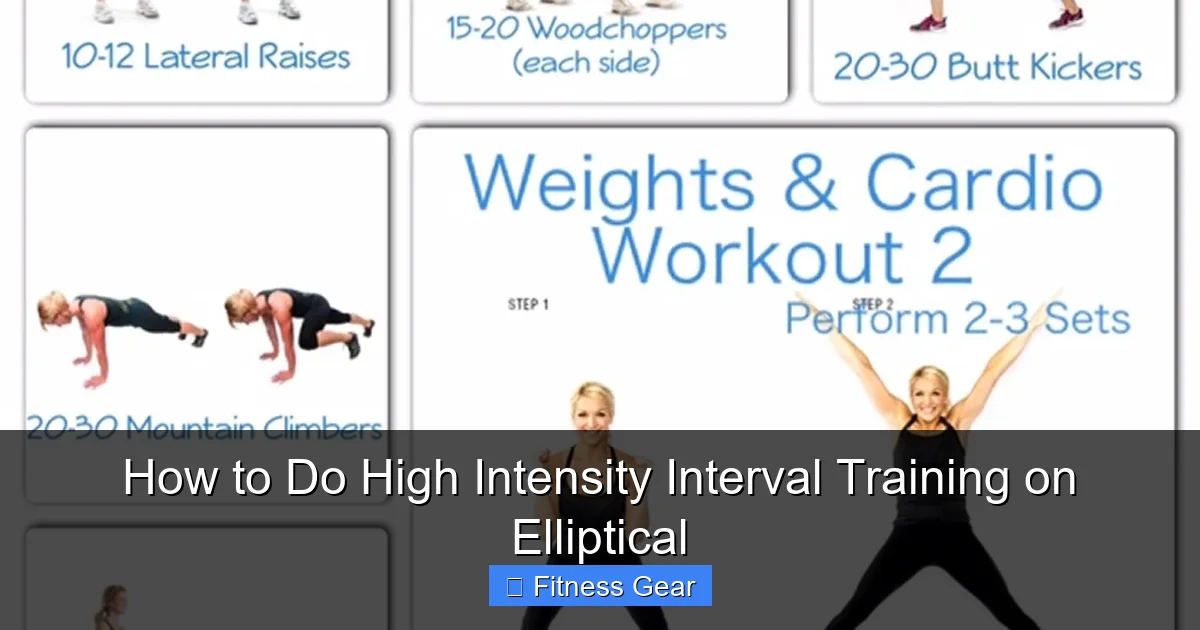
Now for the fun part: building your workout. The essence of HIIT is the interval structure—the specific pattern of work and recovery. This structure is your blueprint for results. The key variables you can manipulate are the duration of the work interval, the duration of the recovery interval, and the level of resistance/incline during the work phase. Understanding how these variables interact is the difference between a good sweat and a transformative session.
Visual guide about How to Do High Intensity Interval Training on Elliptical
Image source: healthjade.net
Decoding Work-to-Rest Ratios
This is the core programming principle. The ratio compares the length of your high-intensity burst to your low-intensity recovery. The classic and most common starting point is a 1:2 ratio. This means if your work interval is 30 seconds, your recovery interval is 60 seconds. This ratio is incredibly sustainable and effective for beginners, allowing for near-maximal effort on each work interval because the rest is long enough to partially replenish your energy systems. As you get fitter, you can move to a 1:1 ratio (30 sec on, 30 sec off), which is much more demanding. Advanced athletes might even use a 2:1 ratio (40 sec on, 20 sec off), which creates a significant lactate buildup and metabolic challenge. A great way to start is with a 1:2 ratio for 8-10 total intervals.
Setting the Right Resistance and Incline
Your work interval must be truly high intensity. On the elliptical, this primarily means increasing the resistance. The goal during your “on” phase is to make your legs burn and your heart race so that you are gasping for air by the end of the interval. If you can chat comfortably, the resistance is too low. A good starting point: for a 30-second sprint, set the resistance to a level where your pedal speed (RPM) drops to 60-80 RPM from your usual 90-100 RPM warm-up pace. You should feel like you are “pushing” the pedals against a solid wall. The incline, if your machine has it, adds another dimension. Adding incline during work intervals dramatically increases glute and hamstring activation, mimicking hill sprints. Try keeping incline at 0 for the first few sessions and focus purely on resistance, then experiment with adding a 3-5 incline during sprints.
Sample Interval Structures for All Levels
Let’s make this concrete. Here are three proven templates:
- Beginner Template (1:2 Ratio): 5-min warm-up. Then: 30 sec HARD (high resistance, fast arms) / 60 sec very easy (level 1, slow pace). Repeat 6-8 times. 5-min cool-down. Total time: ~25 minutes.
- Intermediate Template (1:1 Ratio): 5-min warm-up. Then: 45 sec HARD / 45 sec easy. Repeat 8-10 times. 5-min cool-down. Total time: ~25 minutes.
- Advanced Pyramid Template: 5-min warm-up. Then: 20 sec max effort / 40 sec easy, 30 sec max / 30 sec easy, 40 sec max / 20 sec easy, 30 sec max / 30 sec easy, 20 sec max / 40 sec easy. 5-min cool-down. This varies the stress on your system.
The key is consistency within the interval. Don’t start too hard and fade. Aim to maintain the same level of power and resistance throughout all your work intervals in a given session.
Advanced Techniques to Maximize Your Elliptical HIIT
Once you’ve mastered the basic interval structure and can complete 10-12 intervals with good form, it’s time to level up. The body is an amazing adapter. To continue making gains—whether that’s more fat loss, greater speed, or higher endurance—you need to constantly present it with new challenges. These advanced techniques are your tools to break through plateaus and keep your workouts fresh and brutally effective.

Visual guide about How to Do High Intensity Interval Training on Elliptical
Image source: whyiexercise.com
The Power of the “Sprint” Finish
This is a brutally simple but incredibly effective finisher. After completing your main set of intervals, instead of a standard cool-down, you do one final, all-out sprint. Drop the resistance to a very low level (1-2) but pedal as fast as you possibly can for 30-60 seconds. This taps into your anaerobic capacity in a unique way, depletes the last of your glycogen stores, and creates an “afterburn” effect (Excess Post-exercise Oxygen Consumption, or EPOC) that can elevate your metabolism for hours. It’s a great way to end a session when you’re feeling strong.
Manipulating Incline for Targeted Strength
We touched on incline earlier, but let’s go deeper. Using a high incline (8-10 on a scale of 1-10) during your work intervals turns the elliptical into a serious strength-endurance builder for your posterior chain—glutes and hamstrings. Set your resistance to a challenging but manageable level, then crank the incline high. Your pace will slow dramatically, but the muscular burn in your backside will be intense. This is fantastic for building power that translates to better running, cycling, and overall athleticism. Pair this with a lower incline and higher resistance to target quads and calves. Varying this combination across your weekly workouts builds balanced lower body strength.
Heart Rate Zone Training for Precision
Perceived exertion (RPE) is great, but a heart rate monitor adds objective data. Calculate your approximate max heart rate (220 – your age). For true HIIT, you want to spend your work intervals in Zone 4 (80-90% of max HR) and your recovery in Zone 2 (60-70% of max HR). The goal is to spike your heart rate up high, then let it come down significantly before spiking again. If you notice your heart rate isn’t dropping enough during recovery (e.g., it only goes from 90% to 80%), your rest interval is too short or your work intensity isn’t high enough. This data helps you dial in your intervals for optimal cardiovascular stress.
Common Mistakes That Derail Your Elliptical HIIT Progress
Even with the best program, simple errors can sabotage your results, lead to burnout, or cause injury. Awareness is the first step to correction. Let’s troubleshoot the most frequent pitfalls we see with elliptical HIIT.
Mistake 1: Not Increasing Resistance Enough
This is the #1 error. People set the resistance too low and just “go fast,” thinking speed equals intensity. On the elliptical, resistance is your primary intensity dial. Speed is secondary. Pedaling fast against no resistance is like spinning your wheels—it’s aerobic, not anaerobic. You won’t get the metabolic spike or the muscular recruitment needed for a true HIIT stimulus. The fix: For your work intervals, select a resistance that forces your RPM to drop by 20-40% from your warm-up pace. You should feel like you are powerfully pushing against a load.
Mistake 2: Using the Same Workout Every Time
Your body adapts incredibly fast. If you do the exact same 30/60 interval workout three times a week for a month, your initial gains will plateau. The stimulus becomes too familiar. The fix: Use the periodization ideas from the last section. One week, focus on short, max-effort sprints (15/45). The next, focus on longer, strength-oriented intervals (60 sec high resistance/60 sec rest). Change the ratio, change the resistance profile, change the incline. Keep your body guessing.
Mistake 3: Ignoring Recovery and Overtraining
HIIT is a stressor. A *good* stressor, but a stressor nonetheless. Doing HIIT on the elliptical every single day is a fast track to overtraining, fatigue, injury, and hormonal imbalance (elevated cortisol). Your body needs time to repair and adapt. The fix: Limit HIIT sessions to 2-3 times per week, with at least one full day of rest or very light active recovery (like a walk) between them. On non-HIIT days, focus on strength training, mobility work, or steady-state low-intensity cardio. Sleep and nutrition are your recovery tools—prioritize them.
Mistake 4: Poor Form During Fatigue
As you get tired in later intervals, it’s easy to let your form break down. You’ll start to hunch, lock your knees, or use a “sloppy” arm swing. This shifts stress to your joints and lower back and reduces power output. The fix: Be militant about form. If you can’t maintain upright posture and controlled movements on the last interval, the previous ones were too long or too frequent. It’s better to do fewer, perfect intervals than many sloppy ones. Consider reducing the total number of intervals in a session before increasing work time.
Sample 4-Week Progressive Elliptical HIIT Plan
Theory is great, but a plan is better. Here is a structured, progressive 4-week plan for someone new to elliptical HIIT. The goal is to build tolerance, perfect form, and systematically increase the metabolic demand. Perform these workouts on non-consecutive days (e.g., Tuesday, Thursday, Saturday). On other days, do light activity or strength training.
Week 1: The Foundation
Goal: Learn the rhythm. Focus on hitting the target resistance and maintaining posture.
- Workout: 5-min easy warm-up.
- Main Set: 8 intervals of 30 sec HARD (Resistance 5-6, focus on powerful pushes/pulls) / 90 sec EASY (Resistance 1, slow pace).
- Cool-down: 5-min very easy.
Why 90 sec rest? It’s longer than ideal, but for a total beginner, it ensures you can go truly “HARD” on each work interval without cumulative fatigue ruining your form. Quality over quantity.
Week 2: Adjusting the Ratio
Goal: Introduce a more standard ratio and slightly increase work intensity.
- Workout: 5-min easy warm-up.
- Main Set: 8 intervals of 40 sec HARD (Resistance 6-7) / 60 sec EASY (Resistance 1).
- Cool-down: 5-min very easy.
The work interval is longer, the rest is shorter. This increases the time your body spends at high intensity. The resistance bump makes each interval more challenging.
Week 3: Increasing the Challenge
Goal: Increase total work volume and introduce incline.
- Workout: 5-min warm-up (include 2×30-sec moderate bursts).
- Main Set: 10 intervals of 45 sec HARD (Resistance 7, Incline 3-4) / 45 sec EASY (Resistance 1, Incline 0).
- Cool-down: 5-min easy.
We’ve added two more intervals and made the ratio 1:1. The added incline during work intervals increases muscle engagement, particularly in the glutes and hamstrings.
Week 4: The Peak Week
Goal: A true test of fitness with a pyramid structure.
- Workout: 5-min dynamic warm-up.
- Main Set: Pyramid: 30 sec Max (Resistance 8) / 30 sec Easy, 45 sec Max / 15 sec Easy, 60 sec Max / 60 sec Easy, 45 sec Max / 15 sec Easy, 30 sec Max / 30 sec Easy.
- Cool-down: 6-min gradual decrease in resistance.
This pyramid varies the interval length dramatically. The 60-second “Max” interval in the middle is the longest and most grueling. This week tests your ability to sustain high effort over different durations. After this week, you can either repeat the cycle with higher resistance levels or design a new plan using the principles covered.
The Essential Cool-Down and Beyond
The workout isn’t over when the last interval ends. What you do next is critical for recovery, adaptation, and long-term progress. The cool-down period is not optional; it’s an integral part of the physiological process you’ve just initiated.
Why a Structured Cool-Down Matters
During your HIIT session, your heart is pumping blood at a very high rate to your working muscles. Your veins and capillaries are dilated. If you stop abruptly and step off the machine, that blood can pool in your extremities, leading to dizziness, lightheadedness, or even fainting (post-exercise hypotension). A proper cool-down allows your heart rate, blood pressure, and body temperature to gradually return to resting levels. It also helps begin the process of clearing metabolic byproducts like lactate from your muscles, reducing next-day soreness (DOMS).
The 5-Minute Guided Cool-Down
Immediately after your last work interval, reduce the resistance to the lowest setting (1) and maintain a very slow, comfortable pedaling pace. Keep moving for at least 4-5 minutes. Focus on deep, controlled breathing—inhale for 3-4 counts, exhale for 4-6 counts. This helps activate your parasympathetic nervous system (the “rest and digest” system) and lowers your heart rate systematically. As you pedal, gently stretch your legs by flexing and pointing your feet, and give your arms a light shake-out. This active recovery is far superior to just stopping cold.
Conclusion: Your Journey to a Fitter, Stronger You Starts Here
High Intensity Interval Training on the elliptical is more than just a workout; it’s a strategic, efficient, and sustainable approach to transforming your fitness. You now hold the blueprint: the understanding of why this machine is uniquely suited for intensity, the foundational knowledge of setup and form, the principles of interval design, the advanced techniques for continual growth, and the awareness of common pitfalls. You have a sample 4-week plan to put it all into action.
The elliptical’s low-impact nature means you can pursue this high-intensity path for years to come, without the chronic joint pain that often sidelines runners and jumpers. The full-body engagement builds functional strength and muscular endurance alongside your cardiovascular capacity. Remember, the magic is in the contrast—the true sprint against the solid resistance of the machine, followed by the deliberate, slow recovery. That contrast is what shocks your system into adapting.
Start where you are. Use the beginner template. Nail your form. Listen to your body. Then, use the tools in this guide to progressively challenge yourself. In a few weeks, you’ll look back and marvel at how much stronger, faster, and more resilient you’ve become, all while protecting your joints. That’s the power of doing HIIT the right way, on the right machine. Now, go set up your elliptical and take that first, powerful step.
Frequently Asked Questions
How long should a high intensity interval training session on the elliptical be?
A complete elliptical HIIT session, including warm-up and cool-down, typically lasts between 20 and 30 minutes. The actual high-intensity interval portion is often only 10-15 minutes, but its effectiveness comes from the extreme effort during those short bursts. This makes it one of the most time-efficient workouts available.
How many times per week can I do elliptical HIIT?
Due to its high intensity, limit elliptical HIIT to 2-3 sessions per week, with at least one full day of rest or very light activity between sessions. This allows your body adequate time to recover, repair, and adapt, preventing overtraining and injury. On other days, focus on strength training, mobility, or steady-state cardio.
Is elliptical HIIT good for weight loss?
Yes, extremely effective. The high intensity creates a significant calorie burn during the session and triggers the “afterburn effect” (EPOC), where your metabolism remains elevated for hours afterward, burning extra calories. Combined with a healthy diet, elliptical HIIT is a powerful tool for fat loss while preserving muscle mass.
What resistance level should I use for elliptical HIIT?
Your resistance during the “on” or work intervals should be high enough that your pedal speed (RPM) drops by 20-40% from your warm-up pace and you feel like you are powerfully pushing against a solid load. For most people, this is between a 6 and 9 on a 1-10 scale. The goal is to make each work interval feel sustainably difficult, not impossibly brutal from the first second.
Can a beginner do HIIT on the elliptical?
Absolutely. The elliptical is an ideal starting point for HIIT due to its low-impact nature. Beginners should start with a conservative work-to-rest ratio like 1:3 or 1:2 (e.g., 30 seconds hard, 60-90 seconds easy), focus on mastering form and machine setup, and keep total session time short. The key is to build a habit of high effort before increasing duration or complexity.
Should I use the moving or stationary handlebars for HIIT?
For true full-body HIIT, you should use the moving handlebars. Actively pushing and pulling with your arms significantly increases the intensity, calorie burn, and upper body engagement. Using the stationary handles isolates the lower body, which reduces the overall metabolic demand and turns it into more of a leg-only workout, defeating the primary advantage of the elliptical for HIIT.