How Many Times a Week Should I Do Elliptical

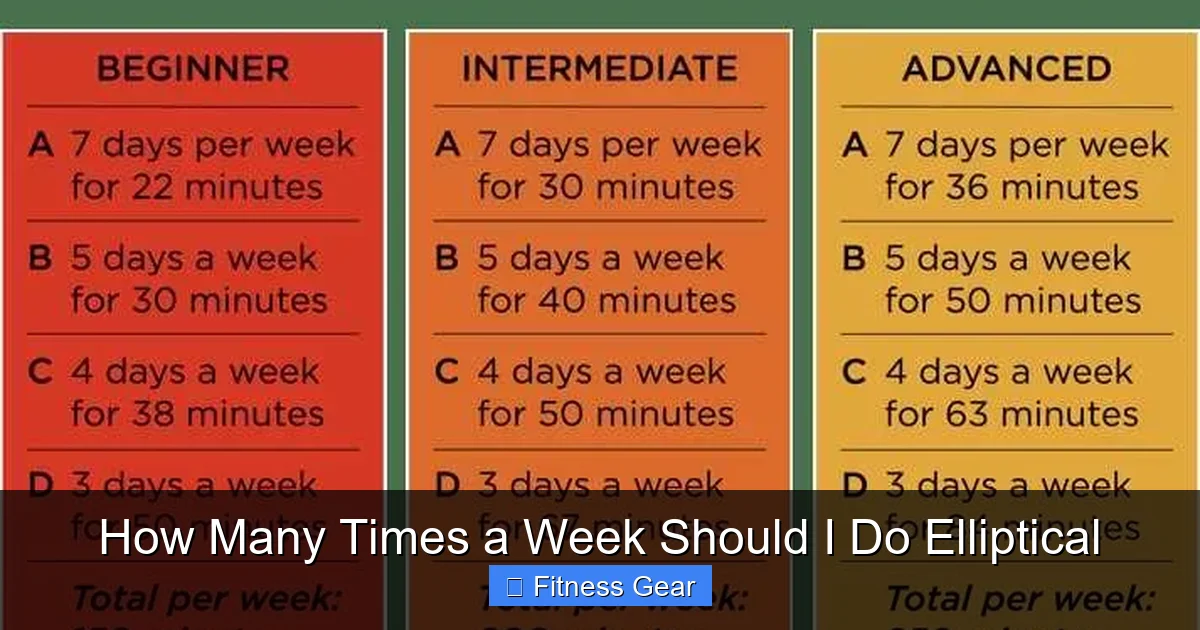
The ideal number of elliptical workouts per week isn’t one-size-fits-all—it depends entirely on your personal fitness goals, current fitness level, and overall schedule. For general health, aim for 3-5 days; for weight loss, 4-5 days with varied intensity; for endurance, 3-4 focused days. Consistency, proper recovery, and listening to your body are far more critical than simply chasing a higher number on the calendar.
Key Takeaways
- Your goal dictates your frequency: Weight loss typically requires 4-5 days/week, general health 3-5 days, and athletic endurance 3-4 high-quality days.
- Intensity matters more than sheer volume: A 30-minute high-intensity interval session can be more effective than a 60-minute casual stroll, allowing for better recovery.
- Rest days are non-negotiable: Your body adapts and gets stronger during recovery. At least 1-2 full rest or active recovery days per week are essential to prevent burnout and injury.
- Quality over quantity: Focus on form, posture, and challenging yourself during the workout rather than simply logging time. A mindful, intense 20 minutes beats a distracted 45 minutes.
- It’s part of a bigger puzzle: The elliptical should complement strength training, flexibility work, and other activities. A balanced routine yields the best long-term results and prevents overuse injuries.
- Listen to your body and adjust: Fatigue, persistent soreness, or decreased motivation are signs to take an extra rest day or dial back intensity. Flexibility in your plan is key to sustainability.
📑 Table of Contents
- Finding Your Perfect Elliptical Rhythm: It’s Not a One-Size-Fits-All Answer
- Goal #1: Weight Loss & Calorie Burn
- Goal #2: Building Endurance & Cardiovascular Fitness
- Goal #3: General Health, Maintenance & Low-Impact Activity
- The Critical Role of Recovery: Why More is NOT Always Better
- Tailoring Your Plan: The Personal Factors You Can’t Ignore
- Putting It All Together: Sample Weekly Schedules
- Conclusion: Your Elliptical, Your Rules
Finding Your Perfect Elliptical Rhythm: It’s Not a One-Size-Fits-All Answer
So you’ve decided to embrace the elliptical. Great choice! It’s a fantastic, low-impact machine that gets your heart pumping without punishing your knees, ankles, or hips. You’re standing in front of it, ready to go, and the big question pops into your head: “How many times a week should I actually do this?”
It’s the most common question, and the honest answer is frustratingly simple: it depends. It depends on why you’re exercising. It depends on who you are—your age, your current fitness level, your schedule. It even depends on what other activities you love (or tolerate!). There is no magic number printed on the machine’s console that applies to everyone. But don’t worry, we’re going to break it all down. Think of this not as a rigid rulebook, but as a customizable guide to help you build a sustainable, effective elliptical habit that fits your unique life and goals.
Goal #1: Weight Loss & Calorie Burn
If shedding pounds and torching calories is your primary mission, your elliptical frequency needs to be consistent and strategic. The basic math of weight loss is burning more calories than you consume. The elliptical is a powerful tool for creating that calorie deficit.

Visual guide about How Many Times a Week Should I Do Elliptical
Image source: samyama.com
The 4-5 Day Sweet Spot
For dedicated weight loss, a frequency of 4 to 5 days per week is generally the most effective sweet spot. This provides enough metabolic stimulus to drive fat loss while allowing for crucial recovery. Here’s why this range works:
- Frequency Fuels Metabolism: Regular exercise keeps your metabolism elevated and improves your body’s ability to use fat for fuel.
- Calorie Accumulation: Even moderate 30-45 minute sessions add up to a significant weekly calorie burn.
However, not all 4-5 days should look the same. This is where variety is your secret weapon.
How to Structure Your 4-5 Days: Mix Intensity
Doing the same 30-minute, moderate-pace workout five times a week leads to a plateau. Your body adapts quickly. Instead, plan your week like this:
- 2-3 Days of Steady-State Cardio: These are your foundational workouts. Aim for 30-45 minutes at a pace where you can talk in short sentences (a 5-6 on a 1-10 perceived exertion scale). This builds aerobic endurance and burns a steady stream of calories.
- 1-2 Days of High-Intensity Interval Training (HIIT): This is where you maximize efficiency. On these days, you’ll do shorter bursts (e.g., 30-60 seconds) of very hard effort (an 8-9 on the exertion scale) followed by equal or slightly longer recovery periods. A 20-25 minute HIIT session on the elliptical can burn a comparable or even greater number of calories after the workout (the “afterburn effect” or EPOC) than a longer steady-state session.
- 1 Active Recovery Day (Optional but Recommended): Instead of a full rest, consider a very light 20-minute “flush ride” on the elliptical at a minimal resistance, just to get blood flowing without stress. Or, swap this for a walk, gentle yoga, or stretching.
Example Weight Loss Week: Mon: HIIT (25 min), Tue: Steady-State (40 min), Wed: Rest or Light Walk, Thu: Steady-State (45 min), Fri: HIIT (20 min), Sat: Steady-State (30 min), Sun: Rest.
Goal #2: Building Endurance & Cardiovascular Fitness
Maybe you’re training for a 5K, a charity bike ride, or you just want to be able to play with your kids without getting winded. Building a strong, efficient heart and lungs requires a different approach than pure weight loss.
Visual guide about How Many Times a Week Should I Do Elliptical
Image source: pulsefitguide.com
The 3-4 Day Focus on Quality and Duration
For endurance, the focus shifts from pure calorie burn to improving the capacity of your cardiovascular system. The sweet spot here is 3 to 4 days per week on the elliptical. Why fewer days? Because endurance training often involves longer session durations, which place a greater systemic demand on your body. More recovery is needed.
How to Structure Your 3-4 Days: The Long Ride Principle
Your key to endurance is one weekly “long ride” or extended session. This teaches your body to efficiently utilize oxygen and burn fat over prolonged periods.
- 1-2 Days of Tempo/Threshold Work: These are moderately hard efforts (a 7 on the exertion scale) sustained for 20-40 minutes. They improve your lactate threshold—the point at which fatigue-inducing lactic acid builds up quickly.
- 1-2 Days of Long, Steady Endurance: This is your cornerstone workout. Aim for 45-60+ minutes at a comfortable, sustainable pace (a 5-6 on the exertion scale). The goal is time on feet/on the machine, not speed or max resistance. This builds your aerobic base.
- Optional 1 Day of Light Technique/Recovery: Use a very low-resistance session to focus on perfect, smooth form and full range of motion. This reinforces good habits without fatigue.
Example Endurance Week: Tue: Tempo (30 min), Thu: Long Steady (60 min), Sat: Light Form Focus (20 min). You could add a fourth, shorter HIIT day for cardiovascular variety if recovery is good.
Goal #3: General Health, Maintenance & Low-Impact Activity
This is the most common and perhaps most important goal. You’re not training for an event or a dramatic weight loss; you just want to be healthy, feel good, maintain your weight, and protect your joints. For this, the elliptical is a perfect staple.

Visual guide about How Many Times a Week Should I Do Elliptical
Image source: otfworkouttoday.com
The Flexible 3-5 Day Guideline
The public health guideline for aerobic activity is at least 150 minutes of moderate-intensity or 75 minutes of vigorous-intensity activity per week. The elliptical fits perfectly here. This translates easily to 3 to 5 days per week on the machine, with sessions lasting 30-50 minutes. The beauty of this goal is flexibility.
How to Structure Your 3-5 Days: Consistency is King
Here, the “how” matters less than the “that you do it.” Your plan should revolve around sustainability and enjoyment.
- Mix It Up Freely: Do 30 minutes at a moderate pace on Monday, a fun 20-minute interval playlist on Wednesday, and a scenic 45-minute steady climb on Saturday. Variety prevents boredom.
- Listen to Your Schedule: Some weeks you’ll manage 5 days, others only 3. That’s okay! The cumulative weekly total is what counts for health benefits.
- Pair with Daily Movement: On non-elliptical days, ensure you’re taking walks, doing yard work, or stretching. The goal is to avoid long, complete sedentary stretches.
Example General Health Week: Mon: 30 min moderate, Wed: 25 min intervals, Fri: 40 min steady, Sun: 30 min light. That’s 125 minutes—add a 25-minute walk on Tuesday and you’re golden.
The Critical Role of Recovery: Why More is NOT Always Better
No matter your goal, this is the most vital section. You must understand that your body gets stronger, burns fat, and adapts during rest, not during the workout. The workout is the stimulus; recovery is where the results happen. Overtraining—doing too much, too often, without adequate rest—is the fastest way to:
- Hit a Plateau: Your body stops improving because it’s constantly in a state of breakdown.
- Get Injured: Stress fractures, tendonitis (like plantar fasciitis or Achilles issues), and muscle strains become much more likely with repetitive motion without rest.
- Feel Miserable: Constant fatigue, irritability, poor sleep, and decreased motivation are classic signs of overtraining.
What does proper recovery look like? It means scheduling at least 1-2 full rest days per week where you do no structured exercise. It means prioritizing 7-9 hours of quality sleep. It means eating enough protein and nutrient-dense food to fuel repair. It means staying hydrated. An elliptical is a tool for stress; your body needs time to recover from that stress. A well-rested body will perform better in every single workout, making those 3-4 days far more effective than 6 sluggish, half-hearted days.
Tailoring Your Plan: The Personal Factors You Can’t Ignore
Before you lock in a number, ask yourself these questions:
What’s Your Current Fitness Level?
If you’re brand new to exercise, starting with 2-3 days per week is wise. This allows your muscles, tendons, and nervous system to adapt to the new movement pattern without overwhelming soreness. You can gradually increase frequency as you build a base. An experienced athlete might handle 5-6 days by incorporating very light “active recovery” sessions, but this is an advanced strategy.
What’s Your Age & Joint Health?
The elliptical is famously joint-friendly, but “friendly” doesn’t mean “zero impact.” If you have osteoporosis, severe arthritis, or are recovering from an injury, less frequent, higher-quality sessions (e.g., 3 days) with a strong focus on perfect form may be better than daily pounding. Always consult with a doctor or physical therapist for specific conditions.
What Else Is in Your Weekly Routine?
Are you also weightlifting 3 days a week? Playing tennis on weekends? Your total activity load matters. If your schedule is already packed with high-impact or strength activities, you might use the elliptical only 1-2 times for active recovery or supplemental cardio. If the elliptical is your primary form of exercise, you can likely do it more frequently.
How’s Your Recovery Game?
Be brutally honest. Do you sleep 7+ hours? Do you eat enough? Do you manage stress? If your recovery habits are poor, you cannot handle as frequent a training stimulus. You’ll need more rest days. Prioritize sleep, nutrition, and hydration first, then build your elliptical schedule around that solid foundation.
Putting It All Together: Sample Weekly Schedules
Let’s make this concrete. Here are three sample weeks for different profiles. Remember, these are templates—adjust them to fit your life!
The Weight Loss Beginner (Goal: Lose 20 lbs, New to Exercise)
- Monday: 25-Minute Beginner HIIT (30 sec hard / 60 sec easy)
- Wednesday: 35-Minute Steady-State (modate pace, watch a show)
- Friday: 25-Minute HIIT
- Saturday: 40-Minute Steady-State (incline focus)
- Tuesday, Thursday, Sunday: Rest or 20-30 min walk. Focus on form and consistency over speed.
The Endurance Enthusiast (Goal: Improve 5K Run Time, 1-Year Experience)
- Tuesday: 30-Minute Tempo (sustain a “comfortably hard” pace)
- Thursday: 45-Minute Interval (5 min warm-up, 8×2 min hard/2 min easy, 5 min cool-down)
- Saturday: 60-Minute Long, Steady (easy pace, focus on posture)
- Monday, Wednesday, Friday, Sunday: Rest, strength training, or yoga. Quality of the three key workouts is paramount.
The Busy Professional (Goal: Maintain Health, Manage Stress, 30s)
- Monday: 30-Minute Moderate (podcast or music)
- Wednesday: 20-Minute HIIT (quick, efficient)
- Friday: 40-Minute “Scenic Ride” (vary resistance, watch Netflix)
- Sunday: 30-Minute Light/Active Recovery
- Other Days: Take stairs, walk at lunch, stretch. Flexibility is key—if Friday gets busy, do Thursday’s workout instead.
Conclusion: Your Elliptical, Your Rules
So, how many times a week should you do the elliptical? The final, empowering answer is: you decide. Use the frameworks above—4-5 days for weight loss, 3-4 for endurance, 3-5 for general health—as your starting compass. Then, become a scientist of your own body. Start with a plan, execute it for 2-3 weeks, and pay close attention. How do you feel? Are you energized or drained? Are you seeing progress? Is your body sore in a good, recovering way, or in a sharp, painful way?
The most successful long-term elliptical users aren’t the ones who blindly follow a rigid number. They are the ones who build a flexible, intelligent routine that respects the dual pillars of stimulus (the workout) and recovery (the rest). They use the machine as a tool for joy, stress relief, and strength, not as a punitive chore. Find your frequency, protect your recovery, and let the elliptical become a sustainable, joyful part of your life for years to come.
Frequently Asked Questions
Can I use the elliptical every day for weight loss?
Using the elliptical every single day is generally not recommended, even for weight loss. Your body needs recovery days to repair muscles and prevent overuse injuries. A better strategy is 4-5 days per week with varied intensity (mixing HIIT and steady-state) and 2-3 days of rest or light activity like walking.
Is 3 days a week on the elliptical enough?
Yes, 3 days a week is absolutely sufficient, especially if your goal is general health, maintenance, or building a sustainable habit. As long as you meet the weekly guideline of 150 minutes of moderate activity (e.g., 3 x 50-minute sessions), you will see significant health benefits for your heart, lungs, and overall well-being.
Should I do elliptical if I have knee pain?
The elliptical is often an excellent choice for those with knee pain because it’s low-impact. However, you must ensure your form is correct—keep your heels down, avoid locking your knees, and maintain an upright posture. If pain is sharp or persists, stop and consult a doctor or physical therapist. Start with short, low-resistance sessions to build tolerance.
Is 30 minutes on the elliptical enough?
For most people, a focused 30-minute session is highly effective, especially if you incorporate intervals or maintain a moderate to vigorous pace. The quality of the time matters more than the quantity. A challenging 30 minutes can be better than a leisurely 60 minutes. For endurance goals, you’ll occasionally need longer sessions (45-60 min).
How long should a beginner use the elliptical?
Beginners should start with 15-20 minute sessions, 2-3 days a week. Focus entirely on mastering smooth, full-range motion and proper posture without worrying about speed or high resistance. Gradually increase duration by 5 minutes per week as it feels comfortable, aiming to build up to 30-45 minutes.
Should I combine elliptical with strength training?
Absolutely. Combining cardio (like the elliptical) with strength training is the gold standard for body composition change. Strength training builds muscle, which boosts your resting metabolism. Aim for 2-3 days of full-body strength training on non-elliptical days or after your elliptical session if you have the energy.