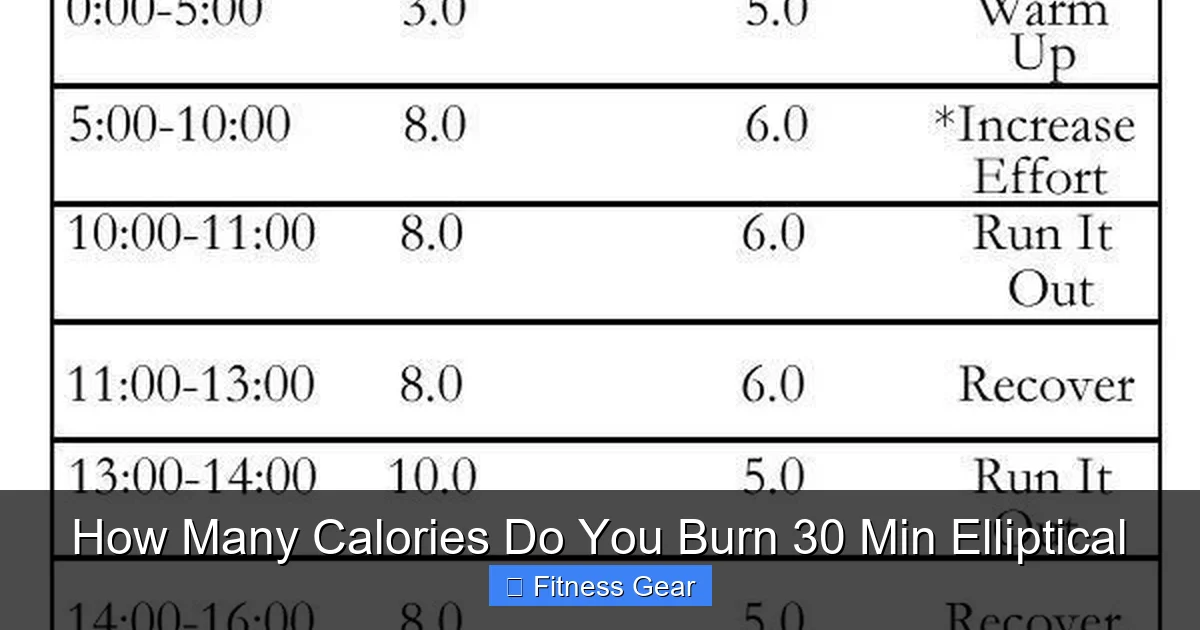
How Many Calories Do You Burn 30 Min Elliptical
The number of calories you burn in 30 minutes on an elliptical is not one-size-fits-all. It primarily depends on your body weight, workout intensity, and fitness level. On average, a 155-pound person burns about 335 calories at a moderate pace. To significantly increase this number, focus on high-resistance intervals, engaging your upper body, and maintaining a heart rate in the optimal fat-burning zone.
Key Takeaways
- Your weight is the single biggest factor: A heavier individual burns more calories performing the same work as a lighter person due to greater energy expenditure.
- Intensity matters more than time: A vigorous 30-minute session can burn nearly double the calories of a leisurely one, making effort level crucial.
- Ellipticals provide a full-body, low-impact workout: This unique combination protects joints while engaging more muscle groups than many other cardio machines, boosting overall calorie burn.
- Machine calorie counters are estimates: They use generalized formulas and often overestimate burn. Use them as a relative gauge, not an exact science.
- Consistency and progressive overload are key: Regularly challenging yourself with more resistance or speed is more effective for long-term calorie burn and fitness than occasional maximal efforts.
- Your fitness level adapts over time: As you become fitter, your body becomes more efficient, burning fewer calories for the same workout. You must continually increase the challenge.
📑 Table of Contents
- Understanding the Science: What Determines Your Calorie Burn on an Elliptical?
- Calculating Your Personal Burn: From Averages to Your Reality
- How to Maximize Your Calorie Burn in 30 Minutes
- Elliptical vs. The Competition: How Does It Stack Up for 30-Minute Burn?
- Debunking Common Myths About Elliptical Calorie Burn
- Your Action Plan: A Sample 30-Minute Maximum Burn Elliptical Workout
- Conclusion: It’s About the Work, Not the Number
Understanding the Science: What Determines Your Calorie Burn on an Elliptical?
So, you’ve stepped onto the elliptical, set the timer for 30 minutes, and you’re ready to sweat. The little screen in front of you starts ticking up calories—200, 250, 300. But is that number real? The truth about how many calories you burn in 30 minutes on an elliptical is a fascinating mix of physics, physiology, and personal effort. There is no universal answer, but by understanding the core principles, you can become the expert of your own workout and truly maximize your results.
At its most basic, calorie burn is about energy expenditure. Your body uses calories (a unit of energy) to power everything from breathing and thinking to the powerful contractions of your muscles during exercise. The harder your muscles work, the more energy they require, and the more calories you burn. An elliptical is a fantastic tool for this because it allows you to safely apply significant resistance to both your lower and upper body simultaneously, creating a high energy demand without the punishing impact of running.
The Primary Factors That Change the Equation
Several key variables interact to determine your personal calorie burn figure. Think of them as levers you can adjust.
- Body Weight: This is the most significant variable. It takes more energy to move a 200-pound body through space than it does to move a 130-pound body. The metabolic cost of simply existing (your Basal Metabolic Rate or BMR) is higher at a greater weight, and this carries over into exercise. A person weighing 250 pounds can burn 40-50% more calories in the same 30-minute elliptical session than someone weighing 130 pounds, all other factors being equal.
- Workout Intensity: This is the “how hard” factor. Intensity is primarily controlled by two things on an elliptical: resistance (or ramp/incline) and speed (strokes per minute or RPM). High resistance with a moderate speed feels like pushing a heavy sled—brutal and muscular. High speed with low resistance feels like rapid, light pedaling—cardiovascular and breathless. A vigorous, high-resistance workout will torch dramatically more calories than a gentle, low-resistance cruise.
- Fitness Level & Efficiency: A beginner’s body is inefficient. New movements, uncoordinated muscle firing, and a cardiovascular system that’s being challenged for the first time all lead to a high calorie cost. As you become fitter, your body adapts. Your muscles become more efficient at using fuel, your heart pumps more blood per beat, and the same 30-minute session becomes easier. To keep burning the same or more calories, you must progressively increase the challenge—more resistance, longer strides, or interval bursts.
- Age and Gender: Younger individuals typically have more muscle mass and a faster metabolism, leading to higher calorie burn. Men, on average, have more lean muscle mass than women of the same age and weight, and muscle tissue is metabolically active, burning more calories at rest and during activity. This is why two 40-year-olds, one male and one female, both weighing 160 pounds, will see different burn rates on the same setting.
- Body Composition: The ratio of muscle to fat in your body matters. Muscle is metabolically active tissue that requires more energy to sustain and use during exercise. Two people of the same weight and height can have vastly different calorie burns if one is highly muscular and the other has a higher body fat percentage.
The Role of MET Values: A Standardized Measurement
Scientists use something called a Metabolic Equivalent of Task (MET) to standardize the energy cost of physical activities. One MET is the energy you use sitting quietly. A “moderate” effort on an elliptical is typically assigned a MET value of around 5.0, while a “very vigorous” effort can be 8.0 or higher.
The formula to estimate calories burned per minute is:
Calories per minute = (METs x 3.5 x weight in kg) / 200
This shows why weight is so critical—it’s a direct multiplier. It also shows why intensity (which changes the MET value) has a massive impact. Doubling the intensity from a 5.0 MET to a 10.0 MET activity (like sprinting on the elliptical) would, in theory, double your calorie burn rate.
Calculating Your Personal Burn: From Averages to Your Reality
Now, let’s get practical. What do the numbers actually look like? Below is a table of estimated calorie burn for 30 minutes on an elliptical at a moderate intensity (roughly a 5.0 MET). These are averages from health organizations like the Harvard Medical School and Mayo Clinic.

Visual guide about How Many Calories Do You Burn 30 Min Elliptical
Image source: boxlifemagazine.com
- 125-pound person: ~270 calories
- 155-pound person: ~335 calories
- 185-pound person: ~400 calories
Remember, these are for a steady-state, moderate effort. If you crank up the resistance and push into a vigorous zone (7.5+ METs), those numbers can jump by 50-100%.
Why the Elliptical’s Own Calculator is Often Wrong
Look down at your machine’s display. It’s probably telling you you’ve burned 400 calories already. Be skeptical. Most elliptical calorie counters use a very simple, flawed formula: they assume an “average” user weight (often 150-170 lbs) and a generic estimate of effort. They cannot measure your heart rate, your true power output, or your individual metabolism. They are programmed to be optimistic, often overestimating burn by 15-30% to make you feel good. The best use for this number is to track your progress relative to yourself—if you do the exact same 30-minute workout at the same settings week after week, a decreasing calorie count might actually mean you’re getting fitter and more efficient, not that the machine is broken.
How to Get a More Accurate Estimate
For a more personalized number, use a heart rate-based fitness tracker or smartwatch. These devices incorporate your actual heart rate, age, weight, and sometimes gender into their algorithms, providing a far more accurate (though still not perfect) estimate. The principle is simple: the harder your heart works to deliver oxygen to your muscles, the more calories you’re likely burning. A chest strap heart rate monitor is the gold standard for accuracy during your elliptical session.
How to Maximize Your Calorie Burn in 30 Minutes
Okay, you’ve accepted that the machine’s number is a guess. Now, let’s make that guess as high as possible with real, effective effort. Your goal is to increase the total work done in those 30 minutes. Here’s your tactical playbook.

Visual guide about How Many Calories Do You Burn 30 Min Elliptical
Image source: boxlifemagazine.com
1. Embrace High-Intensity Interval Training (HIIT) on the Elliptical
This is the number one strategy. Instead of a steady 30-minute grind, break it into intervals. A classic protocol is the 30/60 or 60/90 method.
- Warm-up (5 min): Easy resistance, light pedaling.
- Interval Block (20 min total): Alternate between 30 seconds of ALL-OUT effort (max resistance, as fast as you can go) and 60 seconds of very easy recovery (low resistance, slow pace). Repeat this cycle 10-12 times.
- Cool-down (5 min): Easy pace to bring your heart rate down.
HIIT exploits a physiological phenomenon called Excess Post-Exercise Oxygen Consumption (EPOC). Your body continues to burn calories at an elevated rate for hours after a high-intensity session as it works to restore oxygen levels, repair muscle tissue, and return to homeostasis. This “afterburn” effect can add 6-15% to your total calorie expenditure from the workout.
2. Actively Engage Your Upper Body
Don’t just hold the handles passively! Push and pull with purpose. Imagine you’re doing a standing chest press and a row simultaneously with every stride. This recruits your pectorals, shoulders, back, and biceps/triceps. More muscle mass involved = more total energy demand = higher calorie burn. For an extra challenge, try letting go of the handles entirely (only if you have good balance!) to engage your core for stabilization, further increasing muscle activity.
3. Ignore the Console and Focus on Form & Feeling
Constantly watching the calorie counter is distracting and can lead to poor form. Instead, focus on:
- Full Strides: Extend your legs completely without locking your knees. Think about pushing through your heel on the rearward stroke.
- Posture: Stand tall, chest up, core engaged. Don’t lean heavily on the handles.
- Perceived Exertion: Use the “talk test.” During your high-intensity intervals, you should only be able to speak in short, broken phrases. During recovery, you should be able to hold a conversation easily.
4. Manipulate Resistance and Incline/Ramp
If your elliptical has an adjustable incline or ramp (like a Precor or some NordicTracks), use it! Increasing the ramp angle dramatically changes the muscular demand, engaging your glutes and hamstrings more. Combine a high ramp with a challenging resistance level for a truly full-body, high-calorie burn. The goal is to feel like you’re “pushing” the machine with your legs and arms, not just letting it move you.
Elliptical vs. The Competition: How Does It Stack Up for 30-Minute Burn?
How does the elliptical’s calorie burn compare to other popular cardio machines for a 30-minute session? Let’s compare at a vigorous effort for a 155-pound person.

Visual guide about How Many Calories Do You Burn 30 Min Elliptical
Image source: exercisebikeadvisor.com
- Elliptical (Vigorous): ~450-550 calories. Full-body engagement is its superpower.
- Treadmill (Running, 6 mph/10 min/mile): ~460 calories. High impact, very high cardiovascular demand. Burns similar calories but with more joint stress.
- Stationary Bike (Vigorous, >14 mph): ~390 calories. Primarily lower body. Can be very high burn with high resistance/spinning classes.
- Rowing Machine (Vigorous): ~410 calories. Excellent full-body power movement, but technique is critical to avoid injury and maximize efficiency.
- Stair Climber: ~380 calories. Brutal on the quads and glutes, high burn, but very monotonous and tough on knees.
The Verdict: For pure, sustainable, full-body calorie burn with minimal joint impact, the elliptical is arguably the king. It may not match the raw, explosive calorie burn of a sprint session on a treadmill for a highly trained runner, but it offers a more accessible, safer, and equally effective total-body workout for the average person looking to maximize a 30-minute session.
The “Afterburn” Factor: Which Machine Wins?
When considering EPOC (the afterburn effect), the hierarchy shifts slightly. Exercises that recruit the most muscle mass and create the greatest metabolic disturbance (like HIIT on the elliptical or rowing) tend to produce a larger EPOC response than steady-state, single-mode exercises. So, a 30-minute HIIT session on the elliptical will likely keep your metabolism elevated for longer than a 30-minute steady jog on a treadmill at the same average heart rate.
Debunking Common Myths About Elliptical Calorie Burn
Let’s clear the air on some persistent misconceptions that might be limiting your results.
Myth 1: “The Elliptical is for Old People and Doesn’t Burn Many Calories.”
This is perhaps the biggest myth. The elliptical is a tool. A tool used at a low resistance and slow speed by anyone—young or old—will yield a low calorie burn. A tool used with high resistance, speed, and intervals by a fit athlete will yield a very high burn. The machine’s low-impact nature doesn’t mean low-intensity. You can make it as brutally hard as you want. It’s a gateway to high-intensity training for those who can’t run due to injury, not a symbol of a weak workout.
Myth 2: “Holding the Handrails Reduces Calorie Burn.”
This is half-true. Leaning your full body weight on the handrails to support yourself absolutely reduces the work done by your legs and lowers calorie burn. However, lightly touching the handrails for balance while still pushing with your legs and actively pulling with your arms is the correct, full-body form. The key is not to use your arms to lift your body weight; use them to push and pull against the moving handle arms.
Myth 3: “You Can ‘Target’ Belly Fat by Using the Elliptical.”
Spot reduction is a myth. You cannot decide to burn fat only from your stomach by using a specific machine. When you create a calorie deficit (burn more than you eat), your body draws from fat stores all over your body in a pattern determined by genetics, not the exercise you did. The elliptical is fantastic for burning overall body fat, which will eventually include stubborn belly fat, but it does not specifically target it.
Myth 4: “A Longer, Steady-State Workout is Better for Fat Loss than a Shorter, Intense One.”
While steady-state cardio has its place (active recovery, building aerobic base), for pure calorie burn and metabolic impact in a fixed 30-minute window, high-intensity intervals are superior. They burn more calories *during* the session and create a larger EPOC effect, leading to greater total energy expenditure. For fat loss, intensity often trumps duration.
Your Action Plan: A Sample 30-Minute Maximum Burn Elliptical Workout
Putting it all together, here is a structured, no-thinking-required workout designed to maximize calorie burn in your 30-minute window. This is a HIIT template.
- Minutes 0-5: WARM-UP. Set resistance to a low level (2-4). Find a comfortable stride rate. Focus on full, smooth motions and upright posture.
- Minutes 5-25: INTERVALS. This is 20 minutes of work. For this block, you will use a “ramp” or “incline” setting if available, or just manipulate resistance.
- 0:00-1:00: ALL-OUT SPRINT. Max out your resistance (8-10 if your machine goes to 10) and go as fast as you can safely maintain. Your legs and arms should be burning.
- 1:00-2:00: ACTIVE RECOVERY. Drop resistance to 2-3. Pedal slowly, catch your breath. Keep moving.
- 2:00-3:00: SPRINT. Back to max resistance and speed.
- 3:00-4:00: RECOVERY.
- Repeat this 1-minute on/1-minute off pattern for the entire 20-minute block.
- Minutes 25-30: COOL-DOWN. Resistance to 1-2. Slow your pace gradually. Focus on deep breathing. Let your heart rate come down slowly.
Pro Tip: The first few times, you may not be able to go “all-out” for a full minute. That’s fine! Start with 30-second sprints and 90-second recoveries. The principle is the same: push your极限 (limit), recover, repeat.
Conclusion: It’s About the Work, Not the Number
The quest to discover how many calories you burn in 30 minutes on an elliptical ultimately leads to a simple, powerful truth: the number on the screen is a shadow of the real work you do. Your focus should never be on chasing a specific calorie count, but on chasing the feeling of a powerful, full-body effort. By understanding the factors that influence burn—your weight, your intensity, your technique—and by strategically applying principles like HIIT and full-body engagement, you transform the elliptical from a simple cardio machine into a potent calorie-burning engine.
Consistency is your greatest ally. A 30-minute, high-effort elliptical session, performed 4-5 times a week, combined with a balanced diet, will do more for your body composition and health than obsessing over the exact calorie count of a single, perfect workout. Step on, push with purpose, engage everything, and own the burn. The results will follow.
Frequently Asked Questions
Are the calories burned on an elliptical accurate?
No, the calorie counters on most ellipticals provide only a rough estimate. They use generic formulas based on an “average” user and often overestimate burn by 15-30%. For a more accurate reading, use a heart rate monitor that factors in your personal data and real-time exertion.
What is the best time of day to use the elliptical for maximum calorie burn?
The best time is the time you can consistently do it. Your circadian rhythm and body temperature might slightly affect performance, but the difference in total calorie burn is negligible compared to the importance of simply doing the workout. Prioritize consistency over timing.
Is the elliptical a good workout for weight loss?
Yes, absolutely. It provides an effective, low-impact way to burn a significant number of calories and improve cardiovascular health. When combined with a calorie-controlled diet, regular elliptical workouts are a powerful tool for creating the calorie deficit necessary for weight loss.
Can I build muscle on the elliptical?
You can achieve minor muscle endurance and toning, especially in your legs, glutes, and arms, due to the constant resistance. However, it will not build significant muscle mass (hypertrophy) like dedicated strength training with weights will. Think of it as muscular endurance and conditioning, not bodybuilding.
Should I hold the handles or not to burn more calories?
You should actively push and pull the moving handles to engage your upper body and increase total calorie burn. However, do not lean your body weight on them. Your core should remain engaged and your body upright, using your arms to drive against the machine’s movement, not to support your weight.
Is a 30-minute elliptical workout enough?
For general health and as part of a weight management plan, yes, 30 minutes of moderate-to-vigorous activity most days of the week meets public health guidelines. For significant weight loss or peak athletic performance, you may need longer sessions, higher intensity, or to combine it with strength training and dietary changes.