The number of calories burned in 20 minutes on an elliptical is not one-size-fits-all. It varies significantly based on your weight, age, gender, and, most importantly, your effort level. While averages range from 150 to over 300 calories, understanding the variables and employing strategies like high-intensity intervals can help you get the most from your short, efficient sessions. Consistency and proper form remain the true keys to long-term success.
Key Takeaways
- Calorie burn is highly individual: Your weight, metabolism, and workout intensity are the primary determinants, making generic online calculators only rough estimates.
- Effort trumps time: A vigorous 20-minute session will always burn more calories than a casual one, and can even surpass a longer, low-effort workout.
- HIIT is your 20-minute secret weapon: Incorporating short bursts of maximum effort followed by recovery periods dramatically increases calorie burn during and after the workout (EPOC).
- The elliptical is a full-body, low-impact tool: It engages both upper and lower body musculature, contributing to a higher metabolic demand than lower-body-only cardio machines.
- Form and resistance are critical: Using proper posture and actively pushing/pulling with your arms while increasing resistance (not just speed) builds muscle and boosts burn.
- Don’t chase the machine’s number: Calorie counters on ellipticals are notoriously inaccurate. Use them for relative effort tracking, not as a true medical measurement.
- Consistency is non-negotiable: Burning 200 calories in 20 minutes is effective, but doing it 4-5 times a week is what drives real fitness and weight management results.
📑 Table of Contents
- Why the Elliptical? Understanding the Machine and Its Magic
- The Core Question: What’s the Real Number for 20 Minutes?
- The 5 Key Factors That Change Your 20-Minute Burn
- How to Maximize Your 20-Minute Elliptical Session (The HIIT Blueprint)
- Elliptical vs. The World: How Does It Stack Up for a 20-Minute Burn?
- Designing Your Perfect 20-Minute Routine: Beyond the Basics
- Debunking Myths: What You *Don’t* Need to Worry About
Why the Elliptical? Understanding the Machine and Its Magic
So, you’ve decided to jump on the elliptical. Great choice! It’s a staple in gyms worldwide for good reason. Unlike a treadmill that can be hard on the knees and joints, or a stationary bike that primarily works your legs, the elliptical offers a unique, fluid motion that simulates walking or running without the impact. Your feet never leave the pedals, creating a smooth, gliding pattern that’s gentle on the body while still providing a serious cardiovascular challenge.
But here’s the first crucial thing to understand about calorie burn on the elliptical: it’s not just about leg power. The moving handgrips transform it into a full-body workout. When you actively push and pull with your arms, you’re engaging your chest, back, shoulders, and core. This simultaneous upper and lower body recruitment means you’re activating more muscle mass, and more muscle mass working means a higher demand for energy—in other words, you burn more calories. It’s a two-for-one deal: you get a heart-pumping cardio session and a functional strength burner all in one fluid motion.
The Science of the Burn: What “Calories” Really Mean Here
Before we dive into numbers, let’s clarify what we’re talking about. A calorie is a unit of energy. When we say “burn calories,” we mean your body is expending energy (calories) to fuel the work you’re doing. Your total energy expenditure during a 20-minute elliptical session comes from a few sources: the immediate ATP and glycogen your muscles use, the oxygen your cardiovascular system delivers, and the increased metabolic rate that lingers afterward.
The most important concept for you to grasp is METs, or Metabolic Equivalents of Task. One MET is the energy you use at rest. An activity with a MET value of 3 means you’re burning three times as many calories as you would just sitting there. Moderate elliptical work typically falls in the 4.5-6.0 MET range, while vigorous effort can hit 7.0+ METs. Your personal calorie burn is calculated using your body weight and the MET value of your activity. This is why a 200-pound person burns more than a 130-pound person doing the exact same workout for the same time—their body requires more fuel to move more mass.
The Core Question: What’s the Real Number for 20 Minutes?
Now, for the answer you’ve been waiting for. But remember, it’s a range, not a single figure. Based on widely accepted MET values and using the standard calorie formula (Calories = METs x weight in kg x time in hours), here are realistic estimates for a 20-minute session:

Visual guide about How Many Calories Burned in 20 Minutes of Elliptical
Image source: i.pinimg.com
- Light Effort (leaning on handles, low resistance, casual pace): For a 155 lb (70 kg) person, this might burn 125-180 calories.
- Moderate Effort (steady pace, conscious arm/leg drive, some resistance): This is the most common zone. A 155 lb person can expect to burn approximately 180-250 calories.
- Vigorous Effort / High-Intensity Interval Training (HIIT) (max effort sprints, high resistance, no support on handles): Here, the burn skyrockets. That same 155 lb person can torch 250-350+ calories in just 20 minutes.
See the spread? That’s almost a 200-calorie difference based on effort alone. Your weight is the other huge multiplier. A 185 lb person will burn roughly 20% more than the 155 lb example at the same intensity. A 125 lb person will burn about 20% less.
Why Online Calculators and Machine Readouts Lie to You
That number glowing on the elliptical’s display? Take it with a massive grain of salt. Most cardio machines use very generic, outdated formulas that often overestimate calorie burn by 10-30% to make you feel good and encourage usage. They typically don’t account for your individual body composition (muscle vs. fat ratio), fitness level, or even your precise heart rate. Your heart rate is a far better indicator of true effort and relative calorie expenditure than the machine’s guess. A smartwatch or chest strap with a heart rate monitor will give you a much more personalized—and likely more accurate—estimate if it uses your actual HR data.
The 5 Key Factors That Change Your 20-Minute Burn
To truly understand your number, you must look at these five personal variables. Think of them as levers you can pull to control your burn.

Visual guide about How Many Calories Burned in 20 Minutes of Elliptical
Image source: i.pinimg.com
1. Your Body Weight and Composition
This is the biggest fixed factor. It takes more energy to move a heavier body. But don’t despair if you’re working on weight loss! As you shed pounds, your calorie burn for the same 20-minute workout will naturally decrease. This is normal and expected. The key is to progressively increase your intensity (see below) to compensate. Furthermore, muscle is metabolically active tissue. Two people weighing 155 lbs—one with 30% body fat and one with 20% body fat—will have different burns. The more muscular person will burn slightly more calories at the same speed because muscle requires more energy to contract than fat does.
2. Intensity: The Single Most Important Lever You Control
Intensity is king. It’s the difference between a warm-up stroll and a breathless sprint. You can gauge it in two ways:
- Perceived Exertion (RPE): On a scale of 1-10, where 1 is sitting and 10 is a all-out, can’t-talk sprint, moderate is about 5-6, and vigorous is 7-8.
- Heart Rate: Aim for 70-85% of your maximum heart rate (roughly 220 minus your age) for a vigorous, calorie-crushing 20-minute session.
To maximize a 20-minute window, you must work at a vigorous intensity. A steady, moderate pace is fine for active recovery, but for pure calorie burn efficiency, you need to push.
3. Resistance vs. Speed: Which Matters More?
On an elliptical, increasing the resistance (the knob that makes it harder to push the pedals) is far more effective for burning calories and building muscle than simply pedaling faster with no resistance. High resistance at a controlled pace forces your glutes, quads, hamstrings, and upper body to work harder against the load. This builds strength and elevates your heart rate significantly. Pedaling fast with no resistance is essentially a lower-body swing—it raises your heart rate but provides less muscular engagement and a lower long-term metabolic boost. Always prioritize resistance first. A challenging pace at moderate resistance is better than a frantic, airy pace at the lowest setting.
4. Using Your Upper Body: Don’t Just Hold On!
This is the most common mistake. People lean on the handrails, using them only for balance while their arms go limp. This removes the upper body from the equation, cutting your calorie burn by up to 30%. To activate your arms, think “push and pull.” As you push one pedal forward, you should be pulling the opposite handle towards you in a powerful, controlled motion. Your hands should be open, not clenched, to encourage full range of motion. You should feel the burn in your shoulders, back, and chest. If you’re not using your arms, you’re leaving a massive calorie-burning engine idle.
5. Your Fitness Level and Efficiency
A beginner’s body is less efficient at performing exercise. Everything is new, movements are uncoordinated, and the cardiovascular system is struggling to keep up. This inefficiency means they burn more calories for the same “perceived effort” compared to a seasoned athlete whose body has adapted to become highly efficient. As you get fitter, the same 20-minute, RPE 7 workout will burn fewer calories because your body has gotten better at doing it. This is why progressive overload—consistently trying to do a little more (more resistance, longer intervals, higher speed)—is essential to keep your calorie burn climbing as you improve.
How to Maximize Your 20-Minute Elliptical Session (The HIIT Blueprint)
Given that you only have 20 minutes, your goal is maximum efficiency. The undisputed champion method for this is High-Intensity Interval Training, or HIIT. The structure is simple: alternate short bursts of maximum effort with periods of active recovery.
Visual guide about How Many Calories Burned in 20 Minutes of Elliptical
Image source: i.ytimg.com
The 20-Minute HIIT Elliptical Protocol
Here is a sample, battle-tested workout you can do on any elliptical. Adjust the resistance and speed to fit your fitness level.
- Minutes 0-3: Warm-up. Moderate resistance (level 4-5 out of 10), steady pace. Focus on full arm/leg engagement. Get your heart rate up gradually.
- Minutes 3-5: Build. Increase resistance by 1-2 levels. Push your pace slightly. Aim for an RPE of 6.
- Minutes 5-15: THE INTERVALS. This is the core. Do 4 cycles of:
- 60 seconds ALL-OUT: Crank the resistance up to a very challenging level (7-8+). Push and pull with everything you have. Your heart rate should be near its max. You should be gasping but able to sustain it for the full minute.
- 60 seconds RECOVERY: Drop the resistance back to a moderate level (4-5). Keep moving, catch your breath, shake out your arms. Do not stop moving.
- Minutes 15-18: Cool-down. Return to warm-up resistance and pace. Let your heart rate come down gradually.
- Minutes 18-20: Stretch. Step off and stretch your quads, hamstrings, glutes, chest, and back.
This protocol works because the all-out sprints create a massive oxygen debt. Your body spends hours afterward (the EPOC effect) working to repay that debt, burning extra calories at an elevated rate. A 20-minute HIIT session can have a metabolic afterburn effect that lasts for hours, making it vastly superior for calorie burn than 40 minutes of steady-state cardio.
Form Focus: The Non-Negotiable Foundation
You can have the best interval plan, but bad form will limit your results and risk injury. Here is your checklist:
- Posture: Stand tall. Your chest should be up, shoulders back and down (not hunched). Engage your core gently. Do not lean forward onto the handles.
- Foot Placement: Keep your feet flat on the pedals, heels down. Do not rock up onto your toes.
- Full Range of Motion: Fully extend your legs on the push (but do not lock the knees) and fully flex on the pull. Let the pedals come back towards you.
- Handle Grip: Use an open, relaxed grip. Your hands are guides, not anchors. The power comes from your chest and back muscles pulling the handles.
- No “Conveyor Belt” Effect: If you’re just letting the machine move your arms with no resistance, you’re cheating yourself. You should feel resistance through the entire push-pull cycle.
Elliptical vs. The World: How Does It Stack Up for a 20-Minute Burn?
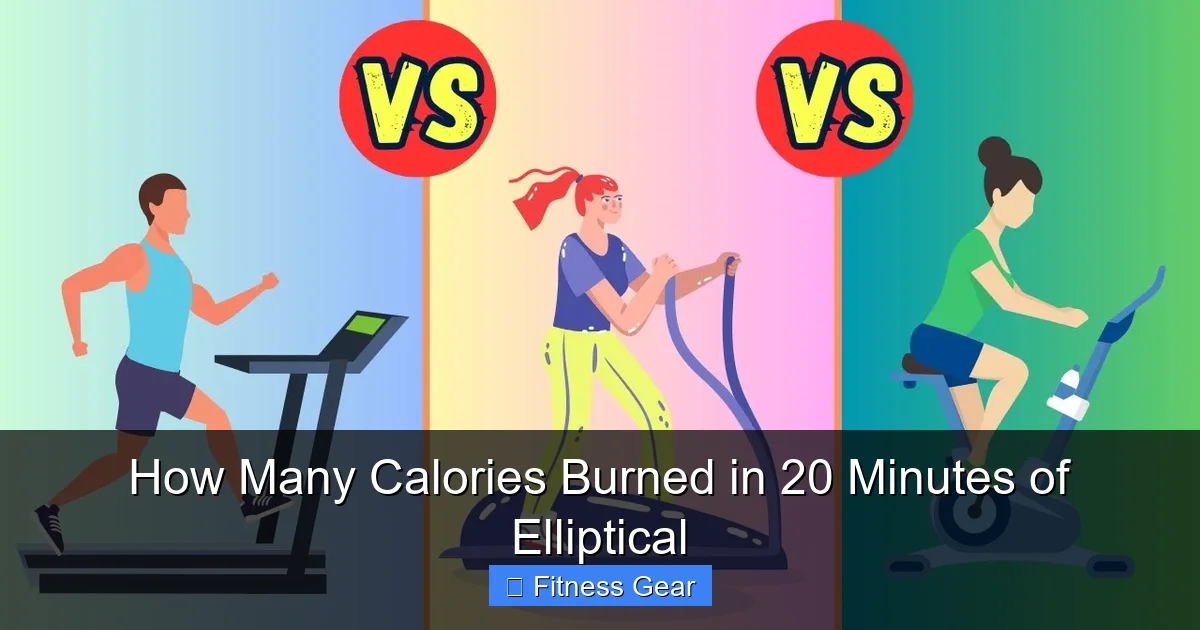
Context is everything. Is the elliptical the best machine for a 20-minute calorie burn? Let’s compare it to other popular cardio options for a 155 lb person at a vigorous effort.
Elliptical vs. Running (Treadmill)
A vigorous 20-minute run at a 6 mph pace (10-minute mile) burns approximately 250-310 calories. This is very similar to a vigorous elliptical session. The key difference is impact. Running is a high-impact activity that stresses joints. The elliptical provides a comparable cardiovascular and caloric burn with zero impact, making it superior for injury prevention, rehab, or those with joint issues. However, running may engage the calves and core stabilizers slightly more.
Elliptical vs. Stationary Bike
A vigorous 20-minute spin on a stationary bike (high resistance, standing sprints) can burn 260-330 calories. The bike is slightly more efficient for pure leg power and can allow for even higher resistance than an elliptical. But again, it’s a lower-body-only workout unless you’re in a cycling class with arm movements. The elliptical’s full-body engagement gives it a slight edge in total muscle recruitment and functional movement patterns for overall fitness.
Elliptical vs. Rowing Machine
This is the heavyweight contender. A vigorous 20-minute row (at a 200+ watt pace) burns a staggering 260-350+ calories. Rowing is arguably the most complete full-body cardio workout there is, driving power from the legs through the core to the arms in a powerful, sequential motion. It also has low impact. For a pure, all-out calorie burn in 20 minutes, a rowing machine is often king. However, the rowing motion has a steeper learning curve for proper, safe form than the elliptical.
The Verdict: The elliptical is a top-tier, highly efficient calorie burner for a 20-minute window. It may not always be the absolute highest on the list (that honor often goes to vigorous rowing or running), but it offers the best combination of high calorie burn, full-body engagement, zero impact, and accessibility for most people.
Designing Your Perfect 20-Minute Routine: Beyond the Basics
Now that you know the “how,” let’s talk about the “what.” A great 20-minute routine is more than just intervals. It’s about smart programming to avoid plateaus and keep you engaged.
Sample Routine #1: The Pyramid
This builds intensity progressively before tapering down.
- 0-3 min: Warm-up (RPE 4)
- 3-5 min: Increase resistance, RPE 6
- 5-8 min: Increase resistance again, RPE 7. Hold this “peak” for 3 minutes.
- 8-10 min: Decrease resistance slightly, RPE 6
- 10-12 min: One final push, RPE 8 for 2 minutes.
- 12-15 min: Recovery, RPE 4
- 15-18 min: Moderate pace, RPE 5-6
- 18-20 min: Cool-down, RPE 3
Sample Routine #2: The “Randomizer”
For those who get bored easily. Every 2 minutes, change one variable: resistance, speed (RPM), or your arm/leg focus (e.g., 2 minutes of only leg drive, 2 minutes of exaggerated arm pull). This mental and physical challenge keeps your body guessing and can spike calorie burn.
Don’t Forget the Fuel and Recovery
Your 20-minute burn doesn’t happen in a vacuum. To support this effort and maximize results:
- Hydration: Drink water before, during (if possible), and after. Dehydration cripples performance and calorie burn.
- Nutrition: You cannot out-exercise a poor diet. The calories you burn in 20 minutes are easily undone by one sugary snack. Focus on whole foods, protein, and fiber to support your workouts and recovery.
- Rest: Your body burns calories and rebuilds during recovery. Do not do HIIT elliptical every single day. Aim for 3-4 high-quality sessions per week, with other days for light activity, strength training, or complete rest.
Debunking Myths: What You *Don’t* Need to Worry About
Let’s clear the air on some persistent elliptical myths that might be holding you back.
Myth 1: “If I’m not sweating buckets, I’m not burning calories.”
Sweat is your body’s cooling mechanism, not a direct calorie meter. You can have an incredibly effective, high-burn workout without drenching the machine, especially in an air-conditioned gym. Rely on heart rate and perceived exertion, not sweat stains.
Myth 2: “Holding onto the handles for support is safer.”
Using the handles for weight support turns the elliptical into a lower-body-only machine and reduces calorie burn. It also promotes poor posture. For safety and maximum benefit, use the handles for balance and power, not for propping yourself up. If you need to hold on tightly to stay upright, the resistance is too high for your current fitness level.
Myth 3: “The elliptical is only for beginners or injured people.”
This is perhaps the greatest myth. A well-programmed, high-intensity elliptical workout is brutally effective and used by athletes for cross-training. The low-impact nature makes it sustainable for a lifetime, allowing for more frequent, high-quality training sessions without the wear and tear of running.
Myth 4: “I need to do an hour to see results.”
Intensity is the currency of time. A focused, brutal 20-minute HIIT session is worth more for fat loss and cardiovascular improvement than a casual, mindless 60-minute stroll. Time is a precious commodity—make every minute count.
Frequently Asked Questions
Is 20 minutes on the elliptical enough to lose weight?
Yes, 20 minutes can be enough if it’s done with high intensity (like HIIT) and combined with a consistent, calorie-conscious diet. It’s the cumulative effect of these efficient, frequent sessions that drives a calorie deficit necessary for weight loss, not the duration of any single workout.
How can I burn the most calories in 20 minutes on an elliptical?
Prioritize high-intensity intervals: alternate 60-90 second all-out sprints at high resistance with 60-second recovery periods. Actively use your arms to push and pull, maintain perfect posture without leaning on handles, and ensure your heart rate reaches 80-90% of its maximum during the sprint intervals.
Should I do elliptical every day?
For weight loss and cardiovascular health, aim for 3-5 sessions per week. Doing high-intensity elliptical every single day can lead to overuse injuries and burnout. On non-elliptical days, incorporate strength training, gentle walking, or yoga for recovery and balanced fitness.
Is it better to increase speed or resistance on the elliptical?
For calorie burn and muscle building, resistance is more important. Increasing resistance makes your muscles work harder against a load, building strength and elevating your metabolic rate. Increasing speed with no resistance often just creates momentum, reducing muscle engagement and overall effectiveness.
Can the elliptical help me lose belly fat?
The elliptical, like all cardio, helps you lose fat overall by creating a calorie deficit. You cannot “spot-reduce” belly fat. However, the full-body muscle engagement of the elliptical helps build lean muscle mass, which increases your resting metabolism, helping you burn more calories 24/7—a key factor in reducing abdominal fat over time when paired with a healthy diet.
Why does the elliptical say I burned fewer calories than my friend who did the same workout?
The machine’s readout is based on a generic formula that uses your entered weight. If your friend entered a higher weight, the machine will automatically estimate a higher calorie burn for the same speed and resistance. Additionally, factors like muscle mass, metabolism, and even subtle differences in form and efficiency cause real-world calorie burn to vary significantly between individuals. Always use the machine’s readout for relative comparison only (e.g., “I burned more today than last week”), not as an absolute truth.