The ideal elliptical workout duration isn’t one-size-fits-all. For general health, aim for 30-60 minutes most days. For weight loss, 45-60 minutes at moderate intensity is effective. Shorter, high-intensity sessions (20-30 minutes) also yield great results. The key is aligning your workout length with your specific fitness goals, intensity level, and schedule consistency.
Key Takeaways
- Duration is goal-dependent: Your “good” workout time changes based on whether you target weight loss, endurance, general health, or time efficiency.
- Intensity trumps time: A focused, high-intensity 30-minute session can be more beneficial than a low-effort 60-minute one.
- Consistency is king: Regularly completing 150 minutes of moderate weekly exercise is more important than any single, heroic session.
- Listen to your body: Your ideal time also depends on your current fitness level, recovery needs, and overall fatigue.
- Quality over quantity: Focus on maintaining good form, using the full range of motion, and engaging your core throughout your session.
- It’s a starting point: Any movement is better than none. Begin with what you can manage and progressively build duration or intensity.
- Warm-up and cool-down are non-negotiable: They are essential parts of your total workout time, preventing injury and aiding recovery.
📑 Table of Contents
- How Long Is a Good Workout on an Elliptical? The Short Answer
- The Core Factors That Dictate Your Ideal Elliptical Duration
- Duration Guidelines by Specific Goal
- How to Measure If Your Duration Was “Good”: Intensity & Perceived Exertion
- Common Mistakes That Sabotage Your Elliptical Duration
- Building Your Personal Elliptical Workout Template
- Conclusion: Your Good Workout is the One You Do Consistently
How Long Is a Good Workout on an Elliptical? The Short Answer
It’s the question on every elliptical newbie’s mind, and honestly, the one even veterans sometimes tweak: how long should I actually stay on this thing? You’ve seen people gliding for what feels like an eternity, and others who power through in 20 minutes flat. Who’s right? The beautiful, frustrating truth is that a “good” elliptical workout duration is highly personal. It’s a moving target based on your unique goals, your current fitness level, the intensity at which you’re pushing yourself, and even what you have going on in your life that day. There is no magic number stamped on the machine’s console that guarantees results for everyone.
Instead of hunting for a single answer, think of it as finding your personal sweet spot. A good workout on an elliptical is one that is sufficient in duration and intensity to stimulate the physical adaptation you desire, while being sustainable and safe enough to repeat consistently. It’s the intersection of effectiveness and practicality. This guide will break down the science, the practicalities, and the strategies to help you determine exactly how long your good elliptical workout should be, whether you’re a complete beginner or a seasoned athlete looking to optimize.
The Core Factors That Dictate Your Ideal Elliptical Duration
Before we dive into specific time recommendations, we must understand the variables. The clock is just one part of the equation. Your workout duration doesn’t exist in a vacuum; it’s inextricably linked to these five key factors. Ignoring them is like trying to bake a cake without knowing the oven temperature—you’ll end up with a mess.
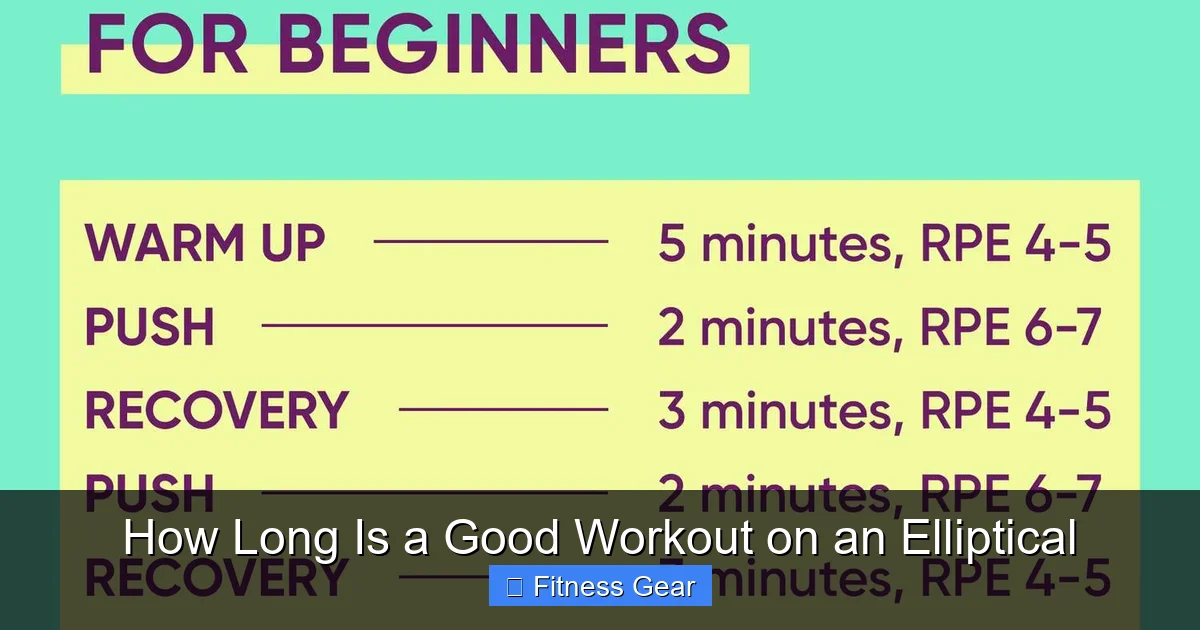
Visual guide about How Long Is a Good Workout on an Elliptical
Image source: shape.com
1. Your Primary Fitness Goal
This is the single biggest driver. Are you trying to shed pounds, build stamina, improve heart health, or just move more? The physiological demands of each goal are different, and thus the time spent at the appropriate intensity varies. A session aimed at building aerobic endurance will look very different in length from one designed to spike your metabolism for fat burning.
2. Your Current Fitness Level
Someone who has been sedentary for years cannot and should not jump on an elliptical for 60 minutes on day one. That’s a recipe for extreme soreness, frustration, and likely giving up. A good workout for a beginner is one they can recover from in 24-48 hours. For an advanced athlete, a “good” workout might require a duration and intensity that would overwhelm a novice. Your starting point dictates your initial duration.
3. Workout Intensity (The Effort You Put In)
This is the most critical and often overlooked factor. Intensity and duration have an inverse relationship in terms of physiological stress. A low-intensity, steady-state (LISS) session can and should be longer—think 45-60 minutes. A high-intensity interval training (HIIT) session on the elliptical, where you’re alternating between all-out sprints and recovery, is profoundly effective but can be perfectly complete in just 20-30 minutes. You cannot sustain maximum effort for an hour. Understanding your intensity zone is key to setting your duration.
4. Your Available Time & Schedule Consistency
Perfection is the enemy of progress. A perfect 60-minute workout you can only do once a month is far less valuable than a consistent, effective 30-minute workout you can do four times a week. A “good” workout must also be a realistic workout given your life circumstances. The best duration is the one you will consistently stick to over weeks and months.
5. Recovery & Overall Weekly Volume
Your body adapts during recovery, not during the workout itself. If you’re doing a very long or intense elliptical session, your body needs more time to repair. This affects how often you can do such sessions. A good weekly plan balances duration, intensity, and rest days. A 60-minute moderate session might be fine daily for some, while a 30-minute HIIT session might only be appropriate 2-3 times a week due to its high systemic stress.
Duration Guidelines by Specific Goal
Now, let’s translate those factors into actionable time ranges. These are general guidelines. Always adjust based on your personal feel and the other factors above.

Visual guide about How Long Is a Good Workout on an Elliptical
Image source: thewellnesswonderland.com
For General Health & Maintenance (The American Heart Association Recommendation)
If your primary goal is to stave off chronic disease, maintain a healthy weight, and boost overall well-being, the target is clear. Major health organizations like the American Heart Association recommend at least 150 minutes of moderate-intensity aerobic activity or 75 minutes of vigorous-intensity activity per week, spread over most days.
- What it looks like on the elliptical: This breaks down to about 30 minutes, 5 days a week at a moderate intensity (where you can talk in short sentences but not sing). This is the foundational, non-negotiable minimum for health. You can also do 25 minutes at a vigorous intensity 3 days a week.
- Practical Tip: If 30 minutes straight feels daunting, break it into two 15-minute sessions. Research shows accumulated activity provides similar health benefits.
For Weight Loss & Fat Burning
Weight loss fundamentally requires a caloric deficit. The elliptical is a tool to increase that deficit. Here, duration and intensity must be balanced to maximize calorie burn without promoting burnout or muscle loss.
- The Sweet Spot: 45-60 minutes at a steady, moderate-to-vigorous pace (a 6-7 on a 1-10 perceived exertion scale). This duration allows you to tap into stored fat as a primary energy source after depleting immediate glycogen stores.
- The HIIT Alternative: 20-30 minutes of High-Intensity Interval Training. This involves 30-60 second bursts of all-out effort (resistance and speed high) followed by equal or longer active recovery periods (low resistance, slow speed). HIIT creates an “afterburn effect” (Excess Post-Exercise Oxygen Consumption – EPOC), where your metabolism stays elevated for hours after, burning more total calories.
- Key Insight: For pure fat loss, consistency and total weekly calorie burn matter more than the split between one long session and several short ones. Do what you can sustain.
For Building Cardiovascular Endurance & Stamina
This goal is about improving the efficiency of your heart, lungs, and muscles to work longer. It’s the domain of endurance athletes, but also crucial for anyone wanting to feel less winded climbing stairs.
- The Long, Slow Distance (LSD) Method: This requires 60+ minutes at a comfortably hard, steady pace (a 5-6 on the exertion scale). The focus is on time on feet, not speed or resistance. This teaches your body to become a more efficient fat-burning machine and improves capillary density.
- Progressive Overload: Start with the duration you can manage (e.g., 30 minutes) and add 5-10% more time each week. The goal is to gradually extend your steady-state capacity.
- Note: Building true endurance is a slow process. One long session per week, supplemented by shorter moderate sessions, is a classic and effective pattern.
For Time-Crunched Efficiency (The Busy Bee)
Got 20 minutes? That’s enough. For those with demanding schedules, the elliptical can be a powerhouse of efficiency if you prioritize intensity.
- Protocol: A dedicated 20-25 minute HIIT session is incredibly effective. Example: 5-minute warm-up, then 8-10 rounds of (45 seconds hard / 75 seconds easy), 3-minute cool-down.
- Why it works: You achieve a greater metabolic disturbance and cardiovascular stimulus in half the time of a steady-state workout. It’s about quality, not quantity.
- Mindset Shift: Don’t think “I only have 20 minutes.” Think “I have 20 minutes to go all-in.” This mindset makes the short duration incredibly potent.
How to Measure If Your Duration Was “Good”: Intensity & Perceived Exertion
Time on the clock is meaningless without context of effort. How do you know if your 30 minutes was productive or just a casual stroll? You need a way to gauge intensity. Here are the best methods for the elliptical:

Visual guide about How Long Is a Good Workout on an Elliptical
Image source: i.ytimg.com
The Talk Test (Simple & Effective)
This is the easiest real-time gauge.
- Moderate Intensity: You can speak in full sentences, but you couldn’t sing a song. You’re breathing noticeably deeper.
- Vigorous Intensity: You can only speak a few words at a time without needing to take a breath. You’re breathing hard and fast.
Match your talk test to your goal. For general health/weight loss, aim for moderate. For HIIT/endurance building, you’ll be in vigorous during your work intervals.
Rate of Perceived Exertion (RPE) – The 1-10 Scale
This is a mental scale where 1 is sitting on the couch and 10 is a maximal, all-out effort you could only sustain for a few seconds.
- Steady-State (Weight Loss/Endurance): Aim for a sustained 5-7.
- HIIT Work Intervals: Aim for an 8-9.
- HIIT Recovery Intervals: Drop to a 3-4.
The RPE is fantastic because it accounts for daily fluctuations in energy and fatigue. A 7 for you on a well-rested day might feel like a 6 on a tired day. Listen to the scale.
Heart Rate Zones (The Most Objective Metric)
If you have a chest strap or reliable optical monitor, use heart rate. First, estimate your max heart rate (220 – your age is a rough estimate). Then:
- Zone 2 (Moderate): 60-70% of max HR. Ideal for long, fat-burning, endurance-building sessions. This is the “conversational” zone.
- Zone 3-4 (Vigorous): 70-85% of max HR. Where you’re breathing hard. Used for HIIT work intervals and improving cardiovascular capacity.
Your “good” elliptical workout duration is the time you spend in your target heart rate zone for your goal. A 30-minute session where 25 minutes are in Zone 2 is excellent for weight loss. A 20-minute session with 10 minutes in Zone 4 is an excellent HIIT session.
Common Mistakes That Sabotage Your Elliptical Duration
People often get the duration wrong because of these all-too-common pitfalls. Avoiding them will instantly make your time on the machine more effective.
Mistake 1: The “Zombie Glide”
This is the 45-minute session where your resistance is at 1, you’re leaning on the handles, and your mind is a thousand miles away. You’re expending minimal energy. Fix: Every 5 minutes, ask yourself: “Can I increase the resistance by 1 level?” or “Can I focus on pushing through my heels?” Make every minute count.
Mistake 2: Sacrificing Form for Speed
Gunning the resistance and speed to the point where you’re bouncing, not striding, or clutching the handles for dear life. This reduces effectiveness and risks injury. Fix: Prioritize a smooth, full pedal stroke. Keep your torso upright, core engaged, and hands light on the handles (or off them for more core challenge). Quality of motion matters more than raw speed.
Mistake 3: Ignoring the Warm-Up & Cool-Down
Jumping straight into your target pace and stopping abruptly. This wastes the potential of your session and increases injury risk. The warm-up and cool-down are part of your total workout time. Fix: Dedicate the first and last 5 minutes to gradual ramp-up and ramp-down. Use the warm-up to practice form and find your initial pace.
Mistake 4: Not Progressing
Doing the same 30-minute workout at the same settings for months. Your body adapts and the stimulus diminishes. Fix: Follow the principle of progressive overload. Each week, try one of the following: add 2-5 minutes to your duration, increase the resistance level, increase your speed/RPM, or add an extra interval. Change one variable at a time.
Mistake 5: Comparing Your Clock to Someone Else’s
Seeing the person next to you do an hour and feeling inadequate. Their goals, fitness, and intensity are different. Fix: Tune out the environment. Your journey is yours. A focused 25-minute HIIT session is a far better workout than a distracted, low-effort 60-minute session. Focus on your metrics (RPE, heart rate, form), not the clock of others.
Building Your Personal Elliptical Workout Template
Enough theory. Let’s build a plan. Use this template to structure your week based on your primary goal. Remember, the elliptical is a tool; you are the architect.
Sample Week for General Health & Maintenance
- Monday: 30 minutes, moderate steady-state (RPE 5-6). Focus on consistent pace.
- Tuesday: Rest or light activity (walking, stretching).
- Wednesday: 30 minutes, moderate steady-state. Try increasing resistance by 1 level from Monday.
- Thursday: Rest.
- Friday: 30 minutes. Add a 5-minute “challenge” in the middle: increase resistance every minute for 5 minutes, then recover.
- Weekend: Active rest. 20-30 minutes of light activity or a fun non-gym activity.
Sample Week for Weight Loss (Mixed Approach)
- Monday: 45 minutes, steady-state (RPE 6). Focus on fat-burning zone.
- Tuesday: 25-minute HIIT: 5-min warm-up, 8x(1-min hard/1-min easy), 5-min cool-down.
- Wednesday: Rest or light walk.
- Thursday: 40 minutes, moderate. Try “pyramid” intervals: 2-min moderate, 1-min hard, repeat 4x.
- Friday: 30 minutes, steady-state. Listen to a podcast, enjoy the movement.
- Saturday: Optional 30-minute fun session (lower resistance, faster RPM).
- Sunday: Rest.
Sample Week for Building Endurance
- Monday: 50 minutes, steady, comfortable pace (RPE 5). This is your long day.
- Tuesday: 30 minutes, moderate with 5×1-minute surges at a higher resistance (RPE 7).
- Wednesday: Rest or cross-train (swim, bike).
- Thursday: 40 minutes, steady. Try to hold a slightly higher average RPM than Monday.
- Friday: Rest.
- Saturday: 60 minutes, steady. Your weekly long session. Focus on pacing and hydration.
- Sunday: Active recovery: 20 minutes very easy, RPE 3.
Conclusion: Your Good Workout is the One You Do Consistently
So, how long is a good workout on an elliptical? The final, synthesized answer is this: A good elliptical workout is the duration that, performed at the appropriate intensity for your specific goal, you can complete with proper form and recover from in time to do it again consistently. For the average person seeking health, that’s often 30 minutes. For weight loss, it might be 45 minutes steady or 20 minutes HIIT. For an endurance athlete, it might be 60+ minutes.
Stop searching for a universal number on the internet. Start listening to your body. Use the tools of perceived exertion and heart rate to gauge your effort, not just the clock. Start where you are. If 10 minutes all-out is your max today, celebrate that. Next week, aim for 12. Progress, not perfection, is the goal. The elliptical is a fantastic, low-impact vessel for your fitness journey. The length of your voyage is up to you, as long as you keep sailing in the right direction, with enough wind in your sails (intensity) to make meaningful progress toward your destination (your goal). Now, step on, set your intention for the session, and make every minute count.
Frequently Asked Questions
Is it okay to do the elliptical every day?
Yes, for most people, daily low-to-moderate intensity elliptical sessions (20-30 minutes) are safe and beneficial, especially if you’re using it for active recovery or general movement. However, if you’re doing very long or high-intensity sessions, you should incorporate 1-2 full rest or active recovery days per week to allow your body to repair and avoid overuse injuries.
Should I work out on an empty stomach for better fat loss?
>While fasted cardio can increase the percentage of fat used as fuel during the session, the total daily fat loss is more dependent on your overall caloric deficit. Many people feel weak or dizzy exercising fasted. If it works for you and you feel good, a short (20-30 min) moderate session is fine. Otherwise, a small pre-workout snack (like a banana) can improve performance and duration, potentially leading to a greater total calorie burn.
How do I know if my elliptical workout is actually challenging me?
Use the talk test or Rate of Perceived Exertion (RPE). If you can easily hold a full conversation throughout, your intensity is too low for significant cardiovascular improvement or weight loss. You should be breathing noticeably harder. For weight loss/endurance, aim for an RPE of 5-7 (moderate to hard). For HIIT, your work intervals should feel like an 8-9.
What’s better for weight loss: long steady sessions or short HIIT on the elliptical?
Both are effective tools. Long steady sessions (45-60 min) burn more calories *during* the workout. Short HIIT sessions (20-30 min) burn fewer calories during the session but create a significant metabolic afterburn (EPOC), leading to elevated calorie burn for hours after. The best approach is often a combination: 2-3 days of steady-state and 1-2 days of HIIT per week. Ultimately, the best one is the one you will do consistently.
Can I lose weight just by using the elliptical without changing my diet?
You can create a caloric deficit with elliptical exercise alone, but it’s very challenging. A 30-minute moderate elliptical session might burn 300-400 calories. It’s easy to overestimate calorie burn and underestimate calorie intake. For sustainable and significant weight loss, combining elliptical workouts with a balanced, mindful diet will yield far faster and more reliable results than exercise alone.
I get bored easily. How can I make longer elliptical workouts more tolerable?
Don’t just stare at the wall. Create engagement: listen to an audiobook or podcast, create high-energy playlists for different segments, use the elliptical’s built-in programs (hills, intervals, random) to change the feel every few minutes, watch a show on a tablet, or focus on your form and breath (a form of moving meditation). Breaking the time into chunks with a specific goal for each chunk (e.g., “next 5 minutes at this resistance”) also helps mentally.