The elliptical and running both deliver excellent cardiovascular workouts, but they are not identical in their benefits. Running typically burns more calories per minute and offers a higher-impact stimulus for bone density. The elliptical provides a low-impact, full-body workout that builds muscle while being gentler on joints. The “best” choice depends entirely on your personal fitness goals, current health status, and preference for impact.
Key Takeaways
- Calorie Burn: Running generally has a higher peak calorie burn per minute, but the elliptical can achieve comparable totals over a session with higher resistance and upper-body engagement.
- Joint Impact: This is the primary difference. Running is high-impact, stressing knees, ankles, and hips. The elliptical is low-impact, mimicking a running motion without the pounding, making it ideal for injury recovery or those with joint concerns.
- Muscle Engagement: Running primarily targets the lower body (quads, hamstrings, glutes, calves). The elliptical actively engages the upper body (chest, back, biceps, triceps) and core in addition to the legs, providing a more balanced full-body workout.
- Bone Health: The weight-bearing impact of running is superior for building and maintaining bone mineral density, which is crucial for preventing osteoporosis. The elliptical’s non-weight-bearing nature offers minimal bone-stimulating benefit.
- Perceived Exertion: Many people can exercise longer and at a higher perceived exertion level on an elliptical than they can run, due to the reduced joint stress and distributed muscle usage.
- Injury Risk & Recovery: The elliptical is a fantastic cross-training and rehabilitation tool, allowing for cardiovascular maintenance while recovering from running-related injuries like shin splints or stress fractures.
- Functional Fitness: Running has a direct carryover to daily activities like sprinting or climbing stairs. The elliptical’s motion is less functional but excels in building muscular endurance in a controlled range of motion.
📑 Table of Contents
- The Great Cardio Debate: Elliptical vs. Running
- Biomechanics and Joint Impact: The Fundamental Difference
- Cardiovascular and Caloric Burn: Which is More Efficient?
- Muscle Engagement: Full Body vs. Lower Body Focus
- Bone Density and Long-Term Skeletal Health
- Weight Loss and Body Composition: The Nuanced Truth
- Mental Health, Enjoyment, and Practical Considerations
- Conclusion: It’s About Your “Why”
The Great Cardio Debate: Elliptical vs. Running
Step into any gym, and you’ll see two of the most popular cardio machines lined up: the trusty treadmill and the versatile elliptical trainer. They both get your heart pumping, your breath quickening, and sweat dripping. But when you drill down to the core question—does the elliptical have the same benefits as running?—the answer is a nuanced “it depends.” They share a common goal of improving cardiovascular health, but the paths they take to get there, and the side benefits (or drawbacks) they offer, are significantly different. This isn’t about declaring a winner; it’s about understanding which tool is right for your specific fitness toolbox, your body, and your long-term goals.
For decades, running was the undisputed king of cardio. It’s simple, requires minimal equipment, and is incredibly effective. The elliptical, a relative newcomer, emerged as a kinder alternative, promising a running-like motion without the brutal joint impact. But in trading impact for smoothness, what else changes? Does it still torch fat, build endurance, and strengthen bones in the same way? Let’s break down the science, the sensations, and the practical applications of each to give you a clear, comprehensive comparison.
Biomechanics and Joint Impact: The Fundamental Difference
What Happens to Your Body When You Run?
Running is a high-impact, weight-bearing activity. With each stride, your body weight—often multiplied by forces of 2-3 times your weight—collides with the ground. This impact travels up through your ankles, knees, hips, and spine. This repetitive stress is a double-edged sword. On one hand, it’s a potent stimulus for building strong bones and connective tissue (tendons, ligaments). On the other, it’s the primary cause of common running injuries: shin splints, plantar fasciitis, runner’s knee, and stress fractures. Your gait cycle is a complex, ballistic motion where you’re essentially propelling your entire body mass forward against gravity.

Visual guide about Does the Elliptical Have the Same Benefits as Running
Image source: verywellfit.com
The Elliptical’s “Floating” Motion
The elliptical’s defining feature is its continuous, circular path. Your feet never leave the pedals, and the machine’s design guides your motion along a fixed, elliptical轨道. This creates a zero-impact or low-impact environment. There is no pounding, no jarring collision. The force is distributed smoothly through the machine’s mechanics and into your muscles. This makes it an exceptional option for:
- Individuals with arthritis, osteoporosis (in early stages), or chronic joint pain.
- Those recovering from lower-body injuries who need to maintain cardio fitness without loading healing tissues.
- People who are significantly overweight, as the reduced stress on weight-bearing joints allows for longer, more comfortable sessions.
Practical Tip: Even on an elliptical, form matters. Avoid “locking” your knees at the top of the stride. Keep a slight bend, and focus on driving through your heels to engage your glutes and hamstrings properly, mimicking a healthy running gait.
Cardiovascular and Caloric Burn: Which is More Efficient?
The Calorie Math: It’s Not Always About the Machine
This is the question on everyone’s mind: “Which one burns more calories?” The short, scientific answer is that running, at the same perceived effort level, typically has a higher caloric expenditure per minute. The high-impact, full-body coordination required to run is metabolically expensive. Studies often show running on a flat surface burns 10-15% more calories than elliptical training at a self-selected, “somewhat hard” intensity. However, this comparison has a critical flaw: it ignores the duration and sustainability of the workout.

Visual guide about Does the Elliptical Have the Same Benefits as Running
Image source: i.pinimg.com
Because the elliptical is so joint-friendly, many users can exercise for significantly longer periods—30, 45, even 60 minutes—at a consistently high heart rate. A person who can only run for 20 minutes due to joint pain may easily elliptical for 40 minutes at a vigorous resistance. The total calorie burn over that longer session can easily surpass the shorter, more intense run. Furthermore, the elliptical’s upper-body involvement recruits more total muscle mass, which also contributes to a higher metabolic cost if you actively use the handles.
Heart Health: A Dead Heat
For the primary goal of improving cardiovascular endurance and heart health, both exercises are superb. Both can effectively elevate your heart rate into the target zones (fat-burning, aerobic, anaerobic) necessary for strengthening the heart muscle, lowering resting heart rate, and improving blood pressure. The key is intensity and consistency. You can achieve a VO2 max (a gold-standard measure of cardio fitness) improving workout on either machine, provided you push yourself. The elliptical might allow you to push harder for longer due to the lack of fatigue-inducing impact.
Practical Example: Try a HIIT (High-Intensity Interval Training) session on both machines. On the treadmill, this might be 1-minute sprints at 90-95% max effort followed by 2 minutes of walking recovery. On the elliptical, it could be 1-minute intervals at a very high resistance (level 8-10 out of 10) with a powerful push-pull on the handles, followed by 2 minutes of active recovery at low resistance. Both will spike your heart rate and improve fitness.
Muscle Engagement: Full Body vs. Lower Body Focus
Running: The Powerhouse of the Lower Chain
Running is predominantly a lower-body and core exercise. The prime movers are your quadriceps (front of thigh), hamstrings (back of thigh), gluteus maximus (buttocks), and calf muscles. Your core (abdominals and lower back) works isometrically to stabilize your torso and pelvis with each landing and push-off. However, the upper body’s role is largely passive—it’s there for balance and counter-rotation. You won’t build significant upper-body muscle from running alone.
Visual guide about Does the Elliptical Have the Same Benefits as Running
Image source: cf.shopee.com.my
Elliptical: The True Full-Body Player
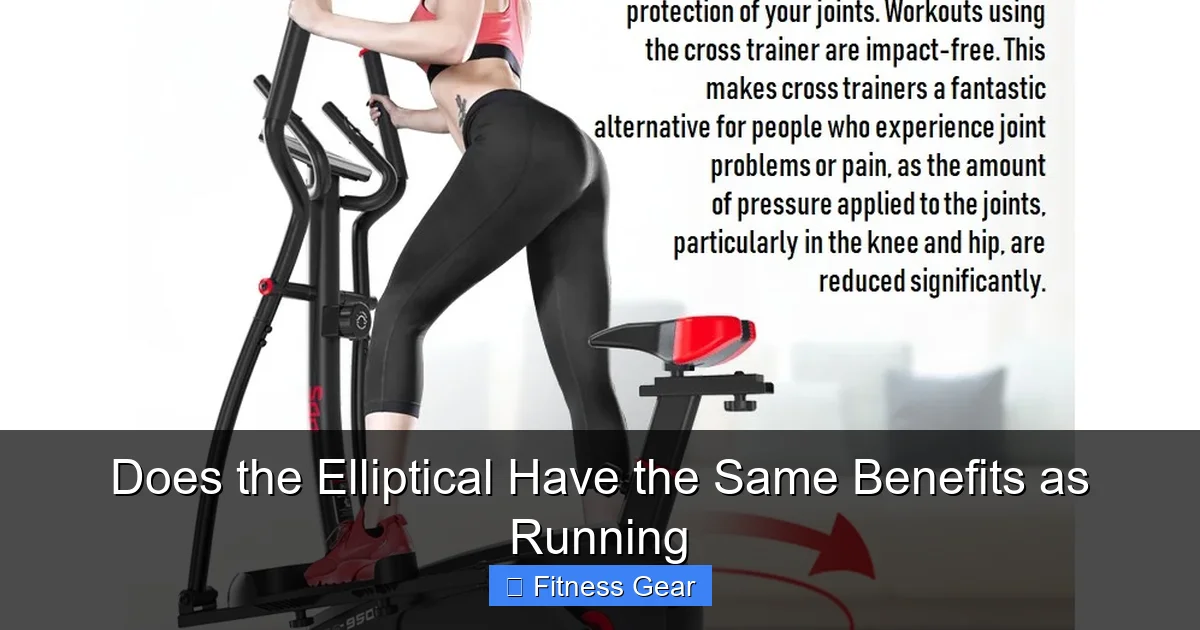
This is where the elliptical shines and fundamentally diverges from running. By design, it has moving handles that coordinate with the foot pedals. When you push and pull these handles with purpose, you turn your cardio session into a concurrent strength and endurance workout. You actively engage:
- Chest (Pecs) and Shoulders (Delts) during the pushing motion.
- Back (Lats, Rhomboids) and Biceps during the pulling motion.
- Core must work harder to stabilize against the rotational force from the handle movement.
This full-body recruitment means you’re toning and building endurance in your arms, chest, and back simultaneously with your legs. For someone looking to improve overall muscular endurance and achieve a more “toned” look without separate weight training sessions, this is a major advantage.
Practical Tip: To maximize the elliptical’s full-body benefit, never rest your hands on the stationary handlebars. Use the moving handles! Focus on a powerful push and pull, imagining you’re trying to snap the handle off the machine. If your gym has an elliptical with adjustable incline/ramp, using higher settings dramatically increases glute and hamstring activation, making it even more comparable to hill running.
Bone Density and Long-Term Skeletal Health
This is the most critical area where running’s high-impact nature provides a benefit the elliptical cannot match. Bone is living tissue that responds to stress by becoming denser and stronger. This principle, Wolff’s Law, means that the compressive forces of running are a powerful stimulus for maintaining and increasing bone mineral density (BMD), especially in the hips, spine, and legs. This is paramount for preventing osteoporosis and related fractures, particularly as we age.
The elliptical, because it is non-weight-bearing (your skeleton isn’t loaded with your full body weight against gravity), provides almost no osteogenic (bone-building) stimulus. For individuals at high risk for osteoporosis or who already have low bone density, running (or other weight-bearing activities like brisk walking, jumping rope, or strength training) is not just beneficial—it’s essential. The elliptical can be part of their routine for cardio, but it must be supplemented with dedicated weight-bearing exercise and resistance training for skeletal health.
Who Should Prioritize Running/Walking for Bone Health? Postmenopausal women, older adults, and anyone with a family history of osteoporosis should ensure their weekly routine includes significant weight-bearing activity.
Weight Loss and Body Composition: The Nuanced Truth
The Afterburn Effect (EPOC)
Excess Post-exercise Oxygen Consumption (EPOC) is the calorie burn that continues after you finish your workout. High-intensity, muscle-damaging exercise (like sprinting or heavy strength training) creates a larger EPOC. Running, particularly interval running or hill sprints, causes more micro-tears in the leg muscles than steady-state elliptical training, potentially leading to a slightly higher afterburn. However, the elliptical’s full-body muscle engagement can also contribute to a notable EPOC if you train at high resistance and intensity.
The Sustainability Factor
For sustainable weight loss, the best exercise is the one you will do consistently, week after week, month after month. This is where the elliptical’s joint-friendliness becomes a huge advantage for many. If running leaves you with achy knees that force you to skip workouts, the elliptical allows for daily or near-daily cardio without that accumulating damage. Consistency over time trumps short-term intensity spikes. Furthermore, by building muscle in your upper body (which running does little for), the elliptical can help increase your overall resting metabolic rate, as muscle tissue is more metabolically active than fat tissue.
The Verdict: If you can run pain-free and enjoy it, running may offer a slight edge in raw calorie burn and metabolic disturbance. If running is a painful, dreaded chore, the elliptical will almost certainly lead to greater total activity, more calories burned over months, and better adherence—making it the more effective tool for your weight loss journey.
Mental Health, Enjoyment, and Practical Considerations
The “Runner’s High” vs. The “Elliptical Flow”
Both activities release endorphins and other mood-boosting neurotransmitters. The legendary “runner’s high” is often attributed to the rhythmic, repetitive nature of running combined with the release of endocannabinoids. The elliptical can induce a similar meditative state—a “flow state”—especially if you’re listening to music, a podcast, or watching TV. The lower perceived physical strain for many can make the mental experience less of a grueling battle and more of a enjoyable, sustained effort. Some find the rhythmic, circular motion of the elliptical strangely soothing.
Convenience, Cost, and Environment
Running: Requires minimal equipment (good shoes). You can do it anywhere—on trails, roads, tracks, or a treadmill. It’s free (outside) or requires a treadmill investment. Weather-dependent outside.
Elliptical: Requires a machine. You’re confined to a gym or your home. It’s weather-proof. You can easily multitask (read, watch a show) due to the stable, hands-on-optional platform. The machine’s settings allow for precise control over resistance, incline, and sometimes stride length, offering more programmed variety.
Practical Reality: For a busy parent working out at home with young kids, the elliptical’s stability and ability to glance at a monitor might be safer and more practical than running on a treadmill. For a nature lover, nothing replaces the mental reset of an outdoor run.
Conclusion: It’s About Your “Why”
So, does the elliptical have the same benefits as running? The evidence shows they are complementary cousins, not identical twins. Running is the gold standard for high-impact, bone-strengthening, calorie-torching, pure lower-body power. The elliptical is the champion of low-impact, full-body endurance and joint-friendly longevity.
Your choice should be guided by your primary objectives and your physical reality:
- Choose RUNNING if: Your primary goals are maximizing calorie burn per minute, building strong bones, training for running events (5k, marathon), and you have no joint pain or injuries. You enjoy the simplicity and outdoor freedom.
- Choose the ELLIPTICAL if: You have knee, hip, ankle, or back issues; you’re significantly overweight; you’re recovering from an injury; you want a significant upper-body workout in your cardio time; or you simply cannot tolerate the impact of running but still want a vigorous, sweaty workout.
For the ultimate fitness enthusiast, the smartest strategy is not to choose one over the other, but to use both. Use running for bone health, power, and specific training. Use the elliptical for active recovery, cross-training to prevent overuse injuries, and days when your joints need a break. This blended approach allows you to harvest the unique benefits of each, minimize their drawbacks, and build a resilient, sustainable, and incredibly effective cardiovascular and overall fitness base for the long haul. Listen to your body, align your choice with your goals, and remember: the best exercise is the one you will actually do, consistently, for years to come.
Frequently Asked Questions
Can I lose belly fat on the elliptical as effectively as running?
Spot reduction is a myth; you lose fat from all over. Both exercises are excellent for creating the calorie deficit needed for fat loss. The elliptical’s full-body muscle engagement may slightly boost your overall metabolic rate, but the key is total calories burned and diet. Consistency with either, paired with a healthy diet, will reduce belly fat over time.
Is the elliptical a good replacement for running if I have knee pain?
Yes, it is often an excellent replacement. The elliptical’s zero-impact motion eliminates the pounding that aggravates most knee conditions (like arthritis or runner’s knee). It allows you to maintain cardiovascular fitness and leg strength while your knees recover. Always consult a doctor or physiotherapist for a specific diagnosis.
Does running build more muscle than the elliptical?
Running builds more muscle in the legs, particularly the calves and core stabilizers, due to the high-force contractions. The elliptical builds more muscle in the upper body (arms, chest, back) if you use the moving handles. For pure lower-body hypertrophy, running has an edge. For balanced full-body muscular endurance, the elliptical wins.
Which is better for improving 5k race time?
Running is unequivocally better. Race-specific training requires running. The biomechanics, impact forces, and neuromuscular patterns of running must be trained directly. The elliptical is a fantastic cross-training tool to build aerobic capacity and leg strength without adding impact stress, but it does not replace running workouts for a runner.
Can I get a good workout on the elliptical without using the handles?
You can, but you’re missing the primary benefit. Using only the foot pedals turns it into a lower-body-only exercise, similar to a stationary bike, and removes the full-body strength and calorie-burning advantage. For the most effective elliptical workout, always use the moving handles with a purposeful push and pull.
Is running or the elliptical better for mental health?
Both are highly effective. Running outdoors, in particular, has strong links to reduced stress and anxiety due to nature exposure. The “runner’s high” is well-documented. The elliptical can be meditative and less mentally taxing for some due to lower impact, making it easier to sustain and potentially more accessible for daily stress relief. The best choice is the one you enjoy and will do regularly.