How Long Should I Be Able to Jump Rope

Wondering how long you should be able to jump rope? Whether you’re a beginner or a seasoned athlete, this guide breaks down realistic time goals, training methods, and how to measure progress. Follow our step‑by‑step plan and jump rope with confidence.
Key Takeaways
- Baseline timing: Most beginners can aim for 30‑60 seconds of continuous jumps within the first few weeks.
- Intermediate goal: 2‑3 minutes of steady jumping is a solid benchmark after 4‑6 weeks of consistent training.
- Advanced endurance: 5‑10 minutes of uninterrupted rope work signals strong cardiovascular fitness.
- Progress tracking: Use a simple timer, heart‑rate monitor, or jump‑counter app to log each session.
- Technique matters: Proper form reduces fatigue, allowing you to jump longer without injury.
- Cross‑training boost: Adding strength, mobility, and interval work speeds up rope endurance gains.
- Recovery is key: Adequate rest, stretching, and footwear protect joints and keep you jumping longer.
📑 Table of Contents
- Introduction: Why Timing Matters in Jump Rope
- 1. Understanding the Basics of Jump Rope Endurance
- 2. Setting Realistic Time Goals
- 3. Building a Jump Rope Training Plan
- 4. Technique Tips to Jump Longer
- 5. Complementary Training for Better Rope Stamina
- 6. Listening to Your Body and Preventing Injuries
- Conclusion: Your Personal Jump Rope Timeline
Introduction: Why Timing Matters in Jump Rope
Jump rope is more than a childhood playground game. It’s a high‑intensity, low‑impact cardio tool that torches calories, improves coordination, and strengthens the lower body. But if you’ve never timed a session, you might wonder, “How long should I be able to jump rope?”
Answering that question gives you a clear target, helps you track progress, and prevents the common trap of over‑training. In this article we’ll explore realistic time goals, the science behind endurance, and a step‑by‑step plan to get you jumping longer—no matter your starting point.
1. Understanding the Basics of Jump Rope Endurance
What does “duration” really measure?
When we talk about how long you should be able to jump rope, we’re measuring two things:

Visual guide about How Long Should I Be Able to Jump Rope
Image source: isisparenting.com
- Continuous time: The length of an unbroken session without stopping.
- Quality of movement: Maintaining proper form, rhythm, and low‑impact foot strikes.
Both factors matter. A 5‑minute session with sloppy technique can be less beneficial—and more injury‑prone—than a focused 2‑minute interval done correctly.
Why time, not reps?
Counting jumps can be misleading because speed varies. One person may do 120 jumps in 30 seconds, another 80. Timing standardizes the workout, making it easier to compare progress across weeks and to follow proven training protocols.
2. Setting Realistic Time Goals
Beginner benchmark: 30‑60 seconds
If you’re brand new to rope work, aim for a solid 30‑second burst within the first 2‑3 weeks. This builds confidence and establishes a base level of coordination. Most people can achieve this by:

Visual guide about How Long Should I Be Able to Jump Rope
Image source: cdn.shopify.com
- Choosing a lightweight rope (≈ 2‑3 mm PVC).
- Practicing the basic “two‑foot hop” for 10‑15 minutes, three times a week.
- Focusing on a steady rhythm—think of the rope as a metronome.
Intermediate benchmark: 2‑3 minutes
After 4‑6 weeks of consistent practice, many jumpers can sustain 2‑3 minutes of continuous rope work. This level indicates decent cardiovascular fitness and improved neuromuscular coordination. To reach it, add:
- Short interval sets (30 s on, 30 s off) building to 90 s on.
- Basic variations (single‑leg hops, side‑to‑side) to keep muscles engaged.
- Light strength work—bodyweight squats and calf raises—to boost endurance.
Advanced benchmark: 5‑10 minutes
Cross‑fit athletes and seasoned boxers often hit 5‑10 minutes of steady jumping. This range demands:
- Efficient foot strike (mid‑foot landing, minimal ground contact time).
- Strong core stability to keep the rope’s path consistent.
- Good aerobic base—usually a VO₂ max of 45 ml·kg⁻¹·min⁻¹ or higher.
Reaching this level typically involves 8‑12 weeks of progressive overload, mixing steady‑state and high‑intensity interval training (HIIT).
3. Building a Jump Rope Training Plan
Week‑by‑week progression
Below is a 10‑week template that moves you from a 30‑second baseline to a 5‑minute goal. Adjust the days to fit your schedule, but keep at least two rest days per week.
Visual guide about How Long Should I Be Able to Jump Rope
Image source: i.pinimg.com
| Week | Sessions per Week | Focus | Sample Set |
|---|---|---|---|
| 1‑2 | 3 | Form & Rhythm | 5 × 30 s on / 30 s off |
| 3‑4 | 3‑4 | Endurance Build | 4 × 45 s on / 15 s off |
| 5‑6 | 4 | Interval Mix | 3 × 1 min on / 30 s off + 2 × 30 s skill drills |
| 7‑8 | 4‑5 | Steady State | 2 × 2 min on / 1 min off |
| 9‑10 | 5 | Peak Endurance | 1 × 5 min continuous, plus 2 × 1 min variations |
Key training components
- Warm‑up (5‑7 min): Light jogging, dynamic leg swings, and ankle circles.
- Skill work (5 min): Practice the “turn‑the‑rope” motion without jumping to perfect timing.
- Core activation (3 min): Plank variations keep the torso stable.
- Cool‑down (5 min): Gentle stretching focusing on calves, hamstrings, and shoulders.
Progress tracking tools
Use any of the following to log your sessions:
- Smartphone timer with lap function.
- Wearable heart‑rate monitor that also counts jumps.
- Free apps like “Jump Rope Counter” or “RopeFit” that sync to your phone.
Record total time, average pace (seconds per jump), and perceived exertion. Review weekly to spot trends.
4. Technique Tips to Jump Longer
Footwork fundamentals
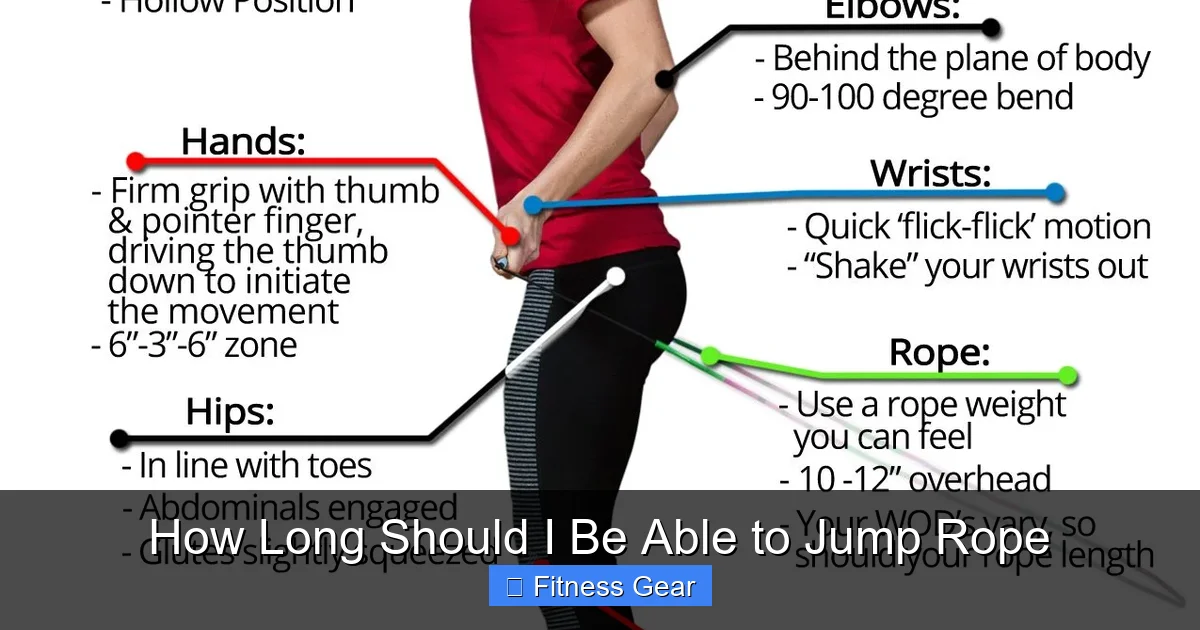
Landing on the balls of your feet reduces impact and shortens ground contact time. Keep knees slightly bent and avoid “stomping.”
Grip and rope length
Hold the handles lightly—just enough to control the rope. The rope should reach your armpits when you stand on its center. A rope that’s too long forces you to over‑rotate; too short makes you chase the rope.
Posture and core engagement
Maintain a tall spine, shoulders relaxed, and gaze forward. Engage the core like you’re bracing for a punch; this stabilizes the hips and prevents the rope from whipping out of sync.
Breathing rhythm
Inhale for two jumps, exhale for two. Controlled breathing supplies oxygen to the working muscles and helps you stay calm during longer sets.
Common mistakes that cut your time
- High jumps: Increases energy cost and joint stress.
- Loose wrists: Causes rope to lag, forcing you to over‑rotate.
- Looking down: Disrupts balance and shortens stride.
5. Complementary Training for Better Rope Stamina
Strength work
Strong calves, glutes, and hamstrings generate the power needed for quick, efficient jumps. Include:
- Calf raises (3 × 15‑20)
- Single‑leg Romanian deadlifts (3 × 10 each side)
- Bodyweight squats or jump squats (2 × 12‑15)
Mobility and flexibility
Limited ankle dorsiflexion can force you to land heavily. Perform:
- Ankle circles (10 each direction)
- Wall‑rocking calf stretch (30 s each side)
- Hip flexor lunge stretch (30 s each side)
Cardiovascular cross‑training
Running, cycling, or rowing 2‑3 times a week builds the aerobic base that lets you sustain longer rope sessions. Aim for 20‑30 min at moderate intensity.
HIIT sessions
High‑intensity interval training improves both anaerobic power and recovery speed—critical for jumping rope at a fast pace. Sample HIIT:
- 30 s max‑effort rope, 30 s rest – repeat 8‑10 times.
- Alternate with bodyweight burpees or mountain climbers for variety.
6. Listening to Your Body and Preventing Injuries
Signs you’re overdoing it
Sharp calf pain, shin splints, or persistent knee soreness indicate you need more rest or a technique tweak. Reduce session length by 20‑30 % and focus on form.
Recovery strategies
- Foam rolling: Spend 2‑3 min on calves and IT bands after each workout.
- Ice baths or cold packs: 10‑15 min if you feel swelling.
- Active recovery: Light walking or yoga on rest days keeps blood flowing.
Choosing the right rope and shoes
A 2‑3 mm speed rope is ideal for fast turns, while a slightly heavier beaded rope can help beginners feel the rhythm. Pair it with low‑profile cross‑training shoes that have good arch support and a flexible sole.
Conclusion: Your Personal Jump Rope Timeline
There’s no one‑size‑fits‑all answer to “How long should I be able to jump rope?” The key is to set incremental, measurable targets—30 seconds, 2 minutes, 5 minutes—and to train with purpose. By mastering technique, following a progressive plan, and supporting your rope work with strength, mobility, and cardio, you’ll naturally extend your jump time while staying injury‑free.
Remember, consistency beats intensity. Jump a little every day, track your progress, and celebrate each new personal best. Before long, you’ll be breezing through 5‑minute rounds and wondering how you ever settled for less.
Frequently Asked Questions
What is a realistic first‑time jump rope duration?
For most beginners, 30‑60 seconds of continuous jumping is a realistic start. Focus on smooth rhythm and proper foot strike during this period.
How often should I practice jump rope to improve my time?
Three to five sessions per week, each lasting 10‑20 minutes, provides enough stimulus for progress while allowing recovery.
Can I use a heavier rope to build endurance faster?
A slightly heavier beaded rope can help beginners feel the rotation, but for endurance the light speed rope (2‑3 mm) is preferred because it reduces fatigue.
Is it normal to feel sore in my calves after a rope session?
Some mild soreness is normal, especially if you’re new to the exercise. Persistent sharp pain may indicate overuse; reduce volume and check your form.
How does jump rope time relate to overall cardio fitness?
Longer continuous jumps require a strong aerobic base. If you can sustain 5‑10 minutes, your VO₂ max is likely in a moderate to high fitness range.
Should I combine jump rope with other cardio activities?
Yes. Adding running, cycling, or swimming 2‑3 times a week complements rope training, improves heart health, and speeds up endurance gains.