An elliptical machine provides a true full-body workout by simultaneously engaging your lower body (quads, hamstrings, glutes, calves), upper body (chest, back, shoulders, arms), and core muscles. Its unique, low-impact motion protects your joints while delivering an efficient cardiovascular session. By adjusting resistance, incline, and using your arms actively, you can target specific muscle groups and maximize calorie burn for strength and endurance gains.
Key Takeaways
- Full-Body Engagement: The elliptical uniquely combines a leg-driven motion with movable arms, working over 80% of your major muscle groups in one session.
- Primary Lower Body Focus: It intensely targets the quadriceps, hamstrings, glutes, and calf muscles through its smooth, weight-bearing pedal motion.
- Active Upper Body: Pushing and pulling the handles engages the chest, back, shoulders, and arm muscles, turning cardio into a strength session.
- Core Stabilization: Your abdominal and lower back muscles constantly engage to maintain posture and balance on the moving platforms.
- Low-Impact Cardio Champion: The elliptical eliminates the jarring impact of running, making it ideal for joint health, injury recovery, and sustainable fitness.
- Customizable Intensity: By manipulating resistance, incline, speed, and arm involvement, you can shift the focus between muscle endurance, strength building, or pure fat-burning cardio.
- Calorie-Torching Efficiency: The involvement of large muscle groups in both upper and lower body leads to a high metabolic demand and significant calorie expenditure.
📑 Table of Contents
- Introduction: More Than Just a Leg Machine
- The Powerhouse: Lower Body Muscles in Detail
- Beyond the Legs: Sculpting the Upper Body
- Cardiovascular and Metabolic Impact
- Maximizing Your Elliptical Workout: Form, Focus, and Variables
- Comparing the Elliptical to Other Cardio Machines
- Conclusion: Your Full-Body, Low-Impact Powerhouse
Introduction: More Than Just a Leg Machine
Step onto an elliptical, and you feel that familiar, gliding motion. Your legs move in an oval, your arms swing in opposition. It’s a comfortable, rhythmic workout that feels easier than running but more involved than a stationary bike. But have you ever paused mid-stride to wonder, what parts of the body does an elliptical actually work?
The common misconception is that the elliptical is purely a lower-body cardio machine. This couldn’t be further from the truth. The elliptical’s genius lies in its design: a fixed, elliptical pathway for the feet combined with independently moving arm levers. This engineering creates a true full-body, weight-bearing, and low-impact exercise. Unlike a bike, which primarily taxes the legs while you sit, the elliptical requires you to stand and coordinate your entire kinetic chain. You are not just pushing pedals; you are pushing and pulling against resistance with your entire body.
Understanding which muscles are activated—and how to maximize their engagement—transforms your elliptical workout from a simple warm-up into a powerful, comprehensive session for building strength, improving cardiovascular health, and managing weight. Let’s break down the anatomy of an elliptical workout, muscle by muscle.
The Powerhouse: Lower Body Muscles in Detail
Your lower body is the engine of the elliptical motion. The force you generate through your legs drives the machine and sets the pace. Because you are standing and bearing weight, these muscles are working in a functional, weight-bearing capacity, which is excellent for bone density and joint stability.

Visual guide about What Parts of the Body Does an Elliptical Work
Image source: cardionerd.com
Quadriceps: The Front Thrust
Located on the front of your thigh, the quadriceps (or “quads”) are a four-headed muscle group responsible for knee extension. On the elliptical, your quads are most active during the push phase—when your foot is moving downward and forward to propel the pedal. You’ll feel this engagement most intensely in the top half of the pedal stroke. To emphasize your quads, focus on pressing through your heels and increasing the machine’s resistance.
Hamstrings: The Rear Pull
The hamstrings, on the back of your thigh, perform the opposite action: knee flexion and hip extension. They are most active during the pull phase—when your foot is moving upward and backward. This phase is crucial for a complete range of motion. If you find your hamstrings aren’t firing, check your form; a slight forward lean from the hips (not the waist) can help engage them more effectively as you pull the pedal up.
Gluteus Maximus: The Hip Engine
Your glutes, or buttocks muscles, are the largest and strongest muscles in the body. They are the primary hip extensors. On the elliptical, they engage powerfully when you drive your hip backward, which occurs most during the rearward portion of the pedal stroke. To really activate your glutes, increase the incline setting. An incline mimics climbing, forcing your glutes and hamstrings to work harder to lift your “body weight” against gravity with each step.
Calves: The Ankle Stabilizers
The gastrocnemius and soleus (your calf muscles) are responsible for plantar flexion—pointing your toes downward. They get a consistent, isometric workout on the elliptical as they help stabilize your ankle throughout the entire circular motion. You can increase calf engagement by consciously pressing through the balls of your feet during the forward push, though be cautious not to let your heels lift completely off the pedal.
Practical Tip: Experiment with foot placement. Keeping your feet flat on the pedals provides balanced activation. Pressing more through your heels shifts emphasis to the glutes and hamstrings, while pressing through the toes targets the quads and calves more.
Beyond the Legs: Sculpting the Upper Body
This is where the elliptical truly separates itself from other cardio machines. The moving arm levers are not an afterthought; they are a fundamental part of the workout. When you actively push and pull these handles, you transform a leg day into a full-body strength and endurance session.

Visual guide about What Parts of the Body Does an Elliptical Work
Image source: cardionerd.com
Chest (Pectoralis Major) and Shoulders (Anterior Deltoids)
When you push the handles forward and away from your body, you perform a movement similar to a standing chest press. This concentric contraction primarily targets the pectoral muscles in your chest and the front portion of your shoulder deltoids. The resistance provided by the machine’s mechanics means your upper body is working against a tangible load, not just swinging its own weight.
Back (Lats, Rhomboids, Rear Delts) and Biceps
The pull phase is equally important. As you draw the handles back toward your torso, you engage the large latissimus dorsi (“lats”) in your back, the rhomboids between your shoulder blades, and the rear deltoids. This motion also involves elbow flexion, which recruits the biceps brachii. This pulling action is crucial for balancing the pushing motion, promoting muscular symmetry, and improving posture by strengthening the pulling muscles of the upper back.
Triceps and Forearms
While the biceps work during the pull, the triceps (on the back of the upper arm) act as stabilizers and assist in the pushing motion. Your forearm muscles (flexors and extensors) are continuously engaged to maintain a firm grip on the handles, building grip endurance.
Practical Tip: The biggest mistake users make is resting their hands on the handles and letting the arms move passively. To maximize upper body work, actively grip and push/pull with purpose. Imagine you are doing a controlled press and row. If your machine has movable arms, never let them swing freely; you control the movement from start to finish.
Core: The Unseen Stabilizer
While not a primary mover like the legs or arms, your core musculature—the rectus abdominis, obliques, and erector spinae—is working constantly as a stabilizer. On an elliptical, your base of support (the pedals) is in constant, unpredictable motion relative to your upper body. To stay upright, balanced, and efficient, your deep core muscles must fire isometrically to prevent excessive leaning, twisting, or swaying. A strong, engaged core protects your lower back and transfers force efficiently between your upper and lower body. To heighten core engagement, focus on maintaining a tall, upright posture with your navel gently drawn in toward your spine. Avoid leaning heavily on the handlebars.
Cardiovascular and Metabolic Impact
The muscular engagement described above has a direct and powerful effect on your heart, lungs, and metabolism.
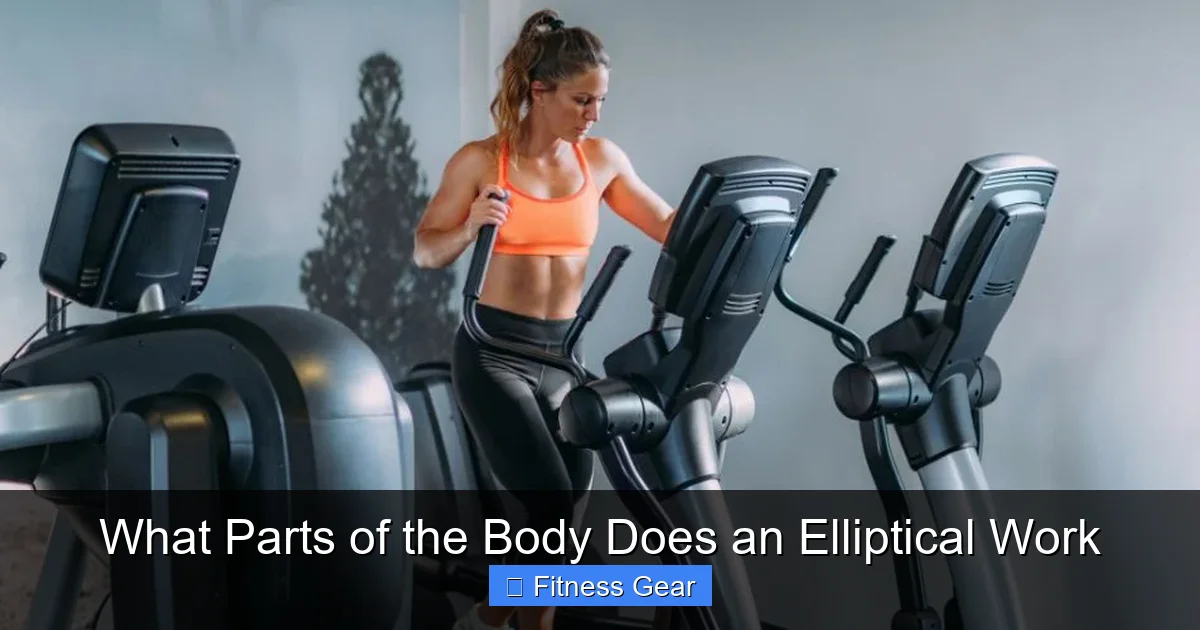
Visual guide about What Parts of the Body Does an Elliptical Work
Image source: liftbigeatbig.com
A Heart-Healthy, Full-Body Pump
Because you are using so many large muscle groups simultaneously, your heart has to work hard to pump oxygenated blood to all of them. This creates a high cardiovascular demand, effectively strengthening your heart muscle and improving lung capacity. The steady-state nature of elliptical exercise is excellent for building aerobic endurance. However, by using interval training (alternating high resistance/speed with recovery periods), you can also powerfully tax your anaerobic system, improving VO2 max and metabolic flexibility.
Torching Calories and Building Endurance
The metabolic equation is simple: more muscle working = more energy (calories) burned. The elliptical’s full-body nature makes it one of the most efficient calorie-burning cardio machines. A 185-pound person can burn approximately 300-400+ calories in a vigorous 30-minute session. Furthermore, by building muscular endurance in your legs, arms, and core, you improve your overall work capacity. This means everyday activities become easier, and you can sustain higher levels of activity for longer periods without fatigue.
Maximizing Your Elliptical Workout: Form, Focus, and Variables
Knowing the muscles involved is only half the battle. To truly capitalize on the elliptical’s potential, you must use it with intention. Your workout is defined by several key variables you can manipulate.
The Pillars of Proper Form
Before adding intensity, master the foundation. Stand tall with a slight bend in your knees, shoulders relaxed and down, and gaze forward. Your weight should be evenly distributed through the entire foot on the pedal. Avoid two common pitfalls: 1) Leaning forward and bearing weight on the arms/handlebars, which disengages your core and glutes, and 2) “Heel stomping” or letting your feet slap the pedals, which reduces efficiency. The motion should be smooth and fluid, like a pendulum.
Resistance vs. Incline: Targeting Different Muscles
These are your primary tools for muscle focus.
- High Resistance / Low Incline: This setting makes each push and pull significantly harder. It emphasizes strength and power development in the quads, glutes, chest, and back. Think of it as a muscular endurance and strength-building phase. Your speed will naturally be slower.
- Low Resistance / High Incline: This simulates a steep hill climb. It dramatically increases activation of the glutes and hamstrings, as they work to “lift” your body against the gradient. It’s a fantastic glute-focused cardio session.
- Moderate Resistance & Incline: This balanced setting is ideal for pure cardiovascular training, promoting heart health and steady calorie burn with moderate muscle engagement.
Interval Training for Peak Results
Don’t just set it and forget it. Incorporate intervals. For example:
- 2 minutes at a moderate, sustainable pace (warm-up)
- 1 minute at a very high resistance (or incline) where you are pushing/pulling with maximum effort
- 2 minutes of active recovery at low resistance
- Repeat 6-8 times
- 2 minutes cool-down
This strategy spikes your heart rate, burns more calories in less time (thanks to the afterburn effect, or EPOC), and prevents workout plateaus.
Comparing the Elliptical to Other Cardio Machines
Understanding the elliptical’s unique muscle recruitment helps clarify where it fits in your fitness ecosystem.
Elliptical vs. Treadmill
The treadmill provides an excellent, weight-bearing cardiovascular workout that heavily targets the calves, quads, and glutes. However, it is a high-impact activity that can stress joints, especially the knees and hips. The upper body is largely passive unless you use arm pumps or incline. The elliptical offers a comparable (often superior) calorie burn with zero impact and built-in upper body engagement.
Elliptical vs. Stationary Bike
The bike (especially a recumbent) is the ultimate low-impact leg machine, fantastic for quad and glute focus with minimal joint stress. However, it is a seated exercise, meaning it’s non-weight-bearing (less beneficial for bone density) and provides no upper body workout unless you have moving handlebars, which are still less dynamic than an elliptical’s. The elliptical offers a more total-body, weight-bearing alternative.
Elliptical vs. Rowing Machine
The rower is perhaps the elliptical’s closest competitor in terms of full-body engagement. It powerfully works the back, legs, and core in a seated, pulling-dominant motion. However, the rowing motion is primarily a hinge at the hips, with less dynamic lower-body range of motion than the elliptical’s circular stride. The elliptical provides a more upright, running-like motion that many find more comfortable and better for mimicking natural gait patterns.
Conclusion: Your Full-Body, Low-Impact Powerhouse
So, what parts of the body does an elliptical work? The comprehensive answer is: almost all of them, in a coordinated, low-impact symphony. It is a master of efficiency, blending the leg-sculpting power of a stair-climber with the upper-body toning of a cross-country ski machine, all while delivering a heart-pumping cardio session.
To reap these benefits, move with purpose. Actively use your arms. Play with resistance and incline to shift focus. Maintain impeccable form. Whether your goal is weight loss, joint-friendly endurance, muscular toning, or simply a time-efficient workout, the elliptical, when understood and used correctly, is an unparalleled tool in your fitness arsenal. It’s not just a warm-up machine; it’s a complete, full-body gym in one sleek, gliding package.
Frequently Asked Questions
Is the elliptical a good workout for weight loss?
Yes, absolutely. The elliptical’s full-body engagement burns a high number of calories per session. By activating large muscle groups in both the upper and lower body, it creates a significant metabolic demand. Combining this with interval training and a consistent schedule can make it a very effective tool for weight management and fat loss.
Will the elliptical build muscle or just tone?
The elliptical primarily builds muscular endurance rather than maximal strength or bulk (hypertrophy). The resistance provided, even at high settings, is generally not sufficient to cause significant muscle size increases like heavy weightlifting would. However, it effectively “tones” and strengthens muscles, improving their definition, stamina, and metabolic activity.
Can I get a good workout on the elliptical without using the handles?
You can, but you lose the primary benefit. Using the handles actively engages your upper body, increasing calorie burn by up to 20-30% and providing a true full-body workout. If you hold on lightly for balance only, you’re mostly doing a lower-body exercise similar to a hybrid between a bike and a stair-stepper. For maximum results, always use the arms.
Is the elliptical better than running for joint health?
For most people, yes. The elliptical’s motion is a closed-chain, gliding movement where your feet never leave the pedals. This eliminates the repetitive impact shock that travels up the legs and into the knees, hips, and spine during running. It is an excellent low-impact alternative for those with joint sensitivities, arthritis, or recovering from injury, while still providing a weight-bearing workout.
How often should I use the elliptical to see results?
For general fitness and weight management, aim for 3-5 sessions per week, each lasting 30-60 minutes. Consistency is key. Pair your elliptical work with a balanced diet and strength training for optimal body composition changes. Listen to your body and allow for at least one full rest day per week for recovery.
What’s the biggest mistake people make on the elliptical?
The most common error is leaning forward and putting all their weight on the arms/handlebars. This takes the work out of your legs and core, reduces calorie burn, and can strain your shoulders and back. Focus on an upright posture with a engaged core, using your legs to drive the motion and your arms to guide and resist, not support your body weight.