How Long to Walk 10 000 Steps on Treadmill
The time to walk 10,000 steps on a treadmill isn’t one-size-fits-all—it depends primarily on your walking speed and stride length. At a moderate pace of 3.5 mph, it typically takes 70-90 minutes for most people. You can calculate your precise time using a simple formula based on your steps per mile. The key is consistency and using the treadmill’s metrics to track progress toward your fitness goals effectively.
So, you’ve committed to the famous 10,000-step-a-day goal. You’ve laced up your walking shoes, hopped on the treadmill, and are ready to log some serious miles. But a natural, and very practical, question pops into your head: “Just how long am I going to be on this thing?” The answer, like your fingerprint, is uniquely yours. There is no universal timer for conquering 10,000 steps. The clock starts ticking based on your individual biomechanics and the settings you choose on the treadmill belt. This guide will walk you through every variable, give you the exact formulas to calculate your personal time, and provide strategies to make those steps count for maximum health benefit. Let’s break down the mystery of treadmill time, step by step.
Key Takeaways
- Your time varies based on speed and stride: A faster pace and longer stride significantly reduce the time needed to hit 10,000 steps.
- Use the steps-per-mile formula: Calculate your personal steps per mile (2,000-2,500 typical) to determine your exact treadmill time.
- Treadmill metrics are your friend: Rely on the machine’s distance and step count (if available) rather than estimating, for accuracy.
- Incline increases intensity, not necessarily time: Adding incline boosts calorie burn and muscle engagement but won’t shorten your step-count duration.
- Focus on consistency over speed: Regular, brisk walking is more beneficial for long-term health than rushing to hit a step count in record time.
- Form matters to prevent injury: Avoid holding the handrails excessively, maintain good posture, and use a natural stride to make your walks sustainable.
📑 Table of Contents
- The 10,000-Step Benchmark: Where Did It Come From?
- Your Personal Blueprint: The Factors That Change Your Time
- Calculating Your Exact Treadmill Time: The Simple Formula
- Maximizing the Benefits: It’s Not Just About the Clock
- Common Mistakes That Waste Time and Risk Injury
- Creating Your Personalized 10,000-Step Treadmill Plan
- The Final Step: Making It a Lifelong Habit
The 10,000-Step Benchmark: Where Did It Come From?
Before we calculate time, let’s understand the target. The “10,000 steps” mantra is everywhere, from fitness trackers to public health campaigns. But is it a scientifically magic number? The origin is less about rigorous science and more about clever marketing. In the 1960s, a Japanese company named Yamasa Tokei Keiki introduced a pedometer called “Manpo-kei,” which translates to “10,000-step meter.” The number was catchy, easy to remember, and promoted as a way to combat obesity. It stuck.
Is 10,000 Steps a Scientific Requirement?
Modern research suggests the benefits are dose-dependent. For general health, adults should aim for at least 150 minutes of moderate-intensity aerobic activity per week, as per the CDC. This often translates to about 7,000-8,000 steps daily for many. However, studies show that more steps correlate with lower mortality rates, with significant benefits seen around the 7,000-step mark and incremental gains beyond that. The 10,000-step goal is an excellent, aspirational target that encourages more movement than most people get in a sedentary lifestyle. It’s a meaningful benchmark, not a rigid medical decree. Your personal “sweet spot” might be slightly lower or higher based on your age, fitness level, and health objectives.
Your Personal Blueprint: The Factors That Change Your Time
Imagine two people starting on identical treadmills at the same speed. One finishes 10,000 steps in 75 minutes, the other in 95. Why? The primary drivers are your stride length and your cadence (steps per minute). These are influenced by your height, leg length, and natural gait.
Visual guide about How Long to Walk 10 000 Steps on Treadmill
Image source: gekbuzz.com
Stride Length: The Biggest Variable
Your stride length is the distance covered from the heel strike of one foot to the next heel strike of the same foot. It’s the single most important factor in determining how many steps you take per mile. Taller individuals generally have longer strides. The average adult stride length ranges from 2.2 to 2.5 feet. You can estimate yours roughly by walking a known distance (like 100 feet) and counting your steps, then dividing the distance by your step count.
- Short Stride (e.g., 2.2 ft): You’ll take more steps to cover the same distance. This means your 10,000-step goal will require more time and distance.
- Long Stride (e.g., 2.6 ft): You’ll take fewer steps per mile, meaning you can complete your 10,000 steps in less time and over a shorter total distance.
Walking Speed (Pace) and Cadence
Speed on a treadmill is measured in miles per hour (mph). Your cadence is your steps per minute (spm). They are directly linked. A faster speed requires a faster cadence and/or a longer stride. Here’s a general guide for treadmill walking speeds:
- Slow Walk (2.0 – 2.5 mph): A leisurely pace. Cadence is around 80-90 spm. Time for 10k steps: 120-150+ minutes.
- Moderate/Brisk Walk (3.0 – 3.5 mph): The most common “exercise” pace. Cadence is 100-110 spm. Time for 10k steps: 80-100 minutes.
- Fast Walk / Power Walk (4.0 – 4.5 mph): Challenging, often near a jog. Cadence is 115-130+ spm. Time for 10k steps: 65-80 minutes.
Your fitness level determines what pace you can sustain. A beginner will take longer at a moderate speed than a seasoned walker due to differences in stride efficiency and cardiovascular endurance.
Calculating Your Exact Treadmill Time: The Simple Formula
Forget guessing. You can calculate your precise time with a two-step process. This turns the “how long” question from a mystery into a solvable equation.
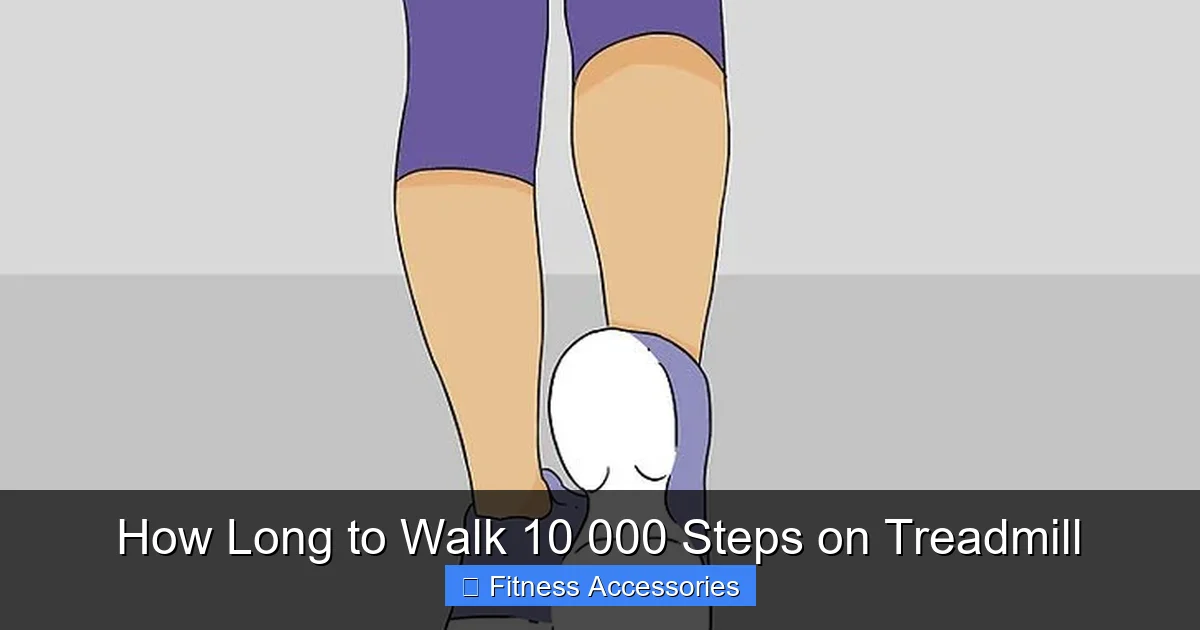
Visual guide about How Long to Walk 10 000 Steps on Treadmill
Image source: wikihow.com
Step 1: Determine Your Personal Steps Per Mile
The average is between 2,000 and 2,500 steps per mile. Use this formula for a more accurate number:
Steps Per Mile = 5,280 / Your Stride Length (in feet)
Example: If your stride length is 2.4 feet: 5,280 / 2.4 = 2,200 steps per mile.
If you don’t know your stride length, a good rule of thumb is to use 2,200 steps per mile if you’re of average height (5’4″ – 5’9″). Adjust up if you’re taller, down if you’re shorter.
Step 2: Calculate Total Time Based on Treadmill Speed
Once you know your steps per mile, the math is straightforward.
Total Minutes = (10,000 / Your Steps Per Mile) x (60 / Treadmill Speed in mph)
Let’s use our example with a 2,200 steps/mile stride at a 3.5 mph pace:
- Miles for 10k steps: 10,000 / 2,200 = 4.55 miles.
- Time to walk 4.55 miles at 3.5 mph: 4.55 miles / 3.5 mph = 1.30 hours.
- Convert to minutes: 1.30 hours x 60 minutes = 78 minutes.
So, for this person, 10,000 steps at 3.5 mph takes about 78 minutes.
Practical Time Estimates at Common Speeds
Based on an average stride of 2,200 steps/mile, here is a quick-reference table. Remember to adjust for your personal stride!
- At 2.5 mph (slow walk): ~109 minutes (1 hr 49 min)
- At 3.0 mph (brisk walk): ~91 minutes (1 hr 31 min)
- At 3.5 mph (moderate exercise walk): ~78 minutes (1 hr 18 min)
- At 4.0 mph (fast power walk): ~68 minutes (1 hr 8 min)
- At 4.5 mph (very fast walk/jog boundary): ~61 minutes
Pro Tip: Many modern treadmills have a “steps” or “steps per minute” readout. If yours does, you can skip the stride calculation! Simply note your average spm at your chosen speed. Time (min) = 10,000 / your average spm. For example, if you maintain 110 spm: 10,000 / 110 = ~91 minutes.
Maximizing the Benefits: It’s Not Just About the Clock
Knowing the time is one thing. Using that time effectively is what transforms a simple walk into a powerful fitness tool. The treadmill offers unique advantages over outdoor walking.
Visual guide about How Long to Walk 10 000 Steps on Treadmill
Image source: wikihow.com
Controlled Environment for Consistent Effort
Outside, you face wind, traffic lights, hills, and potholes. On a treadmill, you control every variable. This allows you to focus purely on your pace, form, and heart rate. You can execute a perfectly consistent workout, which is excellent for building cardiovascular endurance and monitoring progress. Want to improve your time? Simply increase the speed incrementally each week while maintaining the same step goal.
Leveraging Incline for Greater Impact
This is the treadmill’s secret weapon. Adding incline (even 1-2%) simulates walking uphill. This engages your glutes, hamstrings, and calves more intensely, increases calorie burn significantly (by 30-50% at a 5% incline at the same speed), and builds lower-body strength without the joint impact of running. Important: Incline does not change your step count time calculation based on speed alone. If you walk at 3.5 mph at 0% incline for 78 minutes to get 10k steps, walking at 3.5 mph at a 5% incline will also take 78 minutes to get 10k steps. However, you’ll be working much harder in that same time. You can strategically use incline to make your fixed-duration walk more challenging, rather than just extending the time.
Incorporating Intervals to Beat Boredom and Boost Fitness
Staring at a wall for 80 minutes can be mentally taxing. Break up your long walk with interval training. A simple structure:
- Warm-up: 5 minutes at an easy pace.
- Main Set: Alternate 3 minutes at your target “10k pace” with 2 minutes at a slower recovery pace. Repeat 4-6 times.
- Cool-down: 5 minutes easy.
This approach keeps your mind engaged, improves cardiovascular fitness more efficiently than steady-state walking, and can still easily accumulate 10,000 steps within a 60-75 minute window.
Common Mistakes That Waste Time and Risk Injury
Many people sabotage their treadmill walking success without realizing it. Avoiding these pitfalls will make your 10,000-step sessions safer and more effective.
Holding the Handrails Excessively
It’s natural to want stability, but leaning on the handrails shifts your weight unnaturally, reduces the engagement of your core and lower body, and can alter your gait. This leads to fewer calories burned and potentially creates imbalances. Use the handrails lightly for balance only when needed, or not at all. If you need to hold on for safety, your speed is likely too high for your current fitness level. Lower the speed until you can walk hands-free with good posture.
Ignoring Proper Form
Slouching, looking down at your feet, or taking short, shuffling steps is inefficient and hard on your joints. Focus on:
- Posture: Stand tall, imagine a string pulling your head to the ceiling. Shoulders back and down.
- Gaze: Look forward, not at your feet.
- Arm Swing: Let your arms swing naturally at your sides, bent at about 90 degrees. This helps drive your pace.
- Stride: Aim for a smooth stride. Overstriding (landing with your foot too far in front) acts as a brake. Your foot should land almost directly under your hip.
Chasing the Step Count at All Costs
Don’t sacrifice form and safety just to hit 10,000 steps in a hurry. It’s better to take an extra 10 minutes with perfect form than to rush and risk a fall or repetitive strain injury. Consistency over weeks and months is what builds lasting health, not a single heroic, sloppy effort.
Not Adjusting for Your Treadmill
Belt length matters! If you have a shorter home treadmill (often 45-55 inches long), you may need to shorten your stride slightly to stay safely on the belt, which can increase your step count for a given distance. Be mindful of your space and adjust your pace accordingly to avoid stepping off the back.
Creating Your Personalized 10,000-Step Treadmill Plan
Now, let’s put it all together into an actionable plan. Your goal is to make the 10,000-step habit sustainable.
Find Your Baseline
For your first session, don’t worry about time. Just walk at a comfortable, sustainable pace until you hit 10,000 steps. Note:
- What was your average speed?
- What was your total time?
- How did you feel at the end? (Out of breath? Energized? Exhausted?)
This is your personal benchmark. If the time was daunting (e.g., over 2 hours), your plan is to gradually increase your speed over 2-4 weeks to bring that time down to a more manageable 75-90 minutes.
Sample Weekly Schedules
For the Beginner (Current Time: 120+ min):
- Mon: Walk at comfortable pace to 7,000 steps.
- Wed: Walk at comfortable pace to 8,000 steps.
- Fri: Walk at comfortable pace to 10,000 steps.
- Sat: Active recovery (light stretching, short walk).
For the Intermediate (Current Time: 80-100 min):
- Mon: 10,000 steps at steady moderate pace.
- Wed: 10,000 steps with 5% incline for the last 20 minutes.
- Fri: Interval session (as described above) to 10,000 steps in ~70 min.
- Sat: 10,000 steps at a scenic, slower pace (if your treadmill has entertainment).
Key: Your primary goal is to complete the step count. As you get fitter, you will naturally complete it faster at the same perceived effort. Then you can choose to either keep the time shorter (e.g., 60 minutes of faster walking) or keep the time and add more incline for a greater challenge.
Tracking Beyond Steps
While steps are a great motivator, also track:
- Heart Rate: Aim for 50-70% of your max heart rate for general fitness. A chest strap or optical monitor on the treadmill handles is more accurate than wrist-based monitors during arm movement.
- Distance: See your total miles. 10,000 steps is roughly 4-5 miles for most.
- Calories: Use this as a general guide, not an absolute truth. Treadmill estimates are based on weight and speed.
- RPE (Rate of Perceived Exertion): On a scale of 1-10, your steady-state 10k walk should feel like a 5-6 (you can talk in full sentences).
The Final Step: Making It a Lifelong Habit
Understanding how long it takes to walk 10,000 steps on a treadmill is the practical first step. The ultimate goal is weaving this movement into your lifestyle. The treadmill is a tool for consistency—a guaranteed, weather-proof space to move your body. Whether your 10,000 steps take 65 minutes or 110 minutes, the victory is in the doing. It’s the cumulative effect of those steps that strengthens your heart, manages your weight, boosts your mood with endorphins, and improves your overall longevity. Don’t get hung up on the exact minute count. Get hung up on showing up. Start with your calculated baseline time, focus on good form, and let your fitness naturally improve. The clock will tick down faster than you think, and the benefits will last a lifetime.
Frequently Asked Questions
Is walking 10,000 steps on a treadmill the same as outdoors?
Biomechanically, it’s very similar, but there are key differences. The treadmill belt assists with leg turnover, which can slightly reduce the energy cost at the same speed compared to outdoor walking. The biggest difference is the lack of air resistance and varied terrain. To make it more comparable, set your treadmill to a 1% incline to simulate outdoor walking conditions.
How can I make my treadmill walking more effective if I’m short on time?
Focus on increasing intensity rather than just duration. Use intervals: alternate 2-3 minutes at a very fast, challenging pace (where talking is difficult) with 2 minutes of recovery walking. You can complete a highly effective 10,000-step session in 60 minutes or less this way. Adding consistent incline also boosts calorie burn and muscle engagement in the same timeframe.
Can I lose weight by just walking 10,000 steps a day on a treadmill?
Yes, as part of a calorie-controlled diet. Walking 10,000 steps burns approximately 300-500 calories for most people, depending on weight, speed, and incline. This creates a meaningful daily calorie deficit. Combined with strength training and proper nutrition, consistent daily step goals are a powerful, sustainable weight management strategy.
What treadmill speed is best for walking 10,000 steps?
The “best” speed is a sustainable brisk pace for you, typically between 3.0 and 4.0 mph. At 3.0 mph, it takes about 90 minutes for most. At 4.0 mph, it takes about 70 minutes. Choose a speed that elevates your heart rate but still allows you to maintain good posture and conversation. Your goal is consistency, so pick a pace you can do several times a week.
Should I hold the treadmill handrails while walking for steps?
Minimize holding on. Light touch for balance is okay, but leaning on the handrails reduces the workout’s effectiveness by supporting your body weight and altering your natural gait. It also prevents you from engaging your core. Only use them if you feel genuinely unstable. If you need to hold on to walk at your desired speed, lower the speed until you can walk hands-free.
How do I stay motivated to walk for such a long time on the treadmill?
Break the time into chunks. Listen to audiobooks, podcasts, or curated music playlists that last 20-30 minutes. Use the time to watch a TV show or movie (many treadmills have screens or holders). Set mini-goals: “I’ll walk until I finish this podcast episode.” Change your environment mentally with virtual walking tours on apps or screens. Finally, focus on the accomplishment of the step count itself, using the treadmill’s display as your scoreboard.