Can a Plane Take Off on a Treadmill Mythbusters
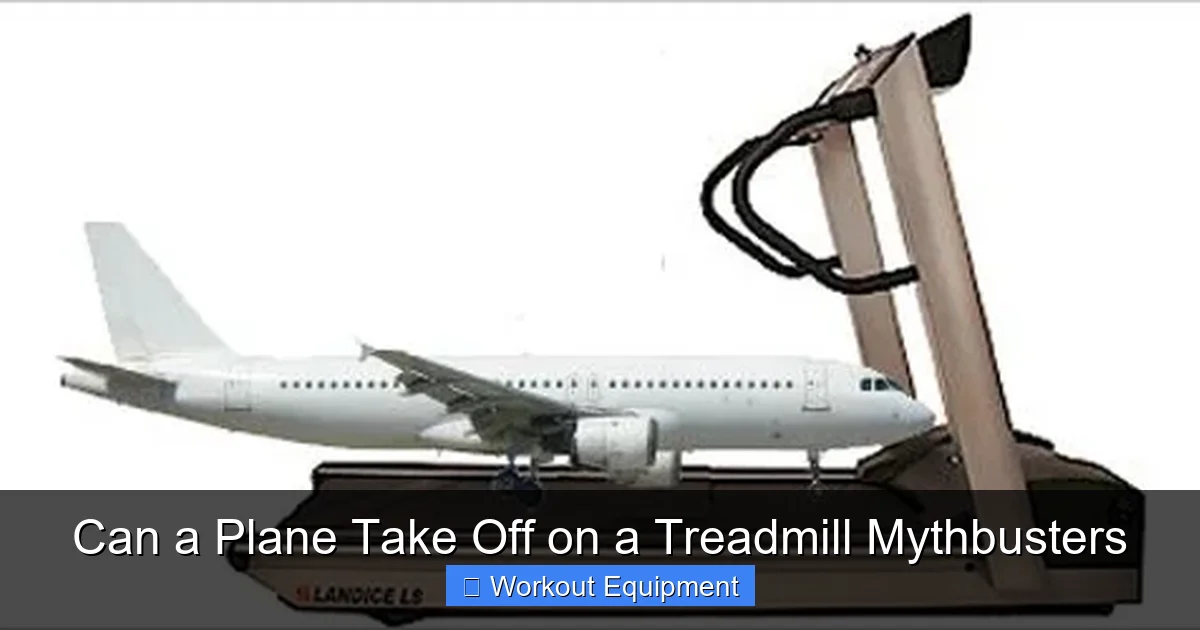
The viral myth that a plane cannot take off from a treadmill if the belt matches its speed is completely false. MythBusters famously debunked this by proving that a plane’s wheels are free-spinning and that thrust from the engines, not ground speed, creates the airflow for lift. The treadmill’s belt speed is irrelevant to the plane’s ability to become airborne. This thought experiment fails because it confuses the independent systems of ground movement and aerodynamic flight.
Key Takeaways
- Thrust, not treadmill speed, enables takeoff: A plane’s engines propel it forward by pushing against air, not the ground. The treadmill only affects the spin of the landing gear wheels, which do not provide propulsion.
- Lift depends on airspeed over the wings: For takeoff, the plane must achieve a specific airspeed. The treadmill does nothing to stop the plane from accelerating through the air if its engines are providing thrust.
- The wheels are passive and unpowered: The landing gear is essentially on bearings. If a treadmill moves backward at any speed, the wheels will simply spin faster or slower, but the plane’s forward motion is determined by its engine thrust versus aerodynamic drag.
- MythBusters provided definitive proof: Their full-scale experiment with a real aircraft and a powerful industrial treadmill showed the plane accelerated normally and took off without issue, despite the treadmill attempting to match its speed.
- The confusion stems from a flawed premise: The myth incorrectly assumes that matching treadmill speed to the plane’s ground speed would “hold it in place.” This ignores that the plane’s speed is measured relative to the air (airspeed), not the ground (ground speed).
- Relevance to fitness equipment: This principle highlights the difference between external resistance (like a treadmill belt) and self-generated power. Just as a runner on a treadmill moves by pushing against the belt, a plane moves by pushing against the air; the moving belt doesn’t negate the runner’s or plane’s ability to generate forward motion.
- Understanding relative motion is key: Whether on a treadmill or in a plane, motion is about the interaction between the object and its immediate medium—the belt for a runner, the air for a plane. One does not cancel the other’s primary force.
📑 Table of Contents
- The Viral Question: Could a Plane Take Off from a Treadmill?
- The Physics of Flight: It’s All About the Air
- MythBusters Takes Flight: The Full-Scale Test
- Why the Thought Experiment is Flawed: A Deeper Dive
- Treadmills in Fitness: What This Myth Teaches Us
- Common Misconceptions and Final Clarifications
- Conclusion: Soaring Above the Myth
The Viral Question: Could a Plane Take Off from a Treadmill?
It’s a classic internet brain-teaser that has sparked countless debates: “If a plane is on a giant treadmill that matches its wheel speed, can it take off?” The scenario seems logical at first glance. The treadmill moves backward as the plane tries to move forward. If the belt perfectly matches the rotation of the wheels, wouldn’t the plane just stay in place, spinning its tires without ever gaining enough speed to fly? This thought experiment captivated the world, and it was the perfect challenge for the science entertainment show MythBusters. They took the myth from the digital realm to a real airstrip with a real airplane and a monstrous treadmill. Their conclusion was a resounding busted. But to understand why, we need to unpack the physics—a lesson that’s surprisingly relevant even when you’re pounding the pavement on your home treadmill.
Where the Myth Comes From
The myth likely originated from online forums as a hypothetical puzzle to test understanding of aerodynamics and relative motion. It’s often phrased with a critical ambiguity: does “match its wheel speed” mean the treadmill moves backward at the same speed the wheels are moving relative to the ground (ground speed), or at the same rotational speed of the wheels (RPM)? This ambiguity is the root of the confusion. In the most common interpretation, the treadmill is said to match the plane’s ground speed. If the plane moves forward at 50 mph relative to the ground, the treadmill moves backward at 50 mph. The myth claims this would keep the plane stationary.
This idea feels intuitive because we apply the logic to cars. If you put a car on a treadmill and set the belt to match the car’s speed, the car would indeed stay in place relative to the building, because the car’s propulsion comes from its drive wheels pushing against the ground. But an airplane is fundamentally different. This is the crucial first step in busting the myth: a plane is not a car.
The Physics of Flight: It’s All About the Air
To solve this, we must separate two distinct concepts: the forces that move a plane forward along the ground and the forces that make it fly.
Visual guide about Can a Plane Take Off on a Treadmill Mythbusters
Image source: allroadsleadtoitaly.com
Thrust vs. Ground Speed
A jet or propeller engine works by Newton’s third law: for every action, there is an equal and opposite reaction. The engine takes in air, accelerates it backward, and the reaction force pushes the plane forward. This force is called thrust. Critically, the engine pushes against the air, not the ground. The wheels are there for support and low-speed maneuvering, not for propulsion. They are free-spinning on bearings, like the wheels on a shopping cart.
So, what determines if the plane can take off? It needs to reach a certain airspeed—the speed of the air moving over and under its wings. This airflow creates a pressure difference (lift) that eventually overcomes the plane’s weight. Airspeed is what matters, not how fast the plane is moving over the ground (ground speed). A plane can have zero ground speed but very high airspeed if it’s facing a strong headwind. In that case, it could take off while practically staying in one spot relative to the earth.
The Role of the Treadmill (and the Wheels)
Now, introduce the treadmill. The plane’s wheels sit on the moving belt. As the engines spool up and produce thrust, they try to pull the plane forward. This force acts on the plane’s body. The wheels, being in contact with the belt, will start to spin. The treadmill’s motion adds a relative speed between the wheel surfaces and the belt. But this interaction only creates a small amount of frictional drag in the wheel bearings. This drag is minuscule compared to the massive thrust of jet engines.
Think of it this way: if you had a toy car with free-spinning wheels on a treadmill, and you pulled the car forward with a string, the treadmill’s speed wouldn’t stop the car. The force pulling the car (your hand) is independent of the wheel-belt interaction. For the plane, the “string” is its engine thrust. The treadmill can only make the wheels spin faster; it cannot exert a significant backward force on the entire plane to counteract the engine’s thrust. Therefore, the plane will accelerate forward through the air just as it would on a normal runway, reaching its necessary airspeed for takeoff.
MythBusters Takes Flight: The Full-Scale Test
Skeptical but thorough, the MythBusters team designed a real-world test. They acquired a real, lightweight aircraft (a Velie Monocoupe) and a massive industrial treadmill normally used for testing truck and tank engines. The treadmill was over 30 feet long and could move at high speeds in reverse.
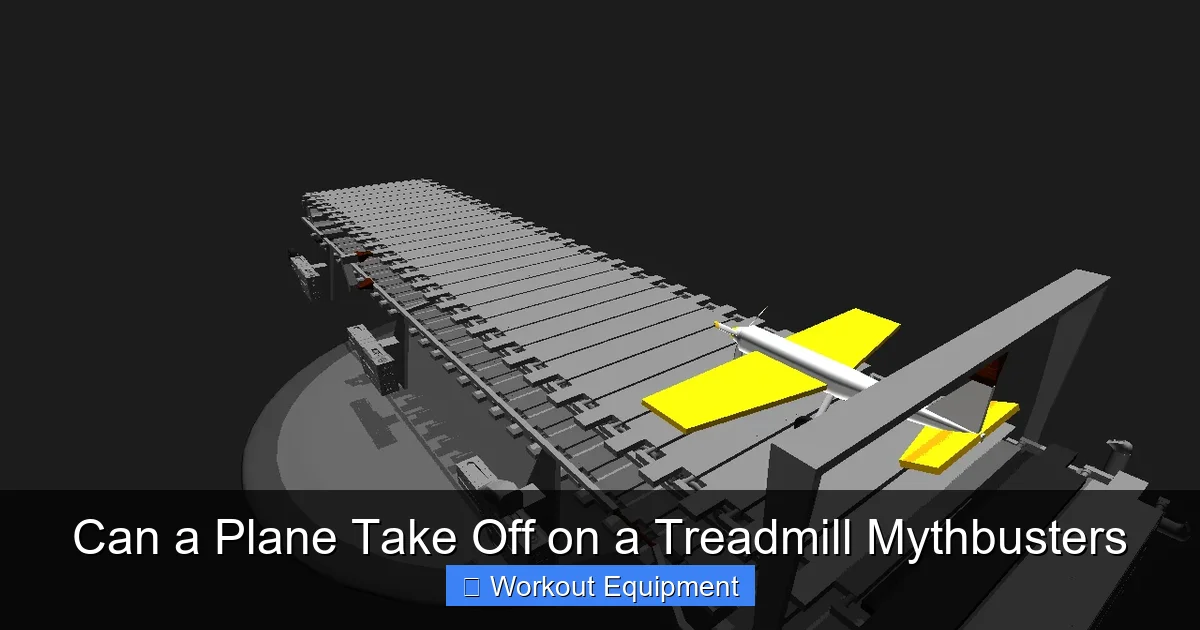
Visual guide about Can a Plane Take Off on a Treadmill Mythbusters
Image source: jundroo.blob.core.windows.net
Setting the Stage
Their interpretation of the myth was the most challenging one: the treadmill would always match the plane’s ground speed in the opposite direction. So, if the plane rolled forward at 20 mph, the treadmill would immediately adjust to move backward at 20 mph. The question was, could the plane achieve takeoff speed?
They secured the plane to the treadmill with a safety line to prevent it from rolling off the end, but this line was designed to break if the plane generated more than a few hundred pounds of force—well below the thousands of pounds of thrust the plane’s propeller could produce.
The Results Are In
The pilot fired up the engine. The propeller began pulling the plane forward. The treadmill immediately started moving backward to “chase” the plane’s ground speed. What happened? The plane accelerated normally down the treadmill. The wheels spun incredibly fast—far faster than they ever would on a concrete runway—but the plane itself moved forward relative to the air. It reached its takeoff speed, lifted off, and flew clear of the treadmill, breaking the safety line in the process. The myth was decisively busted.
The visual was dramatic: the plane was clearly moving forward down the long treadmill belt, gathering speed, and then becoming airborne. The treadmill’s backward motion was irrelevant to the aerodynamic forces at play. The only noticeable effect was the terrifyingly high RPMs on the landing gear wheels.
Why the Thought Experiment is Flawed: A Deeper Dive
Even without the full-scale test, the myth collapses under logical scrutiny. The core flaw is the assumption that the treadmill can exert a constant, equal, and opposite force on the plane to cancel its engine thrust.
Visual guide about Can a Plane Take Off on a Treadmill Mythbusters
Image source: cdn.pixabay.com
The Force Balance Is Misunderstood
For an object to be in equilibrium (not accelerating), the net force on it must be zero. On a normal runway, the forces on a plane are: Thrust (forward) vs. Drag (backward, from air resistance). When thrust exceeds drag, the plane accelerates. The wheels provide a tiny bit of rolling resistance, but this is negligible.
The myth introduces a new force: the force from the treadmill belt on the wheels. But this force is not applied to the plane’s center of mass for forward motion. It is a force at the point of contact with the wheels. Its direction? It’s a frictional force that could act backward on the wheel assembly. However, because the wheels are free-spinning, this frictional force is very small. More importantly, to hold the plane stationary, the treadmill would need to apply a backward force on the plane equal to the engine’s thrust. There is no mechanism for the treadmill to do this. The belt can only make the wheels spin; it cannot magically transmit a counter-thrust force to the airframe. The plane’s engine is still pushing against the stationary air in the hangar, and that air pushes back, moving the plane forward.
The Air is the Medium That Matters
This is the most important concept. An airplane is designed to move through air. The treadmill is a ground-based device. The two operate in separate reference frames. The plane’s engines and wings interact with the air mass surrounding the airport. As long as that air is relatively still (no extreme winds), the plane will accelerate through it, regardless of what the ground beneath it is doing. The moving ground (treadmill) does not move the air. Therefore, as the plane moves forward relative to the air, air flows over the wings, creating lift. The treadmill’s motion is irrelevant to this airflow generation.
Treadmills in Fitness: What This Myth Teaches Us
Now, let’s connect this aviation puzzle to the world of workout equipment. The category is “Workout Equipment,” and the star of the myth is a treadmill. The principles at play offer a fascinating analogy for understanding how our bodies interact with exercise machines.
The Runner on the Treadmill: A Perfect Analogy
Imagine you running on a treadmill. Your legs push down and back against the moving belt. The belt moves backward under your feet. To stay in the same spot on the treadmill’s deck, you must generate enough force with your legs to overcome the belt’s backward motion and your own body’s inertia. You are, in effect, running “in place” relative to the ground outside, but you are moving relative to the treadmill belt.
This is directly analogous to the plane, but with a key difference. You, the runner, are the source of thrust. Your legs provide the force. The treadmill belt provides the external surface to push against. For the plane, the engine is the source of thrust, and the air is the medium it pushes against. The treadmill belt under the plane’s wheels is just a passive surface, like the deck under your feet. It doesn’t provide the propulsive force; it just offers a point of contact that can spin freely.
Practical Lessons for Your Workout
- Understanding Resistance: On a treadmill, the belt’s speed creates a form of resistance. You must work harder to maintain your pace against the moving surface. This is similar to how a plane’s engines work harder to overcome aerodynamic drag. In both cases, the “resistance” comes from the medium you’re interacting with (belt or air), not from the ground itself.
- Self-Generated Power is Key: Your ability to run on a treadmill depends entirely on your own muscular power. Similarly, a plane’s takeoff depends entirely on its engine’s thrust. The treadmill’s motion cannot stop you from running if you have the power to move your legs fast enough. It merely changes the sensation and the force application point.
- Relative Motion is Everything: Your speed on a treadmill is your speed relative to the belt. Your “ground speed” is zero. For a runner, this is fine because the goal is cardiovascular effort, not transportation. For a pilot, airspeed is the critical metric, not ground speed. This myth reminds us to always ask: “Speed relative to what?”
- Equipment is a Tool, Not a Limiter: Just as a powerful enough plane will take off regardless of the treadmill, a determined runner will get a great workout regardless of the belt speed. The equipment sets the conditions, but your body’s output determines the outcome. Don’t blame the treadmill for a lack of progress; focus on increasing your own “thrust”—your effort and power output.
Common Misconceptions and Final Clarifications
Even after the MythBusters episode, some misconceptions persist. Let’s lay them to rest.
“But the wheels are connected to the plane, so the treadmill must pull it back.”
This is the fundamental error. The wheels are connected via bearings that allow them to spin freely. They are not drive wheels. The force from the treadmill on the wheel surface creates a torque that spins the wheel, but it does not create a significant horizontal force on the plane’s fuselage. The only significant horizontal forces on the plane are engine thrust (forward) and aerodynamic drag (backward).
“What if the treadmill was infinitely powerful?”
Even an infinitely powerful treadmill can only exert force on the wheels. To stop the plane, it would need to apply a backward force to the plane’s body. The only way to do that is to physically grab the plane and pull it back. Simply moving the belt under free-spinning wheels cannot do this. The wheel bearings would likely fail or melt from extreme friction before the treadmill could generate enough force to counteract jet thrust.
“Does this mean a plane could take off from a conveyor belt runway in real life?”
In theory, yes, if the conveyor belt could move fast enough backward and the plane’s engines provided sufficient thrust to overcome the minimal extra rolling resistance in the wheel bearings. However, in reality, a conveyor belt runway would be a catastrophic idea. It would destroy landing gear, throw debris, and create immense control issues. But physics-wise, takeoff would be possible because the plane flies on air, not on the ground.
Conclusion: Soaring Above the Myth
The “plane on a treadmill” myth is a brilliant illustration of how our intuitions, often based on everyday experiences with cars and bicycles, can fail us when applied to different systems. A car’s wheels are its means of propulsion; a plane’s engines are. The treadmill, whether in a hangar or a gym, is just a moving surface. It can influence the spin of wheels or the effort of a runner, but it cannot nullify the primary force generating motion—be it engine thrust or muscular power.
MythBusters gave us a spectacular, real-world demonstration that settled the debate with clarity. The plane didn’t just take off; it took off while the treadmill beneath it was racing backward, proving that the two motions are independent. The plane accelerated through the air because its engines pushed against the air, and that air pushed back, moving the plane forward. The wheels just spun along for the ride.
For fitness enthusiasts, this is a powerful metaphor. Your treadmill is your “treadmill.” Your legs and lungs are your “engines.” The belt’s speed is a setting, a challenge you can choose to meet. It doesn’t define your potential. Your ability to generate “thrust”—your consistent effort, strength, and endurance—is what determines your “takeoff” into better health and performance. So next time you’re on that belt, remember: you are not being held back by the moving ground beneath you. You are powered by the force you generate within, pushing against the resistance to build your own lift.
Frequently Asked Questions
Can a plane take off if the treadmill matches its wheel speed?
Yes, absolutely. The treadmill’s speed has no effect on the plane’s ability to generate airspeed. The plane’s engines provide thrust by pushing against the air, not the ground. As long as the engines are running, the plane will accelerate through the air and take off, regardless of how fast the treadmill belt moves.
Did MythBusters really test this with a real plane?
Yes, they did. In a famous 2008 episode, they used a real Velie Monocoupe aircraft and a massive industrial treadmill. The treadmill was programmed to always move backward at the same speed as the plane’s ground speed. The plane successfully accelerated, took off, and flew, definitively busting the myth.
What is the main reason the myth is wrong?
The myth confuses the source of propulsion. A car is driven by its wheels pushing against the ground. An airplane is driven by its engines pushing against the air. The treadmill only interacts with the free-spinning wheels, which do not provide thrust. Therefore, the treadmill cannot counteract the engine’s thrust, which is what moves the plane forward through the air to create lift.
Does the treadmill make the wheels spin faster?
Yes, that is the only direct effect. The wheels will spin at a rate equal to the sum of the plane’s forward speed and the treadmill’s backward speed. On a normal runway, wheel RPM is roughly ground speed divided by wheel circumference. On the treadmill, the RPM would be dramatically higher, potentially to the point of wheel failure, but this does not stop the plane from moving forward.
How is this like running on a treadmill?
The analogy is strong for the runner but inverted for the plane. On a treadmill, you are the engine. You generate the force by pushing against the moving belt. The belt’s speed is the resistance you overcome. For the plane on the treadmill, the plane’s engine is the source of force, and the moving belt is just a passive surface under the wheels. In both cases, the moving surface (belt) is not the primary source of propulsion.
Could a conveyor belt ever be used as a runway?
In theory, physics allows it, but in practice, it would be incredibly dangerous and impractical. The extreme wheel speeds would likely cause tires to disintegrate or wheels to seize. Debris would be thrown everywhere, and the aircraft’s steering and braking systems, designed for static ground, would be compromised. It’s a fun thought experiment, but a terrible real-world idea.