What Is the Best Chest Workout with Dumbbells
The best chest workout with dumbbells combines pressing, flying, and pullover movements to target every part of your pectoral muscles. You do not need a gym or fancy machines to build a powerful chest. With the right dumbbell chest exercises, a pair of adjustable weights, and a consistent routine, you can achieve serious results from home. This guide covers the top exercises, sets, reps, and common mistakes so you can train safely and effectively.
Key Takeaways
- Dumbbells are the most versatile tool for a home chest workout because they allow a full range of motion and correct muscle imbalances.
- Five core exercises — the dumbbell press, incline press, flat fly, incline fly, and pullover — cover your entire chest.
- Progressive overload matters — gradually increase weight or reps to keep your chest growing.
- Avoid common mistakes like flaring elbows too wide or using momentum instead of controlled movement.
- Train your chest 1–2 times per week with at least 48 hours of rest between sessions for proper recovery.
- Pair dumbbell work with resistance bands for added variety and challenge at home.
📑 Table of Contents
- Why Dumbbells Are the Best Tool for Chest Training
- The Best Dumbbell Chest Exercises for a Complete Workout
- How to Structure Your Weekly Chest Routine
- Choosing the Right Dumbbell Weight
- Common Mistakes to Avoid During Chest Workouts
- Adding Variety with Resistance Bands
- Expert Tips for Maximizing Chest Growth
- How Dumbbell Chest Workouts Compare to Other Equipment
- Building a Strong Chest Without a Gym
- Final Thoughts on the Best Chest Workout with Dumbbells
Why Dumbbells Are the Best Tool for Chest Training
Let us be honest. You do not need a crowded gym or a chest press machine to build a strong, defined chest. A simple pair of dumbbells can do everything a machine can — and more. Dumbbells let each arm work independently, which means you fix weak spots you never even knew you had.
When you use a barbell, your stronger side often takes over. Dumbbells prevent that. They also allow a deeper stretch at the bottom of every rep, which is huge for muscle growth. If you are looking for a home chest workout that actually works, dumbbells are the answer.
Chest exercises with dumbbells also require very little space. A flat bench or even the floor works perfectly. This makes them ideal for apartment living, small home gyms, or anyone who wants to skip the commute to the gym.
The Best Dumbbell Chest Exercises for a Complete Workout
Not all chest exercises are created equal. Some target the upper chest. Others hit the lower fibers or the inner chest. The key is to choose a mix of movements that covers the entire pectoral muscle group. Here are the best dumbbell chest exercises you can do right now.
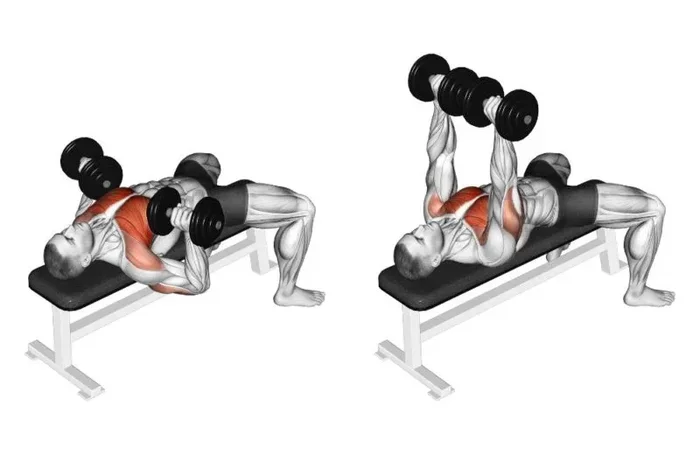
1. Dumbbell Flat Bench Press
This is the king of chest exercises. Lie on a flat bench, hold a dumbbell in each hand at chest level, and press them straight up. Keep your feet flat on the floor and your back naturally arched. Lower the weights slowly until your elbows drop just below your shoulders, then press back up.
This movement builds raw strength and mass across the entire chest. It also engages your front deltoids and triceps as supporting muscles. Aim for 3 to 4 sets of 8 to 12 reps.
2. Incline Dumbbell Press
The upper chest often gets neglected, and that creates an imbalance. Set your bench to a 30 to 45 degree incline. Press the dumbbells up at a slight angle toward your face. This shift in angle puts serious focus on the upper pectoral fibers.
Many people skip this exercise because it feels harder. That is exactly why you should do it. A strong upper chest gives your chest a full, rounded look from every angle. Perform 3 sets of 10 to 12 reps.
3. Dumbbell Flat Fly
The fly movement isolates the chest without involving your triceps as much. Lie on a flat bench, hold dumbbells above your chest with a slight bend in your elbows, and lower them out to the sides in a wide arc. Bring them back together at the top with a squeeze.
This exercise stretches the chest fibers under tension, which is excellent for muscle growth. Go light on the weight. This is not about lifting heavy — it is about feeling the stretch and the squeeze. Do 3 sets of 12 to 15 reps.
4. Incline Dumbbell Fly
Set the bench to an incline and perform the same fly motion. This targets the upper chest and the area where the chest meets the shoulders. It is a fantastic finishing movement that really pumps the upper pecs.
Keep the bend in your elbows consistent throughout the movement. Never lock your elbows. The range of motion is what makes this exercise effective. Stick with 3 sets of 12 to 15 reps.
5. Dumbbell Pullover
The pullover is a unique exercise that hits both the chest and the lats. Lie on a flat bench, hold one dumbbell with both hands above your chest, and lower it slowly behind your head. Bring it back to the starting position with control.
This movement creates incredible tension across the entire chest and ribcage area. It also improves ribcage expansion and posture over time. Use a moderate weight and focus on the stretch. Aim for 3 sets of 10 to 12 reps.
How to Structure Your Weekly Chest Routine
Knowing the exercises is only half the battle. You need a plan. A well-structured chest workout routine ensures you hit every angle of the chest without overtraining.
Beginner Weekly Plan
Start with two sessions per week, separated by at least 48 hours. Here is a simple layout:
- Day 1: Flat Bench Press (3×10), Flat Fly (3×12), Pullover (3×10)
- Day 2: Incline Press (3×10), Incline Fly (3×12), Pullover (3×10)
This balanced approach hits both the upper and lower chest evenly. Rest 60 to 90 seconds between sets. As you get stronger, add a set or increase the weight slightly.
Intermediate Weekly Plan
Once you have built a solid foundation, increase the volume:
- Flat Bench Press (4×8)
- Incline Press (4×10)
- Flat Fly (3×12)
- Incline Fly (3×12)
- Dumbbell Pullover (3×12)
This routine gives your chest a thorough workout. You can also add chest toning exercises like squeeze presses or floor presses as finishers. The key is to challenge your muscles while maintaining proper form.
Choosing the Right Dumbbell Weight
One of the biggest mistakes people make is picking the wrong weight. Too light, and you will not stimulate enough muscle growth. Too heavy, and you sacrifice form and increase injury risk.
For pressing movements like the bench press, choose a weight where the last 2 reps of each set feel challenging but doable. For flyes and pullovers, go lighter since these movements isolate the chest more. If you are unsure where to start, check out our guide on what is the best weight to start with dumbbells for detailed recommendations based on your fitness level.
A good rule of thumb is to be able to complete all prescribed reps with clean form. If you cannot, the weight is too heavy. If the last few reps feel easy, it is time to increase.
Common Mistakes to Avoid During Chest Workouts
Even the best exercises fail when performed with poor technique. Here are the most common mistakes people make during dumbbell chest workouts.
1. Flaring Elbows Too Wide
When your elbows flare out at 90 degrees during presses, you put unnecessary stress on your shoulder joints. Keep your elbows at about a 45 to 60 degree angle from your body. This protects your shoulders and keeps the tension on your chest.
2. Using Momentum
Swinging the dumbbells or bouncing them off your chest kills the effectiveness of every rep. Control the weight on the way down, pause briefly at the bottom, and press up with deliberate force. Slow and steady always wins with chest training.
3. Neglecting the Full Range of Motion
Partial reps limit your muscle growth. Lower the dumbbells until you feel a deep stretch in the chest. Do not cut the movement short just because the weight is heavy. Full range of motion is one of the most important principles of chest hypertrophy.
4. Overtraining Your Chest
More is not always better. Training your chest every day will lead to burnout and injury. Rest and recovery are when your muscles actually grow. Stick to 1 to 2 sessions per week and let your body heal between workouts.
Adding Variety with Resistance Bands
Dumbbells are fantastic, but adding resistance bands can take your chest workout to the next level. Bands provide constant tension throughout the entire range of motion, which dumbbells alone cannot do.
You can loop a band around your back and hold the handles during a press for extra resistance at the top. You can also use bands for flyes and pullovers. If you want ideas for combining bands with dumbbells at home, check out our guide on what are the best resistance bands for home workout for practical setups and routines.
Variety keeps your muscles guessing and prevents plateaus. Switching between dumbbells and bands every few weeks gives your chest fresh stimulus without needing new equipment.
Expert Tips for Maximizing Chest Growth
Here are some pro-level tips that separate good chest workouts from great ones:
- Squeeze at the top. When you press the dumbbells together at the peak, you activate more muscle fibers. This simple cue makes a big difference.
- Breathe properly. Exhale on the press and inhale on the way down. Proper breathing supports core stability and power output.
- Track your progress. Keep a log of weights, sets, and reps. Without tracking, you cannot know if you are actually improving.
- Warm up your shoulders. Before pressing, do a few light shoulder rotations and band pull-aparts. This prepares the joints for heavy work.
- Mind-muscle connection. Focus on feeling your chest do the work, not your arms. Visualize squeezing a towel between your pecs during every rep.
How Dumbbell Chest Workouts Compare to Other Equipment
It helps to understand how dumbbells stack up against other popular chest training tools. Here is a quick comparison:
| Feature | Dumbbells | Barbell | Machine |
|---|---|---|---|
| Range of Motion | Excellent | Good | Limited |
| Muscle Balance | Corrects imbalances | Can hide weaknesses | Guided path |
| Space Needed | Minimal | Minimal | Large |
| Cost | Low to moderate | Low to moderate | High |
| Versatility | Very high | Moderate | Low |
| Best For | Home training | Heavy compound work | Beginners |
As you can see, dumbbells offer the best balance of versatility, space, and effectiveness. They are the clear winner for anyone training at home. For more exercise ideas using dumbbells, explore our article on what are the best exercises to do with dumbbells.
Building a Strong Chest Without a Gym
A home chest workout with dumbbells can be just as effective as any gym routine. The secret is consistency, proper form, and progressive overload. You do not need a fancy setup or expensive equipment.
Pair your dumbbell work with bodyweight exercises like push-ups for a complete chest session. Push-ups warm up the chest and add volume without extra equipment. You can also use resistance bands for warm-up sets before moving to heavier dumbbells.
Remember that your chest is a pushing muscle group. It responds well to compound movements like presses and isolation movements like flies. The combination of both is what creates a balanced, powerful chest.
Final Thoughts on the Best Chest Workout with Dumbbells
A dumbbell chest workout is one of the most effective things you can do for your upper body. It builds strength, improves aesthetics, and enhances overall functional fitness. Whether you are a beginner or an experienced lifter, these exercises deliver results.
Start with the five core movements outlined in this guide. Structure your routine with clear sets and reps. Avoid the common mistakes that hold most people back. And above all, stay consistent. Your chest grows when you give it the right stimulus and enough time to recover.
Grab your dumbbells, set up your bench, and commit to the process. A stronger, more defined chest is well within your reach.
Frequently Asked Questions
How often should I train my chest with dumbbells?
Training your chest 1 to 2 times per week is ideal for most people. This gives your muscles enough time to recover and grow between sessions. Overtraining can lead to fatigue and injury, so rest is just as important as the workout itself.
Can I build a big chest with just dumbbells?
Absolutely. Dumbbells allow a full range of motion and target every part of the chest. Many elite bodybuilders built impressive chests using nothing but dumbbells. Consistency and progressive overload matter more than the equipment you use.
What dumbbell weight should I use for chest exercises?
Start with a weight that challenges you on the last 2 reps of each set. For pressing movements, this is usually heavier than for flyes. If you are new to training, check out our guide on the best weight to start with dumbbells for personalized recommendations.
Do I need a bench for dumbbell chest exercises?
A bench helps, but it is not required. You can perform floor presses and flies on the ground effectively. A bench simply allows a deeper stretch and better range of motion. If you do not have a bench, the floor works great as a starting point.
What is the best dumbbell exercise for the upper chest?
The incline dumbbell press is the best exercise for targeting the upper chest. Set your bench to a 30 to 45 degree angle and press the dumbbells upward. Pair it with incline flies for a complete upper chest workout that builds fullness and definition.
How long does it take to see results from a dumbbell chest workout?
Most people notice visible changes within 4 to 6 weeks of consistent training. Strength improvements often come even sooner, usually within 2 to 3 weeks. Results depend on your diet, recovery, and how consistently you follow your routine.