How to Train Legs at Home with Dumbbells
Learning how to train legs at home with dumbbells is one of the smartest moves you can make for your lower body. You do not need a gym membership or fancy machines to build strong, defined legs. With just a pair of dumbbells and a little space, you can target every major muscle group in your legs and see real results from home.
There is something empowering about training your legs at home. You do not need a crowded gym floor or expensive machines. A pair of dumbbells and a small workout space is all you need to start building stronger, more defined legs. Whether you are a complete beginner or someone looking to switch up your routine, how to train legs at home with dumbbells is a skill worth mastering.
Leg day often gets skipped by home workout enthusiasts. People tend to focus on upper body exercises because they feel more comfortable with those movements. But your lower body contains some of the largest muscle groups in your entire body. Training them properly leads to better balance, improved athletic performance, and a more proportional physique. This guide covers everything you need to know about training legs at home with dumbbells, from basic exercises to full routines.
Key Takeaways
- Full-Body Results: Training legs with dumbbells at home works your quads, hamstrings, glutes, and calves effectively.
- Minimal Equipment Needed: A pair of dumbbells is all you need to start a serious leg routine.
- Beginner-Friendly: You can start with basic moves and progress to advanced variations over time.
- Save Time and Money: Skip the commute to the gym and train on your own schedule.
- Proper Form Matters: Good technique prevents injury and maximizes muscle activation.
- Progressive Overload Drives Growth: Gradually increasing weight or reps keeps your legs growing.
📑 Table of Contents
Why Train Legs at Home with Dumbbells
The Benefits of Home Leg Workouts
Training your legs at home comes with several advantages that go beyond just convenience. First, you save time. No commute, no waiting for equipment, no distractions. You can start your workout the moment you decide to. Second, you feel more comfortable. Home workouts remove the intimidation factor that many people experience in gyms. You can focus entirely on your form and your muscles.
Third, home leg training with dumbbells is incredibly versatile. You can perform a wide range of movements that target every part of your lower body. From squats to lunges to Romanian deadlifts, dumbbells give you the freedom to challenge your muscles in multiple planes of motion. This variety keeps your workouts interesting and effective.
Why Dumbbells Are Perfect for Leg Training
Dumbbells are one of the most practical tools for home leg training. Unlike barbells, they allow each leg to work independently. This helps correct muscle imbalances and improves stability. Dumbbells are also easier to handle and safer for beginners who may not yet have a solid foundation with heavy barbell lifts.
You can adjust the difficulty simply by increasing or decreasing the weight. This makes dumbbells suitable for every fitness level. Whether you are just starting out or you are an experienced lifter, dumbbells can grow with you. They also take up very little space, making them ideal for small apartments or home gyms.
Essential Dumbbell Leg Exercises
To build a complete leg workout at home, you need exercises that target all the major muscle groups. Your quads, hamstrings, glutes, and calves each play a different role in movement. Here are the most effective dumbbell leg exercises you can do at home.
Dumbbell Squats
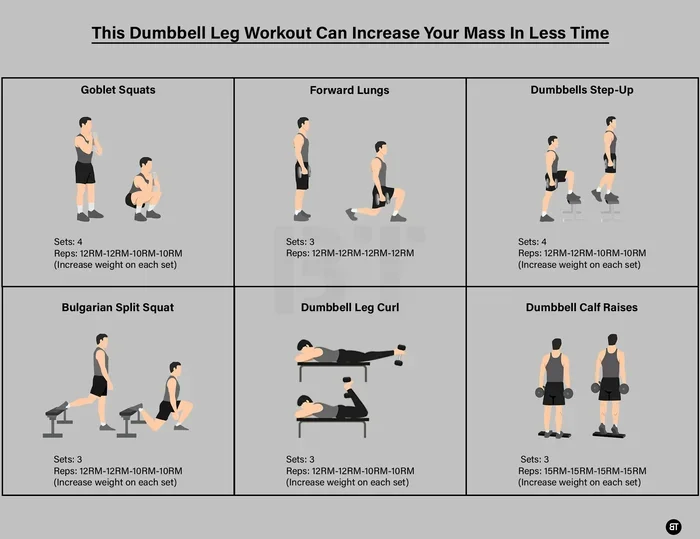
The dumbbell squat is the king of leg exercises. It works your quads, glutes, and hamstrings all at once. Hold a dumbbell in each hand at your sides. Stand with your feet shoulder-width apart. Lower your body by bending your knees and pushing your hips back. Keep your chest up and your back straight. Go down until your thighs are parallel to the floor. Then push through your heels to return to the starting position.
Start with lighter weights to nail your form. As you get stronger, you can increase the load. This exercise is a cornerstone of any home leg workout and should be a regular part of your routine.
Dumbbell Lunges
Lunges are fantastic for building single-leg strength and stability. Hold a dumbbell in each hand. Step forward with one leg and lower your body until both knees form about 90-degree angles. Your back knee should hover just above the ground. Push off your front foot to return to standing. Alternate legs with each rep.
There are many lunge variations you can try. Walking lunges move you across the room. Reverse lunges step backward instead of forward. Stationary lunges keep you in place. Each variation places slightly different emphasis on your muscles. Mixing them up keeps your workouts fresh and challenges your legs in new ways.
Dumbbell Step-Ups
Step-ups are a simple yet highly effective exercise for your quads and glutes. Find a sturdy bench, box, or step. Hold dumbbells at your sides. Step up onto the bench with one foot. Drive through your heel to lift your body up. Step down slowly and repeat. Perform all reps on one leg before switching.
This exercise mimics real-life movements like climbing stairs. It also helps improve balance and coordination. You can adjust the height of the step to make it easier or harder. Higher steps increase the challenge on your glutes and hamstrings.
Dumbbell Romanian Deadlifts
The Romanian deadlift is one of the best exercises for your hamstrings and glutes. Hold a dumbbell in each hand in front of your thighs. Keep a slight bend in your knees. Hinge at your hips and push your butt backward. Lower the dumbbells along your legs until you feel a stretch in your hamstrings. Squeeze your glutes and return to standing.
This movement teaches you to hinge properly, which is a fundamental movement pattern. It also strengthens your lower back and improves posture. Keep your back straight throughout the entire movement. Do not round your spine. This exercise pairs perfectly with squats for a complete leg workout.
Dumbbell Calf Raises
Do not forget your calves. Stand on the edge of a step or platform. Hold dumbbells at your sides. Let your heels hang off the edge. Rise up onto your toes by squeezing your calf muscles. Hold for a second at the top. Lower your heels below the step level to get a full stretch. This simple movement builds strong, defined calves over time.
You can perform this exercise one foot at a time to address any imbalances. Single-leg calf raises are more challenging and force each leg to do its fair share of the work.
How to Build a Home Leg Workout Routine
Now that you know the best exercises, it is time to put them together into a routine. A well-structured program ensures you hit all your leg muscles evenly and progress over time.
Beginner Leg Workout Routine
If you are new to training, start with this simple routine. Perform it two times per week with at least one rest day between sessions.
- Dumbbell Squats: 3 sets of 10-12 reps
- Dumbbell Lunges: 3 sets of 10 reps per leg
- Dumbbell Step-Ups: 3 sets of 10 reps per leg
- Dumbbell Calf Raises: 3 sets of 15 reps
Rest for 60-90 seconds between sets. Focus on controlled movements and proper form. As you get comfortable with these exercises, you can increase the weight or add more sets. This beginner routine is a great starting point for anyone learning how to train legs at home with dumbbells.
Intermediate Leg Workout Routine
Once you have built a solid foundation, you can progress to a more challenging routine. Try this intermediate workout two to three times per week.
- Dumbbell Squats: 4 sets of 12 reps
- Walking Dumbbell Lunges: 3 sets of 12 steps per leg
- Dumbbell Romanian Deadlifts: 3 sets of 10-12 reps
- Dumbbell Step-Ups: 3 sets of 12 reps per leg
- Single-Leg Calf Raises: 3 sets of 15 reps per leg
This routine adds more volume and intensity. The walking lunges and single-leg calf raises increase the challenge on your stabilizing muscles. Rest for 60-90 seconds between sets. Track your progress by noting the weights and reps you use each session.
Common Mistakes to Avoid
Poor Form and Technique
The most common mistake people make is sacrificing form for heavier weight. This leads to poor results and increases your risk of injury. Always prioritize proper technique over lifting heavy. If you cannot complete a rep with good form, reduce the weight.
For squats, keep your knees tracking over your toes. Do not let them cave inward. For deadlifts, maintain a neutral spine throughout. For lunges, keep your front knee behind your toes. These small cues make a big difference in both safety and effectiveness. If you are unsure about your form, consider recording yourself and reviewing the video.
Skipping Warm-Ups
Jumping straight into heavy leg exercises without warming up is a recipe for disaster. Your muscles and joints need time to prepare for intense work. Start each session with 5-10 minutes of light cardio. This could be marching in place, jumping jacks, or brisk walking. Follow this with dynamic stretches like leg swings and bodyweight squats.
A proper warm-up increases blood flow to your muscles. It improves your range of motion and primes your nervous system for the work ahead. Skipping this step is one of the fastest ways to get injured. Make it a non-negotiable part of every leg workout.
Neglecting Recovery
Your muscles grow during rest, not during the workout itself. Many people train their legs too frequently without giving them enough time to recover. Aim for at least 48 hours of rest between leg sessions. Get adequate sleep each night, as this is when your body does most of its repair work.
Nutrition also plays a huge role in recovery. Eat enough protein to support muscle repair. Stay hydrated and fuel your body with whole, nutritious foods. If you feel excessive soreness or fatigue, take an extra rest day. Listening to your body is just as important as following a program.
Tips for Maximum Leg Growth
Use Progressive Overload
Progressive overload is the key principle behind muscle growth. This means gradually increasing the demands on your muscles over time. You can do this by adding more weight, increasing reps, or adding more sets to your workout.
For example, if you are doing 3 sets of 10 dumbbell squats with 20-pound weights, try increasing to 25 pounds once you can comfortably complete all sets. Small, consistent increases lead to significant gains over weeks and months. This principle applies to every exercise in your routine and is essential for anyone serious about building leg muscles at home with dumbbells.
Focus on the Mind-Muscle Connection
Lifting weights mindlessly will not give you the best results. Instead, focus on feeling the target muscles work during each exercise. During squats, concentrate on squeezing your glutes at the top of the movement. During lunges, feel your quads and hamstrings doing the work. This mental focus improves muscle activation and leads to better development.
Slow down your repetitions. Take 2-3 seconds on the lowering phase of each rep. This increases time under tension, which is a key driver of muscle growth. You do not need to rush through your sets. Controlled, deliberate movements are far more effective than fast, sloppy ones.
Pair Leg Training with Proper Nutrition
No workout routine will deliver results without proper nutrition. Your legs are large muscles that need fuel to grow. Aim to eat enough protein each day, targeting about 0.7-1 gram per pound of body weight. Include protein sources like chicken, fish, eggs, beans, and dairy in your meals.
Carbohydrates are also important for leg training. They provide the energy you need to power through tough workouts. Eat complex carbs like oats, brown rice, and sweet potatoes before your training sessions. After your workout, consume a meal with protein and carbs within an hour or two to support recovery and muscle repair.
Final Thoughts
How to train legs at home with dumbbells is a straightforward and effective approach to building stronger, more muscular legs. You do not need a fancy gym or expensive equipment. With a pair of dumbbells and the right exercises, you can work every muscle in your lower body from the comfort of your home.
Start with the basics. Master your form. Build a consistent routine. Progress gradually over time. Your legs are the foundation of your entire body. Taking care of them through proper training pays off in every area of your fitness. Whether your goal is to build muscle, lose fat, or simply get stronger, dumbbell leg exercises at home give you everything you need to succeed.
Stick with it. Leg day might be tough, but the results are worth every rep. Lace up your shoes, grab your dumbbells, and get started today.
Frequently Asked Questions
Can I build big legs with just dumbbells at home?
Absolutely. Dumbbells provide enough resistance to stimulate muscle growth in your legs, especially when you progressively increase the weight over time. Exercises like squats, lunges, and step-ups target all the major leg muscles effectively.
How often should I train my legs at home?
Training your legs two to three times per week is ideal for most people. This gives your muscles enough stimulus to grow while allowing adequate rest and recovery between sessions. Listen to your body and adjust the frequency if you feel overly fatigued.
What weight dumbbells do I need for leg training?
The right weight depends on your fitness level and the exercise. For beginners, a pair of 10-20 pound dumbbells is a good starting point. As you get stronger, you may need heavier weights. Adjustable dumbbells are a great investment because they let you change the weight easily.
Are dumbbell leg exercises effective for fat loss?
Yes. Leg exercises burn calories and build muscle, which increases your metabolism. Combining dumbbell leg workouts with a balanced diet and regular cardio creates a powerful fat-loss strategy. Your lower body has large muscle groups that demand a lot of energy during training.
Do I need a bench for dumbbell leg exercises?
No. Most dumbbell leg exercises can be done without a bench. Exercises like squats, lunges, and calf raises require no equipment beyond dumbbells. A bench or step can be helpful for step-ups and calf raises, but it is not essential.
How long does it take to see results from home leg workouts?
Most people notice improvements in strength and muscle tone within 4-6 weeks of consistent training. Visible changes in muscle size may take 8-12 weeks or longer, depending on your nutrition, genetics, and training intensity. Consistency is the most important factor.
=== INTERNAL LINKS ===
For more guidance on building strong legs, check out this guide on how to build leg muscles at home with dumbbells. It covers additional exercises and strategies to maximize your lower body development.
If you are just getting started, this workout with dumbbells at home for beginners article will help you establish a solid foundation before diving into advanced leg routines.
Want to understand the bigger picture of home training? Learn more about building muscle at home with only dumbbells to see how leg training fits into your overall fitness plan.
For additional lower body exercises that complement your leg routine, explore hip thrusts at home with dumbbells to add variety and extra glute activation to your workouts.