What Is the Best Stride Length for an Elliptical

The “best” stride length for an elliptical isn’t one-size-fits-all; it’s primarily determined by your height and leg length. A stride that’s too short forces an unnatural, choppy motion that strains knees and hips, while a stride that’s too long causes overextension and reduces efficiency. Most home ellipticals offer a fixed stride, typically between 16″ and 21″, so matching this measurement to your body is crucial for a comfortable, effective workout. Always test an elliptical in person if possible to ensure the stride feels natural for your unique physiology.
So, you’re in the market for an elliptical trainer. You’ve compared resistance levels, checked out the console features, and maybe even looked at the weight capacity. But there’s one critical, often-overlooked specification hiding in the fine print: stride length. This seemingly simple measurement—the maximum distance between the pedals at their widest point—is arguably the most important factor in determining whether your new elliptical will feel like a dream machine or a source of persistent discomfort. The “best” stride length isn’t a universal champion; it’s the one that matches your unique body. Let’s break down exactly what stride length is, why it matters so much, and how to find your perfect fit.
Key Takeaways
- Stride length is the single most important fit factor: It dictates the natural range of motion for your legs, directly impacting comfort, joint health, and muscle engagement during your workout.
- Your height is the primary determinant: As a general rule, users under 5’3″ should look for 14″-16″ strides, those 5’4″-5’10” need 16″-20″, and anyone over 5’11” should prioritize 20″ or longer.
- Fixed vs. adjustable stride: Most affordable home ellipticals have a fixed stride. Higher-end commercial and some home models offer adjustable stride lengths, making one machine suitable for multiple users.
- The wrong stride causes problems: A stride that’s too short leads to “sprinting” motion, joint stress, and less glute/hamstring activation. A stride that’s too long causes hyperextension, lower back strain, and a inefficient “reaching” motion.
- Testing is non-negotiable: If buying in-store, perform a 5-minute warm-up at a moderate resistance. Your legs should move smoothly from full extension to a comfortable, deep bend without stretching or straining.
- Consider your primary use: For general cardio and calorie burn, matching your natural gait is key. For specific athletic training (like runners), a slightly longer stride may better mimic running mechanics.
- Don’t ignore other fit factors: Stride length is vital, but also consider step width (Q-factor), pedal size, and console/handlebars reach to ensure overall ergonomic comfort.
📑 Table of Contents
- What Exactly Is Stride Length, and Why Does It Matter?
- The Golden Rule: Matching Stride Length to Your Height
- Fixed vs. Adjustable Stride Length: What’s Available?
- Beyond Height: Other Factors That Influence Your Ideal Stride
- Common Mistakes and How to Avoid Them
- Putting It All Together: Your Action Plan
- Conclusion: Your Perfect Stride Awaits
What Exactly Is Stride Length, and Why Does It Matter?
Imagine your natural walking or running gait. The comfortable, powerful length of your step is your personal stride length. An elliptical attempts to replicate this oval, gliding motion. Stride length on the machine is the horizontal distance the pedals travel from the front-most point of their rotation to the back-most point. It’s measured in inches.
The Biomechanics of a Good Fit
When your elliptical’s stride length aligns with your leg length and natural gait, several positive things happen. Your joints—ankles, knees, and hips—move through a range of motion that feels familiar and safe. Your muscles, particularly your glutes and hamstrings, can fully engage on the “push” phase, while your quads control the return. The motion becomes fluid, efficient, and low-impact, which is the whole point of using an elliptical. You’re not fighting the machine; you’re working with it.
Consequences of a Mismatched Stride
Now, consider the opposite. If the stride is too short for your body, you’ll feel like you’re taking rapid, staccato steps. Your knees won’t fully extend, and you’ll be forced to lift your feet unnaturally to avoid hitting the front pedal. This “sprinting on a treadmill” feeling places excessive shear force on the knee joint and prevents full activation of your posterior chain (glutes and hamstrings). You’ll likely feel it in your shins and the front of your knees after a while.
Conversely, a stride that’s too long creates a different set of problems. To complete the motion, you’ll have to overextend your leg at the back of the stride, potentially locking your knee and straining the joint. You’ll also have to reach forward uncomfortably at the front of the motion, which can strain your lower back and hips. The motion becomes a laborious “stretch and pull” rather than a smooth “push and glide.” Efficiency plummets, and the risk of muscle pull or joint irritation skyrockets.
The Golden Rule: Matching Stride Length to Your Height
While leg length can vary slightly person-to-person, your overall height is the most reliable and accessible predictor for the stride length you’ll need. The fitness industry has developed general guidelines that work for the vast majority of users. Think of these as your starting point, not an absolute law.

Visual guide about What Is the Best Stride Length for an Elliptical
Image source: exercisevibe.com
General Stride Length Recommendations by Height
Here’s a simple breakdown to use as your initial filter:
- Under 5’3″ (160 cm): Look for a stride length of 14 to 16 inches. A shorter stride accommodates a shorter leg length, allowing for a full, comfortable bend and extension without overreaching.
- 5’4″ to 5’10” (163 – 178 cm): This is the most common range, and the sweet spot for many ellipticals. Target a stride length of 16 to 20 inches. A 18″ or 20″ stride will feel natural and powerful for most people in this height bracket.
- Over 5’11” (180 cm+): Taller users with longer legs need room to move. Prioritize machines with a stride length of 20 to 21 inches or more. A 16″ stride on a 6’3″ person will feel painfully cramped and restrictive.
Important Note: These are averages. A person who is 5’8″ with exceptionally long legs might benefit more from a 20″ stride, while a 5’8″ person with shorter legs might be perfectly happy on an 18″ machine.
How to “Test Drive” Your Potential Stride Length
If you’re buying from a store or showroom, this test is your single most important task. Put on your workout shoes and get on the machine.
- Set a Moderate Resistance: Choose a level that allows you to move smoothly but provides some feedback (level 4-8 on a scale of 1-20 is usually good).
- Pedal for 3-5 Minutes: Don’t just do a 30-second hop. Your body needs time to settle into the motion. Pay attention to your first minute and your fifth minute.
- Check Your Form at the Extremes:
- At the Back: When your foot is at the rear-most point, does your leg feel fully extended with a very slight, soft bend in the knee? It should not feel like you’re straining to reach back or that your knee is locking.
- At the Front: When your foot is forward, does your knee bend comfortably without your thigh pressing into your torso? You should be able to achieve a deep, natural bend without having to lift your heel off the pedal or hunch your shoulders.
- Listen to Your Body: Do you feel a smooth, continuous circle? Or are you consciously thinking about where to put your feet? Does it feel like you’re gliding, or like you’re doing a series of single-leg stretches? The former is correct. The latter is a red flag.
Fixed vs. Adjustable Stride Length: What’s Available?
Understanding the types of ellipticals on the market is key to setting your expectations and budget.

Visual guide about What Is the Best Stride Length for an Elliptical
Image source: exercisevibe.com
Fixed Stride Length (The Standard)
The vast majority of elliptical trainers, especially in the home consumer market (typically under $2,500), have a fixed stride length. The geometry of the rail system and the length of the pedal arms are set at the factory. This is a cost-saving and design-simplifying measure. The trade-off is that the machine is optimized for a specific user height range. If you’re in that range, it’s great. If you’re not, you’re out of luck. This is why knowing your height-based recommendation is so important when shopping for these models.
Adjustable Stride Length (The Premium Feature)
Some higher-end home ellipticals and nearly all commercial-grade models (found in gyms) feature an adjustable stride length. This is achieved through a mechanical adjustment—often a pin, lever, or dial—that changes the pivot point of the pedal arms. This allows a single machine to comfortably accommodate users from, say, 5’0″ to 6’5″. Brands like Life Fitness, Precor, and some models from NordicTrack and Sole incorporate this. It’s a fantastic feature for multi-person households or for someone who wants to future-proof their purchase as their own fitness evolves. However, it adds significant cost and mechanical complexity.
Beyond Height: Other Factors That Influence Your Ideal Stride
While height is your best guide, other personal factors can fine-tune your choice.
Visual guide about What Is the Best Stride Length for an Elliptical
Image source: exercisevibe.com
Leg Length Proportion
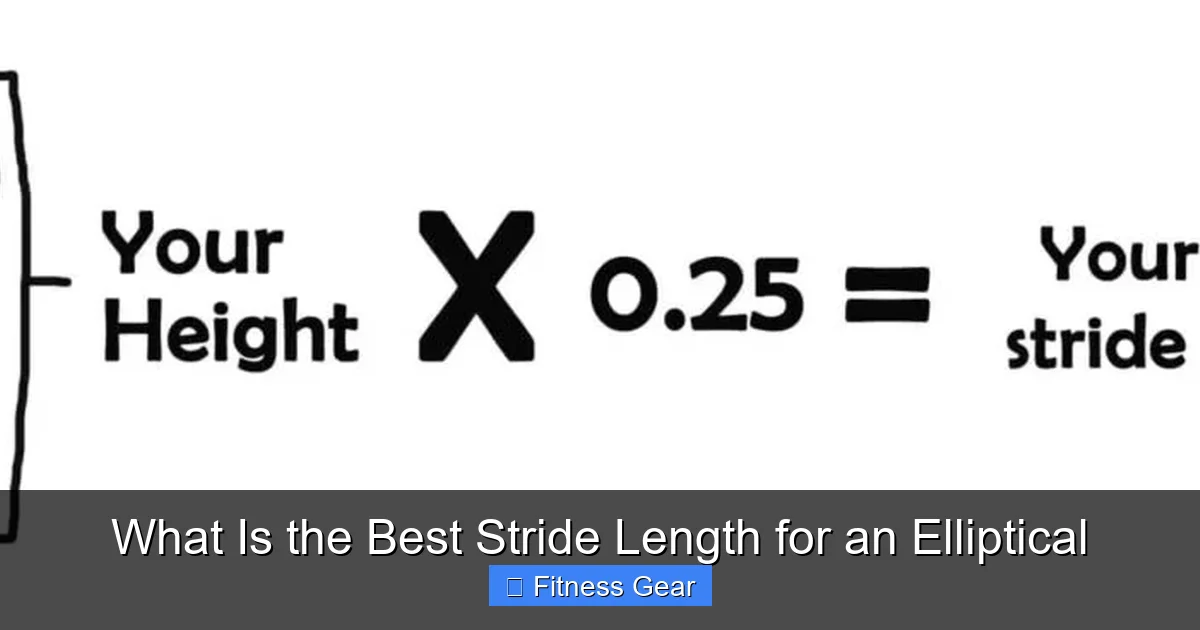
As mentioned, two people of the same height can have different torso-to-leg ratios. If you know you have particularly long or short legs for your height, adjust accordingly. Someone with long legs might benefit from the top end of their height range (e.g., a 5’9″ person with long legs trying for a 20″ stride).
Primary Fitness Goal
General Cardio & Weight Loss: Your primary goal is consistency and comfort. A stride that matches your natural gait will allow for longer, more enjoyable sessions, burning more calories overall.
Runner’s Cross-Training: Runners often prefer a slightly longer stride (within their comfortable range) to better mimic the elongated gait of running. This can help maintain running-specific muscle engagement and neuromuscular patterns. A 6′ runner might seek out a 21″ stride even if they are “only” 6’0″.
Rehabilitation or Low-Impact Focus: For those with joint concerns, the priority is zero jarring. A perfectly matched stride prevents any “reach” or “pull” that could cause strain. Sometimes, a slightly shorter stride within your comfortable zone can feel even more controlled and stable, especially for beginners or those recovering from injury.
Pedal Design and Q-Factor
Stride length isn’t the only dimension. The Q-factor is the horizontal distance between the centers of the two pedals. A narrow Q-factor (pedals closer together) feels more like a natural walk and is often easier on the hips and knees, especially for people with wider hips. A wide Q-factor can feel like you’re “spreading your legs” awkwardly. Check the manufacturer’s specs. Also, look at pedal size—a larger, more contoured pedal provides more surface area and stability for your foot.
Common Mistakes and How to Avoid Them
Let’s debunk some myths and highlight pitfalls.
Mistake: “Longer Stride = Better Workout”
This is a dangerous misconception. A longer stride is only “better” if it matches your body. An overly long stride does not engage more muscles; it creates an inefficient lever system that stresses joints and reduces your ability to maintain pace or resistance. You’ll likely have to lower the resistance to cope, negating any theoretical benefit.
Mistake: Ignoring the “Feel” for the Spec Sheet
Don’t get married to the number. A 20″ stride on Brand A might feel different than a 20″ stride on Brand B due to variations in rail angle, pedal shape, and overall geometry. The spec sheet is a starting point, but the in-person test is the final judge.
Mistake: Forgetting About User Weight and Flywheel
A heavier user (e.g., 250+ lbs) on a low-end elliptical with a small flywheel and a stride at the upper limit of their range may experience a “wobbly” or unsteady feel. The machine’s overall build quality and flywheel weight (aim for 15+ lbs for smoothness) interact with stride length to affect stability. A sturdy frame is non-negotiable for taller/heavier users on longer strides.
Putting It All Together: Your Action Plan
So, how do you actually choose?
- Measure Your Height: Be honest and accurate.
- Apply the Height Guidelines: Use the ranges from Section 2 as your initial search filter. If you’re 5’7″, you’re likely looking at 18″ or 20″ models.
- Read Reviews from Users Your Height: This is invaluable. Search for “elliptical reviews for tall/short people.” See what others with your build are saying about specific models’ stride feel.
- Prioritize In-Person Testing: This cannot be stressed enough. Use the 5-minute test protocol. Bring a friend to watch your form from the side. Do your knees look comfortable? Is your back straight?
- Consider Adjustability if Budget Allows: For families or if you’re on the cusp between two stride lengths (e.g., a 5’10” person debating 18″ vs. 20″), an adjustable stride model removes the guesswork and risk.
- Trust the Discomfort Signal: If a machine *almost* feels right but has a tiny bit of stretch or tightness at the extremes, that will magnify over a 30-minute workout. It’s not “breaking in.” It’s a poor fit. Keep looking.
Conclusion: Your Perfect Stride Awaits
The search for the best elliptical stride length is, at its heart, a search for the machine that disappears. The ideal elliptical is the one you forget you’re on because the motion is so natural, smooth, and aligned with your body’s own mechanics. That feeling is pure fitness freedom. By understanding that stride length is primarily a function of your height, committing to a real-world test, and listening to the subtle signals from your joints and muscles, you can cut through the marketing noise and find the elliptical that will become a cherished, lifelong partner in your health journey. Don’t settle for a number on a spec sheet; settle for a feeling in your legs. That’s how you find the best stride length for you.
Frequently Asked Questions
Can I adjust the stride length on any elliptical?
No. Only specific higher-end and commercial models have an adjustable stride mechanism. The vast majority of consumer/home ellipticals have a fixed stride length set by the manufacturer. Always check the product specifications for the term “adjustable stride” or “variable stride.”
What happens if I use an elliptical with a stride length too short for my height?
You’ll experience a choppy, “sprinting” motion. Your knees won’t fully extend, forcing you to lift your feet awkwardly. This places excessive shear stress on the knee joint, prevents full glute and hamstring engagement, and often leads to shin pain and anterior knee discomfort over time.
Is a longer stride always better for burning more calories?
No. A longer stride is only beneficial if it matches your leg length. An overly long stride forces you into an inefficient, straining motion that will likely cause you to reduce your speed or resistance to cope, ultimately burning fewer calories. A comfortable, matched stride allows for sustained, powerful effort.
How important is stride length compared to other elliptical features?
It is the most critical ergonomic factor. You can have the best programs, the highest resistance, and a beautiful screen, but if the stride length is wrong, you will not use the machine consistently due to discomfort or pain. It is the foundation of a good fit. Other features are secondary to this fundamental biomechanical match.
Do I need a longer stride if I’m a runner looking for cross-training?
Often, yes. Runners are accustomed to a longer, more powerful gait. You may find a stride at the longer end of your recommended height range (or even an adjustable model set to its maximum) feels more natural and better engages the running-specific muscles in your glutes and hamstrings. However, it must still be within a comfortable, non-straining range.
What if my height is exactly between two stride length categories?
This is a common dilemma (e.g., 5’10” considering 18″ vs. 20″). In this case, in-person testing is absolutely essential. Your personal leg length proportion will be the deciding factor. Also, consider the machine’s overall build—a heavier flywheel and sturdier frame on a 20″ model might feel more stable for you than a lighter 18″ model, even if the stride is slightly long.