What Part of Your Body Does an Elliptical Work

An elliptical machine provides a true full-body, low-impact workout simultaneously engaging your lower body (quads, hamstrings, glutes, calves), upper body (chest, back, shoulders, arms), and core stabilizers. It’s primarily a cardiovascular exercise that also builds muscular endurance, making it efficient for burning calories, improving heart health, and strengthening joints without the stress of running. Proper form and resistance adjustments are key to targeting specific muscle groups effectively.
So you’ve stepped onto the elliptical, grasped the handles, and started that smooth, gliding motion. It feels good, maybe even easier than the treadmill. But a quiet question might be echoing in your mind as you move: “What part of my body is this actually working?” It’s a fair question. Unlike a bicep curl that screams “I’m working your arm!” or a leg press that’s brutally honest about its focus, the elliptical can feel like a mystery machine. That’s its genius—and sometimes its curse. It delivers a fantastic, full-body workout, but if you don’t know what you’re targeting, you might be leaving gains on the table. Let’s pull back the curtain and conduct a full-body tour of exactly what muscles fire up during your elliptical session. We’ll go from the ground up, literally, and explain how to use this versatile machine to its absolute fullest potential.
First, a crucial mindset shift: the elliptical is not just a “cardio machine.” Yes, its primary superpower is delivering an outstanding cardiovascular workout that gets your heart pumping and lungs working. But the simultaneous upper and lower body movement transforms it into a comprehensive muscular endurance builder. Think of it as a symphony for your musculature, where different sections play at different volumes depending on how you conduct. Understanding this orchestra—the key muscle groups and how to emphasize them—is the secret to making every minute on the elliptical count toward your specific goals, whether that’s torching fat, building lean endurance, or rehabilitating a sore joint.
Key Takeaways
- Full-Body Engagement: The elliptical uniquely combines a lower-body stride with a pushing/pulling upper-body motion, activating over 80% of your major muscle groups in one session.
- Primary Lower Body Focus: Your quadriceps, hamstrings, glutes, and calf muscles are the powerhouses driving the elliptical motion, with emphasis shifting based on incline and resistance.
- Active Upper Body: The movable handles ensure your chest, back (especially lats), shoulders, biceps, and triceps are continuously working, turning cardio into a strength endurance session.
- Core is Always On: Your abdominal and lower back muscles engage isometrically to stabilize your pelvis and torso throughout the entire range of motion.
- Cardio King, Strength Contributor: It’s exceptional for cardiovascular health and calorie burn, but builds muscular endurance rather than pure mass; high resistance can feel like strength training.
- Low-Impact Hero: The elliptical’s fixed footpath eliminates heel strike, drastically reducing stress on ankles, knees, hips, and the lower back compared to running or stair climbers.
- Form Dictates Results: Leaning forward works glutes/hamstrings more; staying upright targets quads. Pushing emphasizes chest/triceps, pulling focuses on back/biceps. Never lock your knees.
📑 Table of Contents
- The Grand Symphony: Full-Body, Low-Impact Engagement
- Lower Body Powerhouse: Quads, Hamstrings, Glutes, and Calves
- Upper Body Activation: Arms, Chest, and Back in Motion
- The Unseen Anchor: Core and Stabilizer Muscles
- Cardio King, Strength Contributor: Understanding the Adaptation
- Maximizing Your Elliptical Workout: Practical Tips and Strategies
- Conclusion: Your Personal, Full-Body Tuning Fork
The Grand Symphony: Full-Body, Low-Impact Engagement
Before we dive into individual muscle groups, it’s essential to understand the elliptical’s fundamental design philosophy. Unlike a treadmill where your feet pound the belt, or a stationary bike where your legs spin in a restricted circle, the elliptical’s pedals follow a smooth, oval-shaped path that keeps your feet in constant contact with the platform. This is the cornerstone of its low-impact nature. There’s no jarring heel strike. Your knees, ankles, and hips move through a controlled, weight-bearing arc that mimics a natural gait pattern but without the high-impact forces. This makes it a sanctuary for anyone with joint sensitivities, those recovering from injury, or anyone simply wanting to protect their joints while still getting a serious workout.
But that smooth motion requires coordination from nearly your entire body. From the powerful push of your toes through the pedal stroke to the pull of your arms on the handles, your nervous system is firing signals to multiple muscle groups in a sequenced pattern. Your core—the deep abdominal and spinal muscles—acts as the unwavering anchor, preventing your torso from swaying and transferring force efficiently between your upper and lower body. It’s a true functional movement pattern that trains your body to work as a single, integrated unit. This holistic engagement is why 30 minutes on a well-used elliptical can feel like a 45-minute workout split between a leg day and an upper-body circuit. You’re not just working parts; you’re training movement.
The Role of Resistance and Incline
Two primary dials on the elliptical control the symphony’s intensity and focus: resistance and incline (if your machine has it). Resistance is the brake system. Increasing it makes the pedals and handles harder to push and pull, directly increasing the workload on every muscle involved. Think of it as adding weight to your movements. The incline, on some models, tilts the pedal path upward. This dramatically changes the muscle recruitment. A higher incline shifts the emphasis from your quadriceps (front thighs) on the downward push to your glutes and hamstrings (back thighs and buttocks) as you drive your hips upward and backward. Playing with these two settings is your primary toolkit for targeting different areas.
Lower Body Powerhouse: Quads, Hamstrings, Glutes, and Calves
Let’s start at the source of the motion: your legs. The pedal stroke has two distinct phases: the push (or drive) phase and the recovery (or return) phase. Different muscles dominate each.

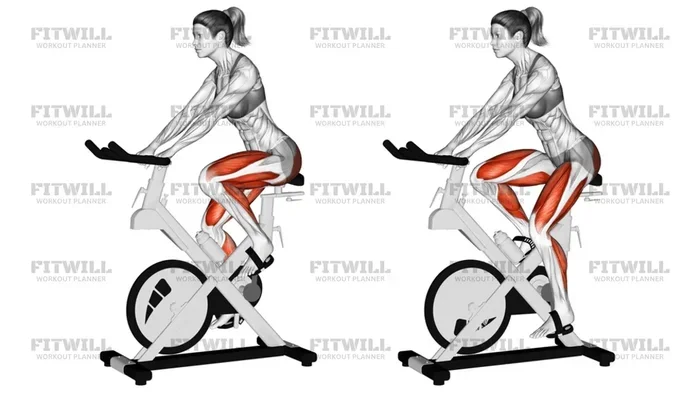
Visual guide about What Part of Your Body Does an Elliptical Work
Image source: high-tech-fitness.com
The Quadriceps: The Engine of the Push
Your quadriceps—the four muscles on the front of your thigh—are the undeniable workhorses during the push phase. As you straighten your leg to propel the pedal downward and forward, your quads are in a powerful concentric contraction. You’ll feel this most acutely when you increase the resistance and focus on a strong, deliberate push through your heels. To maximize quad engagement, keep your torso upright and concentrate on pressing through the ball of your foot as you extend your leg. Higher resistance with a lower incline places the greatest demand on your quads.
The Glutes and Hamstrings: The Hip Drivers
This dynamic duo takes the lead during the latter half of the push and the beginning of the recovery. As your leg extends and your hip moves behind you, your gluteus maximus (buttocks) fires to extend the hip. Simultaneously, your hamstrings (the muscles on the back of your thigh) work to flex the knee, pulling the pedal back up for the return stroke. To really “wake up” your glutes and hamstrings, you need to increase the machine’s incline. This tilts the pedal path, forcing you to drive your hips backward and upward, a motion that directly recruits the posterior chain. A helpful mental cue: imagine you’re trying to push the floor away behind you with your heel as you press down and back.
The Calves: The Ankle Stabilizers and Pushers
Your gastrocnemius and soleus (the two main calf muscles) are active throughout the entire stroke, but their role is most pronounced at the very bottom of the push. As you point your toes (plantarflex) to finish the pedal stroke, your calves contract to provide that final bit of power and stabilize your ankle joint. They also work isometrically to keep your foot secure on the pedal during the recovery. You can emphasize them by consciously pressing through the balls of your feet more, though be cautious not to let your heels lift completely off the pedal, which can strain the Achilles tendon.
Upper Body Activation: Arms, Chest, and Back in Motion
This is where the elliptical truly differentiates itself from other cardio machines. The movable handlebars are not just for holding on; they are an integral part of the resistance system. When you push and pull against them, you’re performing a continuous, dynamic upper-body exercise.

Visual guide about What Part of Your Body Does an Elliptical Work
Image source: cardionerd.com
Chest and Triceps: The Push Muscles
During the phase where your arms are extending forward (the same time your legs are pushing down), your pectoralis major (chest) and triceps brachii (back of the upper arm) are in a concentric contraction. They are literally pushing the handles away from your torso. To maximize this “push” focus, ensure you’re fully extending your arms with each repetition without locking the elbows. Increasing the resistance on the handles (if your machine has independent upper-body resistance) will intensify the burn in your chest and triceps. A helpful cue: “Push the world away from you.”
Back and Biceps: The Pull Muscles
As the handles come back toward your body during the recovery phase of the arm motion, your latissimus dorsi (the wide “lats” of your back), rhomboids (between your shoulder blades), and biceps brachii (front of the upper arm) engage to pull the handles inward. This creates a constant, rhythmic rowing motion. To really activate your back, focus on squeezing your shoulder blades together as you pull. Imagine trying to hold a pencil between them. Avoid simply bending your elbows; the power should come from your back muscles. This pulling action is crucial for balancing the pushing motion and building strong, postural upper-back muscles.
Shoulders: The Stabilizers
Your deltoids (shoulder muscles) work isometrically throughout the entire range of motion to stabilize your shoulder joint. They prevent your arms from flailing and ensure the force is transferred cleanly from your core to the handles. The anterior (front) deltoid assists during the push, while the posterior (rear) deltoid assists during the pull. Maintaining good posture—chest up, shoulders down and back—is vital for healthy shoulder engagement and to prevent hunching.
The Unseen Anchor: Core and Stabilizer Muscles
While your limbs are moving, a deep network of muscles is holding everything together. This is your core, and it’s working overtime on the elliptical. Your rectus abdominis (the “six-pack” muscle), obliques (sides), and erector spinae (along the spine) engage isometrically to keep your torso rigid and prevent excessive side-to-side sway or forward lean. A strong, engaged core is what allows you to transfer power efficiently from your lower body to your upper body and vice-versa. If you find yourself gripping the handles tightly and rocking your torso, it’s a sign your core is disengaged, and you’re relying on momentum rather than muscle. The solution? Brace your midsection gently as if preparing for a light punch. Think of your torso as a solid plank of wood connecting your arms and legs.

Visual guide about What Part of Your Body Does an Elliptical Work
Image source: m.media-amazon.com
Additionally, smaller stabilizer muscles in your hips, knees, and ankles are constantly at work to maintain proper alignment on the moving pedals. This constant, low-level stabilization improves joint proprioception (your body’s sense of its position in space) and contributes to overall functional strength and balance. The elliptical, in this sense, is a wonderful teacher of full-body coordination.
Cardio King, Strength Contributor: Understanding the Adaptation
Here’s where we clear up a common point of confusion. The elliptical is a phenomenal tool for cardiovascular endurance. By keeping your heart rate in a target zone for an extended period, you improve the efficiency of your heart, lungs, and circulatory system. You burn a significant number of calories, often comparable to running but with far less joint punishment. This is its primary, undisputed crown.
But what about strength? Will the elliptical make you “bigger” like lifting weights will? Generally, no. The nature of the movement—continuous, rhythmic, with constant tension but no true “locking out” or maximal load—promotes muscular endurance rather than maximal hypertrophy (muscle size). You will build lean, toned muscles that are fatigue-resistant. Your legs will become stronger and more defined, your arms more sculpted, but you won’t see the same dramatic size increases as with heavy barbell squats or bench presses. However, by significantly cranking up the resistance to a point where you can only maintain a very slow, deliberate pace (almost like a strength exercise), you can absolutely build serious strength-endurance and even some muscle. It’s a spectrum: light resistance & speed = pure cardio; heavy resistance & slow pace = cardio-strength hybrid.
Calorie Burn and Weight Management
Because it engages so many large muscle groups simultaneously, the elliptical is a high-calorie-burning machine. A 185-pound person can burn approximately 300-400+ calories in 30 minutes at a moderate to vigorous pace. The involvement of the upper body increases the total energy expenditure compared to a lower-body-only machine like a stationary bike. For weight loss or management, this efficiency is a huge advantage. Combining the elliptical’s calorie burn with its low-impact nature means you can work out more frequently without overuse injuries, creating a sustainable calorie deficit.
Maximizing Your Elliptical Workout: Practical Tips and Strategies
Knowing the “what” is useless without the “how.” Here’s how to translate muscle knowledge into a more effective session.
Posture is Non-Negotiable
The single most important factor. Stand tall. Imagine a string pulling the crown of your head toward the ceiling. Keep your shoulders pulled down and back, away from your ears. Your chest should be open. Do not lean forward and grip the handles for support. Your hands should lightly rest on the handles or, if using stationary grips, your core should be engaged to keep you upright. Leaning turns a full-body workout into a half-body, upper-body-supported effort and removes core engagement. If you need to lean to catch your breath, reduce the resistance or speed instead.
Use the Full Range of Motion
Don’t take short, choppy strides. Allow your legs to extend fully (but without locking the knee) and your heels to come up slightly on the return. A full stroke ensures your hamstrings and glutes get a complete stretch and contraction in the recovery phase, and your quads get a full extension. Short strides cheat you out of the full muscular benefits and place unnecessary stress on the knee joint.
Mix Up Your Hand Position
Most ellipticals offer multiple grip positions: the primary moving handles, stationary inner grips, and sometimes a “ramp” or “swing” arm option. Change it up! Use the moving handles for the full-body, coordinated workout we’ve described. Switch to the stationary inner grips for a period to isolate your lower body, allowing you to push harder with your legs without arm fatigue. This is great for focused leg days. You can also experiment with a wider or narrower grip on the moving handles to slightly alter shoulder and chest engagement.
Interval Training for Plateaus
Your body adapts. To keep seeing results, use High-Intensity Interval Training (HIIT) on the elliptical. After a warm-up, alternate 60-90 seconds of high resistance (7-9 on a scale of 1-10 effort) with 60-90 seconds of low resistance and/or high speed for active recovery. This spikes your heart rate, burns more calories post-workout (EPOC), and challenges your muscles in new ways. You can also vary the incline in your intervals to specifically target glutes (high inclines) vs. quads (low inclines).
Don’t Forget the Reverse!
If your elliptical allows backward pedaling (most do), use it. Pedaling backward fundamentally changes the muscle emphasis. It places greater demand on your hamstrings and glutes during the “push” phase and shifts the upper-body pull to a more rowing-like motion that can emphasize the mid-back. It’s a fantastic way to balance your development and challenge your coordination. Start with short intervals backward (30-60 seconds) as it feels quite different.
Conclusion: Your Personal, Full-Body Tuning Fork
The elliptical is not a one-trick pony. It’s a sophisticated, full-body tuning instrument. By understanding that its smooth, circular motion is a coordinated dance between your quads driving the push, your glutes and hamstrings powering the hip drive, your chest and triceps pushing against resistance, your back and biceps pulling you through the return, and your core anchoring the entire symphony, you unlock its true potential. You move from passively stepping to actively engaging.
This machine is a testament to efficient design: maximum cardiovascular and muscular endurance benefit with minimal joint stress. It’s the perfect tool for the beginner building a fitness base, the athlete cross-training for injury prevention, the time-crunched professional needing a full-body burn in 30 minutes, and the individual managing arthritis or recovering from surgery. The key is intentionality. Set a goal for your session. Is it a steady-state cardio day? Keep resistance moderate, posture perfect, and use moving handles for full engagement. Is it a strength-endurance day? Crank the resistance high, move slowly, and focus on the squeeze in your muscles. Is it a glute day? Max out the incline and push through your heels.
So the next time you climb on, don’t just go through the motions. Conduct your own symphony. Feel the quad burn on the downstroke, the glute activation on the incline, the back squeeze as you pull. Listen to your body. That’s not just an elliptical you’re on; it’s your personal, adaptable, joint-friendly gym, working you from head to toe. Now go make every stroke count.
Frequently Asked Questions
Does an elliptical work your stomach and help lose belly fat?
Yes, the elliptical engages your core muscles (abs and lower back) isometrically to stabilize your torso, which strengthens and tones those muscles. However, you cannot “spot-reduce” fat from your belly. The elliptical is excellent for burning overall body fat through its high-calorie cardiovascular workout, which, combined with a healthy diet, will lead to fat loss from your midsection and everywhere else.
Is the elliptical better than a treadmill for toning legs?
It depends on your goals. The treadmill (especially with incline) is excellent for building leg power and bone density due to its impact. The elliptical provides a more balanced leg workout, engaging quads, hamstrings, and glutes more evenly, especially when using the reverse motion or high incline. For pure toning and endurance with low impact, the elliptical’s full-leg engagement in both directions is highly effective and joint-friendly.
What muscles does an elliptical work that a bike doesn’t?
The primary difference is the upper body. An elliptical’s moving handles actively work your chest, back, shoulders, and arms in a pushing/pulling motion. A stationary bike (upright or recumbent) is almost exclusively a lower-body and core workout. The elliptical also engages the core differently due to the need to stabilize against the arm movement. Both are excellent low-impact cardio options, but the elliptical provides a more comprehensive full-body session.
Can I build muscle on an elliptical?
You can build muscular endurance and lean, toned muscle, but not significant bulk (hypertrophy). The elliptical uses lighter resistance with high repetitions, which is the perfect recipe for endurance. To build mass, you need to lift progressively heavier weights. However, using very high resistance on the elliptical at a slow, controlled pace can certainly strengthen muscles and lead to some definition, especially for beginners or those returning to fitness.
Why does my back hurt on the elliptical?
Back pain is almost always a form issue. The most common cause is leaning forward and gripping the handles tightly, which removes core engagement and puts strain on the lower back. The fix is to stand perfectly upright, gently brace your core, and let your legs do the work. Also, ensure the machine is properly adjusted—your knees should be slightly bent at the lowest point, and you shouldn’t have to reach excessively for the handles. If pain persists, consult a doctor or physical therapist.
Is the elliptical good for people with bad knees?
Yes, it is widely considered one of the best cardio machines for knee issues. The elliptical’s footplate follows a fixed, oval path that eliminates the heel-strike impact of running. The motion is smooth and weight-bearing (which is good for bone health) but without the pounding forces that aggravate conditions like arthritis, tendinitis, or post-injury recovery. Always start with low resistance and consult your healthcare provider, but for most, it’s a safe and effective knee-friendly option.