What Parts of the Body Does an Elliptical Workout

An elliptical workout is a true full-body, low-impact exercise. It effectively engages all the major muscle groups in your lower body (quadriceps, hamstrings, glutes, calves), upper body (chest, back, shoulders, arms), and core. By using the moving handles, you activate your upper body, while the foot pedals power your lower body. This synchronized motion also provides a significant cardiovascular workout, improving heart and lung health while burning calories. It’s an excellent, joint-friendly option for building strength and endurance simultaneously.
Key Takeaways
- Total-Body Engagement: The elliptical uniquely combines lower body (legs, glutes) and upper body (arms, chest, back) movements in one fluid motion, maximizing muscle activation.
- Primary Lower Body Focus: Your quadriceps, hamstrings, glutes, and calves are the powerhouses, doing the majority of the work with each stride and push.
- Active Upper Body: Using the moving handles actively works your chest, back, shoulders, and arms. Pushing and pulling against resistance builds upper body endurance and tone.
- Core Stabilization: Your abdominal and lower back muscles engage constantly to maintain posture and balance, providing a subtle but effective core workout.
- Joint-Friendly Cardio: The elliptical’s smooth, oval path eliminates impact, making it ideal for those with knee, hip, or ankle concerns while still delivering an intense cardio session.
- Cardiovascular & Metabolic Boost: It significantly elevates heart rate, improving cardiovascular endurance and promoting calorie and fat burn during and after the workout.
- Highly Customizable: By adjusting incline, resistance, and your focus (arms vs. legs), you can shift the emphasis to different muscle groups for a tailored workout.
📑 Table of Contents
The Elliptical: A Full-Body Fitness Machine
When you step onto an elliptical trainer, you’re stepping into a world of balanced, efficient movement. Unlike a treadmill, which primarily taxes your legs and joints, or a stationary bike, which isolates your lower body, the elliptical is designed from the ground up to be a true total-body exerciser. Its defining feature is the combination of a foot pedal path that mimics running or walking and a set of moving handles that engage your arms. This synchronized motion means you’re not just pushing with your legs; you’re actively pulling and pushing with your upper body against resistance. The result is a smooth, flowing, and crucially, low-impact workout that spares your joints from the pounding of high-impact activities while still delivering a serious physical challenge. Understanding exactly which parts of the body an elliptical workout targets helps you use the machine more intentionally, turning a simple cardio session into a comprehensive strength and endurance builder.
How the Elliptical Motion Works
The magic lies in the mechanics. The pedals move in an oval (elliptical) pattern, which keeps your feet in constant contact with the pedal. There’s no moment where you lift off and land, eliminating the jarring impact that can stress knees, ankles, and hips. Simultaneously, the handlebars are connected to this same resistance system. When you push one pedal forward and down, the opposite handle moves toward you. When you pull that handle, you’re driving the other pedal back. It’s a natural, cross-country skiing-like motion that recruits muscles on both sides of your body in a coordinated fashion. This design makes it one of the most efficient machines for burning calories per minute while being accessible to a wide range of fitness levels, from beginners to elite athletes.
Lower Body Powerhouse: Legs and Glutes
Let’s start with the engine room. Your lower body provides the primary force to move the elliptical’s flywheel against resistance. Every part of your leg and hip complex gets a fantastic workout. The specific emphasis can be tweaked by adjusting the machine’s incline and resistance level, but the foundational movement always involves these key muscle groups.
Visual guide about What Parts of the Body Does an Elliptical Workout
Image source: hips.hearstapps.com
Quadriceps (Thighs)
Your quadriceps, or “quads,” are the large muscles on the front of your thighs. They are the primary movers during the “push” phase of the elliptical stride—when you extend your knee to straighten your leg and drive the pedal down and forward. You’ll especially feel them working when you increase the resistance. Higher resistance forces your quads to work harder to generate power with each push. To really emphasize your quads, focus on pressing through the ball of your foot and keeping your feet flat on the pedals.
Hamstrings and Glutes (Back of Thighs and Buttocks)
On the opposite side of the “push” is the “pull” or “recovery” phase, where you bend your knee and pull the pedal back. This is where your hamstrings (the muscles on the back of your thighs) and your gluteus maximus (buttocks) shine. They contract to flex your hip and knee, pulling the pedal upward and backward. You can dramatically increase the work on your hamstrings and glutes by increasing the elliptical’s incline. A steeper incline shifts the motion to mimic a climbing motion, demanding more power from your posterior chain. A pro tip: consciously push through your heels during the upward pull to maximize glute activation.
Calves
Your calf muscles—the gastrocnemius and soleus—are active throughout the entire pedal stroke. They work to stabilize your ankle and assist with the plantar flexion (pointing your toes) as you push down. To give your calves an extra challenge, you can do intervals where you rise up onto the balls of your feet during the push phase, or simply increase the overall resistance. This constant, dynamic engagement helps build ankle stability and calf definition.
Upper Body Sculpting: Arms, Chest, and Back
This is where the elliptical truly separates itself from many other cardio machines. If you only hold the stationary handles, you’re missing out on half the benefit. Gripping the moving handles and actively using them transforms your workout. You’re no longer just a passenger; you’re a full participant, pushing and pulling against the machine’s resistance.

Visual guide about What Parts of the Body Does an Elliptical Workout
Image source: spcfitz.com
Chest (Pectorals) and Shoulders (Anterior Deltoids)
When you perform the “push” motion with the handles—pushing them forward and away from your body—you are primarily engaging your pectoral muscles (chest) and the front of your shoulders (anterior deltoids). This is similar to the motion of a chest press. To maximize this, focus on squeezing your chest muscles at the end of each push. Keep your elbows slightly bent but firm, and avoid locking them out. Increasing the resistance will make this upper body push significantly more challenging, building muscular endurance in your pushing muscles.
Back (Lats, Rhomboids) and Biceps
The “pull” phase—drawing the handles toward your torso—is where your back and biceps get their workout. As you pull, you engage your latissimus dorsi (the large “wings” of your back), your rhomboids (between your shoulder blades), and your biceps. This mimics the motion of a seated row. To ensure you’re using your back and not just your arms, focus on pinching your shoulder blades together as you pull. Think about leading the movement with your elbows, not your hands. This active pulling builds excellent upper back strength, which is crucial for posture, especially for those who sit at desks all day.
Triceps
Your triceps, the muscles on the back of your upper arms, work as stabilizers and assistors during both the push and pull phases. They are most active during the extension of the push phase, helping to straighten the elbow. While not the primary mover, they get a consistent, endurance-based workout that helps tone and strengthen the backs of your arms.
Core Engagement and Stability
Your core—the collective term for your abdominal muscles, obliques, and lower back—is never truly “off” during an elliptical workout. It acts as a vital stabilizer, transferring force between your upper and lower body and maintaining your upright posture against the machine’s gentle sway.

Visual guide about What Parts of the Body Does an Elliptical Workout
Image source: shop.vescape.com
Why Your Core Works on an Elliptical
Because your feet are on moving pedals and your hands are on moving handles, your torso is the stable center that connects these two moving parts. To prevent your hips from swaying excessively side-to-side or your lower back from overarching, your deep core muscles (like the transverse abdominis) and your obliques contract isometrically. This means they hold a static contraction to provide stability. Furthermore, if you intentionally avoid holding onto the handles for support (only for balance), you force your core to work even harder to maintain balance, turning the elliptical into a dynamic balance trainer.
Activating Your Core Intentionally
You can ramp up core activation with a few simple adjustments. First, stand up straight. Avoid slouching or leaning heavily on the handles. Imagine a string pulling your head toward the ceiling, engaging your abs lightly. Second, try letting go of the handles for short intervals (10-20 seconds) at a low resistance to test your balance and core stability. Finally, incorporate conscious breathing: exhale during the push/pull exertion to naturally engage your abdominal wall. This mindful engagement turns a passive stabilizer into an active muscle group being strengthened.
Cardiovascular and Metabolic Benefits
Beyond the muscular engagement, the elliptical is a powerhouse for your heart, lungs, and metabolism. The full-body nature of the movement means you are moving more muscle mass at once compared to a leg-only exercise. More active muscle mass requires more oxygen and energy, which means your heart and lungs have to work harder to supply it.
Heart and Lung Health (Cardio)
An elliptical workout sits squarely in the aerobic training zone for most people. By maintaining a steady, elevated heart rate for 20-60 minutes, you strengthen your cardiac muscle, improve the efficiency of your lungs, and increase the volume of blood pumped with each beat (stroke volume). This translates to a lower resting heart rate, better endurance for daily activities, and a reduced risk of cardiovascular disease. The low-impact nature allows you to sustain this cardio session for longer periods without joint fatigue, making it excellent for building aerobic base.
Calorie Burn and Fat Loss
Because you’re using so many large muscle groups simultaneously, the elliptical is a potent calorie burner. The number of calories expended per minute is comparable to running on a treadmill but without the impact. Furthermore, the resistance-based strength component means you’re also building some muscle. More muscle mass increases your resting metabolic rate (RMR), meaning you burn more calories even when you’re not exercising. For optimal fat loss, combine your elliptical sessions with a slight calorie deficit and consider incorporating high-intensity interval training (HIIT) on the machine, which creates an “afterburn” effect (excess post-exercise oxygen consumption, or EPOC) where your metabolism stays elevated for hours after the workout.
Maximizing Your Elliptical Workout: Tips and Techniques
Knowing which muscles work is only half the battle. To get the most out of your elliptical workout and ensure you’re targeting all areas effectively, you need to use the machine with strategy and good form.
1. Posture is Everything
Stand tall with your chest open, shoulders pulled down and back (not hunched toward your ears). Engage your core as described above. Avoid leaning forward and gripping the handles for support. Your weight should be evenly distributed through your entire foot, not just the toes or heels. Proper posture ensures the work is done by your muscles, not compensated by momentum or joint stress.
2. Use the Handles!
This cannot be stressed enough. If your goal is a full-body workout, you must use the moving handles. Grip them firmly but not white-knuckled. Push and pull with purpose, focusing on the muscle contraction in your chest and back as described earlier. If you only want a lower-body focus, you can lightly rest your fingertips on the stationary handles, but know you’re halving the potential muscle engagement and calorie burn.
3. Play with Incline and Resistance
Don’t just set a random number and zone out.
- Higher Incline (10-20): Emphasizes glutes and hamstrings. Feels like hiking.
- Lower Incline (0-5): Emphasizes quadriceps. Feels like a flatter run or walk.
- Higher Resistance: Makes the movement harder overall, building muscular strength and endurance in all engaged groups. Slows your stride speed but increases power output.
- Lower Resistance / Higher Speed: Creates more of a pure cardio, endurance-focused pace.
Alternate between these settings in your workout (e.g., 5 minutes moderate incline, 2 minutes high resistance) to challenge different muscles and prevent plateaus.
4. Incorporate Intervals
Steady-state is great, but intervals are where you make leaps in fitness. Try this simple structure:
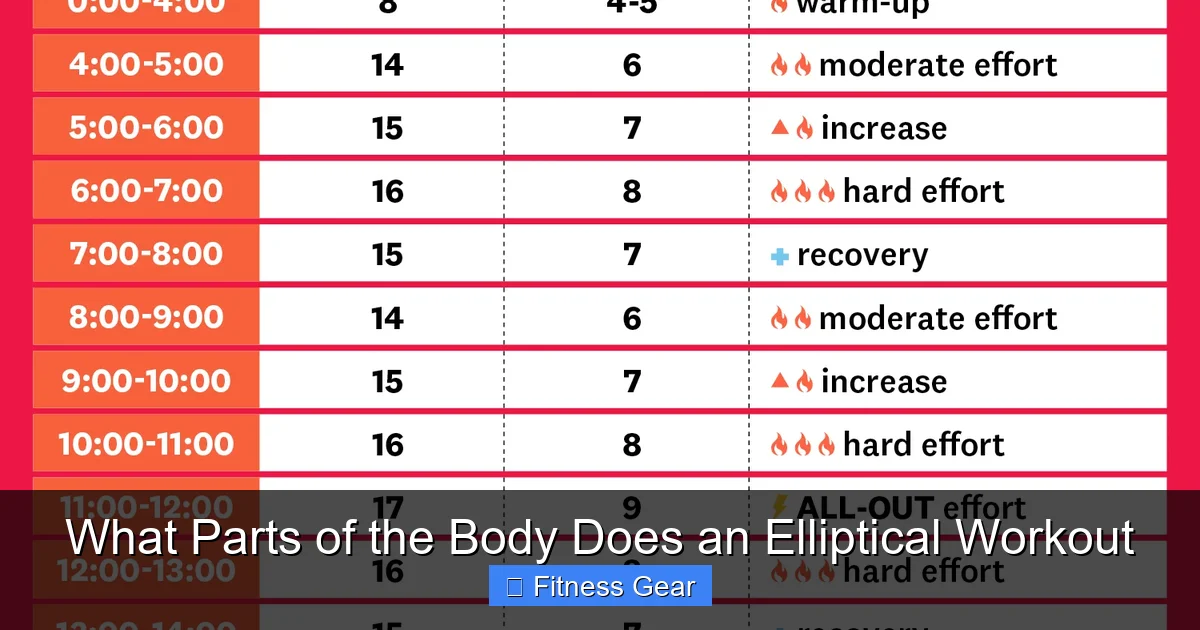
- Warm-up: 3-5 minutes at low resistance.
- Interval Set: 1 minute at a very challenging resistance/incline (max effort), followed by 2 minutes of active recovery at an easy pace. Repeat 6-10 times.
- Cool-down: 3-5 minutes easy pace.
This spikes your heart rate, maximizes calorie burn, and improves both aerobic and anaerobic capacity.
5. Forward and Reverse Motion
Most ellipticals allow you to pedal in reverse. This is not just a gimmick. Reversing the motion shifts the muscle emphasis slightly. It can feel like it works the backs of your legs (hamstrings) and glutes in a different way and also engages the muscles that flex your knees. It’s a great way to add variety and ensure balanced development. Spend 5-10 minutes of your workout in reverse if your machine allows it.
Conclusion: Your All-in-One Fitness Partner
So, what parts of the body does an elliptical workout target? The comprehensive answer is: almost all of them, in a smart, coordinated way. It’s a symphony of motion where your legs drive, your arms pull and push, and your core stabilizes, all while your heart and lungs work at full capacity. This makes the elliptical one of the most efficient and accessible pieces of fitness equipment available. Whether you’re a beginner looking for a gentle way to start, an athlete needing low-impact cross-training, or someone recovering from an injury, the elliptical delivers a potent blend of cardiovascular conditioning, muscular endurance, and joint protection. By understanding the muscles at play—quadriceps, hamstrings, glutes, calves, chest, back, shoulders, arms, and core—and applying the tips on form, resistance, and intervals, you can transform your time on the machine from a simple slog into a highly effective, full-spectrum workout that builds a stronger, more resilient body.
Frequently Asked Questions
Can an elliptical workout help me lose belly fat?
An elliptical is excellent for burning overall body fat, which will eventually reduce belly fat. It provides a high-calorie-burning cardio session. However, spot reduction (losing fat from one specific area) is a myth. Consistent elliptical workouts combined with a healthy diet and overall strength training are the most effective strategy for a leaner midsection.
Is the elliptical good for people with bad knees or joint problems?
Yes, the elliptical is widely considered one of the best low-impact cardio machines for joint health. Its smooth, oval motion keeps your feet in constant contact with the pedals, eliminating the pounding impact of running. This makes it a safe and effective option for those with osteoarthritis, knee pain, or during injury rehabilitation, but you should always consult with a doctor or physical therapist first.
Should I use the moving handles or the stationary ones?
For a full-body workout that maximizes calorie burn and engages your upper body, you should always use the moving handles. They turn the elliptical into a total-body exerciser, working your chest, back, shoulders, and arms. Using only the stationary handles reduces the workout to primarily a lower-body exercise, missing out on half the potential benefit.
How often should I use the elliptical to see results?
For general fitness and weight management, aim for 3-5 sessions per week, lasting 20-45 minutes each. Consistency is key. To see noticeable improvements in cardiovascular endurance and muscle tone, combine these regular sessions with a balanced diet and occasional strength training. Allow for at least one full rest day per week for recovery.
Can you actually build muscle on an elliptical?
You can build muscular endurance and achieve some degree of toning, especially in your legs and arms. However, the elliptical primarily provides resistance through a long range of motion at a moderate level. For significant muscle hypertrophy (size and strength), you need to lift heavier weights with lower reps. Think of the elliptical as building lean, endurance-focused muscle and improving overall body composition alongside fat loss.
What’s better for weight loss: elliptical or treadmill?
Both are excellent for burning calories. The treadmill may have a slight edge in raw calorie burn per minute for running due to its higher impact and intensity. However, the elliptical’s major advantage is sustainability and joint safety. Because it’s lower impact, you can often exercise longer and more frequently on an elliptical without pain or fatigue, which may lead to greater total calorie burn over time. The best machine is the one you will use consistently and safely.