Why Planets Revolve Around the Sun in Elliptical Path
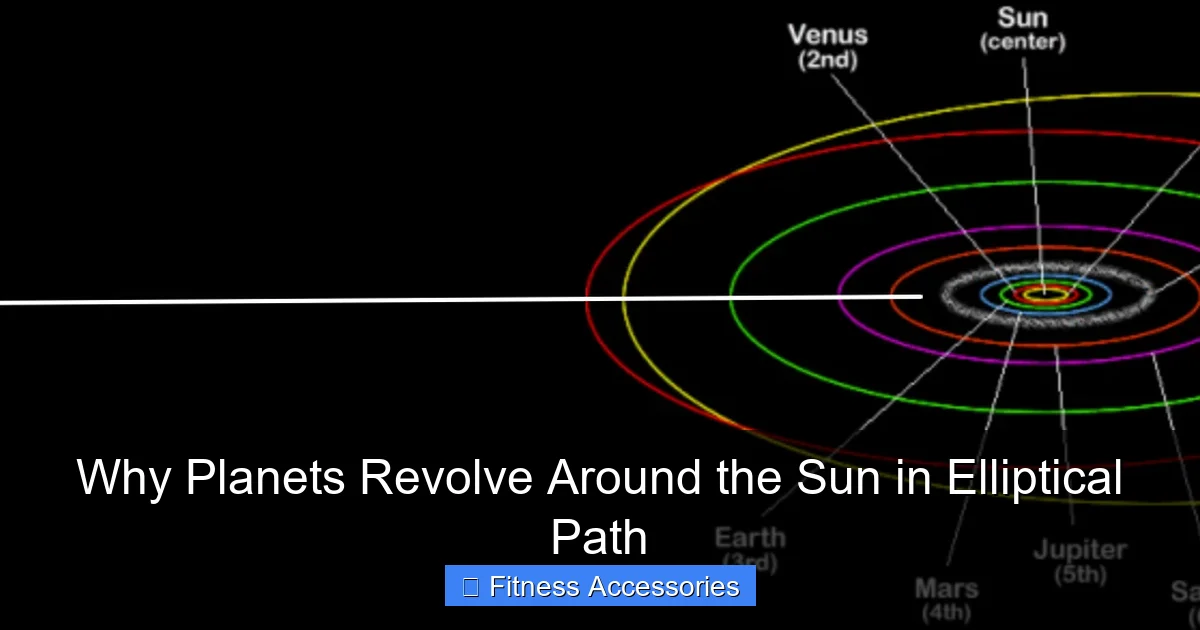
Contrary to popular belief, planets do not orbit the Sun in perfect circles. Kepler’s First Law established that they travel in elliptical paths, with the Sun at one focus. This shape is a direct result of gravity’s inverse-square law and the planets’ initial velocities. The degree of ellipticity, or “eccentricity,” varies, creating unique orbital characteristics for each world. Understanding this fundamental principle explains planetary motion, seasons, and is critical for modern space navigation.
Look up at the night sky or at diagrams in any astronomy book, and you’ll see a familiar pattern: planets circling the Sun. For centuries, the intuitive, almost philosophical, belief was that these paths must be perfect circles. Circles represented divine perfection and harmony. But what if the cosmos didn’t share our love for geometric perfection? What if the true path of a planet was something subtly different, something more elegant and dynamic? The answer, revealed through meticulous observation and revolutionary thinking, is that planets revolve around the Sun in elliptical paths. This isn’t a minor detail; it’s the fundamental rhythm of our solar system, a rhythm dictated by the unyielding laws of gravity and motion. Understanding why planets revolve around the Sun in elliptical paths unlocks a deeper appreciation for the mechanics of our universe, from the changing seasons to the precise trajectories of interplanetary probes.
Key Takeaways
- Kepler’s First Law: All planets orbit the Sun in elliptical paths, with the Sun located at one of the two foci of the ellipse, not at the center.
- Gravity is the Sculptor: The elliptical shape arises from the interplay between a planet’s forward velocity and the Sun’s gravitational pull, governed by Newton’s law of universal gravitation.
- Eccentricity Measures “Flatness”: An orbit’s shape is defined by its eccentricity (e=0 is a circle; 0
- Seasons Are Not Caused by Elliptical Orbits: Earth’s seasons are primarily due to axial tilt, not the slight variation in distance from the Sun during its elliptical orbit.
- Orbital Speed Varies: A planet travels fastest at perihelion (closest approach to the Sun) and slowest at aphelion (farthest point), a direct consequence of its elliptical path.
- Universal Principle: Elliptical orbits apply to moons around planets, binary stars, and artificial satellites, making it a cornerstone of celestial mechanics.
- Historical Shift: The move from circular to elliptical orbits represented a monumental shift from ancient philosophical ideals to observation-based science, led by Johannes Kepler.
📑 Table of Contents
- The Great Misconception: The Circle’s Grip on the Human Mind
- Kepler’s First Law: The Elliptical Truth
- Gravity’s Role: Newton’s Unifying Insight
- Measuring Ellipticity: Eccentricity in Our Solar System
- Real-World Implications: Why Elliptical Orbits Matter
- Beyond Our Solar System: A Universal Pattern
- Conclusion: The Beauty of the Ellipse
The Great Misconception: The Circle’s Grip on the Human Mind
For millennia, the circle was more than a shape; it was an ideal. Ancient Greek astronomers like Aristotle and Ptolemy, working within a geocentric (Earth-centered) framework, insisted that celestial bodies must move in uniform circular motion because circles were perfect. To account for the messy, non-uniform observations of planets (like retrograde motion), they added complex systems of smaller circles called epicycles upon epicycles. It was a mathematical nightmare, but it preserved the sacred circle. Even when Nicolaus Copernicus proposed a heliocentric (Sun-centered) model in the 16th century, he still clung to circular orbits. His model was simpler in structure but still required small epicycles to match the observational data. The circle was a cognitive straightjacket.
The Data That Would Not Fit
The breakthrough came not from philosophy, but from painstaking data collection. The Danish astronomer Tycho Brahe, with his unprecedented naked-eye instruments, compiled the most accurate planetary observations ever made, particularly of Mars. His assistant, the brilliant German mathematician Johannes Kepler, inherited this treasure trove of data. For years, Kepler, a devout man seeking divine geometric harmony, tried to force Mars’s orbit into a circular model. He tested dozens of combinations, adding tiny circular corrections. The numbers simply would not lie. The observed positions of Mars, especially at its closest and farthest points from the Sun, consistently defied any perfect circular prediction. The discrepancy was small but undeniable. Kepler was forced to a stunning, heretical conclusion: the orbit was not a circle. He wrote of his struggle, “The truth of nature, which I had rejected and chased away, returned by stealth through the back door.”
Kepler’s First Law: The Elliptical Truth
In 1609, Kepler published his masterpiece, Astronomia Nova (New Astronomy), containing what we now call Kepler’s First Law of Planetary Motion: “The orbit of every planet is an ellipse with the Sun at one of the two foci.” This was a radical departure. An ellipse is an elongated circle, a shape you can draw by pinning two points (foci), tying a string between them, and moving a pencil while keeping the string taut. The Sun sits at one of those pins, not at the center. This single statement explained all of Brahe’s residual errors. The planet’s distance from the Sun varied continuously, being closest at one point (perihelion) and farthest at another (aphelion). The elliptical orbit was not a sign of imperfection but the natural, elegant solution to the problem of planetary motion.
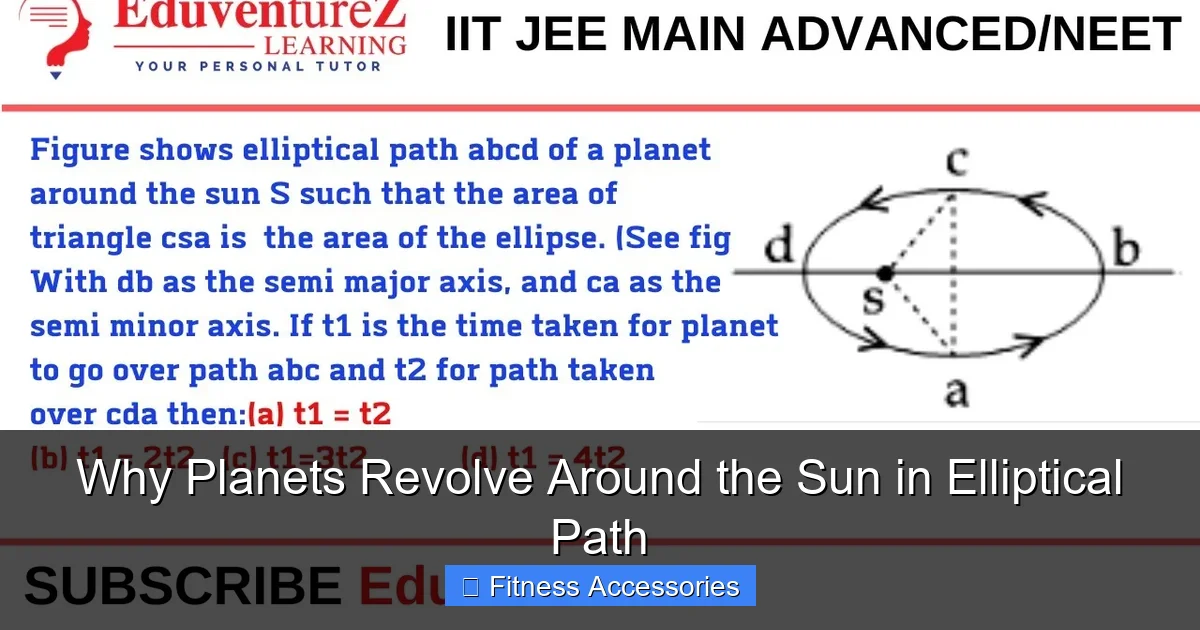
Visual guide about Why Planets Revolve Around the Sun in Elliptical Path
Image source: i.ytimg.com
Defining the Ellipse: Foci, Axes, and Eccentricity
To grasp this, we need to define an ellipse. Its longest diameter is the major axis. The point at the center of this axis is the center. The shortest diameter is the minor axis. The two fixed points inside are the foci (singular: focus). The sum of the distances from any point on the ellipse to the two foci is constant. The Sun occupies one of these foci. The other focus is an empty point in space. The eccentricity (e) is a number between 0 and 1 that describes how “stretched” the ellipse is. An eccentricity of 0 is a perfect circle, where both foci merge at the center. As e approaches 1, the ellipse becomes more and more elongated. Our solar system provides a perfect spectrum: Venus (e=0.0068) and Earth (e=0.0167) have nearly circular orbits. Neptune (e=0.0086) is also very circular. Mars (e=0.0934) is noticeably elliptical. Mercury (e=0.2056) has the most eccentric orbit of the major planets, making its journey around the Sun a much more pronounced oval.
Gravity’s Role: Newton’s Unifying Insight
Kepler described what the orbits were, but he couldn’t explain why. That required Isaac Newton and his law of universal gravitation, published in 1687. Newton realized that the force of gravity between two objects is proportional to their masses and inversely proportional to the square of the distance between them. This “inverse-square law” is the engine behind the elliptical orbit. Imagine a planet moving through space. The Sun’s gravity constantly pulls it inward. If the planet had no sideways motion, it would fall straight into the Sun. If it had too much sideways motion, it would escape entirely. The precise, balanced sideways velocity it possesses means that as it falls toward the Sun, its increasing speed causes it to swing past and then fall back again, tracing an ellipse. Newton proved mathematically that under an inverse-square law of attraction, the only possible closed orbits are conic sections—ellipses (bound orbits), parabolas, and hyperbolas (unbound trajectories). The ellipse is the natural, stable path for a captured object.
Visual guide about Why Planets Revolve Around the Sun in Elliptical Path
Image source: explainingwhy.com
The Velocity-Distance Dance
This interplay creates a beautiful, dynamic effect: a planet’s orbital speed is not constant. Kepler’s Second Law, the Law of Equal Areas, states that a line connecting a planet to the Sun sweeps out equal areas in equal times. This means when a planet is closer to the Sun (at perihelion), it must move faster to sweep the same area as when it is farther away (at aphelion), where it moves slower. Earth, for instance, reaches perihelion around January 3rd and aphelion around July 4th. We are about 3 million miles closer to the Sun in January than in July. Yet, Northern Hemisphere winter occurs around that same perihelion. This is a crucial point that debunks a common myth: the elliptical orbit is not the cause of our seasons. The 3% variation in solar energy received due to distance is far less significant than the 40% variation caused by the 23.5° tilt of Earth’s axis. The elliptical shape governs the orbital speed and distance, but the seasons are a story of axial tilt, not orbital eccentricity.
Measuring Ellipticity: Eccentricity in Our Solar System
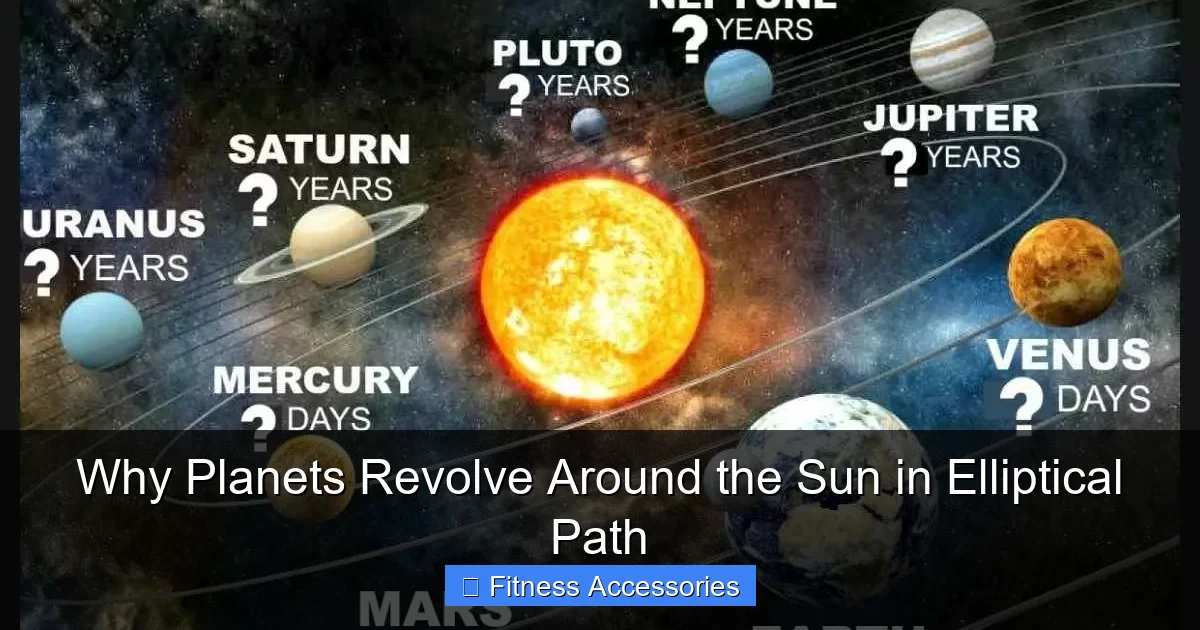
Not all planetary orbits are created equal. Their eccentricities tell a story of formation, gravitational tugs-of-war, and cosmic history. Earth’s orbit, with an eccentricity of just 0.0167, is remarkably circular. If you drew it to scale on paper, your eye would struggle to distinguish it from a circle. This near-circularity is thought to be a result of the early solar system’s dissipative processes and the stabilizing influence of other planets, particularly the giant Jupiter. A more circular orbit like Earth’s may have been beneficial for a stable climate over geological timescales.
Visual guide about Why Planets Revolve Around the Sun in Elliptical Path
Image source: img.jagranjosh.com
The Case of Mars and Mercury
Mars, with an eccentricity of 0.0934, has a noticeably more elliptical orbit. Its distance from the Sun varies by about 26 million miles between perihelion and aphelion. This larger eccentricity contributes to more extreme seasonal variations in the Martian southern hemisphere, where summer is short and hot (occurring near perihelion) and winter is long and cold (near aphelion). Mercury, the closest planet to the Sun, has the highest eccentricity at 0.2056. Its orbit is the most “oval” of the major planets. Mercury’s perihelion is a mere 28.5 million miles from the Sun, while its aphelion is 43.5 million miles. This dramatic variation, combined with its slow 59-day rotation, leads to bizarre solar phenomena. From certain points on Mercury’s surface, the Sun can appear to rise, stop, reverse direction, and set again all on the same day due to the combination of its elliptical orbit and rotational speed. The eccentric orbits of some asteroids and comets are even more extreme, with e values approaching 0.9 or higher, sending them on wildly stretched journeys far from the Sun.
Real-World Implications: Why Elliptical Orbits Matter
This isn’t just abstract astronomy. The elliptical nature of orbits has profound, practical consequences here on Earth and for our exploration of space. For one, it defines the precise timing of the seasons’ lengths. Because Earth moves faster near perihelion (early January), the Northern Hemisphere’s winter and the Southern Hemisphere’s summer are slightly shorter than their opposite seasons. The period from the September equinox to the March equinox is about 7 days shorter than the reverse period. This is a direct result of Kepler’s Second Law acting on an elliptical path.
Spaceflight Navigation
For space agencies like NASA and ESA, understanding and calculating elliptical orbits is a matter of mission success. The most efficient path between two planets is often not a straight line but a transfer orbit—an elliptical path that touches the orbit of the departure planet at one end and the destination planet at the other. This is the famous Hohmann transfer orbit, the most fuel-efficient way to move a spacecraft between two stable orbits. When we sent rovers to Mars or orbiters to Jupiter, we launched them onto a precise elliptical trajectory that would intersect Mars’s own elliptical orbit months later. The timing had to be perfect because both planets are moving along their elliptical paths at different speeds. Furthermore, to study the Sun up close, spacecraft like the Parker Solar Probe use a series of elliptical orbits with a decreasing perihelion, using Venus’s gravity to nudge itself closer and closer to our star. These maneuvers are only possible because we fully understand the mechanics of elliptical motion under gravity.
Beyond Our Solar System: A Universal Pattern
The principle is universal. We have discovered thousands of exoplanets orbiting other stars, and they, too, follow elliptical paths. Some, called “hot Jupiters,” have extremely eccentric orbits that bring them scorchingly close to their stars before swinging them far away. Binary star systems are perhaps the most dramatic example, where two stars dance around their common center of mass in a mutual elliptical orbit, their foci located at each star. Even artificial satellites around Earth follow elliptical orbits. Geostationary satellites are placed in a specific circular orbit (a special case of an ellipse), but many Earth-observation and scientific satellites use elliptical orbits. A Molniya orbit is a highly elliptical Earth orbit with a long dwell time over one hemisphere, perfect for communications or monitoring high-latitude regions. The Moon’s orbit around Earth is also elliptical, with an eccentricity of about 0.055, contributing to the subtle variations in its apparent size and the length of lunar months. The ellipse is the default language of orbital motion in the cosmos.
Conclusion: The Beauty of the Ellipse
The journey from the philosophical circle to the observed ellipse is one of science’s greatest triumphs. Why do planets revolve around the Sun in elliptical paths? The answer is a perfect symphony of initial conditions and physical law. A planet’s birth from the rotating protoplanetary disk gave it a “sideways” velocity. The Sun’s immense gravity, weakening with distance according to the inverse-square law, constantly pulls that planet inward. The resulting balance is not a static circle but a dynamic, elongated ellipse. This shape dictates the planet’s speed, its varying distance from the Sun, and the very timing of its year. It is a concept that scales from Mercury’s swift, eccentric journey to the slow, wide binary stars. Recognizing the ellipse is recognizing the true, elegant, and dynamic nature of our solar system. It moves us from seeing a static diagram to understanding a living, gravitational ballet. The next time you see an orbit drawn as a perfect circle in a cartoon, you’ll know the deeper, more fascinating truth: the cosmos prefers the ellipse, and in that preference lies the key to everything from the length of our summers to the success of our voyages to the stars.
Frequently Asked Questions
Is Earth’s orbit a perfect circle?
No, Earth’s orbit is a very slightly flattened circle, or an ellipse with a low eccentricity of 0.0167. The difference between its closest and farthest points from the Sun is about 3 million miles, which is relatively small.
What is the main reason orbits are elliptical and not circular?
Elliptical orbits result from the combination of a planet’s initial tangential velocity and the Sun’s inward gravitational pull, which follows an inverse-square law. A perfect circular orbit requires an impossibly precise initial speed and direction; any slight deviation naturally creates an ellipse.
Does being closer to the Sun in January cause summer?
No. Earth is actually closest to the Sun (at perihelion) in early January, during Northern Hemisphere winter. Seasons are caused by the 23.5° tilt of Earth’s axis, not the minor distance change from its elliptical orbit.
Which planet has the most elliptical orbit?
Of the eight major planets, Mercury has the most elliptical orbit, with an eccentricity of 0.2056. This means its distance from the Sun varies significantly, from 28.5 to 43.5 million miles.
Do other objects besides planets have elliptical orbits?
Yes, absolutely. Comets often have extremely elliptical orbits, asteroids, moons around planets, binary stars, and artificial satellites all follow elliptical paths under the influence of gravity, as described by Kepler’s laws and Newton’s physics.
What would happen if planetary orbits were perfect circles?
It would require a finely tuned and unlikely initial condition for every planet. The universe naturally produces ellipses. If orbits were perfectly circular, orbital speeds would be constant, and concepts like perihelion and aphelion wouldn’t exist. However, the fundamental laws of gravity and motion would still operate.