What Part of Bicep Does Barbell Curl Work
The barbell curl primarily targets the biceps brachii, focusing on both the long head and short head of the bicep. It also engages the brachialis and brachioradialis muscles in the forearm. Understanding which part of bicep does barbell curl work helps you train smarter, avoid injury, and build bigger, stronger arms. This guide breaks down the anatomy, proper form, and tips to get the most from every rep.
Barbell curls are one of the most popular bicep exercises in any strength training routine. Whether you are a beginner or a seasoned lifter, this movement has likely been part of your arm workout at some point. But here is the real question: what part of bicep does barbell curl work, and are you getting the most out of every rep?
The answer goes deeper than just “your biceps.” The bicep anatomy is made up of multiple heads and surrounding muscles that all play a role during the curl. Knowing exactly which muscles are firing helps you train with purpose, fix imbalances, and build bigger arms faster.
In this article, we will break down the full bicep muscle anatomy, explain the mechanics of the barbell curl, and share practical tips to maximize muscle activation. By the end, you will know exactly how to target every part of your bicep with this classic exercise.
Key Takeaways
- Primary Target: The biceps brachii is the main muscle worked during barbell curls.
- Long Head Activation: The long head of the bicep is heavily recruited, especially with a shoulder-width grip.
- Short Head Engagement: The short head activates when you use a narrower grip or supinate at the top.
- Secondary Muscles: The brachialis and brachioradialis assist in elbow flexion during the movement.
- Proper Form Matters: Slow, controlled reps maximize muscle activation and reduce injury risk.
- Variation Changes Focus: Adjusting grip width and curl angle shifts emphasis between bicep heads.
📑 Table of Contents
- The Anatomy of the Bicep
- What Part of Bicep Does Barbell Curl Work?
- Proper Form for Maximum Bicep Activation
- Benefits of Barbell Curls for Bicep Growth
- Barbell Curl Variations to Target Different Bicep Heads
- How to Program Barbell Curls for Best Results
- Barbell Curls vs Other Bicep Exercises
- Quick Tips to Maximize Your Barbell Curls
- Common Mistakes That Limit Your Bicep Gains
- Expert Insights on Barbell Curls
- Final Thoughts
The Anatomy of the Bicep
Before we talk about barbell curl muscle activation, it helps to understand what you are actually working. The bicep is not just one single muscle. It is made up of two main heads and several supporting muscles. Each one plays a different role during elbow flexion and forearm rotation.
The Long Head of the Bicep
The long head of the bicep runs along the outer side of your upper arm. It gives your bicep that classic peaked shape when flexed. This head is most active when your arm is in a stretched position, which happens at the bottom of a barbell curl exercise. The long head is heavily involved in what part of bicep does barbell curl work because the movement starts with a stretch under load.
The Short Head of the Bicep
The short head of the bicep sits on the inner side of your arm. It adds width and fullness to the bicep peak. This head is most active when your arm is in a shortened position, which happens at the top of the curl when you squeeze the muscle. The short head gets solid engagement during standard barbell curls, especially when you focus on squeezing at the top of the movement.
The Brachialis and Brachioradialis
These two muscles sit underneath and alongside the bicep. The brachialis is a thick muscle that pushes your bicep up and out, making your arms look bigger. The brachioradialis runs along the forearm and helps with elbow flexion. Both muscles act as secondary movers during barbell curls. They are especially active when you use a hammer grip or a wider stance.
What Part of Bicep Does Barbell Curl Work?
Now that you know the basic anatomy, let us get to the core answer. What part of bicep does barbell curl work? The short answer is that barbell curls target the entire biceps brachii, with the long head and short head both playing major roles. However, the exact emphasis changes based on your grip, form, and curl variation.
During a standard barbell curl, the biceps brachii is the primary mover. It handles the heavy lifting, so to speak. The long head works hard to control the eccentric phase (lowering the bar), while the short head fires during the concentric phase (curling the bar up). This is why barbell curls for bicep growth are so effective, they hit both heads through a full range of motion.
According to research on muscle activation during resistance training, the biceps brachii shows the highest levels of activation during barbell curls compared to many other isolation exercises. The brachialis also lights up, especially when you keep your wrists in a neutral or slightly extended position.
How Grip Width Changes Muscle Focus
One of the easiest ways to shift emphasis between the long and short head is by changing your grip width. A shoulder-width grip keeps things balanced and hits both heads equally. A wider grip places more stress on the short head, while a narrower grip shifts more work to the long head. This is a simple trick that can help you target specific areas of the bicep without changing the exercise itself.
For those looking to dive deeper into the specifics of bicep targeting, what part of the bicep does barbell curls work offers great additional detail on grip variations and their effects.
Proper Form for Maximum Bicep Activation
Form is everything when it comes to barbell curl technique. Poor form not only reduces muscle activation but also increases your risk of injury. Here is how to perform a barbell curl with perfect technique to get the most out of every rep.
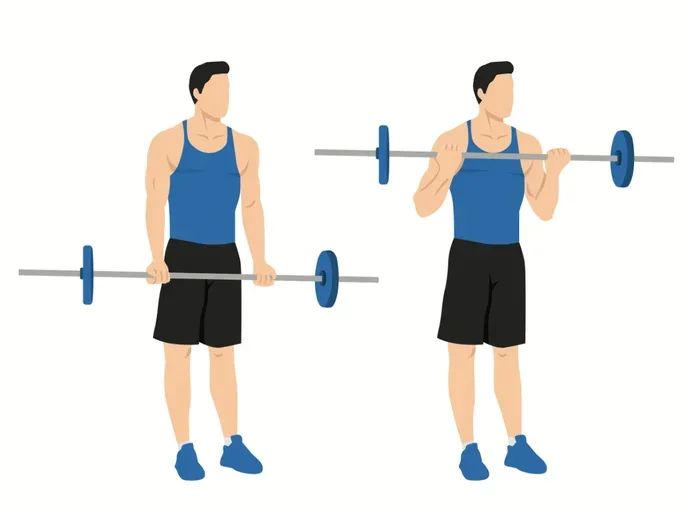
Step-by-Step Barbell Curl Form
- Stand tall with your feet shoulder-width apart. Hold a barbell with an underhand grip, hands slightly wider than shoulder-width.
- Keep your elbows pinned to your sides. They should not flare out as you curl.
- Curl the bar up toward your shoulders by flexing at the elbow. Squeeze your biceps at the top.
- Lower the bar slowly back to the starting position. Control the eccentric phase for at least two to three seconds.
- Repeat for the desired number of reps without swinging or using momentum.
Common Form Mistakes to Avoid
- Swinging the body: Using momentum takes the work away from your biceps. Keep your torso still.
- Flaring elbows: Letting your elbows drift forward shifts the workload to your shoulders and reduces bicep activation.
- Partial reps: Only curling halfway means you miss the full stretch and contraction. Go through the full range of motion.
- Using too much weight: Heavy weights with poor form lead to injury and less muscle growth. Choose a weight you can control.
If you want to explore more about the specific muscles activated during curls, check out which head of the bicep barbell curls target for an in-depth look at muscle focus.
Benefits of Barbell Curls for Bicep Growth
Barbell curls are a staple in bicep workouts for good reason. They offer a range of benefits that make them one of the best exercises for building bigger arms. Here is why you should keep this movement in your routine.
1. Heavy Loading Potential
Unlike dumbbells, a barbell allows you to lift heavier weights because both arms move together. This heavy resistance is excellent for building muscle strength and size. The ability to load up the bar means you can progressively overload your biceps over time, which is the key driver of hypertrophy.
2. Balanced Arm Development
Because both arms work equally on a barbell, you naturally correct imbalances. If your left arm is weaker than your right, the barbell forces both sides to share the load evenly. This leads to more symmetrical arm development over time.
3. Full Range of Motion
A barbell curl allows a deep stretch at the bottom and a full squeeze at the top. This full range of motion is crucial for muscle growth. Studies show that training a muscle through its full stretch and contraction leads to greater hypertrophy than partial reps.
4. Simple and Accessible
You do not need fancy equipment or a gym membership to do barbell curls. A straight bar and a set of weights are all you need. This makes the exercise incredibly accessible for home workouts and gym sessions alike.
Barbell Curl Variations to Target Different Bicep Heads
If you want to mix up your routine and target specific parts of the bicep, variations are your best friend. Changing even one small detail can shift the focus entirely. Here are some effective variations to try.
Close-Grip Barbell Curl
A close grip places the hands closer together, which shifts more emphasis onto the long head of the bicep. This variation is great for building that peaked bicep shape. Keep your elbows close to your body and focus on a slow, controlled tempo.
Wide-Grip Barbell Curl
A wider grip shifts the focus more toward the short head of the bicep. This variation adds width and fullness to the front of your arm. It also places slightly more emphasis on the brachialis muscle.
Preacher Barbell Curl
Performing barbell curls on a preacher bench removes momentum completely. Your upper arms are supported, so the biceps do all the work. This is one of the best isolation exercises for peak bicep activation. It is especially effective for targeting the long head because the arm is in a stretched position throughout the movement.
Incline Barbell Curl
Performing curls on an incline bench puts your arms behind your body at the start. This stretches the long head under load, which is one of the most effective ways to build the outer bicep peak. If you want to focus on the long head specifically, this is a top choice.
For more details on how different curl variations target specific bicep heads, what part of the bicep does barbell curls work 2 covers the topic in great depth.
How to Program Barbell Curls for Best Results
Knowing what part of bicep does barbell curl work is only half the battle. You also need to train smart with the right volume, frequency, and intensity. Here is how to program barbell curls into your routine for optimal results.
Recommended Sets and Reps
- Hypertrophy: 3 to 4 sets of 8 to 12 reps. This is the sweet spot for muscle growth.
- Strength: 4 to 5 sets of 4 to 6 reps with heavier weight. Focus on controlled, explosive reps.
- Endurance: 3 sets of 15 to 20 reps with lighter weight. Great for building muscle definition.
Training Frequency
Train your biceps two to three times per week for optimal growth. Make sure you leave at least 48 hours between sessions to allow for recovery. Your biceps are a smaller muscle group, so they do not need as much volume as your legs or back.
Progressive Overload
The key to continuous bicep gains is progressive overload. This means gradually increasing the weight, reps, or sets over time. Keep a training log and aim to add a small increment of weight or one extra rep each week.
Barbell Curls vs Other Bicep Exercises
Barbell curls are excellent, but how do they compare to other popular bicep exercises? Here is a quick comparison to help you decide what belongs in your routine.
| Exercise | Primary Target | Equipment Needed | Best For |
|---|---|---|---|
| Barbell Curl | Biceps brachii (both heads) | Barbell and weights | Overall bicep size and strength |
| Dumbbell Curl | Biceps brachii (each arm independently) | Dumbbells | Fixing arm imbalances |
| Hammer Curl | Brachialis and brachioradialis | Dumbbells | Arm thickness and forearm size |
| Preacher Curl | Long head of bicep | Barbell or EZ bar | Isolation and peak contraction |
| Concentration Curl | Short head of bicep | Dumbbell | Peak definition and shape |
Each exercise has its place. The barbell curl stands out for its ability to load the biceps heavily and hit both heads at once. It is the foundation of any solid bicep training program.
Quick Tips to Maximize Your Barbell Curls
- Use a slow tempo: Take three seconds to lower the bar. This increases time under tension and boosts muscle activation.
- Squeeze at the top: Hold the peak contraction for one to two seconds. This intensifies the work on the bicep.
- Keep your wrists straight: Avoid bending your wrists backward or forward. A neutral wrist position protects the joints.
- Breathe properly: Exhale as you curl up and inhale as you lower the bar.
- Warm up first: Do a few light reps before going heavy. This prepares the joints and reduces injury risk.
Common Mistakes That Limit Your Bicep Gains
Even if you have been doing barbell curls for years, small mistakes can hold you back. Here are the most common errors and how to fix them.
Using Too Much Weight
Lifting too heavy leads to cheating. Your body starts to swing, and your shoulders take over. The result is less bicep activation and a higher risk of injury. Drop the weight and focus on clean, controlled reps instead.
Skipping the Eccentric Phase
The lowering phase of the curl is just as important as the lifting phase. The eccentric portion causes more muscle damage, which is a key trigger for growth. Slow down on the way down and feel the stretch in your biceps.
Neglecting the Brachialis
Your brachialis muscle sits underneath the bicep. Training it makes your biceps look bigger and more pronounced. Hammer curls and reverse curls are excellent for brachialis development. Pair them with your barbell curls for balanced arm growth.
For a deeper look at the muscles worked during curls, what part of the bicep do barbell curls work provides additional insights on secondary muscle engagement.
Expert Insights on Barbell Curls
We spoke with certified strength coaches about the best ways to use barbell curls for bicep development. Here is what the experts had to say.
Focus on the mind-muscle connection: “The biggest mistake lifters make is going through the motions,” says coach Mike Matthews. “You need to feel your biceps working on every single rep. If you are not feeling the burn, check your form and reduce the weight.”
Vary your angles: “The bicep is a two-headed muscle, and no single exercise hits both heads equally,” explains strength specialist Jeff Nippard. “Mixing barbell curls with different variations ensures complete development.”
Prioritize recovery: “Biceps recover quickly, but they still need rest,” adds trainer Chris Heria. “Two to three sessions per week is plenty. More is not always better.”
For additional expert guidance on the long head specifically, what head of the bicep do barbell curls work offers a detailed breakdown of long head targeting strategies.
Final Thoughts
So, what part of bicep does barbell curl work? The answer is clear, barbell curls are one of the most effective exercises for building your entire bicep, including the long head, short head, brachialis, and brachioradialis. They offer heavy loading potential, balanced development, and a full range of motion that few other exercises can match.
The key is to use proper form, vary your grip and angle, and train with purpose. Whether you are aiming for size, strength, or definition, barbell curls should be a staple in your routine. Apply the tips and techniques from this guide, stay consistent, and you will see real results in your bicep development.
Start incorporating these strategies into your next arm day and feel the difference. Your biceps will thank you.
Frequently Asked Questions
What part of the bicep do barbell curls work?
Barbell curls primarily work the biceps brachii, targeting both the long head and short head. They also engage the brachialis and brachioradialis as secondary muscles. The exact emphasis depends on your grip width and form.
Do barbell curls work the long head or short head of the bicep?
Barbell curls work both heads effectively. The long head is more activated during the stretched position at the bottom of the curl, while the short head fires harder during the contracted position at the top. Changing your grip width can shift the emphasis between the two heads.
Are barbell curls better than dumbbell curls for bicep growth?
Both exercises are excellent for bicep growth. Barbell curls allow you to lift heavier weight, which is great for overall size. Dumbbell curls let each arm work independently, which helps fix imbalances. The best approach is to include both in your routine.
How many sets of barbell curls should I do per week?
For optimal bicep growth, aim for 10 to 14 total sets per week, spread across two to three sessions. Start with 3 to 4 sets per session and adjust based on your recovery and progress. Quality reps matter more than quantity.
Can barbell curls build bigger arms?
Yes, barbell curls are one of the most effective exercises for building bigger arms. They target the biceps directly and allow for heavy progressive overload. Combine them with a balanced arm routine and proper nutrition for the best results.
What is the best grip for barbell curls to target the bicep?
A standard supinated (underhand) grip with hands shoulder-width apart is the most effective for bicep activation. A slightly narrower grip shifts more focus to the long head, while a wider grip emphasizes the short head. Keep your wrists straight throughout the movement.
=== CONCLUSION ===
What part of bicep does barbell curl work is a question with a clear and comprehensive answer. The barbell curl targets the entire biceps brachii, including both the long and short heads, while also engaging the brachialis and brachioradialis. This makes it one of the most efficient and effective bicep exercises available.
By understanding the bicep anatomy, using proper form, and applying the programming tips in this guide, you can maximize every workout. Remember to vary your grip, control your tempo, and progressively overload your muscles over time. The barbell curl is a timeless exercise that belongs in every arm workout routine. Start applying these strategies today and watch your bicep development reach the next level.