Determining a good walking pace on a treadmill is highly personal and depends on your age, fitness level, and specific goals like weight loss or cardiovascular health. It’s not about keeping up with others but finding a speed that challenges you while allowing you to maintain proper form and hold a conversation. This guide breaks down the science, provides target ranges, and offers practical tips to help you find your ideal, sustainable pace safely and effectively.
Key Takeaways
- Your “good” pace is unique: There is no universal standard; it’s determined by your individual fitness, age, and objectives.
- The “Talk Test” is a crucial gauge: A sustainable walking pace should allow you to speak in full sentences with moderate breathlessness.
- Incline dramatically changes the demand: Walking at 3.0 mph with a 5% incline is far more challenging than 3.5 mph on a flat surface.
- Start conservatively and progress: Begin at a pace that feels easy and gradually increase speed or duration to avoid injury and build endurance.
- Metrics are tools, not dictators: Use heart rate zones and perceived exertion alongside speed to get a complete picture of your effort.
- Treadmill walking differs from outdoor: The moving belt requires slightly different mechanics; prioritize good posture and a natural stride.
- Consistency trumps intensity: A moderate pace you can maintain regularly is far more beneficial for long-term health than sporadic high-intensity efforts.
📑 Table of Contents
- Finding Your Perfect Rhythm: It’s Not One-Size-Fits-All
- Decoding “Pace”: Speed, Intensity, and Perceived Effort
- Personalized Pace Ranges: By Age and Fitness Goal
- Treadmill vs. Outdoor Walking: Why the Numbers Lie
- Safety First: How to Find and Test Your Pace Without Risk
- Common Mistakes That Sabotage Your Pace (and How to Fix Them)
- Putting It All Together: Your Action Plan
Finding Your Perfect Rhythm: It’s Not One-Size-Fits-All
You step onto the treadmill, set the belt in motion, and that digital display blinks back at you: 2.5, 3.0, 3.5… miles per hour. The question immediately arises: “What is a good walking pace on a treadmill?” It’s a deceptively simple question with a deeply personal answer. Unlike a standardized test, there’s no “passing” speed. A good pace is the one that aligns with your body, your health profile, and your specific reason for lacing up your sneakers. For a beginner recovering from an injury, a good pace might be a deliberate 2.0 mph. For a seasoned athlete using walking as active recovery, it might be a swift 4.0 mph. The key is understanding the variables and listening to your body’s feedback, not just the machine’s numbers.
This guide will navigate you through the maze of factors that define an effective treadmill walking pace. We’ll move beyond generic charts and explore how age, fitness goals, and even the machine’s incline interact to create your individual “sweet spot.” We’ll provide practical frameworks like the Talk Test and heart rate zones to help you self-assess in real-time. Ultimately, the goal is to empower you to walk with purpose, confidence, and safety, transforming your treadmill sessions from a monotonous chore into a precisely calibrated part of your wellness routine.
Decoding “Pace”: Speed, Intensity, and Perceived Effort
Before we dive into numbers, we must clarify what “pace” really means in the context of exercise. On a treadmill, pace is simply speed, measured in miles per hour (mph) or kilometers per hour (km/h). However, the speed reading alone tells an incomplete story. A 3.0 mph walk on a 0% incline is a light stroll. A 3.0 mph walk on a 10% incline is a serious leg-burning climb. Therefore, a “good” pace must be considered in tandem with two other critical factors: incline and perceived exertion.
Visual guide about What Is a Good Walking Pace on a Treadmill
Image source: marathonhandbook.com
The Incline Multiplier
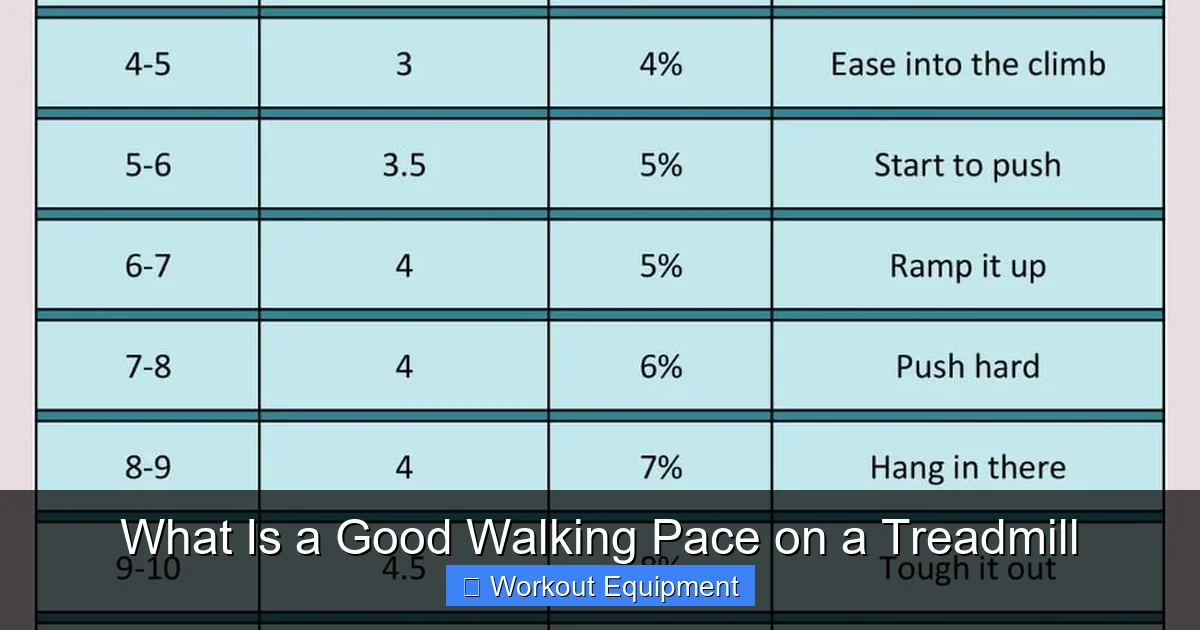
Adding an incline increases the workload exponentially. It engages more muscle groups—glutes, hamstrings, calves—and significantly elevates your heart rate. You can achieve a cardiovascular workout at a much slower speed with a moderate incline than you can on a flat surface. This is excellent news for those with joint sensitivities, as it allows for high-intensity effort with lower impact. When evaluating your pace, always glance at the incline setting. A “good” pace on a 4% grade is fundamentally different from a “good” pace on a 1% grade.
The Gold Standard: The Talk Test
For the vast majority of walkers, especially those focused on general health, weight management, or building endurance, the simplest and most effective tool is the Talk Test. Here’s how it works:
- Can sing a song comfortably? You are likely in a very light, warm-up or recovery zone (intensity level 1-2).
- Can hold a full conversation with ease, with only slightly deeper breathing? You are in a moderate, sustainable, “good” aerobic zone (intensity level 3-4). This is the prime target for most fitness walkers.
- Can speak only in short, broken sentences, with significant breathlessness? You are in a vigorous, high-intensity zone (intensity level 5+). This is excellent for interval training but is not sustainable for long, steady-state walks.
A good walking pace on a treadmill for most people is one that lands them firmly in the “can talk, but not sing” category. If you’re gasping for air after every sentence, your pace is too fast. If you can belt out a tune without breaking a sweat, you can likely push a bit harder.
Personalized Pace Ranges: By Age and Fitness Goal
While self-assessment is paramount, general guidelines can provide a helpful starting point. These are not rigid rules but common reference ranges observed across populations. Always use them as a launchpad, not a destination.
Visual guide about What Is a Good Walking Pace on a Treadmill
Image source: lovelifebefit.com
General Pace Guidelines by Age Group (on 0-1% Incline)
These ranges assume a moderate, sustainable effort (Talk Test: conversation possible).
- 20s-30s (Generally Active Adults): 3.5 – 4.5 mph. Many in this demographic have a natural gait that falls in this range for a brisk, fitness-focused walk.
- 40s-50s: 3.0 – 4.0 mph. Metabolism may begin to shift slightly, and joint health becomes a more prominent consideration for some, making a slightly slower, deliberate pace common.
- 60s and Above: 2.5 – 3.5 mph. The focus for older adults is often on stability, balance, and sustained movement. A pace that promotes good posture and safety is ideal. An incline can be added for intensity without increasing impact speed.
- Absolute Beginners / Post-Rehab: 1.5 – 2.5 mph. The primary goal here is movement and building confidence. Form and consistency are 100x more important than speed.
Goal-Specific Pace Adjustments
Your primary objective should dictate your strategy.
- For Weight Loss & Calorie Burn: Don’t just chase speed. Duration and total energy expenditure are key. A moderate pace (e.g., 3.2 mph) for 45-60 minutes will often burn more total calories than a very fast pace (e.g., 4.0 mph) for 20 minutes. Adding incline is the most efficient way to boost calorie burn per minute without increasing joint stress. Aim for a pace that lets you walk longer.
- For Cardiovascular Health (Building Aerobic Capacity): You need to spend time in your target heart rate zone (typically 60-80% of max HR). This often corresponds to the higher end of the moderate pace range or the lower end of the vigorous range. For many, this means 3.5-4.2 mph on a flat surface, or a slower speed with a 3-5% incline. Use a heart rate monitor to confirm.
- For Stress Reduction & Mental Wellness: Here, the “good” pace is the one that feels meditative and enjoyable. It’s often on the slower side (2.5-3.2 mph), allowing you to disconnect, listen to a podcast, or enjoy the view on a console. The goal is sustainable, stress-free movement.
- For Active Recovery / Low-Impact Cross-Training: This is a very easy, conversational pace (2.0-3.0 mph), possibly with a very slight incline (1-2%). The purpose is to promote blood flow without taxing the system. Speed is irrelevant; gentle movement is the goal.
Treadmill vs. Outdoor Walking: Why the Numbers Lie
If you’re used to walking outside, you might be confused when your “normal” outdoor pace feels different on a treadmill. There are biomechanical reasons for this.
Visual guide about What Is a Good Walking Pace on a Treadmill
Image source: i.pinimg.com
The Belt Effect and Stride
On a treadmill, the belt moves under you. This subtly changes your gait. Many people unconsciously shorten their stride and increase their stride frequency (cadence) to keep up with the moving belt. This can feel faster and more effortful at a given speed compared to walking outdoors, where you propel yourself forward over a stationary surface. Additionally, there’s no wind resistance or terrain variation outdoors. A 0% treadmill incline is actually easier than typical outdoor ground, which has a slight natural grade. Many experts suggest setting your treadmill to a 1% incline to better simulate the energy cost of outdoor walking on flat ground.
Psychological Factors
The monotony of a treadmill can also distort perception. Without changing scenery, you become hyper-aware of the speed display and your own breathing. A 3.0 mph walk can feel interminably slow indoors but feel like a normal pace on a pleasant outdoor path. This means your perceived exertion (how hard it feels) might be higher on the treadmill at the same speed. Be prepared to adjust your pace downward slightly when first transitioning to treadmill walking until you acclimate to the unique mechanics.
Safety First: How to Find and Test Your Pace Without Risk
Experimenting with speed is essential, but it must be done safely. Jumping into a pace that’s too fast is a direct ticket to shin splints, knee pain, or worse.
The Warm-Up Walk is Non-Negotiable
Always start with at least 5 minutes of walking at a very slow pace (1.5-2.0 mph) on a flat or slight incline. This warms up your muscles, tendons, and joints, and gets your cardiovascular system primed. Your warm-up pace should feel effortless.
The Incremental Test: Your Personal Pace Finder
Here is a simple, safe protocol to find your current good walking pace:
- Set Up: Treadmill at 0% incline. Start at 2.0 mph.
- Walk for 3 minutes: Get a feel for it. Is it comically slow? That’s fine.
- Increase by 0.2-0.3 mph: Every 2-3 minutes, press the up arrow. Continue this until you reach a speed where:
- Your breathing is deep but controlled (Talk Test: you can speak in full sentences).
- Your posture is upright—no leaning on the console or holding on tightly.
- Your stride feels natural, not choppy or frantic.
- Identify Your Zone: Note the speed where you feel you are working “moderately.” That is likely your current good, sustainable walking pace. If you can only speak in gasps at 3.8 mph, your good pace might be 3.4 mph. That’s okay! That is your number.
Posture and Form Are Paramount
A good pace is undermined by poor form. Focus on:
- Looking ahead: Keep your gaze forward, not down at your feet or the console.
- Relaxed shoulders: Keep them down and back, not hunched.
- Natural arm swing: Let your arms swing gently at your sides, bent at about 90 degrees. Do not hold the console unless necessary for balance; it ruins your gait and burns fewer calories.
- Mid-foot strike: Aim to land on the middle of your foot and roll through to your toe. Avoid heavy heel-first striking.
If you need to hold the console for balance, your pace is too fast, or your balance needs work. Reduce the speed until you can walk hands-free with confidence.
Common Mistakes That Sabotage Your Pace (and How to Fix Them)
Even with the best intentions, walkers often fall into patterns that make their pace ineffective or unsafe.
Mistake 1: The Speed Chaser
Feeling pressured to match the person next to you or to hit a specific mph number on the display. Fix: Cover the display with a towel after you start. Walk by feel and the Talk Test. Uncover it only after 10-15 minutes to see what speed you landed on. You might be surprised it’s lower (and more appropriate) than you thought.
Mistake 2: Ignoring Incline
Walking only on a flat surface at a moderate speed provides good cardiovascular exercise but misses out on the strength and metabolic benefits of incline. Fix: Incorporate incline intervals. After your warm-up, try 2-3 minute intervals where you increase the incline to 4-6% while maintaining or even slightly reducing your speed. Your heart rate will soar, and your glutes will thank you.
Mistake 3: Using the Handrails to Support Body Weight
Leaning on the front console or gripping the handrails shifts your weight, reduces the work your legs do, burns fewer calories, and promotes poor posture. Fix: Only use the rails for balance during the first minute or if you feel truly unstable. Your hands should be at your sides, swinging naturally. If you feel you must hold on, your pace is too fast for your current balance ability.
Mistake 4: Sticking to the Same Pace Forever
Your body adapts. A pace that felt challenging three months ago is now easy. Fix: Apply the principle of progressive overload. Every 2-4 weeks, try one of the following: increase your pace by 0.1-0.2 mph for your entire walk, add 5 minutes to your duration, or increase your average incline by 0.5-1%. Small, consistent changes drive continued improvement.
Putting It All Together: Your Action Plan
So, how do you synthesize all this into a simple, actionable plan? Follow these steps for your next treadmill session.
- Define Your Primary Goal for Today’s Walk: Is it stress relief? Cardio? Active recovery? This sets your intensity intention.
- Warm-Up (5 min): Very slow pace (2.0 mph), 0% incline. Gentle arm circles, shoulder rolls.
- Find Your Working Pace: Using the incremental test method, find a speed where you can talk comfortably. Note this speed. This is your baseline “good pace.”
- Incorporate Your Goal:
- For general fitness/weight loss: Settle into your baseline pace for 20-40 minutes. Consider adding 2-3 x 3-minute intervals at a 4-5% incline, dropping speed by 0.3-0.5 mph if needed to maintain the Talk Test.
- For cardio focus: Aim for the higher end of your conversational pace. You should be able to speak only in short phrases. Try to maintain this for 20-30 minutes.
- For stress relief: Pick a pace on the lower end of your range. Put on an audiobook or calming music and just move. Duration is more important than speed here.
- Cool Down (5 min): Reduce speed back to your warm-up pace. Stretch your calves, hamstrings, and hip flexors after you step off.
Remember, a good walking pace on a treadmill is a dynamic target. It will change with your fitness, your energy levels on a given day, and your life stage. The real victory is not in hitting a specific number, but in understanding your body’s signals and moving in a way that serves your long-term health and enjoyment. The treadmill is a tool—your awareness is the operator. Use it wisely, start where you are, and walk consistently. That is the true definition of a good pace.
Frequently Asked Questions
Is a 3.0 mph pace on a treadmill too slow?
Not at all. For beginners, older adults, or those prioritizing gentle movement and stress relief, 3.0 mph is an excellent, sustainable pace. Its value is determined by your goals and ability to maintain it with good form. With a moderate incline, 3.0 mph can provide a very challenging workout.
How does adding incline affect my walking pace?
What’s a good walking pace for weight loss on a treadmill?
The best pace for weight loss is one you can sustain for a longer duration (30-60 minutes). For most people, this is a moderate pace of 3.2-3.8 mph where you can still hold a conversation. Prioritizing time and consistency at this pace, or adding incline intervals to boost calorie burn, is more effective than a short, very fast walk.
Should I hold the handrails while walking on a treadmill?
You should only use the handrails for balance during the first minute or if you feel unstable. Leaning on them reduces the work your legs do, burns fewer calories, and promotes poor posture. Aim to walk with your hands at your sides, swinging naturally. If you feel you need to hold on, your pace is likely too fast.
How do I know if my treadmill walking pace is too fast?
The clearest sign is failing the Talk Test—you can only speak in single, gasping words. Other signs include: needing to hold the rails for support, a bouncing or choppy stride, or feeling extreme fatigue in your shins or calves within the first 5-10 minutes. If these occur, reduce your speed by 0.2-0.5 mph.
Is walking on a treadmill the same as walking outside?
No. The moving belt alters your gait slightly, and there is no wind resistance. A 0% treadmill incline is easier than typical outdoor terrain. To better simulate outdoor walking, set your treadmill to a 1% incline. You may also find that a given speed feels more effortful indoors due to the monotony and lack of visual cues for pace.