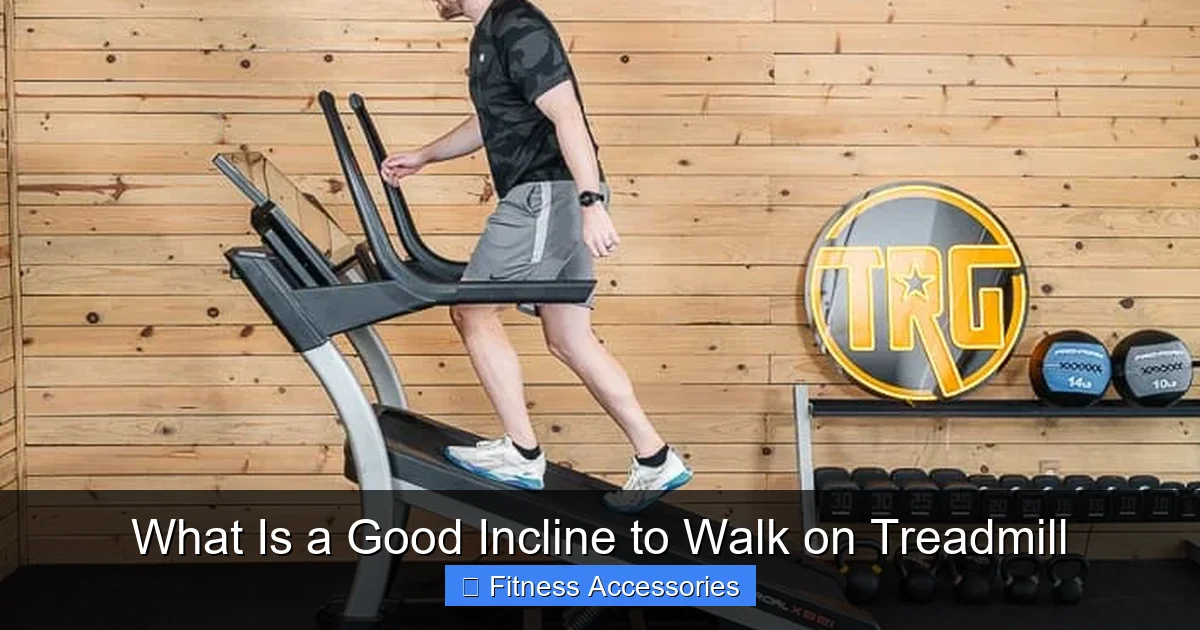
What Is a Good Incline to Walk on Treadmill
Finding the right treadmill incline is personal and goal-dependent. There’s no single “best” number for everyone. A good starting point for most beginners is a 1-3% incline, which mimics outdoor terrain and reduces joint impact. For weight loss and intensity, progressively increasing to 4-8% is effective. The key is to prioritize proper form, listen to your body, and gradually adjust the incline to match your fitness level and specific objectives, whether that’s building endurance, strengthening glutes, or protecting your knees.
Let’s be honest: staring at a treadmill’s console, you see a bunch of numbers for speed and incline. You know speed. You set it to 3.0, 3.5, 4.0 miles per hour. But that incline slider or percentage button? That’s a mystery box. What is a good incline to walk on treadmill? Is 2% a lot? Should you be grinding away at 10%? The truth is, the “perfect” incline isn’t a one-size-fits-all magic number. It’s a powerful, adjustable tool that, when used correctly, can transform your walk from a simple stroll into a full-body, calorie-torching, joint-protecting workout. This guide will cut through the confusion. We’ll break down exactly what those incline percentages mean, how to find the right starting point for *your* body, and how to strategically use incline to smash your specific fitness goals, all while staying safe and strong.
Key Takeaways
- Start Low and Slow: Begin with a 1-3% incline if you’re new to treadmill walking. This slight grade simulates natural outdoor walking and is joint-friendly.
- Your “Good” Incline is Goal-Specific: The ideal percentage changes based on whether your primary aim is weight loss, muscle building, endurance, or rehabilitation.
- Form is Non-Negotiable: A higher incline is only beneficial with correct posture—stand tall, engage your core, and avoid holding the handrails.
- Progressive Overload is Key: To see results, you must gradually increase the incline (or speed/time) as your fitness improves. Don’t stay on the same setting forever.
- Listen to Your Body, Not Just the Number: Discomfort in muscles is expected; sharp joint pain is a sign to stop or reduce the incline. Your personal “good” incline may differ from a generic chart.
- Incline Complements, Doesn’t Replace, Other Training: Use incline walking as part of a balanced routine that includes strength training, flat-ground cardio, and flexibility work.
📑 Table of Contents
- The Power of the Incline: Why Walking Uphill Matters
- Decoding Treadmill Incline: What Do the Percentages Mean?
- Finding Your “Good” Incline: A Personalized Approach
- Sample Treadmill Incline Workouts for Every Goal
- Safety First: The Non-Negotiable Rules of Incline Walking
- Conclusion: Your Journey to the Perfect Incline
The Power of the Incline: Why Walking Uphill Matters
Before we talk numbers, let’s talk about *why* the incline setting is so revolutionary for your treadmill workouts. Walking on a flat surface is great, but adding an incline fundamentally changes the exercise’s demands on your body.
It’s a Full-Body Experience
On a 0% grade, your walk is primarily a lower-body, cardiovascular exercise focused on the quadriceps and calves. As soon as you raise the incline, you recruit a whole new set of muscles. Your glutes (buttocks) and hamstrings fire up dramatically to propel you upward. Your calves work harder. Even your core—your abs and lower back—must engage intensely to stabilize your torso against the pull of gravity. This turns a simple walk into a comprehensive strength and endurance builder for your posterior chain, which is crucial for posture, balance, and functional movement in daily life.
Massive Calorie Burn Without the Joint Shock
This is the big one for many people. Increasing the incline significantly raises your heart rate and energy expenditure. A study from the American Council on Exercise (ACE) found that walking at a 10% incline can burn nearly twice as many calories per mile as walking on a flat surface at the same speed. But here’s the beautiful part: unlike running, which pummels your joints with impact forces of 2-3 times your body weight, incline walking is low-impact. The controlled, pushing motion is much gentler on knees, hips, and ankles. This makes it an ideal strategy for weight loss for those with joint concerns, older adults, or anyone recovering from injury.
Mimicking Real-World Terrain
Unless you live in a perfectly flat state, your outdoor walks likely have hills. Training on an incline prepares your body for real-life terrain. It builds the specific muscular endurance needed to tackle that steep hill on your favorite hiking trail or the parking garage ramp without feeling winded. It also improves your cardiovascular capacity more efficiently than flat walking alone.
Metabolic and Cardiovascular Boost
Walking uphill forces your heart and lungs to work harder to supply oxygen to your working muscles. This strengthens your heart muscle, improves lung capacity, and increases your overall VO2 max (the maximum amount of oxygen your body can utilize during exercise). Over time, this makes everyday activities feel easier and lowers your risk of heart disease.
So, with all these benefits, how do you tap into them? It starts with understanding what the incline numbers actually represent.
Decoding Treadmill Incline: What Do the Percentages Mean?
Treadmill incline is expressed as a percentage, which represents the angle of the belt relative to the horizontal floor. A 0% incline is perfectly flat. A 1% incline means for every 100 horizontal units you travel, you gain 1 unit of vertical elevation. It’s a ratio, not a steepness measurement in degrees.

Visual guide about What Is a Good Incline to Walk on Treadmill
Image source: s.abcnews.com
Here’s a practical way to visualize common percentages:
- 0%: Completely flat. Equivalent to walking on a perfectly level indoor track.
- 1-3%: A very gentle, barely noticeable slope. This is often called a “recovery” or “active” incline. It’s what you’d experience on a very mild, rolling hill. It’s the ideal starting zone for most beginners.
- 4-6%: A noticeable, steady incline. You’ll feel this in your calves and glutes after a few minutes. This is the “work” zone for many fitness walkers aiming for calorie burn and muscle engagement.
- 7-10%: A steep, challenging grade. Walking here is demanding. Your heart rate will climb quickly, and your glutes and hamstrings will burn. This is advanced and often used for short intervals.
- 10%+: Very steep, approaching a mountain hike grade. Sustained walking at this incline is extremely strenuous and is typically reserved for very fit individuals or specific interval training bursts.
A common misconception is that 1% is “nothing.” In reality, a consistent 1-2% incline is one of the most impactful and sustainable adjustments you can make to your routine, offering significant benefits over flat walking with minimal extra perceived effort. The jump from 0% to 5% is where the real “work” begins for most people.
Finding Your “Good” Incline: A Personalized Approach
Now, to the core question: what is a good incline for *you*? The answer depends on three pillars: your current fitness level, your primary goal, and any physical considerations (like joint issues). Let’s build your personal incline profile.

Visual guide about What Is a Good Incline to Walk on Treadmill
Image source: medicdrug.org
For the Absolute Beginner or Rehabilitative Walker
If you are new to exercise, returning after a long break, or managing a condition like mild knee osteoarthritis, your “good” incline is very low. Start at 0% for 5-10 minutes to warm up thoroughly. Then, experiment with a 1% incline for 2-3 minutes. How does it feel? If it feels like a natural, comfortable increase in effort without any pain or excessive breathlessness, that’s your sweet spot. Your goal here is movement quality and consistency, not intensity. A 1-2% incline is often recommended by physical therapists because it reduces the braking force on the knee joint compared to flat walking, while still providing a mild strengthening stimulus. You might spend several weeks or months at this gentle grade before considering an increase.
For Weight Loss and General Fitness
If your main goal is to burn calories, improve cardiovascular health, and build lean muscle, you need to be in the “challenge” zone. Here, a good incline typically falls between 3% and 6%. This range provides a substantial increase in metabolic demand without requiring you to run. For example, a 150-pound person walking at 3.5 mph:
- At 0% incline: ~267 calories burned per hour
- At 4% incline: ~356 calories burned per hour
- At 6% incline: ~425 calories burned per hour
Start your workout with a 5-minute warm-up at 0-1%. Then, settle into your “working” incline. Try 4% for 20 minutes. The next week, try 4.5% for 20 minutes. The key is progressive overload—small, weekly increases in either the incline percentage, the duration you hold it, or your speed. A good benchmark is being able to hold a conversation in short sentences (the “talk test”) during your working interval. If you’re gasping, the incline might be too high for the duration; if it’s too easy, nudge it up by 0.5-1%.
For Glute and Hamstring Activation (The “Booty Burn”)
Want to feel the burn in your backside? You need to target a higher incline range, typically 6% to 10%. At these steeper grades, your body must powerfully extend the hip to push yourself upward, which is the primary function of the glutes and hamstrings. To maximize this effect:
- Slow Down: Drop your speed to 2.5-3.0 mph. A slow, controlled, powerful push is far more effective for muscle activation than a fast, shaky stride.
- Focus on Push-Off: Consciously drive through your heel and squeeze your glutes at the top of each step.
- Short Intervals: You likely won’t sustain 8% for 30 minutes. Instead, do intervals: 2 minutes at 8%, 2 minutes at 2% to recover. Repeat 5-8 times.
This is advanced muscular endurance training. Ensure your form is impeccable before attempting high-incline intervals.
For Endurance and Cardiovascular Conditioning
Building stamina for long walks, hikes, or races requires sustained effort. Your “good” incline here is more about consistency and time under tension than maximal steepness. You might use a moderate 3-5% incline for extended periods (30-60 minutes) at a pace you could theoretically maintain for hours. This builds the specific endurance of your heart, lungs, and leg muscles for prolonged uphill effort. You can also use the “pyramid” method: start at 2%, increase by 1% every 5 minutes up to 6%, then decrease back down. This systematically stresses and improves your aerobic system.
For Joint Protection and Low-Impact Cardio
This is for individuals with knee, hip, or ankle issues. The paradox is that a *slight* incline can be *more* protective than a flat surface. On a flat treadmill, your heel strike creates a “braking force” that sends a jolt up the leg. A 1-2% incline encourages a more mid-foot strike and a smoother, more rolling motion, reducing that jarring impact. Your “good” incline is the lowest grade that still feels like a legitimate workout—often 1.5% to 2.5%. Combine this with a slower speed (2.0-2.5 mph) and focus on a long, fluid stride. The calorie burn will be lower, but the cardiovascular and mobility benefits with minimal joint stress are invaluable.
Sample Treadmill Incline Workouts for Every Goal
Knowing the theory is one thing; applying it is another. Here are three structured workouts that translate the principles into action. Always begin with a 5-minute warm-up at 0-1% incline and a slow, comfortable pace. End with a 5-minute cool-down.

Visual guide about What Is a Good Incline to Walk on Treadmill
Image source: rusticaly.com
Workout 1: The Foundational Fat Burner (Beginner to Intermediate)
Goal: Sustainable calorie burn and cardiovascular improvement.
Incline Strategy: Steady-state in the 3-5% range.
Duration: 30 minutes total.
- Minutes 0-5: Warm-up. Walk at 2.5 mph, 0% incline.
- Minutes 5-7: Increase incline to 3%. Maintain pace.
- Minutes 7-25: Working Set: Hold at 3.5% incline. Adjust your speed (between 3.0-3.5 mph) so you are breathing heavily but can speak in short phrases. This is your “sweet spot.”
- Minutes 25-27: Reduce incline to 1%. Keep pace.
- Minutes 27-30: Cool-down. Return to 0% incline, slow pace.
Progression: Each week, try adding 1-2 minutes to your “Working Set” or increasing the incline by 0.5%.
Workout 2: The Glute & Hamstring Builder (Intermediate to Advanced)
Goal: Maximize posterior chain muscle engagement.
Incline Strategy: High-incline intervals.
Duration: 25 minutes total.
- Minutes 0-5: Warm-up. Walk at 2.8 mph, 0% incline.
- Minutes 5-7: Increase incline to 6%. Reduce speed to 2.8 mph. Feel the push.
- Minutes 7-9: Interval 1: Hold 6% incline. Focus on powerful heel pushes and glute squeezes.
- Minutes 9-11: Recovery: Drop incline to 1.5%. Speed to 3.2 mph. Let your legs recover.
- Minutes 11-13: Interval 2: Incline 7%. Speed 2.8 mph.
- Minutes 13-15: Recovery: Incline 1.5%. Speed 3.2 mph.
- Minutes 15-17: Interval 3: Incline 8%. Speed 2.8 mph.
- Minutes 17-19: Recovery: Incline 1.5%. Speed 3.2 mph.
- Minutes 19-21: Interval 4: Incline 7%. Speed 2.8 mph.
- Minutes 21-23: Recovery: Incline 1.5%. Speed 3.2 mph.
- Minutes 23-25: Cool-down. 0% incline, gradually slowing pace.
Note: The speed during high-incline intervals is deliberately slow. This is about muscle time under tension, not cardio speed.
Workout 3: The Low-Impact Joint Protector (All Levels, Especially with Joint Concerns)
Goal: Cardiovascular health and mobility with zero joint pain.
Incline Strategy: Very gentle, sustained incline.
Duration: 40 minutes total.
- Minutes 0-10: Warm-up. Walk at a comfortable pace (2.0-2.5 mph), 0% incline.
- Minutes 10-12: Increase incline very slowly to 1.5%.
- Minutes 12-35: Main Set: Hold at a 2% incline. Your pace should be brisk but controlled (2.5-3.0 mph). Focus on long, smooth strides, landing mid-foot. Your heart rate should be elevated but comfortable.
- Minutes 35-37: Reduce incline to 0.5%.
- Minutes 37-40: Cool-down. 0% incline, very slow pace.
Key: The entire focus is on pain-free movement. If you feel any joint discomfort (not muscle fatigue), reduce the incline by 0.5% immediately.
Safety First: The Non-Negotiable Rules of Incline Walking
Using incline incorrectly can lead to injury or wasted effort. These rules are universal.
Master the Form Before You Add Incline
Your posture is your foundation. Never add significant incline if your flat-ground form is poor. Stand tall, with your shoulders relaxed and down, gaze forward (not at your feet). Engage your core gently as if bracing for a light punch. Let your arms swing naturally at your sides—do not hold the handrails for support during your working intervals. Holding on drastically reduces the work your legs and core do, cheats you of calories, and can throw off your natural gait, leading to strain. Use the handrails only for balance when first stepping on or off, or if you feel dizzy.
Stride Length vs. Stride Frequency
A common mistake is taking short, choppy, “stair-climber” steps when the incline goes up. This is inefficient and hard on the knees. Instead, focus on maintaining a natural stride length. The incline should make your push-off more powerful, not your steps shorter. You may naturally slow your pace as the incline increases—that’s correct and expected. Your stride frequency (steps per minute) might decrease slightly, but your stride length should remain relatively long and purposeful.
Foot Placement Matters
Land on the middle of your foot or your heel, and then roll through to a strong push-off with your toes. Avoid landing on your toes (which strains the calves) or pounding down on your heels (which jars the joints). A slight lean from the ankles (not the waist) is okay on steeper inclines, but your torso should remain mostly upright.
Hydration and Temperature
Incline walking is a more intense workout than flat walking at the same speed. You will sweat more and your heart will work harder. Hydrate well before, during (if walking for more than 30 minutes), and after your session. Be mindful of the room temperature; the extra exertion can make you overheat faster.
Know When to Stop
Muscle fatigue and a burning sensation in your glutes/hamstrings are normal. Sharp pain in the knee, ankle, hip, or lower back is not normal. Dizziness or extreme shortness of breath are warning signs. Stop the workout, reduce the incline, or consult a doctor or physical therapist. “No pain, no gain” does not apply to joint pain.
Conclusion: Your Journey to the Perfect Incline
So, what is a good incline to walk on treadmill? It’s the one that aligns with your unique body, your current fitness, and your personal goals. It’s the incline that challenges you just enough to stimulate change—whether that’s fat loss, stronger muscles, or a healthier heart—without causing pain or dread.
Start with the humility of a beginner, even if you’re not. Try 1%. See how it feels. Next week, try 2%. Keep a simple log of your incline, speed, time, and how you felt. This data is your map to progress. Remember, the most effective workout is the one you do consistently and safely. The treadmill incline is not a setting to be conquered once, but a dial to be turned thoughtfully throughout your fitness lifetime. As you get stronger, you’ll turn it higher. As you recover from a minor injury, you’ll turn it lower. It’s a tool for a lifetime of movement.
Now, step on, set that incline just a touch higher than yesterday, and walk with purpose. Your stronger, healthier self is waiting at the top of that hill.
Frequently Asked Questions
What is the best incline for weight loss on a treadmill?
For sustainable weight loss, an incline between 3% and 6% is highly effective. This range significantly increases calorie burn compared to flat walking while allowing you to maintain a controlled pace for longer durations (20-40 minutes). Combine this with a consistent calorie-conscious diet for best results.
Is walking on a high incline (like 10%) bad for your knees?
A steep 10% incline is not inherently “bad” for healthy knees, but it places immense demand on the quadriceps and patellar tendon. It can be problematic if you have pre-existing knee issues like severe arthritis or tendinitis. For most people, high inclines should be used in short intervals (1-3 minutes) with recovery periods, and only with perfect form. The “sweet spot” for joint protection is actually a very low 1-2% incline.
Should I hold the handrails when walking on an incline?
You should not hold the handrails during your working intervals. Holding on shifts the work from your legs and core to your arms, reduces calorie burn by up to 30%, and can alter your natural gait, leading to strain. Use the rails only for balance when getting on/off or if you feel unstable. Let your arms swing naturally to counterbalance your leg movement.
How long should I walk on an incline to see results?
For noticeable cardiovascular and weight loss benefits, aim for 20-30 minutes of total incline work within your 30-45 minute session. For muscle-building (glute/hamstring) results, focus on intensity and form during shorter, high-incline intervals (e.g., 8×2-minute intervals). Consistency is key—3-4 sessions per week will yield results over time.
What’s a good incline for someone with bad knees?
A very gentle 1.5% to 2.5% incline is often ideal. It reduces the braking force on the knee joint compared to flat walking while providing a mild strengthening stimulus. Pair this with a slower, controlled speed (2.0-2.5 mph). The goal is pain-free movement and building endurance, not pushing into discomfort. Always consult a physical therapist for a personalized plan.
Can I use incline walking instead of strength training?
No. While incline walking is excellent for building muscular endurance in the glutes, hamstrings, and calves, it is not a substitute for traditional strength training (squats, lunges, deadlifts). Strength training builds maximal strength, power, and bone density using progressive overload with weights. Incline walking is a fantastic complementary exercise—a form of “conditioning” for those muscles—but should be part of a balanced routine that includes dedicated strength sessions.