Is It Better to Run on Treadmill or Outside
The “better” choice between treadmill and outdoor running depends entirely on your personal goals, physical condition, and preferences. Treadmills offer controlled, low-impact, and convenient training, while outdoor running provides varied terrain, mental health boosts, and real-world race preparation. Neither is universally superior; the most effective routine often strategically incorporates both. Your priority should be consistency and listening to your body, whether that’s on a belt or a trail.
It’s one of the oldest debates in the running world, whispered in gyms, argued on internet forums, and pondered on every solo run: is it better to run on a treadmill or outside? There’s no single, definitive answer that applies to every runner, every goal, and every day. The truth is, the “better” option is a deeply personal calculus that shifts with your training phase, physical health, mental state, and even the weather forecast. This isn’t about picking a side in a feud; it’s about understanding the unique advantages and trade-offs of each surface so you can make an informed choice that serves your fitness journey. Think of it not as a binary choice, but as having two essential tools in your running toolbox.
Let’s settle this once and for all, not with opinion, but with science, practicality, and a hefty dose of real-world experience. We’ll dissect the impact on your joints, the mental game, the calorie burn, and the logistical nightmares (or bliss) of each. By the end, you’ll have a clear framework to decide what’s best for you, today, and how to strategically use both to become a stronger, more resilient runner.
Key Takeaways
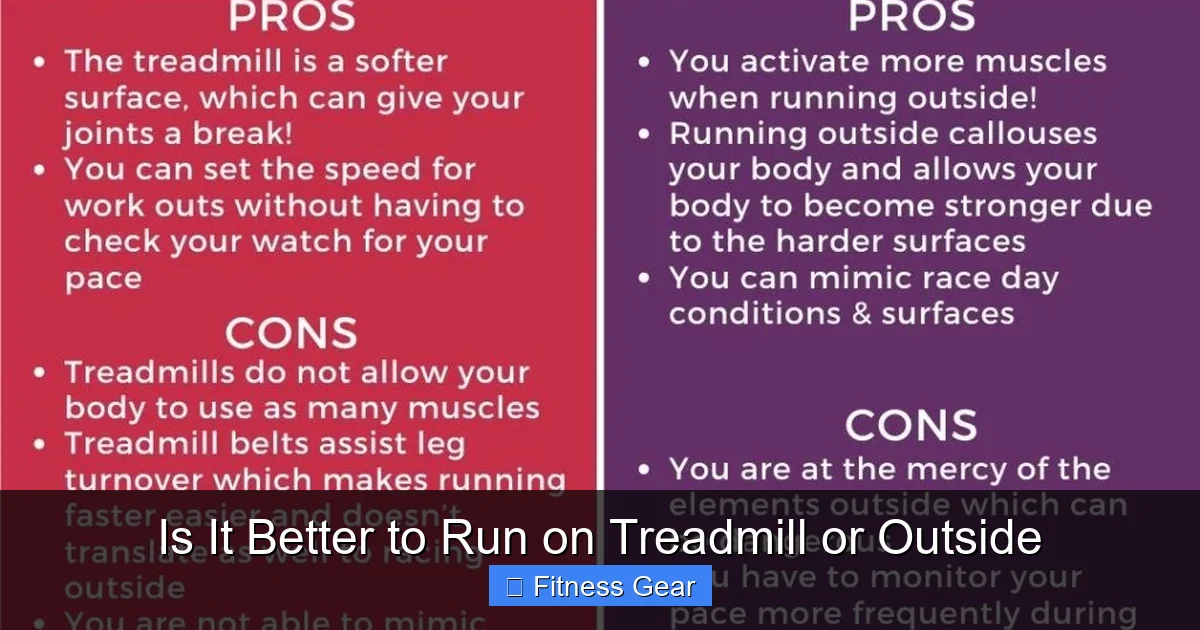
- Impact & Injury: Treadmills generally reduce joint stress due to their cushioned, consistent surface, making them a safer option for those with arthritis, injuries, or high body weight. Outdoor running’s uneven terrain can strengthen stabilizing muscles but increases impact forces and acute injury risk (like ankle sprains).
- Environment & Weather: Outdoor running exposes you to variable conditions (wind, hills, temperature) which build greater cardiovascular and muscular resilience. Treadmills provide a climate-controlled, predictable environment free from weather delays, pollution, or unsafe neighborhoods.
- Mental & Psychological Factors: Many runners find outdoor running more engaging and mood-boosting due to nature exposure, changing scenery, and “green exercise.” Treadmills can feel monotonous, but they allow for focused interval training, podcasts, or TV without distraction.
- Control vs. Realism: Treadmills offer precise control over speed, incline, and duration, perfect for structured workouts and pace consistency. Outdoor running better simulates race conditions with natural variations in terrain, wind resistance, and turns, building functional fitness.
- Convenience & Logistics: Treadmills win on convenience—run anytime, no travel, safe at night, and easy to hydrate. Outdoor running requires travel to a safe location, weather planning, and more gear (reflective clothing, ID, hydration).
- Calorie Burn & Effort: Studies show outdoor running typically burns 5-10% more calories at the same *perceived* effort due to air resistance and terrain changes. However, many people push harder on treadmills with visible speed/incline data, potentially equalizing the burn.
- The Hybrid Approach is Optimal: Most coaches and sports medicine experts recommend a blend. Use the treadmill for speedwork, hill repeats, and injury recovery. Use the outdoors for long runs, mental health, and race-specific training. This balances benefits while mitigating drawbacks.
📑 Table of Contents
- The Great Debate: Treadmill vs. Outdoor Running
- Impact on Your Body: Joints, Muscles, and Injury Risk
- The Mental Game: Psychology, Boredom, and “Green Exercise”
- Training Specificity: What Are You Training For?
- Convenience, Cost, and Logistics: The Everyday Reality
- Calorie Burn, Effort, and the Data Dilemma
- Crafting Your Hybrid Running Strategy
The Great Debate: Treadmill vs. Outdoor Running
The core of the debate often centers on authenticity. Purists argue that running outside is the only “real” running, a raw interaction with the elements and terrain. Pragmatists swear by the treadmill’s reliability and controlled environment. Both perspectives have merit. To move beyond the dogma, we need to evaluate these environments across several critical dimensions: biomechanics, psychology, training efficacy, and practicality.
It’s Not “Real Running”? Debunking the Myth
A common criticism of the treadmill is that it’s “easy” or “cheating” because the belt moves for you. This is a biomechanical misunderstanding. Research, including studies in the Journal of Sports Sciences, shows that running on a treadmill at a given speed requires roughly the same oxygen consumption and heart rate as running outdoors at that same speed. The motion is slightly different—your stride can become shorter and quicker on a belt—but the cardiovascular demand is nearly identical when effort is matched. The perceived ease often comes from the lack of wind resistance and the psychological comfort of a controlled space, not from a fundamental reduction in work. So, no, you are not a fraud for logging miles on a treadmill. You are running.
Impact on Your Body: Joints, Muscles, and Injury Risk
This is the most frequently cited and scientifically examined difference. The surface you run on profoundly affects the repetitive stress placed on your musculoskeletal system.

Visual guide about Is It Better to Run on Treadmill or Outside
Image source: treadmill.run
The Cushioned Consistency of the Treadmill
Modern treadmills feature decks with significant shock absorption. This consistent, forgiving surface reduces the peak impact force transmitted up through your ankles, knees, and hips with each footstrike. For runners dealing with osteoarthritis, tendinopathies (like Achilles or patellar tendinitis), stress fractures, or those carrying excess weight, this can be a game-changer. It allows for maintenance of cardiovascular fitness and running mechanics during rehab or as a preventive measure. The predictability also means you don’t have to worry about unexpected potholes, curbs, or trail rocks that can cause acute twists or falls.
The Unforgiving Reality of the Road and Trail
Running on asphalt or concrete is significantly harder. These surfaces are unyielding, sending sharp shock waves up your legs. Over time, this repetitive high-impact loading is associated with a greater risk of overuse injuries. However, there’s a crucial counterpoint: trail running on soft, uneven surfaces like dirt or grass is actually *lower* impact than a treadmill. The variability of the trail—stepping on roots, navigating rocks, adjusting to slopes—forces your smaller stabilizing muscles in your ankles, feet, and core to work overtime. This builds incredible proprioception (body awareness) and strength in these often-neglected areas, which can make you a more robust and injury-resistant runner in the long term. The trade-off is the acute risk of ankle sprains or falls.
Practical Tip: If you’re injury-prone or returning from an injury, start on a treadmill. Once pain-free, gradually introduce short bouts of soft-surface trail running to build that stabilizing strength. Always prioritize softer surfaces (grass, dirt) over concrete when running outdoors for recovery.
The Mental Game: Psychology, Boredom, and “Green Exercise”
Running is as much a mental endeavor as a physical one. The environment you run in directly influences your mood, motivation, and adherence to a training plan.

Visual guide about Is It Better to Run on Treadmill or Outside
Image source: treadmill.run
The Treadmill Tunnel: Focus and Monotony
Let’s be honest: the treadmill can be mind-numbingly boring. Staring at a wall, a TV, or the same street outside a gym window for 45 minutes is a mental challenge for most. This monotony can make time feel slower and effort feel greater. However, this very predictability is also its mental strength. The lack of navigational decisions (where to turn? is that hill coming?) frees up significant cognitive load. You can completely zone out with a podcast, audiobook, or show, making the run feel shorter. It’s also a safe, enclosed space, eliminating anxiety about traffic, getting lost, or personal safety—a huge benefit for those running at dawn, late at night, or in unfamiliar areas.
The Outdoor Escape: Nature, Exploration, and Mood
This is where outdoor running often shines brightest. The concept of “green exercise” — physical activity in natural environments — is backed by robust research showing significant reductions in stress, anxiety, and depression, along with boosts in self-esteem and mood. The changing scenery, sunlight (for Vitamin D), fresh air, and sensory experience (birds, trees, water) provide powerful intrinsic motivation. A run can become an adventure, a moving meditation, or a social activity with a friend. This variety and connection to the outdoors make it easier for many people to stick with running long-term. The downside? Bad weather, unsafe areas, or a monotonous city loop can kill this joy just as effectively as a treadmill wall.
Practical Tip: Combat treadmill boredom by creating engaging workouts—interval sessions, hill programs, or “pyramid” workouts that require constant attention to speed and incline. For outdoor runs, actively practice mindfulness: notice the sounds, smells, and sights. Use a new route every week to keep exploration alive.
Training Specificity: What Are You Training For?
Your primary training goal should be the loudest voice in this decision. Are you training for a 5K, a marathon, general health, or weight loss? The specificity principle in sports science states that your body adapts specifically to the demands you place on it.

Visual guide about Is It Better to Run on Treadmill or Outside
Image source: run.outsideonline.com
Treadmills: The Lab for Precision and Control
The treadmill is an unparalleled tool for controlled, repeatable workouts. Need to run exactly 6-minute miles for 20 minutes? Set it and forget it. Want to do a precise hill repeat session with a 7% incline for 2 minutes, then 0% for 2 minutes, repeated 8 times? The treadmill does it perfectly every single time. This makes it ideal for:
- Speedwork & Intervals: Precise pace control without terrain or wind interference.
- Hill Training: Consistent, measurable incline that’s impossible to replicate naturally on flat terrain.
- Pacing Discipline: Forces you to hold a target pace, crucial for race strategy.
- Rehabilitation: Allows for gradual, controlled increases in speed and incline under safe conditions.
The Outdoors: The Unpredictable Arena of Race Simulation
If your goal is a road race, trail race, or simply functional fitness for the real world, outdoor running is non-negotiable. You must prepare your body for:
- Terrain Variability: The constant micro-adjustments for cracks, cambered roads, and trail obstacles.
- Wind Resistance: A headwind increases effort; a tailwind gives a boost you won’t feel on a still treadmill.
- Environmental Stress: Running in heat, humidity, or cold teaches your body to thermoregulate efficiently.
- Navigation & Pacing: Learning to pace by feel (RPE – Rate of Perceived Exertion) rather than a machine is a critical skill for race day when GPS or course measurements can be off.
A runner who only trains on a treadmill may be physiologically fit but will be biomechanically unprepared for the demands of a road or trail, potentially leading to fatigue or injury on race day.
Practical Tip: If your goal race is outdoors, make sure at least 50-70% of your weekly long run and key workouts are done outside, especially in the 8-12 weeks leading up to the event. Use the treadmill for secondary workouts and recovery runs.
Convenience, Cost, and Logistics: The Everyday Reality
Beyond pure training theory, the choice is often dictated by the practicalities of daily life.
The Treadmill’s Allure: Anytime, Any Weather
The convenience factor of a treadmill—whether in a home gym or a 24-hour fitness center—is massive. You can run at 5 AM in a blizzard or 10 PM after a late dinner. There’s no travel time to a park or trail. You have immediate access to water, a bathroom, and climate control. For parents with young children, those living in high-crime areas, or individuals with unpredictable schedules, this accessibility can be the difference between consistent training and inconsistency. The financial cost is a factor: a quality home treadmill is a significant investment ($1,500-$3,000+), while a gym membership is a recurring fee. However, for many, the time saved and the elimination of weather-related cancellations justify this cost.
The Outdoor Reality: Free, but Not Effortless
Running outside is, on the surface, free. You just need a pair of shoes and an open door. But the hidden logistics are real. You must plan your route, check the weather, wear reflective gear in low light, carry ID and possibly hydration or fuel, and navigate traffic or trailheads. Bad weather can scuttle plans for days. Safety is a legitimate concern, requiring situational awareness and sometimes a running buddy. For those with limited mobility or no safe outdoor space within walking distance, the “free” run becomes a complex logistical puzzle involving drives to parks or tracks.
Practical Tip: Have a “treadmill workout” and an “outdoor workout” pre-planned for each week. On days when time is short or weather is poor, the treadmill workout is your reliable backup. When the sun is shining and you have a free hour, prioritize the outdoor run for the mental and physical variability benefits.
Calorie Burn, Effort, and the Data Dilemma
Many runners are laser-focused on calorie burn and pace metrics. How do these compare between the two surfaces?
The Science of Energy Expenditure
Multiple studies, including one from Syracuse University, have found that running outdoors typically burns about 5-10% more calories than running at the same speed on a treadmill. Why? Primarily due to air resistance. On a treadmill, you’re in a still room. Outside, you’re pushing against the wind. Additionally, outdoor running’s subtle changes in terrain and direction engage more muscle groups overall. However, this difference is largely erased at slower jogging paces (below 6 mph) or with a strong fan pointed at you on the treadmill to simulate wind resistance.
The Perception Gap: RPE vs. Machine Data
Here’s the fascinating twist: while outdoor running *objectively* requires more energy at the same speed, runners often *perceive* a treadmill run as harder at the same pace. Why? On a treadmill, you have no visual flow—the scenery doesn’t move past you—which can make the effort feel more intense. Conversely, outdoors, the forward motion and changing landscape can be psychologically motivating, making a given pace feel easier. Furthermore, the treadmill’s digital readout is a powerful psychological tool. Seeing “7.5 mph” can push you to sustain a pace you might self-limit to 7.0 mph outside without the data prompt. So, while the treadmill may slightly under-represent the real-world energy cost of a pace, its visible metrics can push you to match or exceed your outdoor effort.
Practical Tip: Don’t get obsessed with direct pace-for-pace comparisons between treadmill and outdoor running. A 10-minute mile on a treadmill is not the same physiological effort as a 10-minute mile outside. Use the Rate of Perceived Exertion (RPE) scale (1-10) to gauge effort across both surfaces. Aim for the same RPE for similar training purposes. A “7” on the treadmill should feel like a “7” on the road.
Crafting Your Hybrid Running Strategy
Given the distinct profiles, the most resilient, well-rounded running strategy is a hybrid one. You don’t have to choose. You can leverage the strengths of each environment while using the other to compensate for weaknesses.
When to Choose the Treadmill
- Injury Prevention/Recovery: The go-to for reduced-impact maintenance.
- Precise Speed & Hill Sessions: When you need exact pace and incline control for intervals or tempo runs.
Weather Extremes: Dangerous heat, cold, ice, or poor air quality. - Time-Crunched Days: Eliminates travel time; you can run in your basement in 30 minutes flat.
- Darkness/Safety Concerns: Running alone at night in an unsafe area.
- Mental Focus Workouts: When you need to block out the world and focus solely on hitting split times.
When to Choose the Outdoors
- Long Runs & Race Preparation: Essential for simulating race conditions and building mental fortitude.
- Mental Health & Enjoyment: When you need the mood boost, sunshine, and adventure to stay motivated.
- Building Functional Strength: Trail runs to strengthen stabilizers and improve proprioception.
- Social Runs: Easier to run with a friend or group outside than on side-by-side treadmills.
- Variety & Exploration: To prevent training staleness and discover new routes.
- When Weather is Ideal: Don’t waste a perfect, cool, sunny day on a treadmill.
Practical Hybrid Plan Example: A weekly plan for a beginner-to-intermediate runner might look like: Monday: Treadmill interval workout (controlled speed). Wednesday: Outdoor easy run (mental break, variability). Friday: Treadmill hill repeats (controlled incline). Sunday: Outdoor long run (race-specific endurance). This balances control, impact, and mental engagement.
Frequently Asked Questions
Does running on a treadmill burn fewer calories than running outside?
At the same speed, outdoor running typically burns 5-10% more calories due to wind resistance and terrain changes. However, many people run faster or at a higher perceived effort on treadmills because they can precisely control and see their pace, which can offset the difference. Matching effort by feel (RPE) is more important than matching pace.
Is treadmill running bad for your knees?
Generally, no—it’s often *better* for sensitive knees. The treadmill’s cushioned, consistent surface reduces peak impact forces compared to hard pavement. It’s a preferred option for those with knee osteoarthritis or recovering from certain injuries. However, over-reliance can weaken stabilizing muscles, so a mix with softer outdoor trails is ideal for long-term joint health.
What is the best option for a complete beginner?
>For a complete beginner, the treadmill is often the less intimidating, safer starting point. It offers a controlled environment to build endurance without worrying about traffic, navigation, or weather. You can start with walk-walk-run intervals and precisely control speed and duration. Once basic fitness and confidence are built, introducing short, easy outdoor runs on soft surfaces is highly beneficial.
Should I set the treadmill to a 1% incline to simulate outdoor running?
Yes, setting a 1% incline is a widely accepted practice to account for the lack of air resistance on a treadmill and make the effort more comparable to a calm-day outdoor run. For slower speeds (under 6 mph), a 0.5-1% incline is sufficient. For faster speeds, some studies suggest up to 2% may be needed, but this can increase perceived effort significantly. Use it as a guide, not a strict rule.
Can I train for a half marathon solely on a treadmill?
You can *complete* a half marathon training plan on a treadmill, but you likely won’t be optimally prepared for race day. The lack of terrain variation, wind, and real-world conditions can leave you unprepared for the physical and mental challenges of the event. At minimum, your long runs and the last 4-6 weeks of training should be done primarily outdoors on similar terrain (road or trail) to the race.
Is outdoor running better for mental health?
Strong evidence suggests that running in natural environments (“green exercise”) provides greater mental health benefits—reducing stress, anxiety, and depression more effectively than indoor exercise. The combination of physical activity, nature exposure, sunlight, and sensory engagement creates a potent mood-boosting effect that is hard to replicate indoors. However, for those with safety concerns or seasonal affective disorder (SAD) in winter, the reliable treadmill can also be a crucial mental health tool.