Is a Heavier Flywheel Better on a Spin Bike

The debate over flywheel weight is central to spin bike design, but the answer isn’t simple. A heavier flywheel creates more momentum and a smoother, road-bike-like feel, which many riders prefer for power and consistency. However, it also increases inertia, making quick accelerations harder and potentially stressing joints. A lighter flywheel offers snappier response and is often better for beginners, rehab, or high-intensity interval training (HIIT). The “best” weight depends entirely on your fitness goals, experience level, and physical condition—there is no universal “better.”
You’re shopping for a spin bike, comparing specs, and you see it: flywheel weight. One model boasts a 50-pound monster, while another features a sleek 30-pound design. The sales pitch is clear—bigger is better, right? More mass means more momentum, a smoother ride, and a more “realistic” cycling experience. But is that the full story? After years in the fitness industry and countless hours on every type of indoor bike, I can tell you the question “Is a heavier flywheel better on a spin bike?” has one definitive answer: it depends entirely on you. There is no single “best” weight that reigns supreme for every rider, every goal, and every body. This isn’t about picking a side; it’s about understanding the physics, the trade-offs, and matching the machine to your unique needs. Let’s peel back the layers of this enduring debate.
Key Takeaways
- Heavy Flywheels (40-50+ lbs): Provide superior momentum, a ultra-smooth pedal stroke, and a ride feel closest to a traditional road bike, but require more force to start/stop and can be jarring on joints.
- Light Flywheels (30-40 lbs): Offer quicker acceleration and deceleration, making them ideal for HIIT, beginners, and those with joint sensitivities, but can feel “choppy” at very low resistances.
- Inertia is Key: It’s not just weight, but the combination of flywheel mass and how it’s driven (gear ratio) that determines the rotational inertia, which dictates the true “feel” of the bike.
- Your Goals Dictate Choice: Choose for power/endurance (heavier) versus agility/HIIT (lighter). Consider your primary workout style.
- Resistance Type Matters: Magnetic resistance systems pair well with lighter flywheels, while friction (pad) systems often benefit from more mass to smooth out the contact.
- No Safety “Winner”: Neither is inherently safer; improper form with any bike can cause injury. The right flywheel for *you* reduces compensatory movements.
- Test Ride is Non-Negotiable: The subjective feel is personal. A 45-lb flywheel on one brand can feel different from a 45-lb on another due to design and gearing.
📑 Table of Contents
- The Physics of Pedaling: Understanding Momentum and Inertia
- The Case for the Heavier Flywheel: Power, Smoothness, and Realism
- The Case for the Lighter Flywheel: Agility, HIIT, and Joint Friendliness
- Matching the Flywheel to the Rider: Your Personal Prescription
- Debunking Common Myths and Marketing Hype
- Practical Buying Tips: How to Choose Your Flywheel Fate
- The Verdict: It’s About the Symphony, Not Just the Bass
The Physics of Pedaling: Understanding Momentum and Inertia
Before we debate heavy vs. light, we need a quick, painless physics lesson. The flywheel is the heavy disc attached to the crank arms. When you pedal, you’re applying torque to spin this mass. Two key concepts govern the experience: momentum and inertia.
Momentum: The “Keep on Spinning” Force
Once a flywheel is spinning, its mass wants to keep spinning. This is momentum. A heavier flywheel, once up to speed, has more momentum. This means it’s less affected by tiny variations in your pedal stroke—the “dead spots” at the top and bottom of the rotation. The result is a feeling of continuous, seamless motion. If you’ve ever ridden a high-end road bike, you know that smooth, gliding sensation where the pedals seem to pull your feet through the entire revolution. A heavy flywheel replicates this.
Inertia: The “Get Up to Speed” Force
Inertia is the resistance to change in motion. A heavy flywheel has high inertia. This is a double-edged sword. On the positive side, it makes starting from a dead stop or rapidly changing resistance feel very stable and controlled. On the negative side, it means you must apply significantly more force to get it moving initially or to speed it up. Conversely, a light flywheel has low inertia. It can accelerate and decelerate almost instantly, responding immediately to every micro-adjustment you make with your legs or the resistance knob.
Critical Insight: It’s not just the raw weight in pounds that matters. The gear ratio—how the drive train connects your pedals to the flywheel—dramatically affects the final feel. A 40-pound flywheel with a small drive pulley and a large flywheel pulley (high gear ratio) will feel much heavier and have more inertia than a 50-pound flywheel with a 1:1 gear ratio. Manufacturers don’t always publish this ratio, which is why a test ride is the only true way to judge.
The Case for the Heavier Flywheel: Power, Smoothness, and Realism
Proponents of heavier flywheels (typically 45-60+ pounds) are often serious cyclists, endurance athletes, and riders who prioritize a road-bike simulation. Their arguments are rooted in tangible benefits.

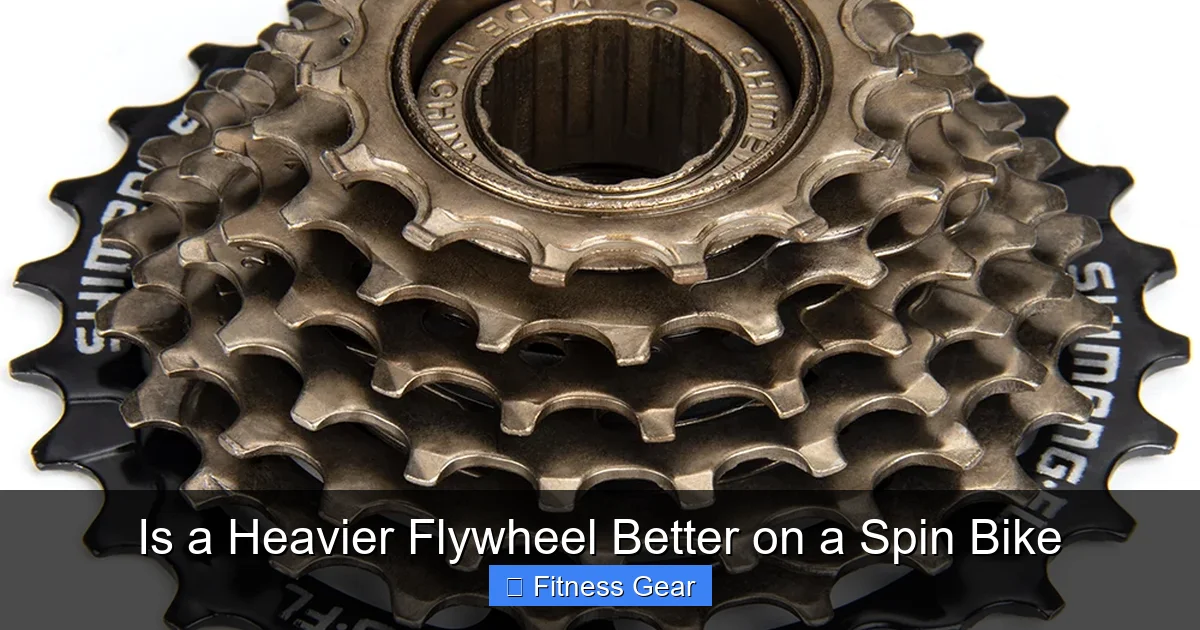
Visual guide about Is a Heavier Flywheel Better on a Spin Bike
Image source: cpimg.tistatic.com
The Unmatched Smoothness and Momentum
This is the heaviest (pun intended) argument. The sheer mass of a heavy flywheel acts as a giant buffer. It erases the “dead spots” in your pedal stroke. When you push down, the flywheel’s momentum carries the cranks through the upstroke, so you don’t feel a lull. This encourages a circular, efficient pedal stroke and can feel incredibly natural and flowing. For long, steady-state rides at a consistent cadence, this smoothness is unparalleled. It reduces the need for “muscling” through the stroke and promotes better form.
Mimicking Outdoor Cycling Dynamics
Think about riding your road bike outdoors. Once you’re rolling, there’s a significant amount of kinetic energy in the wheels and drivetrain. You don’t stop pedaling between strokes. A heavy flywheel on an indoor bike simulates this energy storage. It forces you to maintain a more consistent cadence and discourages the “mashing” of gears that can happen on a lighter-flywheel bike when resistance is high. The feel under load—when you’re climbing a simulated hill—is more stable and less “jerky.”
Potential for Greater Power Development
Because the heavy flywheel demands force to overcome its inertia, some strength and conditioning coaches argue it’s better for building raw power in the glutes, hamstrings, and quads. The constant tension and need to drive the mass can lead to greater muscular recruitment, especially during seated climbs or sprints from a rolling start. It’s like the difference between pushing a stalled car (high inertia) and pushing a moving shopping cart (low inertia).
Practical Example: A competitive cyclist training for a long road race would likely prefer a 50+ lb flywheel. Their workouts are often long, at steady, high cadences (90+ RPM). The smooth momentum helps them maintain an efficient, race-specific pedal stroke for hours, simulating the feel of their actual bike.
The Case for the Lighter Flywheel: Agility, HIIT, and Joint Friendliness
Don’t count the lighter flywheel (typically 30-40 lbs) out. It has a passionate following for very valid reasons, especially in the modern era of high-intensity, short-duration training.

Visual guide about Is a Heavier Flywheel Better on a Spin Bike
Image source: apexbikes.com
Snappy Response and Agility
This is the light flywheel’s superpower. With low inertia, the bike responds instantly. If you want to sprint from a standstill, the wheels (flywheel) are already spinning with your first push. If you’re doing a HIIT workout with rapid changes in resistance and cadence—30 seconds all-out, 15 seconds recovery, then a climb—the light flywheel keeps up effortlessly. There’s no “lag” as the heavy mass spins up or down. This snappiness makes the bike feel more playful and connected to your every intent. It’s ideal for workouts that involve a lot of out-of-the-saddle jumps, fast transitions, and Tabata-style intervals.
Lower Joint Stress and Better for Beginners
Starting a heavy flywheel from a dead stop requires a significant burst of force from your quads and hips. For someone with knee issues, weak glutes, or who is just starting their fitness journey, this initial “kick” can be problematic. It can encourage using momentum from the body (rocking hips) to get the wheel moving, which is poor form and stresses the lower back. A lighter flywheel eliminates this harsh starting force. It’s easier to control, making it more forgiving and allowing a beginner to focus on proper pedal technique and cardiovascular response before worrying about raw power output.
Pairing Perfectly with Modern Resistance Systems
The rise of magnetic resistance has changed the game. Magnets provide instant, frictionless resistance changes. A heavy flywheel with magnetic resistance can sometimes feel too “floaty” because there’s no physical pad to create a baseline tension. A lighter flywheel paired with a strong magnetic system offers a crisp, immediate feel that matches the quick resistance adjustments. Many premium magnetic-resistance bikes (like the NordicTrack Commercial R35 or certain Keiser models) use flywheels in the 30-40 lb range for this precise reason.
Practical Example: Someone recovering from a knee replacement or doing physical therapy would be better served by a 35-lb flywheel bike. They can perform controlled, low-impact movements without the jarring start-up force. Similarly, a CrossFit athlete doing 20-minute AMRAPs with burpees and bike sprints would benefit from the agile, responsive nature of a lighter flywheel.
Matching the Flywheel to the Rider: Your Personal Prescription
So, how do you choose? Forget the number on the spec sheet for a moment. Ask yourself these questions.
Visual guide about Is a Heavier Flywheel Better on a Spin Bike
Image source: i5.walmartimages.com
What is Your Primary Workout Style?
- Long, Steady Endurance (Zone 2-3): Heavier flywheel (45-60+ lbs). The smooth momentum is key for maintaining a high, consistent cadence for 60+ minutes.
- High-Intensity Interval Training (HIIT)/Tabata: Lighter to medium flywheel (30-40 lbs). You need that instant response for 30-second max efforts with rapid recovery.
- Strength & Power Focus (low cadence, high resistance): Medium to heavy (40-50 lbs). You want the stability under heavy load, but not so much inertia that you can’t control the pedal stroke at 40 RPM.
- Active Recovery / Rehab / Beginner: Lighter flywheel (30-40 lbs). Prioritize control, low start-up force, and smooth motion at low resistances.
What is Your Experience and Physical Condition?
A seasoned cyclist with strong glutes and hamstrings will naturally generate the force needed to spin up a heavy flywheel efficiently. They’ll appreciate the challenge and the feel. A sedentary beginner or someone with chronic knee pain will likely find a heavy flywheel intimidating, uncomfortable, and a potential source of compensatory bad form (like bouncing in the saddle). Be honest about your current strength and mobility. The goal is to make the bike a tool for progress, not a barrier to entry.
Do You Have a Specific Goal (Weight Loss, Athletic Performance, Health)?
For general health and weight loss, consistency is king. The bike you enjoy riding more will be the one you use more often. For many, the smoother, more “premium” feel of a heavy flywheel is more enjoyable and thus more motivating. For an athlete training for a sport that requires explosive power (basketball, soccer), the agility trained on a lighter flywheel bike might have more direct transfer.
Debunking Common Myths and Marketing Hype
The spin bike world is full of strong opinions and marketing claims. Let’s set the record straight.
Myth 1: “Heavier is Always More Challenging and Builds More Muscle.”
This is a half-truth. Challenge comes from resistance, not flywheel weight alone. You can have a 60-lb flywheel on the lightest resistance setting and it will be easy to spin. True muscular challenge is created by the combination of high resistance and the need to overcome the flywheel’s inertia. A heavy flywheel at high resistance is indeed a brutal strength workout. But a light flywheel at the same high resistance setting is equally challenging for your muscles—it just feels different. The muscle engagement pattern shifts slightly. The “builds more muscle” claim is not scientifically proven to be exclusive to heavy flywheels; progressive overload is the key principle, regardless of the tool.
Myth 2: “Lighter Flywheels Are Unsafe and Cause Injury.”
This is fear-mongering. Injury comes from poor form, not flywheel weight. However, a poorly matched flywheel can *encourage* poor form. A beginner on a very heavy flywheel might rock their hips excessively to get the wheel moving, straining the lower back. But a lightweight flywheel, if used with terrible form (e.g., bouncing with no resistance), is equally unsafe. The “safest” flywheel is the one that allows you to maintain a stable, controlled, and neutral spine throughout the entire pedal stroke. For most people, that’s a medium-weight flywheel that feels intuitive.
Myth 3: “You Need a 50+ lb Flywheel for a ‘Real’ Cycling Feel.”
The “real cycling feel” is subjective. A road cyclist might crave the momentum of a heavy flywheel. A mountain biker, who is constantly accelerating and decelerating on technical trails, might find a lighter, more responsive feel more authentic. Furthermore, the overall bike geometry, saddle, and handlebar positioning contribute more to the “road bike” feel than the flywheel alone. A cheap bike with a 50-lb flywheel but a terrible saddle and awkward reach will feel less “real” than a well-designed bike with a 35-lb flywheel.
Practical Buying Tips: How to Choose Your Flywheel Fate
Spec sheets are useful, but they don’t tell the whole story. Here’s how to navigate your purchase.
Prioritize the Test Ride Above All Else
This cannot be stressed enough. A 40-lb flywheel on a Sunny Health & Fitness bike will feel completely different from a 40-lb flywheel on a Schwinn or a Keiser due to gearing, bearing quality, and frame stiffness. Go to a showroom. Do a 5-minute warm-up at a moderate resistance. Then, try a few things:
- The Start-Up Test: Come to a complete stop. Then, pedal from a dead stop with a moderate amount of resistance. How hard is that initial push? Does it feel smooth or jerky?
- The Low-Resistance Spin: Set resistance to a very low level (1-2 out of 10). Pedal at 90+ RPM. Is the pedal stroke silky smooth, or does it feel slightly “pulsating” or lumpy?
- The High-Resistance Climb: Crank the resistance up (8-10 out of 10). Can you maintain a controlled, steady cadence (e.g., 60 RPM) without your hips bouncing wildly? Does the bike feel stable, or does it feel like you’re fighting to keep the cranks moving?
Look Beyond the Flywheel Weight Spec
Ask about or research the drive system. Is it a chain drive (often louder, requires maintenance) or a belt drive (quieter, smoother)? What is the approximate gear ratio? A reputable brand will be happy to discuss their engineering. Also, consider the type of resistance. Friction pads (like on a classic Keiser M3) create a tactile, connected feel that pairs well with mass. Magnetic resistance is smoother and quieter and often pairs with a slightly lighter flywheel.
Consider the Whole Package: Your Budget and Bike Quality
Don’t sacrifice overall build quality for a specific flywheel weight number. A $500 bike with a “50-lb flywheel” will likely have poor bearings, a wobbly frame, and a cheap resistance system, making the heavy wheel feel unstable and noisy. A $2,000 bike with a “40-lb flywheel” will have precision engineering that makes that 40 lbs feel perfect. A well-built bike with a medium-weight flywheel (40-45 lbs) is often the best all-around compromise for most riders. Focus on stability, adjustability, and the quality of the ride feel over the raw poundage.
The Verdict: It’s About the Symphony, Not Just the Bass
So, is a heavier flywheel better on a spin bike? The answer is a nuanced no. It’s not inherently better; it’s different. A heavier flywheel is a specialized tool for a specific type of rider and workout. It delivers an unparalleled smooth, momentum-filled experience that serious endurance cyclists and those who love long, steady rides will adore. It provides a stable, road-bike-like platform under heavy load.
But for the athlete crushing HIIT sessions, the beginner taking their first spin class, the person with knee concerns, or anyone who values quick responsiveness, a lighter flywheel is not just acceptable—it’s superior. It offers agility, lower joint stress, and perfect harmony with modern magnetic resistance systems.
The “best” flywheel weight is the one that disappears. It’s the one that doesn’t make you think about the machine. You just ride. Your focus is on your breath, your power, your music—not on fighting or being surprised by the equipment beneath you. That harmony is achieved when the flywheel’s inertia matches your physiology and your workout intention. So, toss out the idea that bigger is better. Embrace the idea of right-sized. Your ideal spin bike isn’t defined by a single number on a spec sheet; it’s defined by how it makes you feel when the music starts and you begin to turn the pedals. Find the flywheel that feels like an extension of your own intent, and you’ve found your winner.
Frequently Asked Questions
Will a heavier flywheel make my legs bigger?
Not directly. Muscle growth (hypertrophy) comes from progressive overload and a caloric surplus. While a heavy flywheel can provide a strength-oriented workout, it’s the resistance level and volume of work that matter most. It will build muscular endurance and strength, but significant size gains require specific strength training protocols and nutrition.
Are lighter flywheels better for weight loss?
Both can be equally effective for weight loss. Weight loss is driven by calorie burn, which comes from workout intensity and duration. A lighter flywheel may allow you to do more explosive, high-intensity intervals (which burn a lot of calories), while a heavier one may suit longer, steady-state rides. The best flywheel for weight loss is the one that helps you stick to a consistent, challenging routine you enjoy.
Can a flywheel be too heavy?
Yes, for certain individuals. For beginners, those with limited lower-body strength, or people with joint issues (like knee arthritis), an extremely heavy flywheel (55+ lbs) can create a harsh, high-impact starting force. This can lead to poor form (rocking hips) and place unnecessary shear stress on the knees and lower back. It can also be intimidating and discouraging, leading to less frequent use.
Does flywheel weight affect the noise level of a spin bike?
Indirectly, yes. A heavier flywheel has more mass, which can help dampen vibrations and create a quieter, more solid feel if the bearings and construction are high-quality. However, the primary noise sources are the resistance system (magnetic is quieter than friction pads) and the drive system (belt drives are quieter than chains). A poorly built light-flywheel bike can be louder than a well-built heavy-flywheel one.
Is there a safety risk of the flywheel “taking off” if I stop pedaling?
No. The flywheel’s momentum is what keeps it spinning, but it’s not a self-propelling engine. On any properly functioning spin bike, if you stop applying force, the flywheel will gradually slow down due to friction (from bearings and resistance pads) and air resistance. The only “take off” risk is if you are using a bike with a freewheeling mechanism (rare on spin bikes) and you lose control at high speed, but this is extremely uncommon on modern fixed-gear spin bikes.
Should I choose magnetic or friction resistance based on flywheel weight?
They work well together in different combinations. Friction pads (like on a classic Keiser) create a physical connection to the flywheel, and a heavier flywheel helps smooth out the potential “gritty” feel of the pads. Magnetic resistance is silent and smooth, and it pairs excellently with a lighter-to-medium flywheel, as the magnet provides the resistance feel without needing mass to buffer pad contact. Consider your priority: silent operation (magnetic + lighter) or classic “squeaky brake” feel and maximum heat generation (friction + heavier).