How to Workout Biceps and Triceps with Dumbbells
Wondering how to workout biceps and triceps with dumbbells effectively? This guide covers everything from the best exercises to proper form and pro tips. You’ll learn a complete dumbbell arm workout routine that builds real muscle, boosts arm strength, and fits into any schedule. Whether you’re a beginner or experienced, these bicep and tricep exercises will take your training to the next level.
Key Takeaways
- Compound and isolation movements: Combining both types of arm exercises with dumbbells gives you the best results for muscle growth and definition.
- Proper form matters most: Using correct technique prevents injury and ensures you’re actually targeting your biceps and triceps with dumbbells effectively.
- Progressive overload is key: Gradually increasing weight or reps drives arm hypertrophy and keeps your muscles growing.
- You don’t need a gym: A solid home arm workout with just dumbbells can build impressive arm muscles. A pair of adjustable dumbbells is all you need.
- Rest and recovery count: Your muscles grow outside the gym. Allowing proper rest between dumbbell workout sessions is just as important as the exercises themselves.
- Nutrition fuels growth: Eating enough protein and staying hydrated supports build arm muscles and speeds up recovery after every session.
- Consistency beats everything: Sticking to a regular dumbbell arm training schedule for weeks and months is what creates real, lasting results.
📑 Table of Contents
Introduction
Want bigger, stronger arms? You’re not alone. Millions of people hit the gym every day dreaming of impressive biceps and triceps with dumbbells. The good news? You don’t need fancy machines or a gym membership. A simple pair of dumbbells is all it takes.
Learning how to workout biceps and triceps with dumbbells opens up a world of possibilities. You can train at home, at the park, or anywhere. These exercises target every part of your arms. They build strength, improve definition, and boost your confidence. Plus, they fit into any busy schedule.
This guide gives you everything you need. We’ll cover the best exercises, proper form, common mistakes, and a full routine. By the end, you’ll have a clear plan to build the arms you want. Let’s dive in.
Why Train Biceps and Triceps with Dumbbells?
Before jumping into exercises, let’s talk about why dumbbell training is so effective for your arms. Understanding the “why” keeps you motivated and helps you make smarter choices.
The Benefits of Dumbbell Arm Training
Dumbbells offer unique advantages that machines and barbells simply can’t match. Here’s why they’re a top choice for arm muscle training:
- Freedom of movement: Dumbbells let your arms move naturally. This reduces strain on your joints and improves muscle activation.
- Balanced strength: Each arm works independently. This fixes imbalances that often go unnoticed with barbell exercises.
- Safety: If a weight gets too heavy, you can simply drop dumbbells. This makes home arm workout sessions much safer.
- Versatility: One pair of dumbbells covers dozens of exercises. You can target every head of your biceps and triceps with simple movements.
- Space-saving: A small set of dumbbells fits in any closet. Perfect for anyone who wants to build arm muscles at home.
Understanding Your Arm Muscles
To train effectively, you need to know what you’re training. Your upper arms have two main muscle groups that work together during bicep and tricep exercises.
Biceps: Located on the front of your upper arm, your biceps have two heads. The long head and short head work together to bend your elbow. They also help rotate your forearm. Strong biceps improve pulling movements and overall arm strength.
Triceps: These sit on the back of your upper arm. Your triceps actually have three heads: the long head, lateral head, and medial head. Together, they straighten your elbow. Triceps make up roughly two-thirds of your upper arm. Training them is essential for building real arm hypertrophy.
Best Dumbbell Exercises for Biceps
Now let’s get to the good stuff. These bicep exercises target every part of your biceps using just dumbbells. Focus on controlled movements and full range of motion.
Dumbbell Bicep Curls
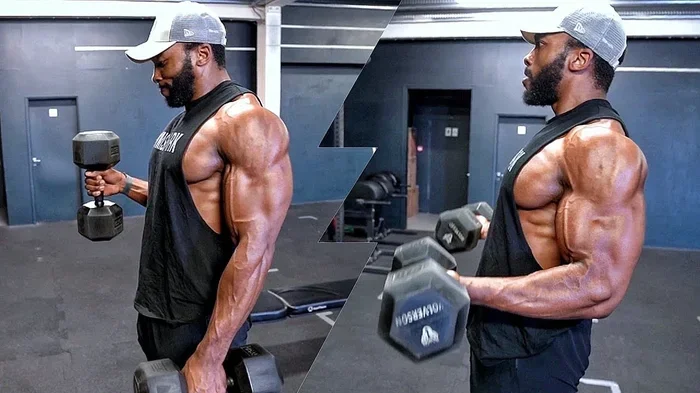
The classic dumbbell bicep curl is a staple for a reason. It’s simple, effective, and isolates your biceps perfectly. Stand tall, hold a dumbbell in each hand, and curl upward. Keep your elbows pinned at your sides. Lower the weights slowly. This basic movement builds serious bicep strength.
Hammer Curls
Hammer curls target your brachialis, a muscle beneath your biceps. Hold the dumbbells with your palms facing inward. Curl up just like a regular curl. This exercise adds thickness to your arms. It also strengthens your elbow flexion and improves grip strength.
Concentration Curls
Sit on a bench or chair. Rest your elbow against the inside of your thigh. Curl one dumbbell up slowly. This isolation exercise squeezes every fiber of your bicep. It’s perfect for mind-muscle connection and peak contraction.
Incline Dumbbell Curls
Lie back on an incline bench. Let your arms hang straight down. Curl the dumbbells up. This position stretches your biceps fully at the bottom. It creates a deep stretch that promotes arm hypertrophy and builds long, defined biceps.
Best Dumbbell Exercises for Triceps
Your triceps deserve just as much attention. After all, they’re the bigger muscle group. These tricep exercises with dumbbells will fill out the back of your arms.
Overhead Tricep Extension
Hold one dumbbell with both hands behind your head. Extend your arms upward until the weight is locked out. This movement targets the long head of your triceps. It’s one of the most effective dumbbell exercises for arms when it comes to adding size.
Tricep Kickbacks
Hinge forward at the waist. Keep your upper arm still and extend your forearm backward. Squeeze at the top. This isolation exercise hits the lateral and long heads beautifully. It’s a go-to move for arm toning exercises and building definition.
Close-Grip Dumbbell Press
This is a compound arm movement that also involves your chest and shoulders. Lie on a bench and hold dumbbells close together. Press upward. The narrow grip shifts more tension to your triceps. It’s a powerhouse exercise for building overall upper body workout strength.
Floor Dumbbell Press
Similar to the close-grip press, but done on the floor. The floor limits your range of motion slightly. However, it protects your shoulders and keeps the focus on tricep exercises. This is a great option for home arm workout sessions.
Creating Your Dumbbell Arm Workout Routine
Knowing exercises is only half the battle. Putting them together into a smart routine is what drives results. Here’s how to structure your dumbbell workout routine for arms.
Sample Routine for Beginners
New to biceps and triceps with dumbbells? Start simple. Aim for two arm sessions per week with at least 48 hours of rest between them.
- Warm-up: 5 minutes of light cardio and arm circles.
- Dumbbell Bicep Curls: 3 sets of 10-12 reps.
- Hammer Curls: 3 sets of 10-12 reps.
- Overhead Tricep Extension: 3 sets of 10-12 reps.
- Tricep Kickbacks: 3 sets of 10-12 reps.
- Cool-down: Light stretching for 3-5 minutes.
Intermediate to Advanced Routine
Ready to level up? Add more exercises and increase the volume. Train arms once or twice per week with heavier weights.
- Warm-up: 5-10 minutes of dynamic stretching.
- Incline Dumbbell Curls: 4 sets of 8-10 reps.
- Concentration Curls: 3 sets of 10-12 reps per arm.
- Close-Grip Dumbbell Press: 4 sets of 8-10 reps.
- Overhead Tricep Extension: 3 sets of 10-12 reps.
- Tricep Kickbacks: 3 sets of 12 reps per arm.
- Cool-down: Stretching and foam rolling.
Comparing Beginner vs Advanced Routines
| Aspect | Beginner | Intermediate/Advanced |
|---|---|---|
| Weekly Frequency | 2 sessions | 2-3 sessions |
| Sets per Exercise | 3 sets | 3-4 sets |
| Rep Range | 10-12 reps | 8-12 reps |
| Total Exercises | 4-5 | 6-7 |
| Rest Between Sets | 60-90 seconds | 45-90 seconds |
| Focus | Form and base strength | Arm hypertrophy and progressive overload |
Proper Form and Common Mistakes
Form can make or break your arm exercises with dumbbells. Poor technique wastes your time and increases injury risk. Here’s what to watch out for.
Key Form Cues
- Keep your core tight: A braced core protects your lower back during every dumbbell exercise.
- Control the weight: Don’t swing or use momentum. Slow, deliberate reps build more muscle.
- Full range of motion: Stretch completely at the bottom and squeeze at the top. Partial reps limit growth.
- Elbow position: During curls, keep elbows locked at your sides. During tricep work, keep upper arms still.
- Breathing: Exhale on the hard part (the lift). Inhale on the easy part (the lowering phase).
Common Mistakes to Avoid
Even experienced lifters make these errors. Avoiding them will accelerate your progress toward build arm muscles goals.
- Using too much weight: Heavy dumbbells with sloppy form don’t build arms. They build injuries. Choose a weight you can control for the full set.
- Rushing reps: Fast reps reduce muscle time under tension. Aim for a 2-second lift, 1-second pause, 3-second lower.
- Neglecting triceps: Many people focus only on biceps. Remember, triceps are two-thirds of your upper arm. Give them equal attention with tricep exercises.
- Skipping warm-up: Cold muscles don’t perform well. A quick warm-up prepares your joints and activates your arm muscles.
- Training every day: Muscles need rest to grow. Overtraining leads to fatigue and plateaus. Schedule rest days between dumbbell arm training sessions.
Pro Tips for Faster Arm Growth
Want to see real results faster? These expert-backed tips take your workout biceps and triceps with dumbbells to the next level.
Apply Progressive Overload
Progressive overload means gradually increasing the demands on your muscles over time. You can add weight, reps, or sets each week. This is the single most important driver of arm hypertrophy. Without it, your muscles have no reason to grow.
Focus on the Mind-Muscle Connection
Don’t just go through the motions. Think about your biceps working during curls. Feel your triceps stretching during extensions. Research shows that mental focus increases muscle activation. This technique works incredibly well for bicep and tricep exercises.
Train Arms After Compound Movements
If you do a full-body session, train arms after exercises like rows and presses. Your central nervous system is already warm. This lets you focus on isolation exercises with better mind-muscle connection.
Use a Variety of Angles
Your arms move in multiple directions. Train them from different positions. Use incline curls, decline extensions, and overhead movements. This ensures complete arm strength development across all muscle fibers.
Quick Tips for Success
- Track your workouts: Write down weights, reps, and sets. Progress becomes visible and motivating.
- Stay hydrated: Dehydration reduces performance and recovery. Drink water before, during, and after training.
- Eat enough protein: Aim for 0.7-1 gram of protein per pound of body weight. Protein fuels build arm muscles and repairs tissue.
- Get enough sleep: Growth hormone releases during deep sleep. Aim for 7-9 hours nightly for optimal recovery.
- Be patient: Real arm muscle training results take weeks and months. Trust the process and stay consistent.
Nutrition and Recovery for Arm Muscles
Your dumbbell routine is only part of the equation. What you eat and how you recover directly impact your results. Let’s break down the essentials for building arm muscles at home with dumbbells.
Fueling Your Workouts
Your body needs the right fuel to build muscle. Protein is the most critical macronutrient. It provides the building blocks for new muscle tissue. Good sources include chicken, fish, eggs, Greek yogurt, beans, and protein powder.
Carbohydrates fuel your workouts. They give you energy for every set and rep. Don’t fear carbs. Choose complex sources like oats, brown rice, and sweet potatoes. Healthy fats from avocados, nuts, and olive oil support hormone production. This includes testosterone, which plays a big role in arm hypertrophy.
Recovery Essentials
- Rest days: Plan at least 1-2 rest days per week. Your muscles grow during rest, not during the workout.
- Sleep: Deep sleep is when growth hormone peaks. Prioritize quality rest every night.
- Stretching: Light stretching after dumbbell exercises reduces soreness and improves flexibility.
- Active recovery: Light walks or swimming on off days promotes blood flow. This speeds up healing.
How Long Until You See Results?
Most people notice visible changes in 4-6 weeks. Significant arm strength and size gains take 3-6 months. The timeline depends on your starting point, genetics, nutrition, and consistency. The key is to stick with your dumbbell arm training plan. Results compound over time.
Conclusion
Learning how to workout biceps and triceps with dumbbells is one of the most rewarding fitness journeys you can take. You now know the best exercises, how to build a smart routine, and how to avoid common mistakes. You understand the role of nutrition and recovery in building powerful arm muscles.
The path to bigger, stronger arms is clear. Grab your dumbbells, commit to a consistent schedule, and push yourself progressively. Every rep brings you closer to your goals. Whether you’re training for arm toning exercises or serious arm hypertrophy, the tools in this guide will get you there.
Start today. Your future stronger self will thank you.
For more detailed guidance on targeted bicep and tricep exercises with dumbbells, check out this comprehensive guide on getting bigger biceps and triceps with dumbbells. Also, explore how to build bigger biceps at home with dumbbells and discover effective tricep exercises at home to round out your upper body workout.
FAQs
How often should I train biceps and triceps with dumbbells?
Train your arms 2-3 times per week with at least 48 hours of rest between sessions. This gives your muscles enough time to recover and grow. Beginners can start with twice a week. More advanced lifters may benefit from three sessions spread across the week.
What weight dumbbells should I use for arm exercises?
Choose a weight that challenges you in the last 2-3 reps of each set. You should be able to complete all reps with good form. For bicep exercises, this might be 10-25 pounds. For tricep exercises, it could be 15-30 pounds. Adjust as you get stronger over time.
Can I build big arms with just dumbbells at home?
Absolutely. Many people have built impressive arm muscles using only dumbbells. Focus on progressive overload, proper form, and a variety of bicep and tricep exercises. A pair of adjustable dumbbells gives you everything you need for a complete home arm workout.
How long does it take to see results from a dumbbell arm workout?
You’ll typically notice visible changes in 4-6 weeks. More significant arm strength and size gains take 3-6 months of consistent training. Eating enough protein and getting proper sleep also play a big role in how fast you build muscle.
Should I do more bicep or tricep exercises?
Give both equal attention. Since triceps make up about two-thirds of your upper arm, many experts recommend slightly more tricep volume. However, balanced development of both biceps and triceps with dumbbells creates the best overall look and function.
What’s the best exercise for triceps with dumbbells?
The overhead tricep extension is widely considered one of the best tricep exercises. It targets the long head effectively and allows a deep stretch. Combine it with kickbacks and close-grip presses for a complete tricep exercises routine that builds serious arm size.