How to Make Biceps at Home with Dumbbells
You can build bigger biceps at home with just a pair of dumbbells and the right technique. This guide covers the best bicep exercises, a structured workout plan, and proven tips for fast arm growth. Whether you are a beginner or intermediate lifter, these methods will help you add real size and strength to your arms without stepping into a gym.
Building bigger biceps at home is easier than most people think. You do not need a fancy gym membership or expensive machines. A pair of dumbbells and a solid plan are all you need to start growing your arms.
The biceps are one of the most visible muscles in your body. They are the muscles everyone notices when you flex. That is why so many people want to know how to make biceps at home with dumbbells. The good news is that you can achieve real results with simple, targeted exercises.
This guide breaks down everything you need to know. From the best bicep exercises to a complete workout routine, you will find practical advice you can start using today. Let us dive in and start building bigger arms.
Key Takeaways
- Dumbbells are all you need: A simple pair of adjustable dumbbells can deliver serious bicep growth at home.
- Variety matters: Mixing curls, hammer curls, and concentration exercises targets all parts of the bicep for balanced development.
- Progressive overload drives growth: Gradually increasing weight or reps is essential for building bigger biceps over time.
- Form beats ego: Using proper technique prevents injury and maximizes muscle activation for better results.
- Consistency wins: Following a structured routine 2-3 times per week leads to noticeable arm gains within weeks.
- Recovery is part of the process: Rest, nutrition, and sleep play a huge role in muscle repair and growth.
📑 Table of Contents
- Why Dumbbells Are Perfect for Bicep Growth
- Best Bicep Exercises with Dumbbells
- How to Build a Bicep Workout Routine at Home
- Progressive Overload: The Key to Bigger Arms
- Common Mistakes That Slow Down Bicep Growth
- Nutrition Tips for Bicep Growth
- Tracking Your Progress and Staying Motivated
- Quick Tips for Maximum Bicep Growth
- Conclusion
Why Dumbbells Are Perfect for Bicep Growth
Dumbbells are one of the best tools for building biceps at home. They allow you to isolate the bicep muscles more effectively than many other exercises. You can also easily adjust the weight as you get stronger.
Unlike barbells, dumbbells let each arm work independently. This means you can fix strength imbalances over time. Your weaker arm will catch up to your stronger one. That leads to more balanced and symmetrical arm development.
Another big advantage is convenience. You can do a full bicep workout in your living room, garage, or bedroom. No commute, no waiting for equipment, no excuses. Building muscle at home with only dumbbells is one of the most efficient ways to train.
Key Benefits of Using Dumbbells for Biceps
- Full range of motion: Dumbbells let your arms move freely through the entire exercise.
- Joint-friendly: They put less stress on your wrists and elbows compared to barbells.
- Versatile: You can perform dozens of bicep variations with just one pair.
- Space-efficient: A single pair of dumbbells takes up minimal room.
- Scalable: You can go from light to heavy by simply adding weight plates.
Best Bicep Exercises with Dumbbells
The right exercises make all the difference when you want to build bigger biceps. Here are the most effective movements you can do at home with dumbbells.
Standing Dumbbell Curl
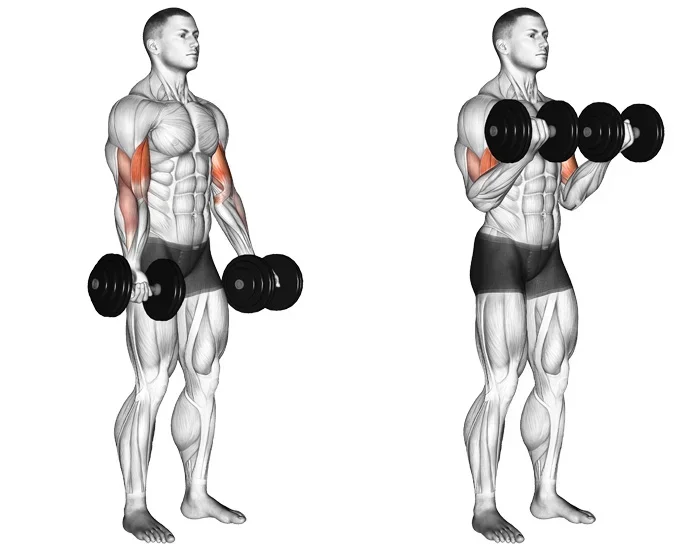
This is the king of bicep exercises. Stand tall with a dumbbell in each hand. Keep your elbows pinned to your sides. Curl the weights up slowly while squeezing your biceps at the top. Lower them back down with control. Do 3 sets of 10 to 12 reps.
The standing curl hits the short head and long head of the bicep. It also engages your forearms and core for stability. Keep your back straight and avoid swinging your body. Momentum will reduce the work your biceps do.
Hammer Curl
Hold the dumbbells with a neutral grip, meaning your palms face each other. Curl up just like a regular curl. This variation targets the brachialis muscle, which sits underneath the bicep. Building the brachialis makes your arms look wider and more defined.
Hammer curls also strengthen your forearms. This is great for overall arm development. Try adding these at the end of your bicep workout for a strong pump.
Concentration Curl
Sit on a bench or chair and rest your elbow against your inner thigh. Curl the dumbbell up slowly. This exercise isolates the bicep like nothing else. It removes momentum and forces the muscle to do all the work.
Concentration curls are perfect for hitting the bicep peak. They create a strong mind-muscle connection. You will feel the burn in a way that other curls simply cannot match.
Incline Dumbbell Curl
Set a bench or chair to about 45 degrees. Sit back and let your arms hang straight down. Curl the dumbbells up while keeping your elbows behind your body. This stretch under load targets the long head of the bicep.
The long head is responsible for the bicep peak that everyone wants. Incline curls are one of the best ways to develop it. Use a lighter weight than your regular curls and focus on the stretch.
How to Build a Bicep Workout Routine at Home
A good routine gives your biceps the right amount of stimulus to grow. You do not need to train them every day. In fact, rest is just as important as the workout itself.
Beginner Bicep Routine (2x Per Week)
If you are just starting out, keep things simple. Here is a beginner-friendly routine you can follow:
- Standing Dumbbell Curl: 3 sets of 10-12 reps
- Hammer Curl: 3 sets of 10-12 reps
- Concentration Curl: 2 sets of 12-15 reps
Rest for 60 to 90 seconds between sets. Train your biceps on non-consecutive days, like Monday and Thursday. This gives your muscles time to recover and grow.
Intermediate Bicep Routine (3x Per Week)
Once you have built a foundation, you can increase the volume and intensity. Try this routine:
- Standing Dumbbell Curl: 4 sets of 8-10 reps
- Incline Dumbbell Curl: 3 sets of 10-12 reps
- Hammer Curl: 3 sets of 10-12 reps
- Concentration Curl: 3 sets of 12-15 reps
Drop the weight slightly on your last set and do as many reps as possible. This technique, called a drop set, pushes your muscles past their normal limit. It triggers more muscle growth and creates a great pump.
Getting bigger biceps at home with dumbbells comes down to sticking with a routine and tracking your progress over time.
Progressive Overload: The Key to Bigger Arms
Progressive overload is the most important principle in muscle building. It means gradually increasing the demands on your muscles over time. Your biceps will not grow if you keep lifting the same weight for the same reps forever.
There are several ways to apply progressive overload:
- Add weight: Increase the dumbbell weight by 1-2 pounds every one to two weeks.
- Add reps: Do one or two more reps each week with the same weight.
- Add sets: Increase from 3 sets to 4 sets per exercise.
- Reduce rest time: Shorten your rest periods to increase intensity.
- Improve form: Slow down the eccentric (lowering) phase for more muscle tension.
Track your workouts in a notebook or app. Write down the weight, reps, and sets for every session. This makes it easy to see when you need to push harder. Small, consistent increases lead to big results over weeks and months.
Common Mistakes That Slow Down Bicep Growth
Many people make mistakes that hold back their bicep gains. Avoiding these errors will help you train more effectively and see faster results.
Using Too Much Weight
This is the most common mistake. Lifting too heavy causes you to swing and use momentum. Your biceps stop doing the work, and other muscles take over. Choose a weight where you can complete all reps with good form. You should feel a strong burn by the last few reps of each set.
Skipping the Negative Phase
The lowering part of a curl is just as important as the lifting part. Lower the dumbbell slowly over 3 to 4 seconds. This creates more muscle damage, which is a key driver of growth. Many people drop the weight quickly, wasting half the benefit of the exercise.
Training Biceps Every Day
Your muscles grow during rest, not during the workout. Training biceps daily prevents them from recovering properly. Stick to 2 or 3 sessions per week with at least one rest day between them. Give your arms time to repair and grow stronger.
Ignoring the Brachialis and Forearms
Your biceps sit on top of the brachialis muscle. Developing the brachialis pushes your bicep up and creates a fuller look. Hammer curls are the best exercise for this. Do not neglect your forearms either, as they support stronger curls overall.
Building arm muscles at home with dumbbells requires a balanced approach that targets all the muscles in your upper arm, not just the biceps alone.
Nutrition Tips for Bicep Growth
Exercise is only half the equation. What you eat plays a huge role in building bigger biceps. Without proper nutrition, your muscles have nothing to grow with.
Eat Enough Protein
Protein provides the building blocks your muscles need to repair and grow. Aim for about 0.7 to 1 gram of protein per pound of body weight each day. Good sources include chicken, fish, eggs, Greek yogurt, beans, and protein powder.
Eat in a Slight Calorie Surplus
To build muscle, you need to eat slightly more calories than you burn. A surplus of 200 to 300 calories per day is ideal. This gives your body the energy it needs to build new muscle tissue without adding excess fat.
Stay Hydrated
Water is essential for muscle function and recovery. Drink at least 8 glasses of water per day, more on workout days. Dehydration can reduce your strength and make your workouts feel harder than they need to be.
Time Your Meals Around Workouts
Eat a meal with protein and carbs 1 to 2 hours before your workout. This gives you energy for your session. After training, have a protein-rich snack within an hour to kickstart recovery. A simple option is a banana with peanut butter or a protein shake.
Getting bigger biceps and triceps with dumbbells also depends on overall nutrition, not just training. Fuel your body right and watch your arms grow.
Tracking Your Progress and Staying Motivated
Building biceps takes time and patience. You will not see dramatic results overnight. But if you stay consistent, the changes will come.
Take progress photos every two weeks. Compare them side by side to see the changes. You can also measure your arm size with a tape measure. Track your strength gains too. Note when you add weight or reps. These small wins keep you motivated.
Set realistic goals for yourself. Maybe you want to add an inch to your arms in three months. Or maybe you want to curl a certain weight for 12 reps. Whatever your goal, write it down and work toward it every day.
Remember that everyone progresses at a different rate. Some people see results faster than others. What matters most is that you keep showing up and putting in the work. Getting bigger arms at home with dumbbells is a journey, and every rep brings you closer to your goals.
Quick Tips for Maximum Bicep Growth
- Squeeze at the top: Hold the squeeze at the peak of every curl for one second.
- Use a full range of motion: Lower the weight all the way down to fully stretch the bicep.
- Train close to failure: Your last rep should be challenging but doable with good form.
- Vary your grip: Switch between supinated, neutral, and pronated grips to hit different muscle fibers.
- Rest 60-90 seconds between sets: This allows enough recovery to maintain intensity.
- Warm up before training: Do 5-10 minutes of light cardio and arm circles to prepare your joints.
- Sleep 7-9 hours per night: Growth hormone is released during deep sleep, which is critical for muscle repair.
Conclusion
Learning how to make biceps at home with dumbbells is straightforward and effective. You have the exercises, the routine, and the nutrition knowledge you need. The only thing left is to take action and stay consistent.
Start with the beginner routine if you are new to training. Focus on proper form before adding weight. Gradually increase the challenge as your strength improves. Give your muscles time to recover between sessions. And most importantly, enjoy the process.
Bigger biceps do not require a gym or expensive equipment. They require dedication, smart training, and patience. Pick up those dumbbells and start your journey today. Your dream arms are closer than you think.
Frequently Asked Questions
How long does it take to see bicep growth from dumbbell curls at home?
Most people start noticing visible changes in their biceps within 4 to 6 weeks of consistent training. Beginners often see faster results because their muscles respond quickly to new stimulus. Staying consistent with your routine and nutrition is the key to steady progress.
How heavy should my dumbbells be for bicep curls at home?
Choose a weight that challenges you during the last 2 to 3 reps of each set. If you can easily do 15 reps, the weight is too light. If you cannot complete 8 reps with good form, the weight is too heavy. Adjust as you get stronger over time.
Can I build big biceps at home without a bench?
Absolutely. Many effective bicep exercises like standing curls, hammer curls, and concentration curls do not require a bench. You can use a chair or even the floor for support. Working out at home with dumbbells has become increasingly popular and requires minimal equipment.
How often should I train my biceps with dumbbells at home?
Training your biceps 2 to 3 times per week is ideal for most people. This gives your muscles enough stimulus to grow while allowing adequate recovery time. Rest at least one full day between bicep workouts to let the muscles repair.
What is the best time of day to do bicep workouts at home?
The best time is whenever you can train consistently. Some people prefer mornings when their energy is fresh. Others work better in the afternoon or evening. The most important factor is showing up regularly and giving your best effort during each session.
Do I need different dumbbells for each bicep exercise?
No, you can use the same pair of dumbbells for all bicep exercises. You may use lighter weights for isolation exercises like concentration curls and heavier weights for compound movements like standing curls. Adjustable dumbbells are a great option for home workouts since they let you quickly change weights between sets.