How to Hit Chest with Dumbbells and No Bench

You can absolutely build a powerful chest without a bench. By using the floor and creative bodyweight variations with dumbbells, you can target all areas of your pectoral muscles. The key is focusing on controlled movements, a strong mind-muscle connection, and progressively overloading your muscles. This guide provides the exact exercises, form tips, and programming strategies you need to see real results from your no-bench chest workouts.
Hey there, fitness friend! Ever stared at a pair of dumbbells, itching to train chest, only to find your gym’s benches all taken? Or maybe you’re building a home gym on a budget and a weight bench just isn’t in the cards right now. Before you shrug and skip chest day, let me tell you a secret: you don’t need a bench to build a formidable chest. That’s right. With just a set of dumbbells and a little creativity, you can absolutely hit your chest harder, safer, and more effectively than you might think. The idea that a bench is mandatory for chest development is one of the biggest myths in fitness. In this complete guide, we’re going to dismantle that myth piece by piece. We’ll dive deep into the anatomy of the chest, master the most effective no-bench exercises, build smart workout routines, and fix the common mistakes that hold people back. Get ready to transform the way you think about chest training forever.
First, a quick anatomy lesson so you know what you’re targeting. Your chest is primarily made up of one major muscle: the pectoralis major. It has two main parts. The sternal head (or lower chest) makes up the bulk of the muscle and is responsible for bringing your arm across your body and pressing. The clavicular head (or upper chest) sits higher, underneath your collarbone, and is crucial for that full, “armor-plating” look. A well-developed chest also involves the smaller pectoralis minor underneath. When you train without a bench, you’re not at a disadvantage; you’re simply changing the stimulus. The floor provides a natural, stable stop that protects your shoulders from excessive stretch, which can be a major benefit for joint health. Our goal is to use that stability to our advantage, focusing on maximal contraction and time under tension.
This article is your definitive blueprint. We’ll cover everything. But remember, the most important piece of equipment you have is your mind. You must learn to feel your chest working on every single repetition. That mind-muscle connection is what turns a simple movement into a muscle-building powerhouse. So, grab your dumbbells, clear some floor space, and let’s get to work.
Key Takeaways
- Floor Press is Your New Best Friend: The dumbbell floor press is the cornerstone no-bench chest exercise, providing a stable range of motion that protects your shoulders while maximizing chest contraction.
- Bodyweight Plus Dumbbells = Unlimited Potential: Exercises like weighted push-ups and decline push-ups with feet elevated turn your entire body into a powerful resistance machine for the chest.
- Mind-Muscle Connection is Critical: Without the stability of a bench, you must actively focus on squeezing your chest muscles throughout every rep to ensure they do the work, not your shoulders or triceps.
- Control the Negative: The lowering (eccentric) phase is where muscle damage and growth occur. Always lower the weight slowly—3 to 4 seconds—for maximum effect.
- Start Lighter Than You Think: The floor limits your range of motion, which can feel stronger, but you still need to master form with lighter weights to avoid joint stress and build a solid foundation.
- Consistency Trumps Complexity: A simple, repeatable routine performed 2-3 times per week with progressive overload will yield far better results than constantly chasing new, complex exercises.
- Warm-Up is Non-Negotiable: Prepare your shoulders, elbows, and chest with dynamic stretches and light activation sets to prevent injury and prime your muscles for work.
📑 Table of Contents
The Foundational Principle: Why Floor Pressing Works Wonders
Let’s start with the absolute king of no-bench chest training: the dumbbell floor press. This isn’t just a “make-do” exercise; it’s a premier mass-builder with unique advantages. When you perform a press on a bench, your arms can drop below the level of your torso, creating a deep stretch in the pecs. The floor eliminates that deep stretch. Your upper arms (humerus) will make contact with the floor, stopping the descent. This has three huge benefits. First, it drastically reduces stress on the shoulder joint and rotator cuff, making it a fantastic option for anyone with shoulder issues or those looking to train more sustainably. Second, it forces you to generate power from a dead stop, which builds explosive strength at the start of the press—a sticking point for many on the bench. Third, because the range of motion is shorter, you can often press more weight than you could on a bench, allowing you to overload the muscle safely.
How to Perform the Perfect Dumbbell Floor Press
Form is everything here. A sloppy floor press is a waste of time and a recipe for injury.
- Setup: Sit on the floor with your dumbbells resting on your thighs. Lie back, planting your feet firmly on the ground. You can tuck your elbows slightly more than you would on a bench—aim for about a 45-degree angle from your torso—to protect the shoulders. Your forearms should be vertical at the bottom of the movement when your triceps touch the floor.
- The Descent: Slowly lower the dumbbells until your upper arms are flat on the floor. Your elbows should be tucked, and you should feel a gentle stretch in your chest, not a sharp pain in your shoulders. Pause for a half-second to eliminate momentum.
- The Press: Drive the weights up powerfully, squeezing your chest muscles hard at the top. Imagine you’re trying to bring your elbows together in front of your chest. Do not lock out your elbows completely; keep a soft bend to maintain tension on the chest.
- Grip: Use a neutral (palms facing each other) or semi-neutral grip. This is easier on the shoulders than a fully pronated (palms forward) grip. Ensure your wrist is straight and strong; don’t let it bend backward.
Start with a weight that allows you to perform 3 sets of 8-12 reps with perfect, controlled form. The pause on the floor is your friend—it prevents you from bouncing, which is a common and dangerous cheat.
Beyond the Press: Building a Complete Chest Routine
Relying on only the floor press will get you strong, but it won’t build a balanced, fully-developed chest. You need to attack the muscle from different angles. Here’s where we get creative with bodyweight and dumbbell combinations.
Visual guide about How to Hit Chest with Dumbbells and No Bench
Image source: i.ytimg.com
Weighted Push-Ups: The Ultimate Mass Builder
This is arguably the best chest builder you can do without any equipment at all, and adding a dumbbell on your back supercharges it. Push-ups allow for a fantastic stretch and contraction, and they engage your core and stabilizers in a way a bench press cannot.
- How to load: Place a single dumbbell vertically on your upper back, between your shoulder blades. You may need to ask for help getting it positioned. Alternatively, use a weight plate if you have one. If you don’t have a weight to add, you can do deficit push-ups (hands on books or yoga blocks) to increase the range of motion.
- Form: Keep your body in a straight line from head to heels. Don’t let your hips sag. Lower your chest all the way down until it’s an inch or two from the floor. Push up with maximum force, squeezing your chest at the top. To emphasize the lower chest, lean forward slightly as you push. To emphasize the upper chest, keep your torso more upright.
Decline Push-Ups (Feet Elevated)
This variation shifts the emphasis to your upper chest and shoulders, mimicking an incline press. It’s brutally effective.
- Setup: Place your feet on a chair, sofa, or stairs. The higher your feet, the harder the exercise and the more it targets the upper chest.
- Execution: Keep your hands slightly wider than shoulder-width. Lower your chest towards the floor with control. The angle will naturally cause you to lean forward, so focus on driving up and slightly forward to fully engage the upper pectorals.
Single-Arm Floor Press & Flyes
Unilateral (single-arm) training is a secret weapon. It corrects imbalances, forces core stability, and allows for a deeper stretch on the non-working side.
- Single-Arm Floor Press: Perform your floor press with one dumbbell at a time. Your body will want to rotate; fight it by tightening your core and glutes. This also allows you to use a slightly heavier weight per arm than you could with both arms together.
- Floor Dumbbell Flyes: This is the ultimate stretch exercise for your chest on the floor. Lie back with a light dumbbell in each hand, palms facing each other. Keep a micro-bend in your elbows (don’t lock them). With a wide arc, lower your arms until you feel a deep stretch across your chest. Your upper arms should be at least parallel to the floor, if not slightly lower. The floor stops you from over-stretching dangerously. Then, squeeze your chest to bring the weights back together in a wide “hugging” motion. Use very light weight for these—the stretch is the goal, not the load.
Crafting Your No-Bench Chest Workout Program
Knowing the exercises is one thing; putting them together into a coherent, progressive plan is another. Here are sample templates based on your experience level and available equipment.

Visual guide about How to Hit Chest with Dumbbells and No Bench
Image source: powerliftingtechnique.com
Beginner Template (2x per week)
Focus on mastering form and building a mind-muscle connection.
- Exercise 1: Dumbbell Floor Press – 3 sets of 10-12 reps (90 sec rest)
- Exercise 2: Weighted Push-Ups (use a manageable weight) – 3 sets to near failure (90 sec rest)
- Exercise 3: Floor Dumbbell Flyes (very light) – 3 sets of 12-15 reps (60 sec rest)
Progression: Add 1-2 reps per set each week. Once you can do 12 reps with good form on all sets, increase the weight slightly on the floor press and push-ups.
Intermediate/Advanced Template (2x per week)
Incorporate more volume and intensity techniques.
- Exercise 1: Dumbbell Floor Press (Heavy) – 4 sets of 6-8 reps (2 min rest)
- Exercise 2: Decline Push-Ups (Feet Elevated) – 3 sets to failure (90 sec rest)
- Exercise 3: Single-Arm Floor Press (each arm) – 3 sets of 8-10 reps (60 sec rest)
- Exercise 4: Floor Dumbbell Flyes (with a drop set on the last set) – 3 sets of 12-15 reps
Progression: Add weight to the floor press each week. For bodyweight movements, add more elevation (higher feet) or a heavier dumbbell on your back. On the last set of flyes, do a drop set: go to failure, immediately drop the weight by 30-50%, and go to failure again.
Frequency: Train chest 2 times per week, with at least 72 hours of recovery in between (e.g., Monday and Thursday). Your chest muscles grow when you rest, not when you train.
Critical Form Fixes and Common Mistakes
Even with the best exercises, poor form will sabotage your gains and risk injury. Here are the most common pitfalls and how to fix them.
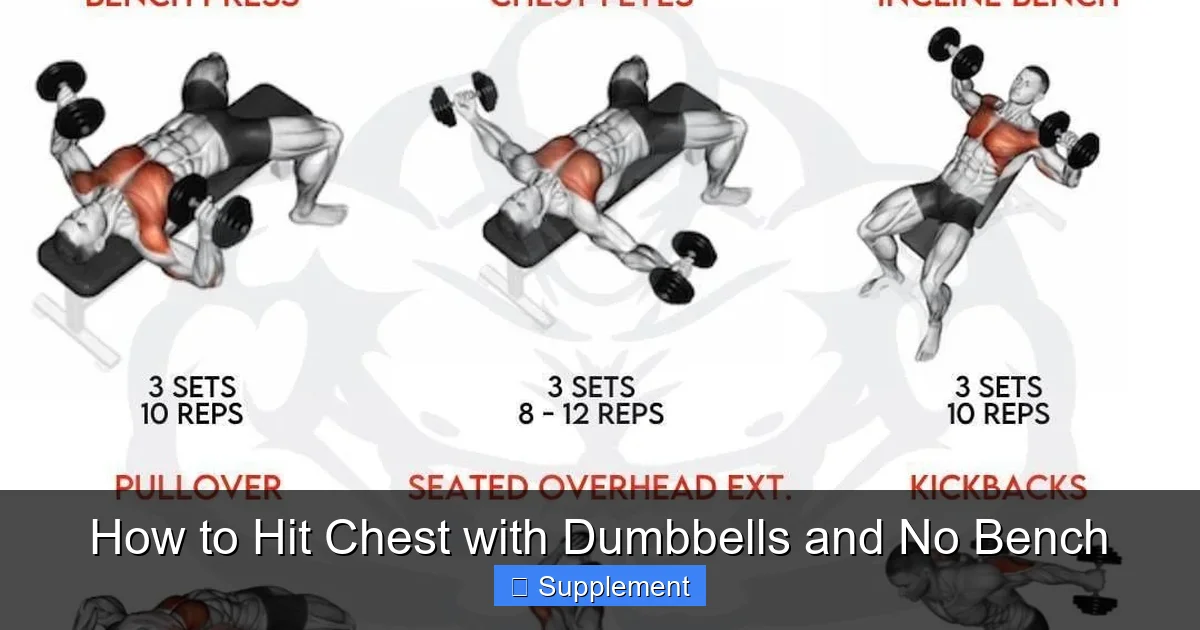
Visual guide about How to Hit Chest with Dumbbells and No Bench
Image source: i.pinimg.com
Mistake 1: Bouncing the Dumbbells Off the Floor
This uses momentum and completely removes tension from your chest. It also jars your shoulder joint.
The Fix: Lower the weight under control until your upper arm gently rests on the floor. Pause for a full second. Think “touch, don’t bounce.”
Mistake 2: Flaring Your Elbows Out
Pointing your elbows out to the sides at a 90-degree angle places immense stress on the shoulder rotator cuff.
The Fix: Tuck your elbows at a 45-degree angle to your torso. Your forearms should be vertical at the bottom of the floor press. This keeps the stress on the chest and the shoulder joint in a safe, stable position.
Mistake 3: Not Using a Full Range of Motion
Partial reps are fine for advanced intensity techniques, but most people cheat by not going deep enough on the negative or not fully locking out (without hyperextending) on the concentric.
The Fix: For presses, touch your upper arm to the floor fully. For flyes, stretch until you feel a deep pull. On the way up, push until your arms are fully extended (but with a soft elbow).
Mistake 4: Rushing the Tempo
Bouncing the weight up and down quickly turns a strength exercise into a momentum exercise.
The Fix: Use a tempo. A great starting point is 3 seconds down, 1-second pause, 1 second up. The slow eccentric (lowering) phase is where the magic happens for muscle growth.
Nutrition and Recovery: The Other Half of the Equation
You can have the perfect workout, but without proper nutrition and recovery, your chest won’t grow. Training breaks down muscle fibers; eating and resting rebuilds them bigger and stronger.
Fuel for Growth
You need to be in a calorie surplus to build muscle. Aim for 250-500 calories above your maintenance level. Most importantly, hit your protein target: aim for 0.7-1 gram of protein per pound of body weight daily. Good sources include chicken, fish, eggs, Greek yogurt, tofu, and protein supplements. Don’t neglect carbohydrates—they fuel your workouts—and healthy fats, which support hormone production. Consider a high-quality whey protein supplement to conveniently meet your daily protein goals, especially post-workout.
Prioritize Sleep and Manage Stress
Growth hormone is released primarily during deep sleep. Aim for 7-9 hours of quality sleep per night. Chronic stress elevates cortisol, a hormone that can break down muscle tissue and promote fat storage. Find ways to manage stress through meditation, walking, or hobbies.
Conclusion: Your Bench-Free Chest is Possible
So, there you have it. The bench is not a gatekeeper to chest development. The floor is your new platform, and your dumbbells are your tools. By mastering the floor press, incorporating weighted push-up variations, and programming intelligently with a focus on control and progression, you can build a chest that is not only big but also strong, healthy, and resilient. The lack of a bench forces you to be more mindful of your form, more connected to the muscle you’re working, and more creative with your training. That’s a good thing. Start with the beginner template, perfect your technique, and gradually add weight and complexity. Listen to your body, prioritize recovery, and fuel your growth. Your future, powerful chest is waiting for you on the floor. Now go press something!
Frequently Asked Questions
Is the dumbbell floor press as effective as the bench press for building chest muscle?
Yes, it is highly effective, but it’s a different stimulus. The floor press is excellent for building strength and size in the mid to lower chest with greater shoulder safety. The bench press allows for a deeper stretch, which can be beneficial for growth. For a complete chest, you should ideally incorporate both, but the floor press alone can absolutely drive significant muscle growth when trained with proper intensity and volume.
Can I really build a full chest without an incline bench?
Absolutely. While an incline press directly targets the upper chest, you can effectively train this area with exercises like decline push-ups (feet elevated), single-arm floor presses with a focus on the top contraction, and even by performing floor presses with your upper back on a slight incline if you have an aerobic step or books. Consistent focus on these movements will develop the upper chest.
What’s the best weight to start with for floor presses?
Start light enough to master the form. A good test: choose a weight you could easily press for 15 reps on a bench. On the floor, with the shorter range of motion, it might feel easier. Perform a set of 10. If the last 2 reps are challenging but you maintain perfect form (no bouncing, controlled descent), that’s a good starting weight. The goal is control, not ego.
How often should I train my chest with this no-bench routine?
2 to 3 times per week is ideal for most lifters. Ensure you have at least 48-72 hours of rest between chest sessions to allow for recovery and muscle growth. For example, training chest on Monday and Thursday, or Tuesday and Friday, works perfectly. More frequent training is possible with lower volume per session, but 2x per week is a sustainable and highly effective sweet spot.
Will I get a good “stretch” in my chest without the bench?
You can, but it’s a different stretch. The floor prevents the extreme, sometimes risky, stretch at the bottom of a bench press. Instead, focus on achieving a deep stretch with exercises like the floor dumbbell flye, where you control the weight into a wide arc until you feel a deep pull across your pectorals. This controlled stretch under tension is actually safer and very effective for muscle growth.
Are weighted push-ups enough on their own for a chest workout?
They are an phenomenal compound movement that can be a cornerstone of your routine. However, for balanced development, it’s wise to pair them with a pressing movement that allows for heavier, more controlled loading (like the floor press) and an isolation movement for the stretch (like flyes). A combination of these three movement patterns will give you the best results.