How Much Time on Stationary Bike to Lose Weight

The time you need on a stationary bike to lose weight isn’t a one-size-fits-all number. It depends on creating a consistent calorie deficit through a combination of ride duration, intensity, and your diet. Generally, aim for 30 to 60 minutes per session, most days of the week, while focusing on nutrition. The key is sustainable, long-term habits, not just clocking minutes.
So, you’ve bought or joined a gym with a stationary bike. Great choice! It’s a low-impact, accessible, and incredibly effective piece of fitness gear for transforming your health. But the burning question on your mind is likely: “How much time on this bike do I actually need to put in to see the number on the scale go down?”
Let’s be clear from the start: there is no magic number. There is no secret “30-minute rule” that guarantees weight loss for everyone. The answer is a dynamic equation that involves your current weight, your effort level, your eating habits, and your lifestyle. This guide will cut through the confusion. We’ll break down the science of calorie burn, give you practical frameworks for duration and intensity, and build a sustainable plan that turns your stationary bike into a powerful weight-loss engine.
Key Takeaways
- Calorie Deficit is King: Weight loss happens when you burn more calories than you consume. The bike is a tool to create that deficit.
- Duration Ranges from 30-60+ Minutes: For significant weight loss, target 150-300 minutes of moderate-intensity cycling weekly.
- Intensity Matters More Than Time: Higher intensity (like HIIT) can yield greater calorie burn and metabolic benefits in less time.
- Consistency Trumps Marathon Sessions: Regular, shorter rides (e.g., 30 min/day) are more effective and sustainable than occasional 2-hour sessions.
- Nutrition is 80% of the Battle: You cannot out-exercise a poor diet. The bike complements, but does not replace, healthy eating.
- Track Progress Beyond the Scale: Use measurements, photos, and how your clothes fit, as muscle gain can mask fat loss on the scale.
- Listen to Your Body & Rest: Overtraining leads to injury and burnout. Incorporate rest days and active recovery for long-term success.
📑 Table of Contents
- The Foundation: Understanding Weight Loss Science
- Determining Your Personal Time & Intensity Framework
- Maximizing Every Minute: Intensity Techniques for the Bike
- The Unavoidable Truth: Nutrition is 80% of the Equation
- Tracking Progress & Avoiding Common Plateaus
- Conclusion: Your Sustainable Stationary Bike Journey
The Foundation: Understanding Weight Loss Science
Before we talk minutes, we must talk metabolism. Weight loss, at its most fundamental level, is about energy balance. The law of thermodynamics applies: if you consume more energy (calories) than you expend, you gain weight. If you expend more than you consume, you lose weight. The stationary bike’s job is to help you tilt that balance toward expenditure.
The Calorie Deficit Explained
A “calorie deficit” is the non-negotiable state for fat loss. To lose one pound of body fat, you need a total deficit of approximately 3,500 calories. This doesn’t mean you need to burn 3,500 calories in one go! It means over days and weeks, your total “calories out” must exceed your total “calories in” by that cumulative amount.
Your daily calorie needs (Total Daily Energy Expenditure or TDEE) are made up of:
- BMR (Basal Metabolic Rate): Calories your body burns at complete rest. This is your engine’s idle speed.
- NEAT (Non-Exercise Activity Thermogenesis): Calories burned through all daily movement (walking, fidgeting, chores).
- EAT (Exercise Activity Thermogenesis): Calories burned during planned exercise—this is where your bike comes in.
- TEF (Thermic Effect of Food): Calories burned digesting food.
When you hop on the bike, you’re increasing your EAT. A 155-pound person burns roughly:
- Moderate (12-13.9 mph): ~260 calories in 30 minutes.
- Vigorous (14-15.9 mph): ~335 calories in 30 minutes.
- Very Vigorous (16+ mph): ~400+ calories in 30 minutes.
Note: These are estimates. Actual burn depends on weight, age, gender, muscle mass, and genetics. A heart rate monitor or fitness tracker with a chest strap provides the most accurate data.
Why “Time” is a Variable, Not a Fixed Answer
If a 155-pound person burns ~260 calories in 30 minutes of moderate cycling, they’d need about 13-14 sessions to burn one pound of fat (3,500 / 260 = ~13.5), assuming diet stays the same. But that’s an oversimplification. Here’s why:
- Metabolic Adaptation: As you lose weight, your BMR drops slightly because a smaller body burns fewer calories at rest. You may need to adjust calories or increase effort over time.
- Muscle Gain: If you’re new to resistance training (even on the bike with high resistance), you might build leg muscle. Muscle is denser than fat, so the scale might not move much, but your body composition improves. This is why tracking measurements is crucial.
- The “Afterburn” Effect (EPOC): High-intensity workouts create an “excess post-exercise oxygen consumption” (EPOC) effect, where your body continues to burn extra calories for hours after the ride as it recovers. A 20-minute HIIT session can sometimes lead to greater total daily calorie burn than a 40-minute steady-state ride.
So, the question isn’t just “how long?” It’s “how long at what intensity, and combined with what diet?”
Determining Your Personal Time & Intensity Framework
Now for the practical part. Based on major health organizations like the CDC and ACSM, here are the evidence-based guidelines for exercise to promote weight loss and health.

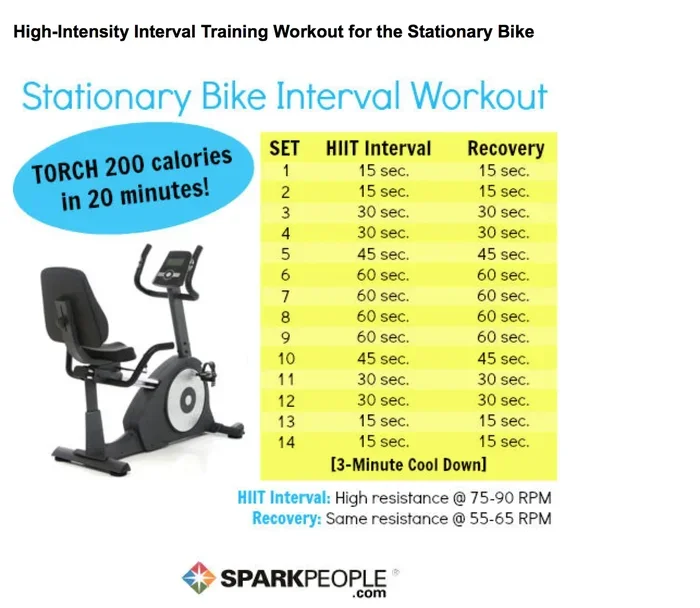
Visual guide about How Much Time on Stationary Bike to Lose Weight
Image source: s-media-cache-ak0.pinimg.com
The Weekly Minimum: 150 Minutes of Moderate Activity
The foundational public health recommendation is at least 150 minutes of moderate-intensity aerobic activity per week. For weight loss, research consistently shows that 300 minutes per week (or more) yields significantly better results. This is your target range.
Let’s translate that to your stationary bike:
- Weight Loss Starter Goal: 150-200 minutes/week. That’s 30-40 minutes, 5 days a week.
- Optimal Weight Loss Goal: 250-300+ minutes/week. That’s 50-60 minutes, 5 days a week, or 30 minutes, 7 days a week.
What does “moderate-intensity” feel like? On a scale of 1-10 (RPE or Rate of Perceived Exertion), it’s a 5-6. You’re breathing deeper, you can talk in short sentences but not sing. Your heart rate should be roughly 64-76% of your max heart rate (220 – your age).
The Power of High-Intensity Interval Training (HIIT)
If you’re crunched for time, HIIT is your best friend. It alternates short bursts of all-out effort with periods of low-intensity recovery or rest.
Example Stationary Bike HIIT Workout (20-25 minutes total):
- 5 min warm-up (easy pace)
- Repeat 8-10 times:
- 30 seconds ALL-OUT sprint (RPE 9-10)
- 60-90 seconds very easy recovery (RPE 2-3)
- 5 min cool-down (easy pace)
Why HIIT works for weight loss:
- Time Efficiency: You get comparable or superior calorie burn and metabolic benefits in half the time of steady-state cardio.
- EPOC Boost: It creates a larger afterburn effect, keeping your metabolism elevated post-workout.
- Preserves Muscle: Some studies suggest HIIT is better at sparing muscle mass during weight loss compared to long, slow cardio.
Caveat: HIIT is high-stress. It should not be done every day. Limit HIIT to 2-3 sessions per week, with the rest of your weekly minutes filled with moderate, steady-state rides or other low-impact activities.
Finding Your “Sweet Spot”: The Blend Approach
The most effective and sustainable approach for most people is a blend:
- 3-4 days of Moderate, Steady-State (MISS): 45-60 minutes at a consistent, conversational pace. This builds aerobic endurance, burns a high number of calories per session, and is mentally manageable.
- 1-2 days of HIIT: 20-30 minutes of intervals. This boosts metabolism and adds variety.
- 1-2 days of Active Recovery or Rest: Light stretching, walking, or complete rest. This is when your body repairs and gets stronger.
Sample Weekly Plan (Total ~275 minutes):
- Monday: MISS – 50 minutes
- Tuesday: HIIT – 25 minutes
- Wednesday: MISS – 45 minutes
- Thursday: Rest or Light Walk
- Friday: MISS – 50 minutes
- Saturday: HIIT – 25 minutes
- Sunday: MISS – 40 minutes
Maximizing Every Minute: Intensity Techniques for the Bike
Once you know how long to ride, you must make those minutes count. Here’s how to optimize your effort on the stationary bike.

Visual guide about How Much Time on Stationary Bike to Lose Weight
Image source: 1.bp.blogspot.com
Resistance is Your Best Friend
Don’t just spin at zero resistance! That’s “fake cycling.” To build leg strength, burn more calories, and mimic real-world hills, you must increase the resistance knob or gear on your bike.
- Low Resistance (Easy/Flat Road): Good for warm-ups, cool-downs, and active recovery. Calorie burn per minute is lower.
- Moderate-High Resistance (Hill Climb): This is where the magic happens for weight loss. Pushing against resistance builds muscle in your quads, hamstrings, and glutes. More muscle = higher resting metabolic rate. It also dramatically increases the calorie burn per minute.
Practical Tip: During your steady-state rides, incorporate “hill intervals.” Every 5 minutes, increase your resistance 2-3 levels for 1-2 minutes, then return to your base level. This breaks up monotony and spikes your effort.
Cadence (Pedaling Speed) and Its Role
Cadence is measured in revolutions per minute (RPM). For weight loss:
- Higher Cadence (80-100 RPM) with Lower Resistance: This is cardiovascular-focused. It’s great for building endurance and is easier on the joints.
- Lower Cadence (60-80 RPM) with Higher Resistance: This is strength-focused. It’s more muscularly demanding, builds power, and can lead to a higher calorie burn per pedal stroke.
For overall fitness and weight loss, a mix is ideal. Try to spend most of your ride between 70-90 RPM, adjusting resistance to control intensity. If you’re doing a “climb” interval, let your RPM drop to 60-70 as you push harder against the resistance.
Using the RPE Scale (Your Built-in Monitor)
Not everyone has a heart rate monitor. The Rate of Perceived Exertion (RPE) scale of 1-10 is your most accessible tool.
- 1-2: Very, very easy. Barely moving.
- 3-4: Easy. Comfortable, can hold a full conversation.
- 5-6: Moderate. Breathing deeper, can talk in short sentences. This is your primary “fat-burning zone” for steady-state.
- 7-8: Hard. Difficult to talk more than a few words. This is your threshold/HIIT work zone.
- 9-10: Very, very hard. Maximal effort. Can only speak a single word. Used for short sprints.
Structure your rides around these zones. A good 45-minute ride might look like: 10 min warm-up (RPE 3-4), 30 min main set alternating 5 min at RPE 6 and 2 min at RPE 4, 5 min cool-down (RPE 2-3).
The Unavoidable Truth: Nutrition is 80% of the Equation
I cannot say this enough: You cannot out-exercise a bad diet. You could cycle for an hour and burn 500 calories, but then consume an 800-calorie smoothie and a muffin, and you’ve just moved backward. The bike creates the opportunity for a deficit, but your food choices determine the outcome.

Visual guide about How Much Time on Stationary Bike to Lose Weight
Image source: trikeadviser.com
How to Eat to Support Your Cycling Habit
This is not about extreme dieting. It’s about smart fueling.
- Don’t Undereat: Drastically cutting calories while exercising intensely will leave you exhausted, hungry, and more likely to binge or quit. Your body needs fuel to perform and recover. Use a TDEE calculator online to find your maintenance calories, then subtract 300-500 calories for a moderate, sustainable deficit.
- Prioritize Protein: Protein is crucial for muscle repair (especially after a ride), and it increases satiety (feeling full). Aim for 0.7-1 gram of protein per pound of target body weight. Include lean sources like chicken, fish, eggs, Greek yogurt, tofu, and legumes in every meal.
- Fuel Your Rides Smartly: For rides under 60 minutes at a moderate pace, water is usually sufficient. For longer or more intense sessions (like your HIIT day), a small pre-workout snack (e.g., a banana 30-60 min prior) can improve performance and prevent post-ride hunger crashes.
- Mind Your Post-Ride Habits: It’s easy to think, “I earned this treat!” A 30-minute moderate ride burns ~260 calories. That’s one store-bought muffin or a large latte with syrup. Be mindful of post-exercise eating. A balanced meal with protein and complex carbs (like chicken and sweet potato) is a far better choice.
You don’t need to count calories forever, but tracking for 1-2 weeks can be an eye-opening education on portion sizes and hidden calories.
Tracking Progress & Avoiding Common Plateaus
You’re riding consistently, you’re watching your food—and then… the scale stops moving. This is a normal, frustrating part of the process called a plateau. Here’s how to track correctly and break through.
Ditch the Scale obsession (Sometimes)
The scale is a liar. It doesn’t differentiate between fat, muscle, water, and gut contents. A better strategy is a multi-faceted tracking system:
- Weekly Measurements: Use a tape measure on your waist, hips, thighs, and arms. A loss of inches is a win, even if the scale doesn’t budge.
- Progress Photos: Take front, side, and back photos in the same lighting/clothes every 2-4 weeks. Visual changes are often more dramatic than scale changes.
- How Clothes Fit: This is the ultimate real-world metric. Are your jeans looser? Does your shirt feel less tight?
- Performance Gains: Track your ride metrics! Can you now ride at a higher resistance for the same time? Can you recover faster between HIIT intervals? Increased fitness is a huge non-scale victory.
Breaking the Plateau: When to Change Things Up
Your body is an adaptation machine. It gets efficient. To keep losing, you need to challenge it in new ways.
- Increase Duration or Frequency: If you’ve been doing 30 minutes, 4 days a week, try adding 5 minutes to each ride or adding a 5th day.
- Increase Intensity: Add more resistance. Make your HIIT intervals 5 seconds longer. Push your steady-state pace into a higher RPE zone.
- Change the Modality: Your body adapts to cycling. Add 1-2 days of strength training (squats, lunges, push-ups) to build muscle, which boosts metabolism. Even bodyweight exercises at home help.
- Re-assess Your Diet: As you lose weight, your calorie needs drop. Have you been “eating back” your exercise calories? Be honest. Use your tracking data to see if your portion sizes have crept up.
Conclusion: Your Sustainable Stationary Bike Journey
So, how much time on a stationary bike to lose weight? Let’s synthesize it all.
Start with the goal of 150-300 minutes of moderate-intensity cycling per week, blended with 1-2 HIIT sessions. That translates to 30-60 minutes per day, 4-6 days a week. But remember, a 30-minute high-effort ride is often more valuable than a 60-minute lazy spin.
However, your success hinges on the trifecta: Consistent Effort on the Bike + Intelligent Nutrition + Adequate Recovery. The bike is your powerful, low-impact vehicle for burning calories and building fitness. But you must fuel it properly with food and give it time to rest.
Begin where you are. If you can only do 20 minutes today, do it. Tomorrow, try 22. Build the habit. Celebrate the non-scale victories. Focus on how you feel—more energy, better sleep, stronger legs. The weight loss will follow as a natural consequence of a healthier, more active lifestyle. Your stationary bike isn’t just a machine for losing weight; it’s a gateway to a more vital, capable you. Now, go turn that knob up and pedal with purpose.
Frequently Asked Questions
What is the absolute minimum time on a stationary bike to see weight loss results?
While any movement is beneficial, research suggests that for measurable weight loss, you should aim for at least 150 minutes of moderate-intensity exercise per week. This could be 30 minutes, 5 days a week. Anything less may improve health but will likely create too small a calorie deficit for significant fat loss without major dietary changes.
Is it better to cycle for longer at a low intensity or shorter at a high intensity for weight loss?
Both work, but they serve different purposes. Longer, steady-state rides (45-60 min) burn more total calories per session and are great for building endurance. Shorter, high-intensity interval training (HIIT, 20-30 min) burns more calories per minute and creates a greater afterburn effect (EPOC). For optimal results, blend both approaches in your weekly routine.
Can I lose weight by cycling 30 minutes a day?
Yes, absolutely, if you combine it with a healthy diet. A daily 30-minute moderate ride burns roughly 250-350 calories. Over a week, that’s a potential 1,750-2,450 calorie deficit. Combined with a modest 300-calorie daily reduction from your diet, you could create a 500-800 calorie daily deficit, leading to 1-1.5 pounds of fat loss per week. Consistency is key.
Should I cycle every single day to lose weight faster?
Not necessarily. Your body needs recovery to repair and get stronger. Overtraining increases injury risk and can lead to burnout. A better strategy is 4-6 days of cycling per week, mixing intensities, and incorporating 1-2 days of complete rest or very light activity like walking. This allows for consistent progress without derailing you with injury or exhaustion.
What if my weight hasn’t changed after a month of regular cycling?
First, don’t panic. The scale is a poor tracker of body composition. Check your measurements and how your clothes fit—you’ve likely lost fat and gained some muscle. Second, honestly evaluate your diet. Are you inadvertently consuming more calories? Use a tracking app for a week. Third, you’ve adapted! It’s time to increase your ride intensity, duration, or resistance to challenge your body anew.
Is it safe to do a stationary bike workout every morning on an empty stomach for faster fat loss?
This practice, called “fasted cardio,” is debated. While some studies suggest it may increase the percentage of fat burned *during* the workout, the total daily calorie burn is what matters most for weight loss. For many people, fasted intense exercise can lead to low energy, poor performance, and increased hunger later, potentially leading to overeating. A small, easily digestible snack (like half a banana) before your ride is often a better strategy for sustainability and performance.