How Many Steps on an Elliptical Is a Mile

The number of steps on an elliptical that equals a mile is not a fixed number. It depends entirely on your specific machine’s stride length and your personal gait. A common estimate is 2,000 steps per mile, but this can range from 1,500 to over 2,500 steps. Instead of chasing a precise step count, focus on your perceived exertion, time, and heart rate for a more effective and less frustrating workout.
Key Takeaways
- No Universal Standard: There is no single, correct step count for a mile on an elliptical because machines have different stride lengths and users have different step mechanics.
- Stride Length is Key: The primary factor is the machine’s stride length (the distance from one full pedal cycle’s front to back), typically 14″-22″. Longer strides mean fewer steps per mile.
- It’s Not “Real” Walking: Elliptical motion is a glide, not a step. Calibrating elliptical steps to outdoor walking steps is an imperfect science and not a reliable fitness metric.
- Focus on Effort, Not Steps: Metrics like time, distance, resistance level, and heart rate are far more accurate and useful for tracking progress and intensity than a fluctuating step count.
- Your Form Matters: Your personal stepping pattern—whether you take long, deliberate strides or short, quick ones—will change your step count on the same machine.
- Manufacturer Estimates Are Rough: Any step counter on an elliptical is an estimate based on an assumed average stride. Treat it as a loose guide, not a precise measurement.
- Consistency is What Counts: The most important factor is using the machine consistently at a challenging intensity. Comparing your step count to someone else’s or to a treadmill is often meaningless.
📑 Table of Contents
- The Great Elliptical Mystery: Why There’s No Simple Answer
- How Elliptical Machines Count Steps: The Mechanics Behind the Number
- Personal Factors: Why Your Count Differs From Your Friend’s
- Busting the Myth: Comparing Elliptical Steps to Outdoor Walking Steps
- So, What’s the Actual Number? Estimates and Ranges
- What You Should Track Instead: Meaningful Metrics for Real Results
- Practical Tips: Making Your Elliptical Workout Work For You
- Conclusion: Free Yourself from the Step Count
The Great Elliptical Mystery: Why There’s No Simple Answer
You’ve hopped on the elliptical, started your workout, and glanced at the console. It’s flashing a number: steps. Maybe you’re trying to hit 10,000 steps a day. Maybe you’re wondering how this translates to the miles you used to track on your morning run. The question seems simple: how many steps on an elliptical is a mile? But if you’ve searched for an answer, you’ve likely found a frustrating range of numbers—2,000 steps, 2,400 steps, 3,000 steps. Who’s right?
The truth is, there is no universal, scientifically agreed-upon conversion. The step you see on your elliptical’s display is not a direct, standardized measurement like a mile on a treadmill’s belt. It’s an estimate generated by the machine’s computer based on its own internal assumptions. To understand why, we need to dive into the mechanics of the elliptical itself and separate fitness myth from practical reality. This guide will unravel the mystery, giving you the knowledge to use your elliptical more effectively, without getting hung up on a misleading number.
How Elliptical Machines Count Steps: The Mechanics Behind the Number
To grasp why the step count is so variable, you must first understand how an elliptical “counts” a step. Unlike a pedometer on your wrist that senses your hip movement, or a treadmill that measures belt rotation, an elliptical uses a different method. Most modern ellipticals use a sensor on the flywheel or crank arm to count revolutions.

Visual guide about How Many Steps on an Elliptical Is a Mile
Image source: images.squarespace-cdn.com
The Revolution-to-Step Conversion
One full rotation of the pedals (from the frontmost point, all the way around, and back to the front) is counted as one revolution. The machine’s computer then converts these revolutions into “steps” and “distance” using a pre-programmed stride length factor. This factor is the manufacturer’s best guess at the average distance a user travels per revolution. It’s a fixed number stored in the machine’s firmware.
- The Formula (Simplified): Distance = (Revolutions) x (Assumed Stride Length). Steps are then often calculated by dividing that distance by an assumed average human walking step length (usually around 2.5 feet).
This means the step count is two conversions deep: revolutions to distance (using the machine’s stride), then distance to steps (using a generic step length). Both conversions involve assumptions, which is where the major inaccuracies creep in.
Stride Length: The Heart of the Matter
The single biggest variable is the designated stride length of your elliptical. This is the maximum linear distance the pedal travels from its furthest forward point to its furthest backward point. It’s a fixed specification of the machine, usually listed in the product details.
- Compact/Home Models: Often have stride lengths of 14″-16″. These require a higher step turnover to cover the same distance as a longer-stride machine.
- Commercial/Gym Models: Typically feature 20″-22″ stride lengths, mimicking a more natural, longer gait. This results in fewer counted steps per revolution.
If Machine A has a 16″ stride and Machine B has a 20″ stride, Machine B will register significantly fewer steps to complete the same number of pedal revolutions because it assumes each revolution covers more ground.
Personal Factors: Why Your Count Differs From Your Friend’s
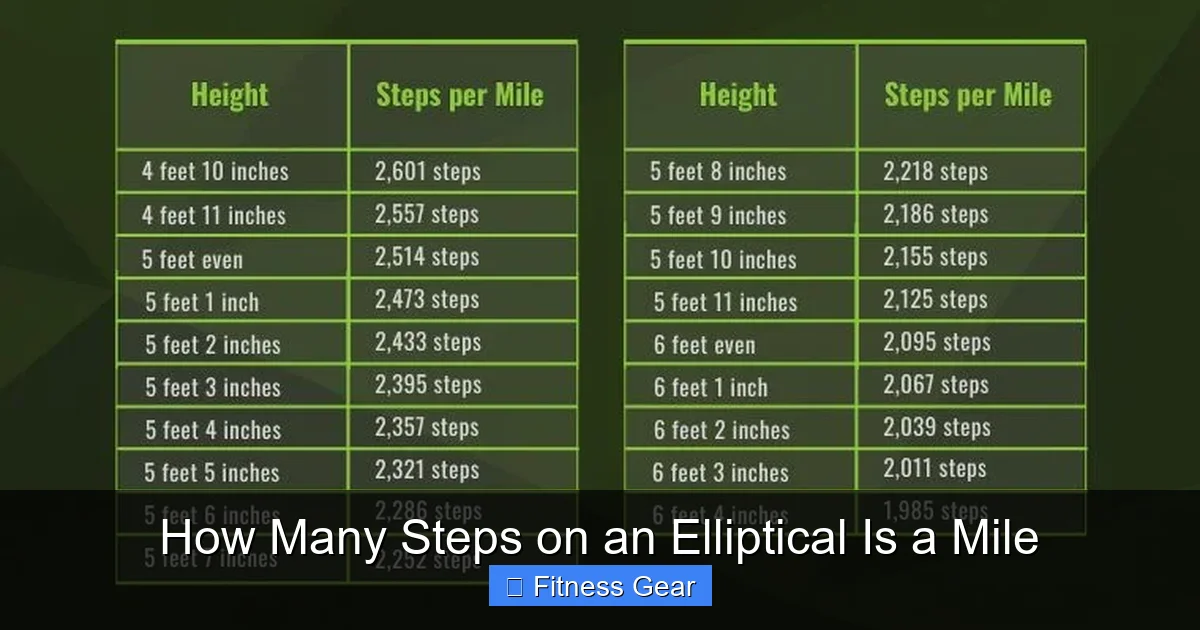
Even if you and a friend are on the exact same elliptical model, your step counts for the same workout will likely differ. Why? Because the machine’s conversion doesn’t account for your individual physiology and technique.
Visual guide about How Many Steps on an Elliptical Is a Mile
Image source: barbend.com
Your Unique Gait and Form
The machine assumes an average, efficient stride. But you might have a naturally shorter or longer stride. Your form on the elliptical—how far you allow your feet to travel front-to-back, whether you “walk” with high knee lift or “glide” with minimal motion—directly impacts the actual distance your body moves per revolution. If you take short, choppy steps, you’ll rack up more step counts. If you use a full, smooth range of motion, you’ll register fewer steps, even though your work output might be identical or greater.
Resistance and Incline: The Hidden Step-Killers
Increasing resistance or incline makes the workout harder by demanding more force from your muscles, but it does not increase the distance the pedals travel per revolution (the stride length remains fixed). Therefore, a high-resistance, slow-and-powerful workout will generate the same or even fewer step counts than a low-resistance, fast-and-bouncy session, despite being a far more intense and beneficial workout. This decouples step count from effort, rendering it a poor metric for intensity.
Speed vs. Cadence
On an elliptical, your speed (mph or kph) is calculated from your cadence (revolutions per minute) and the machine’s fixed stride length. If you speed up your cadence, both your speed and your step count will rise. But again, this is a direct function of the machine’s programming, not a measure of your actual biomechanical steps.
Busting the Myth: Comparing Elliptical Steps to Outdoor Walking Steps
The most pervasive myth is that 2,000 elliptical steps equal one mile because 2,000 walking steps (with an average 2.5-foot stride) roughly equal one mile (2,000 x 2.5 ft = 5,000 ft, or ~0.95 miles). This is a convenient rule of thumb for overground walking, but it falls apart on the elliptical for several critical reasons.

Visual guide about How Many Steps on an Elliptical Is a Mile
Image source: runwithcaroline.com
The Motion is Fundamentally Different
Walking is a discrete, weight-bearing activity. You pick up one foot, put it down, and propel your body forward against gravity. There’s a clear “step” event. The elliptical motion is a continuous, non-weight-bearing glide. Your feet never leave the pedals. The motion is a smooth oval, not a heel-to-toe progression. The machine’s attempt to translate this smooth, circular motion into discrete “steps” is inherently arbitrary.
Energy Expenditure Disconnect
Studies and practical experience show that for many people, a mile on an elliptical feels and expends energy more like 1.5 to 2 miles of brisk walking, depending on resistance and effort. Yet, the step count might suggest you’ve only done the equivalent of one mile of walking. This creates a misleading perception of your effort. You could be burning significantly more calories than your step count would imply.
The Practical Implication: Chasing a False Target
If your goal is to match the energy output of a 3-mile walk, you might aim for 6,000 elliptical steps based on the 2,000-steps-per-mile rule. But on a long-stride machine with high resistance, you might achieve the same or greater calorie burn in 4,000 steps. By fixating on hitting 6,000 steps, you’d be doing unnecessary extra work. Conversely, on a short-stride machine, 6,000 steps might represent a much higher energy output, potentially leading to overexertion if you’re used to a different machine.
So, What’s the Actual Number? Estimates and Ranges
Given all these variables, we can only provide broad estimates based on common machine types and average user form. Think of these as ballpark figures, not gospel.
General Estimates by Stride Length
Using the common 2.5-foot walking step length as a baseline for the machine’s internal conversion:
- 16″ Stride Length (Compact Home Ellipticals): ~2,250 – 2,500 steps per mile.
- Calculation: A 16″ stride is 1.33 feet. 5,280 ft (1 mile) / 1.33 ft/rev = ~3,966 revolutions. If the machine then divides by 2.5 ft/step, you get ~1,586 steps. However, machine programming varies, and users often take shorter *effective* strides, pushing the count higher. The 2,250-2,500 range is a common real-world observation.
- 20″ Stride Length (Standard Commercial Ellipticals): ~1,900 – 2,200 steps per mile.
- Calculation: 5,280 ft / 1.67 ft/rev = ~3,163 rev. / 2.5 ft/step = ~1,265 steps. Again, real-world counts are higher due to user stride inefficiency and programming, landing in the 1,900-2,200 range.
- 22″ Stride Length (Long-Stride/Advanced Models): ~1,700 – 2,000 steps per mile.
Important: These are still approximations. Your personal count on a given machine could easily be 200-300 steps higher or lower based on your form and the machine’s specific software.
What You Should Track Instead: Meaningful Metrics for Real Results
If step count is such a flawed and variable metric, what should you focus on to ensure you’re getting a great, effective workout? Ditch the step obsession and zero in on these far more reliable indicators.
Time and Intensity (The Golden Duo)
The simplest and most effective approach is to base your workout on time and perceived exertion. The American College of Sports Medicine recommends 150 minutes of moderate-intensity cardiovascular exercise per week. On your elliptical, this means:
- Moderate Intensity: You can talk in short sentences, but not sing. Your breathing is elevated. You feel a light sweat after 10 minutes.
- Vigorous Intensity: You can only say a few words at a time. Breathing is heavy and deep. Sweating begins quickly.
Set a goal of 30 minutes at a moderate pace, or 20 minutes at a vigorous pace. Use the Talk Test as your real-time guide. This eliminates all machine-to-machine variability.
Heart Rate: Your Objective Intensity Gauge
A heart rate monitor (chest strap or optical sensor) is the single best tool for an elliptical. It gives you an objective measure of effort, independent of stride length or machine quirks. Calculate your target heart rate zones (e.g., 50-70% of max heart rate for fat burn, 70-85% for cardio). Aim to spend a certain amount of time in your desired zone. This tells you exactly how hard your cardiovascular system is working.
Resistance Level and Programmed Workouts
Ellipticals are designed with resistance systems for a reason. A workout at Level 5 for 20 minutes is objectively harder than Level 2 for the same time, regardless of step count. Utilize the machine’s pre-set programs (like intervals, hills, or cardio blast). These programs automatically manipulate resistance and sometimes ramp (incline simulation) to structure your intensity. Your goal becomes completing the program as prescribed.
Calories Burned: A Cautionary But Useful Estimate
While also an estimate, the calorie readout is often more consistent between machines than step count, as it’s primarily based on your entered weight, heart rate (if connected), and the workout’s intensity (resistance/speed). Use it as a relative benchmark—aim to burn 300-500 calories per session, for example. Don’t take the number as absolute truth, but use it to compare your effort on the same machine over time.
Practical Tips: Making Your Elliptical Workout Work For You
Armed with the knowledge that step count is a fuzzy metric, here’s how to practically apply it and get the most from your sessions.
1. Use Steps as a Consistency Metric, Not a Distance Metric
Instead of thinking “I need 3,000 steps for a mile,” think “I want to complete 30 minutes.” Then, use the step count as a loose indicator of your pace consistency. If on Week 1 you average 150 steps per minute (SPM) for 30 minutes (4,500 steps), and on Week 4 you average 165 SPM for the same 30 minutes (4,950 steps), you know you’ve improved your cadence and likely your cardiovascular fitness. The absolute number is less important than the trend on the same machine.
2. Measure Your Own Stride
Want a personalized estimate? You can do a simple test. Set the elliptical to a low resistance. Pedal at a comfortable, steady pace for 2 minutes, noting the average SPM from the console. Then, manually count your revolutions for one full minute to verify. Now, measure your actual effective stride. With the pedals level, place a piece of tape on the floor in front of the machine. Step onto the pedal at its furthest forward point, mark that spot on the floor. Step to the furthest back point and mark it. Measure the distance between the marks in inches. This is your personal, in-use stride length on that machine. You can now calculate a more accurate personal steps-per-mile: (63,360 inches per mile) / (Your Stride Length in inches) = Your estimated steps per mile. This will still be an estimate, but it’s tailored to you.
3. Ignore Cross-Machine Comparisons
Do not compare your step count from the gym’s commercial 20″ stride elliptical to your home 16″ stride machine. The numbers are from different planets. If you switch machines, reset your expectations. Base your workout on time, heart rate, and how you feel. The 30 minutes you did on the long-stride machine is the same 30 minutes on the short-stride machine, even if the step count differs by 1,000.
4. Prioritize Full Range of Motion
Resist the temptation to take quick, shallow steps to inflate your step count. This reduces the effectiveness of the workout and can lead to knee or hip discomfort. Focus on a smooth, controlled, full range of motion. Let your legs extend fully in the back and comfortably reach forward. This engages more muscle groups (glutes, hamstrings) and provides a better workout, even if your step count is lower.
5. Sync with Other Fitness Trackers Wisely
If you wear a fitness tracker (Fitbit, Apple Watch, Garmin), it will likely count your elliptical motion as steps via arm movement. This will create a dual step count: one on the elliptical console, one on your wrist. They will not match. Decide which one matters for your daily goal. Most experts recommend relying on the elliptical’s internal metrics for that specific session and either ignoring or manually adjusting your tracker’s count, or simply not wearing it during dedicated elliptical workouts to avoid confusion.
Conclusion: Free Yourself from the Step Count
The pursuit of a definitive answer to “how many steps on an elliptical is a mile” leads to a dead end of confusion and frustration. The number is a phantom, a product of machine programming and user variance, not a true measure of distance or effort. Chasing a specific step target on different ellipticals is like trying to measure a gallon of water with cups of different sizes—the number will change based on the tool.
The real power of the elliptical lies in its ability to provide a low-impact, adjustable, full-body cardiovascular workout. Your success should be measured by the time you dedicate, the intensity you sustain (monitored via heart rate or perceived exertion), the resistance you conquer, and the consistency of your routine. Let go of the step count as a primary metric. Instead, listen to your body, use a heart rate monitor if possible, and focus on completing your planned workout with good form. When you shift your focus from an arbitrary number to the tangible feeling of strength, endurance, and accomplishment, you unlock the true potential of your elliptical and build lasting fitness habits that no machine’s console can accurately tally.
Frequently Asked Questions
Is the step count on an elliptical accurate?
No, it is not an accurate representation of actual steps taken, as it’s based on a pre-programmed conversion from pedal revolutions using an assumed average stride length. It’s best used as a rough estimate of workout volume on that specific machine.
Should I use my elliptical steps to contribute to my daily 10,000-step goal?
It’s not recommended. The conversion is unreliable and will inflate or deflate your true ambulatory step count. If you must, only add a fraction (e.g., 50-75%) of your elliptical step count to your daily total, or better yet, focus on your dedicated walk/run steps separately.
What is a good stride length for an elliptical?
For most adults, a stride length of 20″-22″ is considered optimal for a natural, full range of motion and effective workout. Shorter stride lengths (14″-16″) are common in compact models but may feel cramped for taller users and lead to a higher, less accurate step count.
Can I use distance instead of steps on an elliptical?
Yes, the distance reading is slightly more consistent than steps, as it’s directly calculated from revolutions x machine stride length. However, it still relies on the manufacturer’s programmed stride length, which may not match your actual movement. Use it as a relative measure on the same machine.
Does higher resistance on an elliptical increase steps per mile?
No. Higher resistance makes the workout harder by increasing force requirement, but it does not change the distance the pedal travels per revolution (the stride length). Therefore, for the same time, a higher resistance workout may actually have the same or fewer steps than an easy, fast-paced low-resistance session.
Why do I feel like I worked much harder than my step count suggests?
This is common. Your effort is tied to resistance, speed, and heart rate, not step count. A challenging interval session with high resistance might yield fewer steps than a mindless, low-resistance 30-minute bounce, yet the former is vastly more effective for building fitness and burning calories. Always prioritize how you feel over the step number.