For beginners, elliptical workouts should start at just 10-15 minutes per session. Focus on consistent, low-intensity movement rather than pushing too hard too soon. Gradually increase duration by 2-5 minutes weekly as your fitness improves, always prioritizing proper form and listening to your body to avoid injury.
You’ve made the brilliant decision to start your fitness journey with an elliptical machine. It’s a fantastic choice—low impact, full-body, and incredibly beginner-friendly. But as you stand before it, a very common and very valid question pops into your head: “How long should a beginner workout on an elliptical?” The desire to do it “right” is strong, but the fear of doing too much or too little is stronger. Let’s completely erase that anxiety. The answer is not a magic number, but a principle: start deceptively short. Your goal for the first few weeks is not to conquer the machine, but to befriend it. We’re going to break down exactly what that means, why it works, and how to build from there safely and effectively.
Key Takeaways
- Start Extremely Short: Begin with just 10-15 minute sessions to build a habit without overwhelming your body or mind.
- Form Over Duration: Prioritize correct posture and smooth motion from the start; 10 perfect minutes are better than 20 sloppy ones.
- Consistency is King: Three short sessions per week are far more effective than one long, miserable session for building lasting fitness.
- Progress Gradually: Increase your workout time by only 2-5 minutes per week once the current duration feels easy.
- Listen to Your Body: Muscle fatigue is normal; sharp pain, dizziness, or extreme breathlessness are signals to stop immediately.
- It’s a Marathon: Your goal is to build a sustainable, enjoyable habit for life, not to burn out in the first week.
- Consult When Needed: If you have pre-existing health conditions, get clearance from a doctor before starting any new exercise.
📑 Table of Contents
- Why the Elliptical is a Beginner’s Best Friend
- The Golden Rule for Beginners: Start With 10-15 Minutes
- Building Your First Weekly Routine: More Important Than One Long Session
- Common Beginner Mistakes That Sabotage Duration (And How to Fix Them)
- How to Safely Progress Your Duration After the First Month
- Safety and Wellness: The Non-Negotiables
- Conclusion: Your Journey Starts With a Single (Short) Step
Why the Elliptical is a Beginner’s Best Friend
Before we dive into the clock, it’s crucial to understand why the elliptical is such a standout piece of gear for someone just starting out. This context will make the duration guidelines make perfect sense.
The “No-Pain” Advantage
Unlike running on a treadmill or pounding the pavement, the elliptical provides a smooth, gliding motion. There is no jarring impact on your ankles, knees, hips, or spine. Your feet never leave the pedals, which means you’re not slamming your body weight down with each stride. For a beginner, this is everything. It allows you to move for longer periods without the crippling muscle soreness (DOMS) or joint pain that can derail a new routine after just one session. This low-impact nature means you can focus on learning movement patterns and building cardiovascular endurance without the penalty of recovery days lost to injury.
A Full-Body Introduction
Most cardio machines isolate your lower body. The elliptical, with its moving handlebars, engages your legs and your arms, shoulders, and back. This dual-action means you’re burning more calories per minute than on a stationary bike and building more overall muscle tone. For a beginner, this is a huge efficiency win. You’re getting a comprehensive workout in one session, which is motivating and sets a strong foundation for more advanced training later.
It’s Incredibly Forgiving and Adjustable
The elliptical has a built-in “easy button.” You control everything: the resistance (how hard it is to push/pull), the incline (which mimics walking uphill), and the stride rate. If you’re winded, you can drop the resistance to almost nothing and just glide, still moving but with minimal effort. This adjustability is a psychological lifesaver. It means you can always make the workout match your energy level on any given day, preventing the all-or-nothing thinking that leads to quitting. You never have to stop completely; you can always just ease up.
The Golden Rule for Beginners: Start With 10-15 Minutes
So, here it is, the direct answer to “how long should a beginner workout on an elliptical?” For your very first session, aim for 10 to 15 minutes of continuous movement. That’s it. Not 30. Not 20. Ten to fifteen.

Visual guide about How Long Should a Beginner Workout on an Elliptical
Image source: media-cldnry.s-nbcnews.com
Why Such a Short Time Feels “Too Easy” (And That’s the Point)
Your brain is screaming that this isn’t a “real” workout. Ignore it. Here’s why this strategy is genius:
- It Builds the Habit, Not the Burn: The single biggest predictor of long-term fitness success is whether you stick with it. A 10-minute workout requires almost no mental negotiation. You can always find 10 minutes. There’s no dread. You finish feeling accomplished, not annihilated. This positive reinforcement makes you want to do it again tomorrow.
- It Prevents Crippling Soreness: If you’re completely new to exercise, even 20 minutes of unfamiliar motion can leave you so sore the next day that you can barely walk. That soreness becomes the reason you quit. Ten minutes minimizes this effect, allowing you to return to the machine the very next day if you choose.
- It Teaches Technique, Not Survival: When you’re gasping for air after 5 minutes, your form goes out the window. You lean on the handles, hunch your shoulders, and develop bad habits. Starting short allows you to focus entirely on a smooth, powerful stride: pushing through your heels, engaging your core, maintaining an upright chest, and using a full range of motion with the arms.
- It’s a Baseline: You need a starting point to measure progress. If your first session is 10 minutes, then next week’s 12 minutes is a clear, motivating victory. If you start at 30 minutes and can only do 25 the next week, you feel like you’ve failed.
How to Execute Your First 10-Minute Session
Don’t just hop on and go. Have a plan:
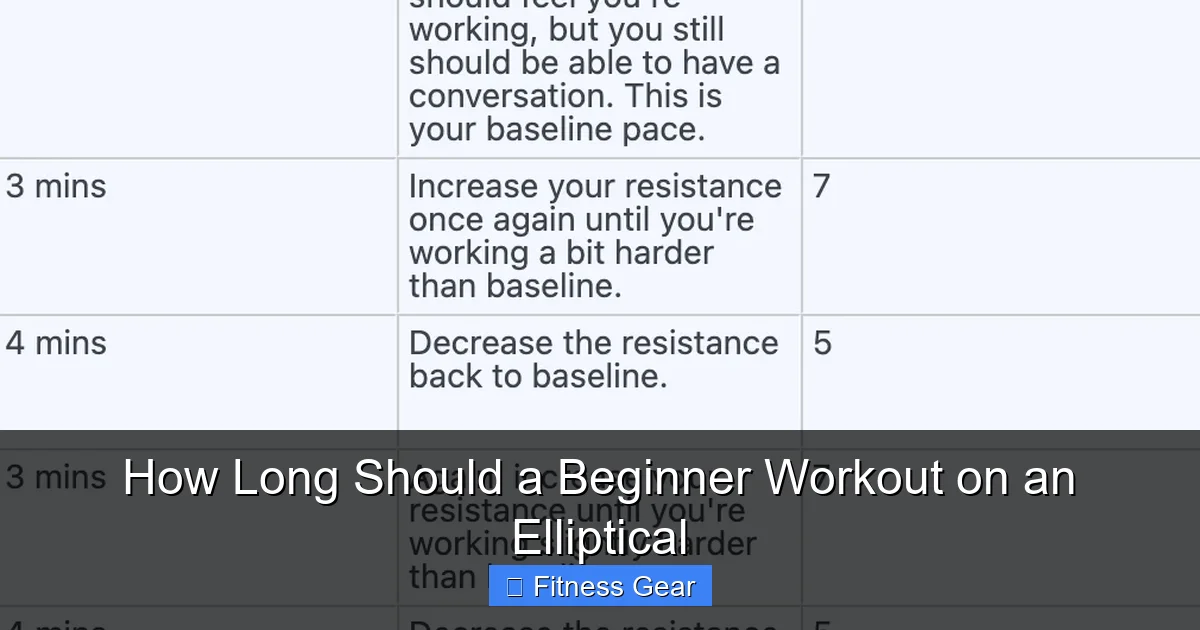
- Warm-Up (2 minutes): Set the resistance to the lowest setting (Level 1 or 2). Glide at a comfortable, slow pace. Let your body wake up. This isn’t part of your “workout” time; it’s prep.
- Main Set (8-10 minutes): Increase the resistance to a level where you feel you’re working, but you could still hold a conversation (this is the “talk test”). Keep your revolutions per minute (RPM) steady, around 60-80. Focus on the full-body motion. This is your workout duration.
- Cool-Down (2 minutes): Drop the resistance back to 1. Glide slowly. Let your heart rate come down. This is essential for heart health and flexibility.
Your total time on the machine: 12-14 minutes. Your active, working time: 8-10 minutes. That’s a complete, effective, and sustainable session.
Building Your First Weekly Routine: More Important Than One Long Session
The question “how long” is inextricably linked to “how often.” For a true beginner, frequency trumps length. It is far better to do three 15-minute sessions per week than one 45-minute session. Why? Because consistency drives adaptation.
Visual guide about How Long Should a Beginner Workout on an Elliptical
Image source: j4e6i8v8.rocketcdn.me
The Sample Starter Schedule
Here is a perfect, no-fail first-month template:
- Monday: 10-15 minute elliptical session (as described above).
- Tuesday: Rest or light walking/stretching. Recovery is when you get stronger.
- Wednesday: 10-15 minute elliptical session. Try to match or slightly beat your Monday time.
- Thursday: Rest.
- Friday: 10-15 minute elliptical session.
- Weekend: Active rest (a fun walk, gentle yoga) or complete rest.
That’s just 30-45 minutes of actual cardio per week, but it’s structured, repeatable, and builds the critical habit of showing up. You are teaching your body and mind that exercise is a non-negotiable, pleasant part of your weekly rhythm.
The “Two-Day Rule” and Listening to Your Body
What if you feel great on Tuesday after Monday’s session? Can you go again? Yes, but follow the “two-day rule”: never do the same intense activity on consecutive days when starting. If you want to move on an off-day, make it something completely different and gentle—a 20-minute walk, some mobility work, or a stretching video. This allows the muscles used in the elliptical workout to properly recover and rebuild, which is when you actually get stronger and more endurance-capable.
Common Beginner Mistakes That Sabotage Duration (And How to Fix Them)
Many beginners try to increase time too fast or use the machine incorrectly, leading to frustration or injury. Here are the critical errors to avoid.
Visual guide about How Long Should a Beginner Workout on an Elliptical
Image source: runningshorts.com
Mistake 1: Leaning Heavily on the Handrails
This is the #1 fault. People grip the handles and use their arms to support their body weight, taking all the work off their legs. This turns a fantastic full-body workout into a ineffective arm-and-shoulder shrug. The Fix: Lightly rest your fingertips on the handles for balance only. Your core should be engaged to keep you upright. If you need to hold on tightly for balance, your resistance or speed is too high. Drop it.
Mistake 2: Ignoring the “Talk Test” and Pushing Too Hard
Beginners often equate a good workout with gasping for air and drenched in sweat from minute one. This is a recipe for burnout and hatred. The Fix: For the first month, your intensity should be such that you can speak in full sentences with only a slight increase in breathing. You should feel warm and like you’re working, not like you’re in a sprint to the finish. This builds aerobic capacity safely.
Mistake 3: Comparing Your Chapter 1 to Someone Else’s Chapter 20
You’ll see people on adjacent machines going full speed for 45 minutes. That is not your benchmark. Their journey started months or years ago. The Fix: Your only competition is the person you were yesterday. Track your own time and resistance. If you did 12 minutes at level 3 this week, try for 14 minutes at level 3 next week. Your progress is your own.
How to Safely Progress Your Duration After the First Month
Once your 10-15 minute sessions feel genuinely easy—you finish with energy to spare, your breathing is steady, and you’re not sore—it’s time to progress. But we do it in tiny, manageable increments.
The 2-5 Minute Rule
Each week, add only 2 to 5 minutes to your total working time. If you were doing 15 minutes, aim for 17 or 18 minutes the following week. This slow increase allows your cardiovascular system, muscles, tendons, and bones to adapt without stress injury. Rushing this is the most common reason beginners “plateau” or get hurt. Fitness is a marathon of small, consistent wins.
Progressing Intensity Before Just Adding Time
Don’t just add minutes forever. Once you reach a comfortable 30 minutes, the next challenge is intensity. You can:
- Increase the resistance level by 1-2 notches while keeping time constant.
- Add a slight incline (if your machine has it) for 2-3 minutes of your workout.
- Try short, 30-second bursts of faster RPM (intervals) followed by 90 seconds of recovery.
This “time vs. intensity” progression keeps your body guessing and continues to build fitness without endlessly elongating your workouts.
Safety and Wellness: The Non-Negotiables
Duration is just one piece. How you perform that duration is what makes it truly beneficial or potentially harmful.
Hydration is Part of the Workout
Even a 15-minute session causes fluid loss through sweat and heavy breathing. Drink a full glass of water before you start, and have water nearby to sip during your cool-down. Dehydration leads to premature fatigue, cramps, and headache, making your session feel worse and shorter.
Posture is Your Armor
Injury on an elliptical is rare, but poor posture can cause shoulder, neck, or back tweaks. Your checklist: head up, eyes forward (not at the display), shoulders down and back, core gently braced (as if preparing for a light punch), and a slight bend in the knees—never locked. Your movement should come from the hips and glutes, not just the calves or arms.
Know the Stop Signs
While muscle fatigue is normal, these are not. Stop immediately if you feel:
- Sharp, stabbing pain in a joint (knee, ankle, hip).
- Chest pain, pressure, or tightness.
- Dizziness, lightheadedness, or nausea.
- Sudden shortness of breath where you cannot speak at all.
These are your body’s emergency signals. It’s okay to end a workout early. It’s not okay to ignore these warnings.
Conclusion: Your Journey Starts With a Single (Short) Step
So, how long should a beginner workout on an elliptical? The empowering, sustainable answer is: as long as you can while maintaining perfect form and feeling in control, starting with 10-15 minutes. The elliptical is a tool for a lifetime of health, not a punishment to endure. By starting short, you build the unshakable habit. By focusing on consistency over heroics, you build the resilient body. By progressing slowly, you build the lasting fitness. Your first month is about discovery and consistency, not calorie torching. Show up, move well for your chosen 10-15 minutes, and walk away feeling like you could do it again tomorrow. That is how lifelong fitness habits are born. Now, go set that timer for 12 minutes and give yourself the gift of a perfect, powerful start.
Frequently Asked Questions
What if I can only do 5 minutes at first? Is that okay?
Absolutely. Five minutes is a fantastic start. The goal is to move without stopping. If 5 minutes is your max, do that. The next day, try for 5 minutes and 30 seconds. Celebrate every second added. The habit of daily movement is more important than hitting an arbitrary number.
How many days per week should a beginner use the elliptical?
Aim for 3 non-consecutive days per week (e.g., Monday, Wednesday, Friday). This provides enough stimulus for your body to adapt while ensuring adequate recovery time, which is when your fitness actually improves.
Should I use the highest resistance to get a better workout faster?
No. For beginners, high resistance often leads to poor form (leaning, rocking) and early quit. Use a low to moderate resistance where you can maintain a smooth, controlled motion and pass the “talk test.” Build endurance first, then strength.
Can I lose weight with just short elliptical workouts?
Weight loss primarily happens in the kitchen, but exercise is its crucial partner. Short, consistent elliptical workouts build muscle, boost metabolism, and improve cardiovascular health. Combined with a balanced diet, they are highly effective for sustainable weight management.
Is the elliptical better than a treadmill for a beginner?
For many absolute beginners, especially those with joint concerns, the elliptical is superior due to its zero-impact motion. A treadmill’s walking motion is also great, but the elliptical’s low-impact nature reduces injury risk, allowing for more consistent, longer-term training.
How do I know if I’m progressing too quickly and risking injury?
If you add more than 5-10% to your duration or intensity each week and start feeling persistent joint pain (not muscle soreness), extreme fatigue that lasts more than a day, or you dread your workouts, you’re progressing too fast. Dial it back to your last comfortable week and progress more slowly from there.