Can You Do 12 3 30 Without a Treadmill

Yes, you can absolutely do the 12-3-30 workout without a treadmill! The magic lies in the workout’s core principle: low-intensity, steady-state cardio for 30 minutes. You can replicate this using stairs, a stationary bike, an elliptical, or even brisk walking outdoors. The key is maintaining a pace where you can talk but not sing, mimicking the “12 incline, 3 mph” effort level. This makes the 12-3-30 method incredibly versatile and accessible for any home gym setup.
Key Takeaways
- The 12-3-30 is a principle, not a prescription: It’s about 30 minutes of low-intensity, steady-state cardio, not a specific treadmill setting.
- Any sustained, moderate effort works: Brisk walking, stair climbing, cycling, and elliptical training can all replicate the physiological benefits.
- Focus on perceived exertion: Aim for a “conversational pace” where talking is possible but singing is not, to hit the correct intensity zone.
- Adaptability is key: You can modify duration, intensity, and modality (the exercise type) to match your fitness level and available equipment.
- Mind the impact: Non-treadmill options like cycling or elliptical are excellent low-impact alternatives for those with joint sensitivities.
- Consistency trumps specificity: Regularly completing 30 minutes of moderate movement is far more important than using a treadmill.
📑 Table of Contents
- Introduction: The Treadmill Phenomenon and The Freedom to Adapt
- Demystifying 12-3-30: It’s a Metabolic Blueprint, Not a Machine Mandate
- Your Arsenal of Alternatives: Replicating the 12-3-30 Feel Without the Belt
- Designing Your Personal 12-3-30 Replacement Routine
- Common Mistakes and How to Avoid Them
- Conclusion: Your Workout, Your Rules
Introduction: The Treadmill Phenomenon and The Freedom to Adapt
You’ve seen it everywhere. The “12-3-30” workout has taken the fitness world by storm, promising fat loss, improved endurance, and a simple, almost meditative routine. For the uninitiated, it’s deceptively simple: set a treadmill to a 12% incline, walk at 3 miles per hour, and do it for 30 minutes. But what if you don’t own a treadmill? What if your home gym is a modest corner with a yoga mat, a set of dumbbells, and maybe a resistance band? Or perhaps you simply hate running and prefer the great outdoors. The burning question for many is: Can you do 12-3-30 without a treadmill?
The resounding answer is a confident, empowering yes. The 12-3-30 method’s genius is not in the machine, but in the metabolic principle it champions: sustained, low-to-moderate intensity cardiovascular exercise. This article is your definitive guide to understanding that principle and, more importantly, applying it using whatever tools—or lack thereof—you have at your disposal. We will break down the science, explore a universe of alternatives, and provide you with practical, actionable plans to reap the benefits of 12-3-30, all without ever stepping on a treadmill belt. Your fitness journey is yours to define, and your home gym is more capable than you think.
Demystifying 12-3-30: It’s a Metabolic Blueprint, Not a Machine Mandate
Before we dive into the “how,” we must fully understand the “what.” The name “12-3-30” is merely a descriptor of the original creator’s chosen settings. To replicate the workout’s true effect, we need to translate those numbers into physiological terms.

Visual guide about Can You Do 12 3 30 Without a Treadmill
Image source: i.pinimg.com
What Do the Numbers Actually Mean?
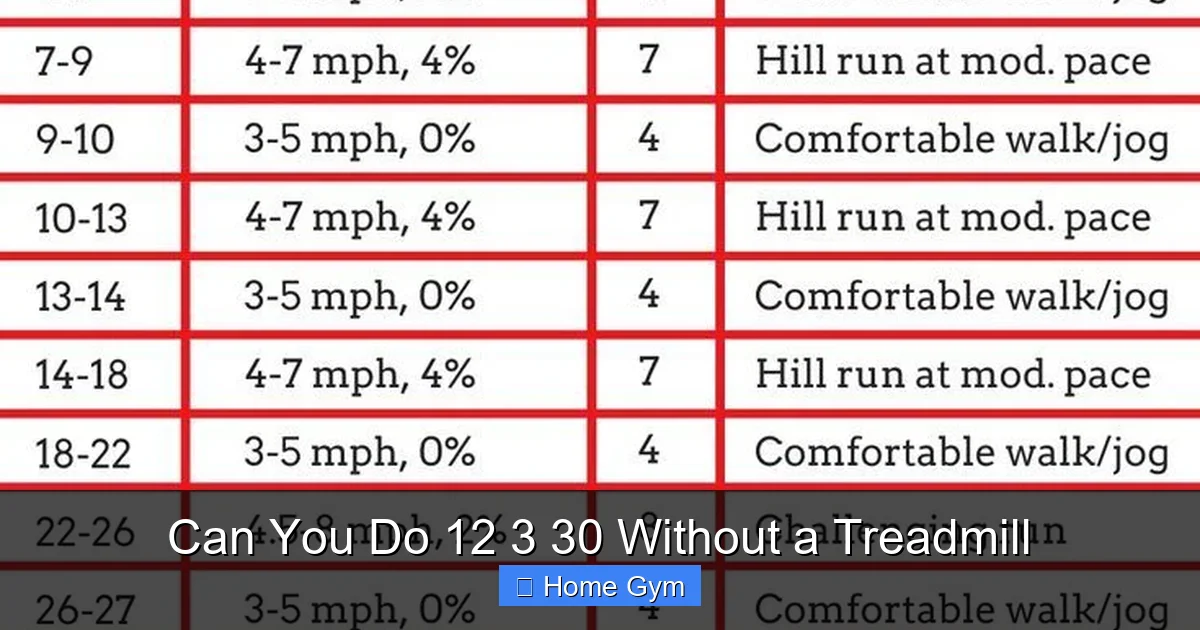
The “12” refers to a 12% incline. This dramatically increases the workload on your glutes, hamstrings, and calves, turning a simple walk into a powerful strength and endurance builder for your lower body. The “3” is the speed: 3 miles per hour. This is a brisk, purposeful walk for most people—far from a sprint, but faster than a casual stroll. The “30” is the duration: 30 continuous minutes. This length of time spent in a specific heart rate zone is the key driver of the workout’s famed fat-burning and aerobic capacity benefits.
So, the core prescription is: 30 minutes of exercise at an intensity that significantly elevates your heart rate due to added resistance (like an incline) but remains sustainable. The treadmill is just one convenient tool to deliver that prescription. Our mission is to find other tools that deliver the same metabolic stress and muscular engagement.
The Target Heart Rate Zone: Your True North Star
The most reliable way to gauge if your non-treadmill version is working is by monitoring your effort. The 12-3-30 workout typically lands you in Zone 2 of cardio training—about 60-70% of your maximum heart rate. A simple formula to estimate your max heart rate is 220 minus your age. At Zone 2, you should be able to hold a conversation with short sentences, but you wouldn’t be able to sing a song comfortably. This is the “fat-burning zone” where your body efficiently uses fat as fuel and builds aerobic capacity without excessive fatigue or joint strain. If you don’t have a heart rate monitor, the “talk test” is your perfect substitute.
Your Arsenal of Alternatives: Replicating the 12-3-30 Feel Without the Belt
Now for the fun part. Let’s translate that “brisk walk uphill” sensation into actionable exercises you can do anywhere. The goal is to find an activity that is weight-bearing (or simulates it), involves large lower body muscles, and can be sustained at a moderate, steady pace for 30 minutes.

Visual guide about Can You Do 12 3 30 Without a Treadmill
Image source: i.etsystatic.com
Option 1: The Stairmaster Substitute (Using Your Own Stairs or a Hill)
This is arguably the closest natural replication. Walking or slowly jogging up stairs or a steep hill provides the same powerful glute and hamstring activation as a treadmill incline. The resistance is gravitational, just like on an incline.
- How to do it: Find a long staircase (like in a stadium, park, or your own home) or a sustained hill with a moderate grade. Walk up steadily at a pace that gets you to Zone 2. Carefully walk back down to recover, then repeat. For a pure 30-minute steady state, you can continuously walk up and down a long flight for the duration, though this will be more interval-like due to the descent recovery.
- Home Gym Hack: No stairs? Use a sturdy step or workout bench. Perform continuous step-ups, alternating legs, for 30 minutes. This will be more repetitive but hits the same muscles. Focus on controlled movements and a steady rhythm.
Option 2: The Stationary Bike or Air Bike
While cycling is non-weight-bearing (seated), it is exceptional for sustained cardio. To mimic the “incline” effort, you dramatically increase resistance. This shifts the work from your quads to your glutes and hamstrings, creating a similar lower-body burn.
- How to do it: On a spin bike or stationary bike, set the resistance to a level where you’re pedaling at about 60-80 RPM and feel a deep muscular push with each stroke. You should break a sweat and breathe heavily within 5 minutes. Maintain that resistance and cadence for 30 minutes. On an air bike (like an Assault or Echo bike), you control the resistance by how hard you push and pull the handles—push hard to simulate the incline effort.
- Pro Tip: Try “climb intervals.” Set a timer for 30 minutes. For the first 5 minutes, use moderate resistance. Then, every 5 minutes, increase the resistance by one small notch, holding that new, harder level for 5 minutes. This creates a progressive overload similar to the constant incline of the treadmill.
Option 3: The Elliptical or Cross-Trainer
The elliptical is a fantastic, low-impact machine that allows you to engage your arms and legs. To replicate the incline, you increase the “ramp” or “incline” setting, which changes the pedal path to require more force from your posterior chain (glutes/hamstrings), just like walking uphill.
- How to do it: Set the elliptical to a high incline (if it has that function) and a moderate resistance. Use your arms actively, pushing and pulling the handles. Aim for a stride rate that feels challenging but sustainable. The motion should feel powerful and deliberate, not bouncy and fast.
- Key Note: Some ellipticals have a “fixed ramp.” In that case, simply crank up the resistance to a very high level. The effort will feel more like slogging through mud, which perfectly mimics the muscular fatigue of a steep walk.
Option 4: The “No-Equipment” Power Walk
You don’t need anything but your own two feet and some open space, indoors or out. The trick is to maximize the “incline” effect through form and intentionality.
- How to do it (Outdoors): Find the steepest hill you can find. Walk up it. That’s it. The descent is your active recovery. Repeat the climb as many times as needed to accumulate 20-30 minutes of *total uphill walking time*. The rest periods walking down will extend your total session time.
- How to do it (Indoors): In a long hallway or around your living room, perform “power walks” with exaggerated form. Focus on pushing through your heel, squeezing your glutes at the top of each step, and driving your arms. You can also walk in a “lunge walk” pattern, taking long, controlled strides to massively increase the demand on your legs. This is more fatiguing, so you may need to break it into intervals (e.g., 5 minutes on, 1 minute rest) to reach 30 minutes of total work.
Option 5: The Hybrid “Home Gym” Approach
This is where creativity shines. Combine bodyweight or weighted movements with cardio to simulate the continuous effort.
- Example Circuit (30 Min Total): Set a timer for 30 minutes. Perform 5 minutes of continuous step-ups on a bench (moderate pace). Then, without rest, move to 5 minutes of bodyweight or lightly weighted lunges in place (marching lunges). Then, 5 minutes of high-knee marches or “butt kicks” in place. Repeat this 3-exercise cycle twice. You’ll have a full 30 minutes of continuous, varied, lower-body focused movement that will leave you feeling the same burn.
- Weighted Vest Walk: If you have a weighted vest, put it on and go for a brisk 30-minute walk, either outside or on a treadmill (if you have access to one occasionally). The added load increases the intensity and muscular demand, closely mimicking the incline effect.
Designing Your Personal 12-3-30 Replacement Routine
Choosing an alternative is step one. Structuring it into a sustainable, effective routine is step two. Here’s your blueprint.
Visual guide about Can You Do 12 3 30 Without a Treadmill
Image source: i.pinimg.com
Start with the Talk Test, Not the Tech
Forget exact speeds and percentages. Your first session with any new modality should be about learning the effort level. Start your 30-minute session. After 5 minutes, try to speak a full sentence. If you can sing a song easily, you need to increase your resistance, speed, or hill steepness. If you can only gasp out one or two words, you’re going too hard—back off a little. Find that sweet spot of “I can talk, but I don’t want to.” That’s your Zone 2. That’s your new “3 mph on a 12% incline.”
Sample Weekly Plans
Consistency is everything. Here are two sample plans to get you started.
- Plan A: The Minimalist (No Equipment)
- Monday: 30-min continuous hill walk (outdoors) or indoor power walk/lunge march circuit.
- Wednesday: 30-min continuous hill walk or circuit.
- Friday: 30-min continuous hill walk or circuit.
- Weekend: Active recovery (light stretching, leisurely walk).
- Plan B: The Home Gym Enthusiast (With Equipment)
- Monday: 30-min Stationary Bike (high resistance, steady pace).
- Tuesday: 30-min StairMaster substitute (bench step-ups or stadium stairs).
- Thursday: 30-min Elliptical (high incline/resistance).
- Saturday: 30-min Hybrid Circuit (as described above).
Note: Always include at least 1-2 full rest or active recovery days per week.
Progression: How to Get Better Over Time
Your body adapts. What feels challenging today will feel easy in a month. To keep progressing, you must manipulate one of the three variables: Duration, Intensity, or Frequency.
- Duration: Once 30 minutes feels too easy, add 5 minutes. Aim for 35, then 40.
- Intensity: This is your primary lever. On the bike, add more resistance. On the stairs, find a steeper hill or use a weighted vest. On a walk, quicken your pace slightly while maintaining the talk test.
- Frequency: Add a fourth day per week once you’ve mastered the routine.
Progression should be slow and steady. Increase one variable by no more than 10% per week to avoid injury and burnout.
Common Mistakes and How to Avoid Them
Even with the best intentions, it’s easy to miss the mark. Here are the pitfalls to watch for.
Mistake 1: Going Too Hard, Too Soon
Many people equate “harder” with “better.” They sprint up the stairs or crank the bike resistance to a level where they’re gasping after 3 minutes. This pushes you out of Zone 2 and into anaerobic territory. The benefit shifts from aerobic fat-burning and endurance to high-intensity interval training. That’s a different workout with different goals (and often higher injury risk). Solution: Be patient. The power of 12-3-30 is in its sustainability. Start conservatively and build up. If you finish and feel you could have done more, you’re probably at the right intensity.
Mistake 2: Ignoring Form and Joint Health
Especially with stair climbing or lunges, poor form (like letting knees cave in, leaning too far forward, or pounding steps) can lead to knee or hip pain. Solution: Focus on controlled movements. On stairs, place your whole foot on the step. In lunges, keep your front knee tracking over your ankle. If you feel sharp pain, stop. Choose a lower-impact alternative like cycling or the elliptical.
Mistake 3: Neglecting the “Incline” Principle
Just going for a flat, 30-minute walk is great, but it misses the crucial element of increased resistance that builds lower-body strength and spikes the metabolic cost. A flat walk is significantly easier than a 12% incline walk at the same speed. Solution: Ensure your chosen activity has a clear “harder” setting you can engage. If you’re walking outdoors, seek hills. If you’re inside, use resistance bands, a weighted vest, or a machine with an incline/resistance setting.
Mistake 4: Boredom and Lack of Adherence
Doing the same 30-minute session every day can become monotonous, leading you to skip workouts. Solution: Use the variety of modalities we’ve discussed! Alternate between biking, stairs, and your hybrid circuit. Listen to an audiobook, podcast, or your favorite music playlist. The time will fly by. The goal is to build a habit, and variety is a powerful tool for habit formation.
Conclusion: Your Workout, Your Rules
The 12-3-30 workout exploded in popularity because it offered a simple, effective, and time-bound formula for improving fitness. But its true power was always in its underlying philosophy: consistent, moderate-intensity cardiovascular exercise that is gentle enough to do daily yet potent enough to transform your body and health. A treadmill is merely a vessel for that philosophy. By understanding the “why”—the target heart rate zone, the muscular engagement, the time commitment—you liberate yourself from the “how” of a specific machine.
So, look around your home gym. See that step? That’s your incline. See that bike? That’s your steady-state engine. See that hill outside your window? That’s your free gym. The question is no longer “Can you do 12-3-30 without a treadmill?” The question is now, “Which of these powerful, accessible alternatives will you choose to make your own?” Start with the talk test, be consistent, progress slowly, and listen to your body. You have everything you need to succeed, right where you are. Now, go take your first 30-minute walk—wherever and however you choose.
Frequently Asked Questions
Is a 12-3-30 workout effective for weight loss without a treadmill?
Yes, absolutely. Weight loss is driven by burning calories and creating a sustainable calorie deficit. The 12-3-30 principle of 30 minutes of moderate-intensity cardio burns a significant number of calories, primarily from fat at the Zone 2 intensity level. Whether that 30 minutes is on a treadmill, a bike, or climbing stairs, the caloric expenditure and metabolic benefit remain highly effective for weight management.
What is the closest non-treadmill machine to a 12-3-30?
The stair climber or a step mill is the closest direct analog, as it perfectly replicates the incline walking motion and glute/hamstring engagement. A stationary bike set to very high resistance is an excellent low-impact alternative that mimics the muscular “push” of an incline. An elliptical on a steep ramp setting is also a very close match.
Can I do a 12-3-30 workout walking outdoors?
Yes, and this is a fantastic option. Find a hill with a sustained, moderate grade. Your “12% incline” is that hill. Your “3 mph” is a brisk, steady walking pace up it. Your 30 minutes will be the total time spent walking uphill. You will walk back down to your starting point for recovery, which extends the total session time but keeps the uphill work in the target zone.
Is the 12-3-30 workout good for beginners?
It can be, with modifications. The key is starting at an intensity that feels “moderately challenging.” Beginners should begin with 15-20 minute sessions and focus on the talk test. They should also prioritize low-impact options like cycling or elliptical to protect joints. The workout’s beauty is its scalability; you control the duration and intensity to match your current fitness level.
How do I know if my non-treadmill version is working as hard as the original?
Use the “talk test” as your primary guide. After 5-10 minutes of your activity, try to speak in full sentences. If you can but it requires moderate effort, you’re in the correct Zone 2. If you can sing easily, increase your effort (more resistance, steeper hill). If you can only speak single words with gasps, you’re going too hard and should ease up. A heart rate monitor aiming for 60-70% of your max HR is the most objective tool.
Will I build the same leg muscle from non-treadmill versions?
You will build similar muscle endurance and strength in your glutes, hamstrings, and calves. Activities that involve pushing against resistance with your legs—like stair climbing, high-resistance cycling, or weighted step-ups—provide a potent strength stimulus. While the muscle-building (hypertrophy) effect might be slightly different from the constant tension of treadmill walking, the improvements in muscular endurance and functional strength will be comparable and highly beneficial.