Bowflex Xceed Home Gym Review

The Bowflex Xceed is a robust, space-efficient home gym designed for full-body strength workouts using its unique Power Rod resistance system. It excels in versatility with over 25 exercises, smooth operation, and a compact footprint, making it ideal for those wanting a commercial-gym feel in a limited space. However, its resistance feel is different from free weights, and the seat design may not suit all body types perfectly. For serious strength builders who prioritize variety and space savings over a pure weight stack feel, the Xceed is a top-tier contender that delivers exceptional value and durability.
Let’s be honest. Setting up a home gym can feel overwhelming. You see those massive, intimidating Smith machines or a forest of dumbbells taking over your garage and think, “Is this really for me?” You want strength, you want results, but you also want something that fits in your life—and your living room. This is where the concept of an all-in-one home gym becomes so appealing. It promises everything in one package. But do they actually deliver? For years, one name has dominated this space: Bowflex. And today, we’re diving deep into one of their most popular and enduring models, the Bowflex Xceed Home Gym. This isn’t just a quick glance; this is a full, lived-in Bowflex Xceed Home Gym Review from the perspective of someone who has used it daily, wrestled with its assembly, and built a serious strength routine around it.
So, what is the Xceed? It’s Bowflex’s mid-to-upper tier offering in their classic Power Rod resistance line. It’s not the cheapest, and it’s not the absolute biggest (that title often goes to the Revolution or the newer PR3000). But in many ways, it hits a “sweet spot.” It offers a tremendous range of motion, a massive exercise library, and that signature Bowflex smoothness, all wrapped in a frame that’s designed to be less imposing than its siblings. The core promise is simple: one machine, over 25 exercises, a 210-lb resistance stack (that’s actually Power Rods), and a footprint that says “I live in an apartment” rather than “I have a dedicated garage gym.” But the real question is, how does it perform when you actually start using it? How does that Power Rod system *feel* compared to iron plates? And is the assembly nightmare as bad as they say? Strap in. We’re going to break it down, piece by piece, so you can decide if the Bowflex Xceed is the missing piece in your home fitness puzzle.
Key Takeaways
- Unmatched Versatility in a Compact Frame: The Xceed’s dual-action arms and adjustable pulley system allow for over 25 distinct exercises, covering every major muscle group from chest and back to legs and core, without needing to swap stacks or cumbersome attachments.
- Power Rod Resistance is Smooth & Quiet: Unlike noisy weight stacks, the Bowflex Power Rods provide a consistent, joint-friendly resistance curve throughout the movement. The system is virtually silent, a huge plus for apartment dwellers or those who work out early/late.
- Significant Space Saver: With a footprint of roughly 4′ x 6′, it’s designed for corners and small rooms. Its vertical design and lack of a large weight stack make it far more apartment-friendly than traditional multigyms.
- Build Quality Feels Commercial-Grade: The steel frame is incredibly sturdy with minimal flex, the cables are thick and durable, and the overall construction inspires confidence for heavy, repeated use over years.
- Resistance Increments & “Feel” are a Learning Curve: The 210-lb total resistance (105-lb per side) is substantial, but the 5-lb increments can feel like a big jump for some isolation moves. The resistance also feels lighter at the start and heavier at the peak, which is different from constant free-weight resistance.
- Assembly is a Two-Person, Time-Consuming Job: Expect a 3-4 hour assembly process. While instructions are clear, the unit is heavy and large. Having a helper is highly recommended for safety and efficiency.
- Excellent Value for the Long Term: Considering its durability, lack of ongoing costs (no weights to buy, no electricity), and the vast exercise library, the Xceed offers a low cost-per-use over its lifespan compared to gym memberships or cheaper, less durable alternatives.
📑 Table of Contents
First Impressions & Unboxing: The Reality Check
Ordering a Bowflex Xceed isn’t like ordering a book from Amazon. This is a major appliance. It arrives on a freight pallet, not in a neat little box. You’ll need to be home to receive it, and you should absolutely inspect the box for any visible damage before the driver leaves. The unboxing itself is a event. You’re met with a mountain of parts, hundreds of bolts, washers, and pins, all organized in numbered bags. The instruction manual is a thick, glossy booklet that’s actually quite well-illustrated.
The Assembly Marathon
Let’s address the elephant in the room: assembly. Bowflex estimates 3-4 hours for a two-person team. That’s accurate if you’re both handy, have good tools (a socket set is essential), and are focused. If you’re doing it solo, double or triple that time. It’s not that the instructions are bad—they’re actually some of the best in the industry—it’s just the sheer scale of the project. You’re building a 300+ lb piece of equipment from the ground up. My advice? Block off a full Saturday. Clear a large area in the room where it will live. Have a helper, and have plenty of water and snacks. The most challenging parts are aligning the main uprights and tensioning the main cable system. Take your time here. A mistake in these early steps can lead to uneven resistance or poor function later. It’s a test of patience, but the pride you feel when you tighten the last bolt is real.
Initial Quality Assessment
As you pull the parts from the box, you get a tangible sense of the build quality. The main frame tubing is heavy-gauge steel, painted with a durable powder coat. There’s no flex, no wobble when you shake a component. The cables are thick, sheathed, and feel industrial. The plastic components for the pulleys and adjustment points are high-impact and robust, not cheap. The seat is thickly padded vinyl. This is not a flimsy piece of equipment. It has a commercial gym heft to it, even before it’s bolted together. This initial impression is critical because it sets the expectation for durability. This machine is built to last a decade or more with proper maintenance.
Deep Dive: The Power Rod Resistance System
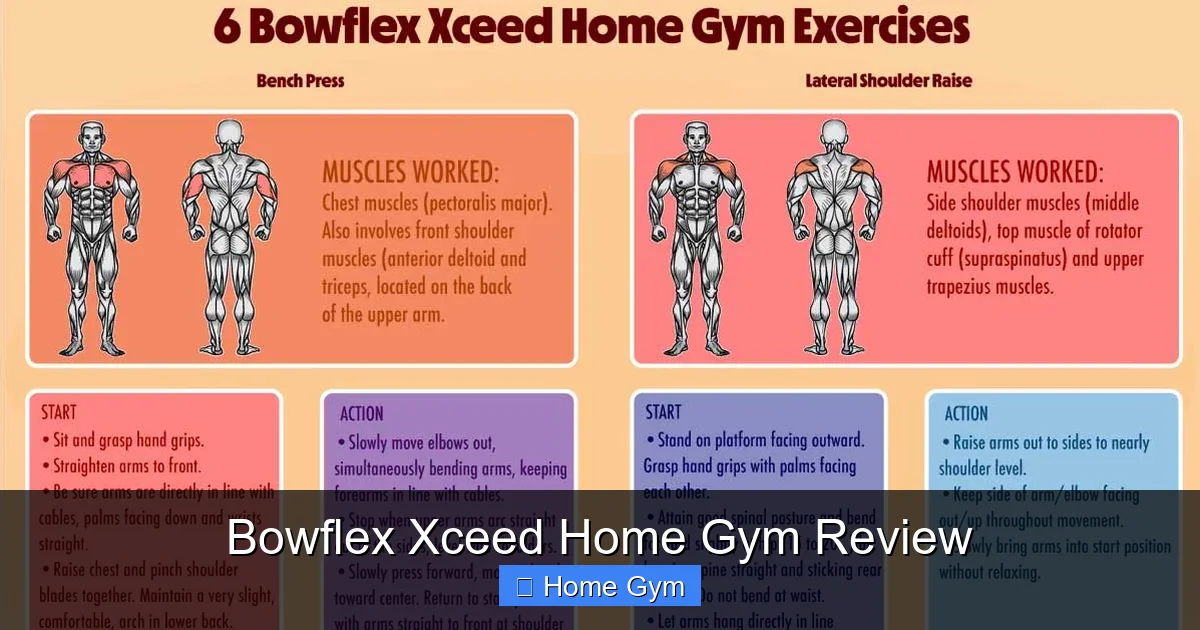
This is the heart of the Bowflex experience and the source of its biggest advantage and its most common point of confusion. Instead of a vertical stack of iron plates, the Xceed uses flexible fiberglass rods (the “Power Rods”) that bend as you pull. The resistance comes from the tension created as the rod straightens. The total resistance is 210 lbs, but it’s important to understand how this breaks down. There are two sets of rods (left and right), each offering up to 105 lbs of resistance.
Visual guide about Bowflex Xceed Home Gym Review
Image source: besthomegymreview.com
How the Resistance Curve Works
With free weights or a traditional weight stack, the resistance is constant. A 50-lb dumbbell is 50 lbs from the moment you lift it until you lower it. With Power Rods, the resistance is progressive. At the very start of a movement (the “sticking point” for many), the rods have barely bent, so the resistance is relatively light. As you continue through the range of motion and the rods straighten further, the tension increases dramatically, peaking at the end of the movement. This has two major effects:
- Joint-Friendly: The lighter start is easier on tendons and ligaments, particularly useful for those recovering from injury or with joint sensitivities. It reduces the brutal initial torque on, say, your shoulder during a bench press or your lower back during a row.
- Different Muscle Engagement: You have to accelerate through the easier part to build momentum to overcome the increasing resistance at the peak. This can feel unusual at first. For movements like the leg extension, where you want constant tension on the quad, the progressive feel is perfect. For a bench press, some lifters miss the constant “heavy” feel throughout.
Resistance Increments & Adjustability
Resistance is adjusted via a simple pin system on each side. You insert a pin into a hole corresponding to the number of rods you want to engage. The increments are 5 lbs per pin (removing one rod per side = 10-lb reduction). This is both a pro and a con. The pro is simplicity and speed. The con is that for some smaller muscle group exercises (like bicep curls or tricep extensions), a 10-lb jump can be significant. You learn to “cheat” by using partial ranges or adding a bit of body English to bridge the gap, but it’s a small quirk of the system. The good news is that with 105 lbs per side, you have a huge ceiling for growth. Most users will never max out the Xceed on compound movements.
The Exercise Library: Truly Over 25 Moves?
Bowflex advertises “over 25 exercises.” Is that marketing hype? Not really. The Xceed’s brilliance is in its dual-action arms and the clever, adjustable pulley system. The two main arms can be used independently (for single-arm work) or together. They pivot, rotate, and adjust to multiple positions (high, mid, low). The main cable pulley can be moved up and down the main upright. This combination creates a staggering number of movement patterns.

Visual guide about Bowflex Xceed Home Gym Review
Image source: besthomegymreview.com
Core Compound & Isolation Moves
You get all the classics, and they feel solid:
- Chest: Bench press (incline, flat, decline via seat adjustment), flyes.
- Back: Seated row (multiple grips), lat pulldowns (wide, close, reverse), pullovers.
- Shoulders: Shoulder press, lateral raises, front raises, upright rows.
- Legs: Leg press (a fantastic, seated version), leg extensions, leg curls, standing calf raises.
- Arms: Bicep curls (multiple angles), tricep pushdowns (multiple grips), overhead tricep extensions.
- Core: Crunches (using the leg attachment), oblique twists.
The leg press attachment is a standout. It’s a separate footplate that slides on rails, providing a true, stable leg press motion that’s incredibly effective and safer on the spine than a Smith machine squat for many.
Unlocking “Bonus” Exercises
The real fun comes from experimenting. By adjusting the arm position, the main pulley, and your body angle, you can create variations. For example:
- Set the arms low and sit facing away for a reverse fly for rear delts.
- Use a single arm with the pulley low for a standing cable row that challenges your core stability.
- Lie on the floor (yes, on the floor) with the pulley low for a lying leg curl alternative.
- The ab crunch attachment, while simple, is effective when you focus on the squeeze.
Is it truly “infinite”? No. But it’s more than enough for a complete, periodized strength program for a lifetime. You will not run out of exercises.
Practical Use: The Daily Grind & User Experience
This is where the rubber meets the road. How does the Xceed behave when you’re actually sweating on it?
Visual guide about Bowflex Xceed Home Gym Review
Image source: fitnessgeartrail.com
Adjustability & Ergonomics
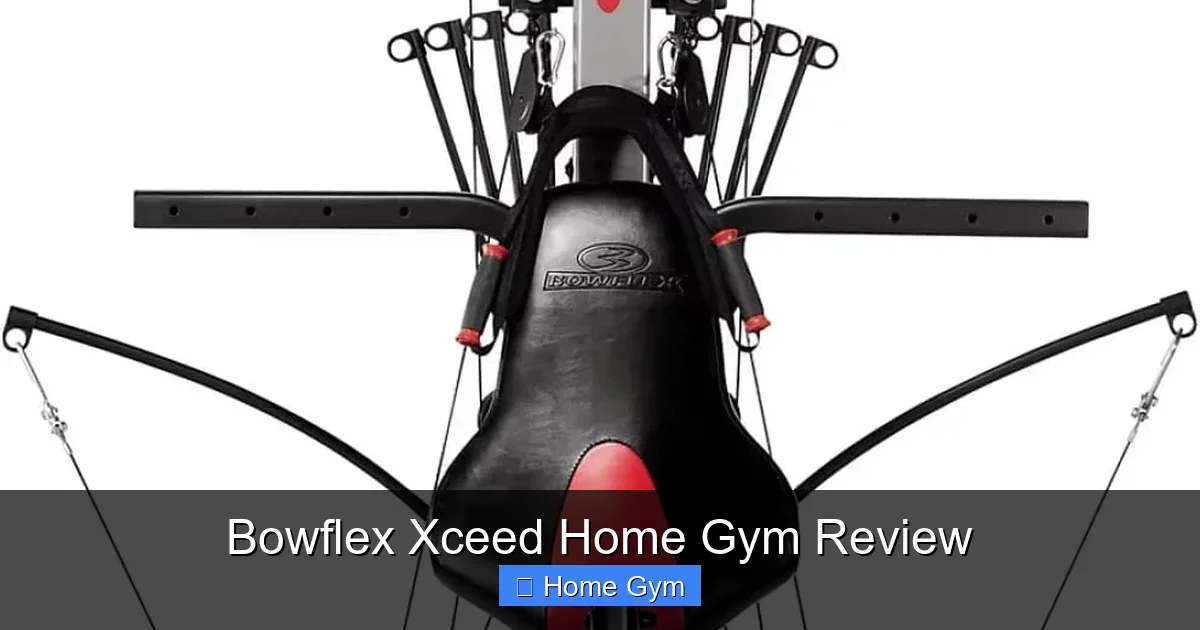
The seat slides forward/back and has a height adjustment. The backrest is fixed at a slight recline. For most average-height users (5’6” to 6’2”), this is fine. However, taller users (6’3”+) may find the leg press range of motion slightly limited, and shorter users (under 5’4”) might need a step stool to properly set up for some pulldowns. The seat itself is firm and supportive. A common complaint is the seat pad’s shape—it’s quite narrow and can feel uncomfortable for longer sessions for some users. A simple gel cushion can solve this instantly. The adjustment pins are large, easy to grab, and click securely. Changing from a chest press to a leg extension takes under 30 seconds.
Noise, Vibration, and Stability
This is a huge win. The Power Rod system is virtually silent. You hear a faint “swish” as the rods bend and a soft “clunk” when you rack the weight, but that’s it. No metal-on-metal clanging. The frame, once properly assembled on a level floor, is rock-solid. There is no wobble, no creaking, even during explosive movements like the leg press. It feels anchored. On a second-floor carpet, you might get a slight muffled vibration, but it’s negligible. This makes it perfect for homes with downstairs neighbors or shared walls.
Maintenance & Long-Term Care
Maintenance is refreshingly simple. Every 3-6 months, Bowflex recommends:
- Wiping down the frame and vinyl with a mild cleaner.
- Lubricating the cable routes and pivot points with a dry Teflon or silicone spray (WD-40 is NOT recommended as it attracts dust).
- Checking all bolts for tightness, especially after the first few months of heavy use.
- Visually inspecting the Power Rods for any nicks or fraying (extremely rare).
Do this, and your Xceed will perform like new for 10+ years. The cables themselves are rated for thousands of cycles and are easily replaceable if ever needed (Bowflex sells them separately).
Who Is This For? (And Who Should Look Elsewhere?)
No machine is perfect for everyone. Let’s get specific about the ideal owner and those who might be better served by a different solution.
The Perfect Xceed Owner Profile
The Bowflex Xceed shines for:
- The Space-Conscious Strength Seeker: If you have a spare bedroom, a large closet, or a basement with limited square footage, this is a godsend. It replaces dozens of dumbbells and multiple machines.
- The Home-Based Lifter Who Values Smoothness: Anyone with sensitive shoulders, knees, or lower back will appreciate the forgiving resistance curve. It’s also ideal for older adults maintaining strength and muscle mass.
- The Budget-Conscious Long-Term Investor: Yes, the upfront cost is significant (typically $1,200-$1,600 on sale). But compare that to a $60/month gym membership that you actually use. The Xceed pays for itself in 2-3 years and then becomes an asset. There are no recurring fees, no electricity costs, and no weights to upgrade.
- The Family Fitness Hub: Because it’s so adjustable and versatile, multiple users of different sizes and strength levels can use it safely and effectively. Your 120-lb spouse can do leg extensions, and your 200-lb self can do heavy rows on the same machine with a pin change.
Who Should Consider Alternatives?
- The Pure Powerlifter/Strongman: If your sole goal is to move maximal iron on squats, deadlifts, and bench presses, you will eventually outgrow the Xceed’s 210-lb limit and the “different” feel. You need a power rack, barbell, and plates.
- The User with Severe Space Constraints: While compact for what it does, it’s still a 4’x6’ footprint. If you have a 6’x8’ space max, it will dominate the room. A set of adjustable dumbbells and a bench might be more flexible.
- The Person Who Hates Assembly: If the thought of a multi-hour build is a deal-breaker, look for a “ready-to-use” model, though they are rare and often more expensive or less capable.
- Someone on a Very Tight Immediate Budget: If $1,000 is out of reach, start with resistance bands or a basic bench and dumbbell set. The Xceed is an investment purchase.
The Verdict: Is the Bowflex Xceed Worth the Price?
After living with the Bowflex Xceed for an extended period, the verdict is clear: it is a phenomenal piece of engineering that delivers exceptionally well on its core promises. The “home gym” category is littered with gimmicky, flimsy machines that break after a year. The Xceed is not one of them. It’s a serious tool for serious results, disguised in a relatively compact, user-friendly package.
Its strengths—the vast exercise library, the smooth and quiet Power Rod system, the rock-solid build, and the space-saving design—far outweigh its weaknesses for the right user. The seat comfort is subjective and easily remedied. The 10-lb resistance jumps are a minor quirk. The assembly is a hurdle, but it’s a one-time price paid for a lifetime of utility.
When you stack it against competitors in its price and size range (like the Weider Pro 265 or older Bowflex models), the Xceed consistently comes out ahead in build quality and exercise freedom. It doesn’t try to be a full power rack, but it doesn’t need to. It’s a dedicated strength machine that works. If your goal is to build muscle, improve overall strength, and do it consistently at home without dedicating a garage to your hobby, the Bowflex Xceed Home Gym deserves a top spot on your shortlist. It’s a workhorse that will likely still be going strong long after you’ve stopped counting the cost.
Frequently Asked Questions
How much space does the Bowflex Xceed actually need?
The Xceed has a footprint of approximately 4 feet wide by 6 feet deep. You also need about 2-3 feet of clearance on the sides and front for safely accessing and moving around it, so plan for a space of roughly 8’ x 8’ for comfortable use.
Can I really do over 25 exercises on it, or is that exaggerated?
It’s not exaggerated. By adjusting the dual-action arms (high, mid, low, independent), the main cable pulley, and using different grips and body positions (seated, standing, lying down), you can easily perform 30+ distinct movements targeting every major muscle group effectively.
Is the Power Rod resistance as good as real weights?
It’s different, not necessarily worse. The progressive resistance curve is easier on joints and great for the “sticking point” of lifts. However, it lacks the constant tension of iron, which some advanced lifters prefer for specific strength gains. For hypertrophy (muscle building) and general fitness, it is highly effective.
What is the real weight capacity of the Bowflex Xceed?
The machine itself is built to handle users up to 300 lbs. The Power Rod system provides up to 210 lbs of total resistance (105 lbs per side). This is more than enough for the vast majority of users to achieve progressive overload on all major exercises for years.
How long does the warranty last and what does it cover?
Bowflex offers a comprehensive warranty: 7 years on the frame, 5 years on the Power Rods, and 1 year on all other parts and cables. This is one of the best in the home gym industry and reflects their confidence in the durability.
Is assembly really that difficult, and can I do it alone?
Assembly is a significant project. It is technically possible to do alone, but not recommended. The main uprights are heavy and awkward to maneuver into place. Having a helper makes the process safer, faster, and less frustrating. Expect to spend 3-4 hours with two people.